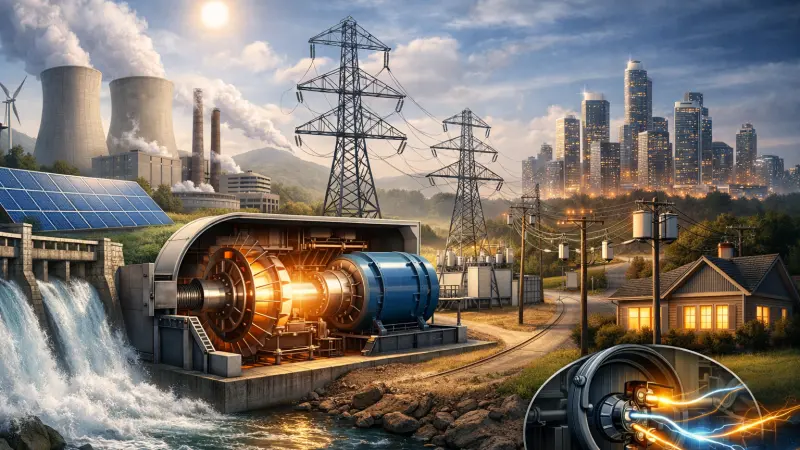
Have you ever paused to consider the complex sequence of physical and mechanical events that occur every time you flick a light switch or plug in a laptop? In the United Kingdom, our modern economy and domestic comfort rely entirely on a constant, stable flow of electrons, yet the fundamental science behind this utility remains a mystery to many. Understanding the journey from a power station to your 230V wall socket is not merely an academic exercise; for UK SMEs, contractors, and facility managers, this knowledge is the foundation for improving energy efficiency and reducing operational overheads.
The Fundamental Principles of Power Generation
Electricity is not a primary energy source that we "mine" from the ground; rather, it is an energy carrier that must be converted from other sources. At the heart of almost every power generation method is the electromagnetic generator. This device operates on the principle of electromagnetic induction, discovered by Michael Faraday. By rotating a powerful magnet within a core of coiled copper wiring, a fluctuating magnetic field is created, which forces electrons to move through the conductor—this movement is what we define as an electrical current.
The Role of the Turbine
To keep the magnet spinning within the generator, a mechanical force is required. This is achieved using a turbine. Depending on the resource available, the method used to turn this turbine varies significantly across the UK energy mix:
- Steam Turbines: High-pressure steam is directed at turbine blades to create rotation. This steam can be produced by burning fossil fuels (natural gas or biomass) or through nuclear fission. While nuclear power provides a consistent "baseload" of carbon-free energy, it remains a subject of public debate regarding long-term waste management.
- Hydro-electric Power: This method utilises the kinetic energy of falling water. In regions like Scotland and North Wales, large-scale dams or natural waterfalls provide a reliable, renewable source of mechanical energy. It is often considered one of the cleanest forms of generation due to its low lifecycle carbon footprint.
- Wind Energy: The UK is a global leader in offshore wind. Wind turbines bypass the need for steam, using the wind’s kinetic energy directly to turn the blades connected to a generator. While intermittent, technological advancements in battery storage are increasingly mitigating the "dark doldrums" when the wind does not blow.
- Solar Photovoltaics (PV): Unlike the methods above, solar panels do not use turbines. They convert sunlight directly into electricity via the photoelectric effect. While initially requiring significant space, modern high-efficiency panels have made solar a viable option for UK commercial rooftops.
Understanding the Foundations: Ohm’s Law
For anyone managing electrical systems or reviewing energy bills, a grasp of Ohm’s Law is essential. It describes the relationship between the three fundamental pillars of electricity: Voltage, Current, and Resistance. Without this understanding, it is impossible to diagnose why equipment might be overheating or how to safely scale an electrical circuit.
1. Electrical Pressure (Voltage - V)
Measured in Volts (V), voltage represents the potential difference or "pressure" that pushes electrons through a circuit. In the UK, the standard domestic supply is nominally 230V. Higher voltages are used for long-distance transmission because they allow for lower current, which significantly reduces energy lost as heat during transit.
2. Electrical Intensity (Current - I)
Measured in Amperes or "Amps" (A), current is the actual volume of electricity flowing through a conductor. Every piece of equipment has a maximum rated current.
If a device draws more amps than its wiring can handle—known as an overload—the resistance within the wire generates excessive heat. This is the primary cause of electrical fires in both domestic and industrial settings.
3. Resistance (Ohms - Ω)
Resistance is the opposition to the flow of current. Different materials possess varying levels of resistance. Metals like copper and silver have very low resistance, making them ideal conductors. Conversely, materials like rubber, plastic, and glass act as insulators because their resistance is so high that current effectively stops.
It is a common misconception that water conducts electricity; in fact, pure distilled water is an insulator. However, because water is a "universal solvent," it almost always contains dissolved minerals and ions that make it highly conductive. This is why electrical safety near moisture is paramount.
AC vs DC The Battle of Currents
The electricity grid operates on Alternating Current (AC), whereas most portable electronics run on Direct Current (DC). Understanding the distinction is vital for proper equipment maintenance and power supply management.
Alternating Current (AC)
In an AC system, the flow of electrons reverses direction periodically. In the UK, this happens 50 times per second (50 Hertz). This waveform is the natural byproduct of a rotating generator. AC is the preferred choice for national grids because it is remarkably easy to "step up" or "step down" using transformers, allowing for efficient long-distance transmission.
Direct Current (DC)
Direct Current flows in one constant direction. It is the type of power supplied by batteries and solar panels. Because delicate electronic components (like microchips) require a steady, unidirectional flow of energy, devices like laptops and LED televisions include "rectifiers" or power bricks to convert the AC from your wall socket into the DC required by the internal circuitry.
The Journey: From Generator to Plug
The UK National Grid is a marvel of engineering that ensures supply meets demand in real-time.
The transmission of electricity involves several critical stages of transformation:
- Transmission: Electricity leaves the power plant at high voltages (up to 400,000V) to minimise loss over long distances.
- Substations: Large transformer stations reduce this voltage to around 132,000V for regional distribution.
- Local Distribution: "Feeder" lines carry approximately 11,000V to 33,000V to local neighbourhoods.
- Final Step-Down: Local pole-mounted or ground-level transformers perform the final reduction to the 230V single-phase supply used in UK homes.
While industrial sites often receive "three-phase" power (which provides a more consistent, heavy-duty supply for large motors), residential properties typically receive a single phase. This is why large industrial equipment cannot be simply "plugged in" at a domestic residence without significant infrastructure upgrades.
Energy Efficiency Practical Steps for UK Consumers
With energy prices remaining a significant concern for UK households and businesses, efficiency is no longer optional. Small adjustments in hardware and habits can lead to substantial financial savings.
Lighting and LED Technology
Moving from traditional incandescent or even CFL (Compact Fluorescent) bulbs to LED (Light Emitting Diode) lamps is one of the highest-return investments available. An LED bulb can use up to 90% less energy than a traditional halogen bulb while providing the same light output. Furthermore, LEDs have a significantly longer lifespan, reducing maintenance costs for SMEs.
Optimising Appliance Usage
In the UK, the "Energy Rating" label is a legal requirement for most white goods. Appliances are rated from A to G (under the new 2021 simplified scale). A 5-star or 'A-rated' appliance might have a higher initial purchase price, but the "Total Cost of Ownership" over its lifetime is invariably lower due to reduced electricity consumption.
The Hidden Cost of "Standby"
Many modern electronics, particularly televisions and office equipment, continue to draw power even when turned "off" via a remote.
This "vampire power" can account for a significant percentage of a monthly bill. Unplugging devices or using smart power strips that cut power entirely can eliminate this waste.
| Appliance Type | Traditional Consumption | Energy Efficient Alternative | Estimated Saving |
|---|---|---|---|
| Lighting | 60W Incandescent | 6W LED | 90% |
| Ceiling Fan | 110W Standard | 60W High-Efficiency | 45% |
| Tube Lighting | T12 Copper Choke | T5 Electronic Ballast | 30% |
Safety First Protecting Your Infrastructure
Electricity is inherently "lazy"—it will always seek the path of least resistance to the earth. If that path is through a human or a faulty piece of equipment, the results are catastrophic. To prevent this, modern UK electrical installations utilise several safety layers:
- RCDs (Residual Current Devices): These monitor the balance of current and "trip" the circuit in milliseconds if a leak to earth is detected.
- Circuit Breakers: These protect the building's wiring from overloads by cutting the connection if the current exceeds the safe limit.
- Fuses: A sacrificial link that melts during a surge, preventing damage to the specific appliance.
Frequently Asked Questions (FAQ)
Single-phase is the standard for UK homes, delivering 230V via two wires. Three-phase is used in industrial settings, delivering power through three "hot" wires, providing a more stable and powerful supply for heavy machinery and large motors.
This is largely a historical legacy of infrastructure development. Higher voltage (230V) is slightly more efficient as it requires less current for the same amount of power, allowing for thinner wiring, though it requires more stringent insulation and safety standards.
Yes. Modern solar PV panels do not require direct, "baking" sunshine to generate electricity; they work on light intensity. While they are more productive on sunny days, they still produce significant energy during overcast UK weather.
In the UK, we primarily use the A-G energy label. These ratings indicate the efficiency of the appliance relative to its size and type.
Choosing a higher-rated appliance is the most effective way to ensure long-term energy savings.
By understanding the mechanics of how electricity is generated and the mathematical laws that govern its flow, UK residents and business owners can make more informed decisions. Respecting the power of the grid while implementing modern efficiency standards is the key to a safer, more sustainable, and more cost-effective future.