
How Much Notice You Must Give and What Garden Leave Means
Handing in your resignation can feel straightforward until someone asks, “When exactly is your last day?” The answer depends on your employment contract, your length of service, your employment status and whether you are resigning, being dismissed or being made redundant.
For most employees in the UK, the contract sets the notice period you must give when leaving. If the contract says nothing different, an employee who has worked for at least one month will generally have to give at least one week's notice. Employers have separate statutory minimum notice obligations when dismissing an employee, which increase with length of service and can reach 12 weeks.
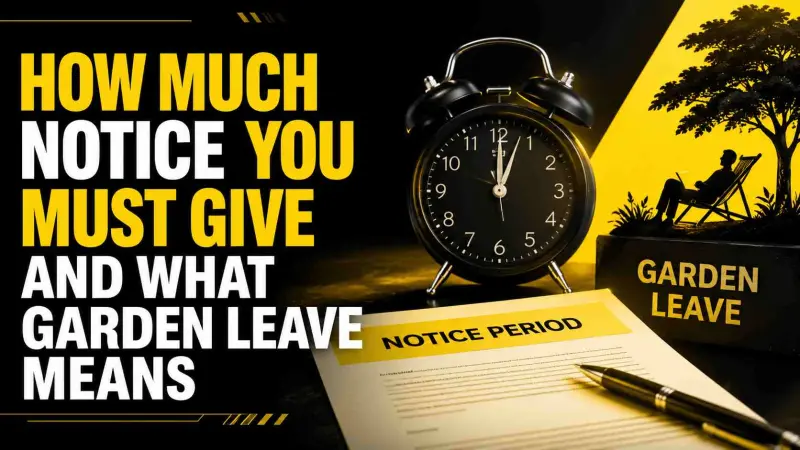
Then there is garden leave. This is often misunderstood. You may be told not to work during your notice period, but you remain employed and normally continue receiving your usual pay and contractual benefits. It is different from payment in lieu of notice, where employment ends immediately and the employer pays you instead of having you work your notice.
This guide explains how UK notice periods work, how to calculate your leaving date, what happens if you want to leave early, how holiday and pay are treated, and what garden leave means if your employer does not want you working during your notice.
Notice periods UK: what you actually have to give
A notice period is the amount of time between giving notice that employment will end and the actual termination date.
The first thing to check is your employment contract or written statement of employment particulars. For employees, this should state how much notice you are required to give. Your contractual notice may be longer than the statutory minimum.
What is the legal minimum notice an employee must give?
If you are legally an employee and have worked for your employer for at least one month, you generally must give at least one week's notice when resigning.
If you have worked for less than one month, you generally do not have to give statutory notice unless your written terms say otherwise.
However, this does not mean that one week is automatically your notice period.
For example, your contract might say:
| Contract wording | Likely notice you must give |
|---|---|
| “One week's notice” | 1 week |
| “One month's notice” | 1 month |
| “Four weeks' notice” | 4 weeks |
| “Three months' notice” | 3 months |
| No contractual period after 1 month of service | At least 1 week statutory notice |
A senior employee may therefore have a three-month contractual notice period even though the statutory minimum for an employee resigning is generally one week.
Does the one-week rule increase with your years of service?
This is a common misconception.
The statutory notice period that increases according to years of service applies primarily to notice an employer gives when dismissing or making an employee redundant. It does not mean that an employee automatically owes their employer one additional week for every year they have worked there.
If you resign, your required notice is normally the period stated in your contract, subject to the statutory minimum.
For example, someone who has worked for a company for eight years does not automatically owe eight weeks' resignation notice. If their contract says four weeks, four weeks is normally the contractual period they must give.
How much notice must an employer give?
When an employee is dismissed or made redundant, the statutory minimum is based on continuous service.
The current statutory scale is:
| Continuous employment | Minimum employer notice |
| At least 1 month but less than 2 years | 1 week |
| 2 to 12 years | 1 week for each complete year |
| 12 years or more | 12 weeks |
An employment contract can provide a longer notice period, but an employer generally cannot contract below the statutory minimum where the statutory rules apply.
So, if an employee has four years and nine months of continuous service, the statutory notice entitlement is four weeks because the calculation is based on completed years.
Why the distinction between employee and worker matters
Not everyone working for a business has the legal status of an employee.
Employees generally have broader employment rights. Workers, casual workers, agency workers and people on some zero-hours arrangements can have different rules.
For example, Acas says a worker is not usually entitled to a statutory minimum notice period when their employment ends. For a zero-hours worker, the arrangement can also differ depending on whether they are legally an employee or worker.
If you are unsure about your status, do not assume that the standard employee rules automatically apply.
When does your notice period start?
This can affect your final working day, particularly when you are working to a tight deadline for a new employer.
If your contract specifies when notice starts, follow the contractual wording.
If it does not, Acas says that when an employee resigns, the notice period normally starts the day after the employee tells the employer they are resigning. If notice is given in writing, there can be questions about when the employer has had a reasonable opportunity to read it.
GOV.UK similarly states that a resignation notice period usually runs from the start of the day after notice is handed in.
Example: giving one month's notice
Suppose your contract requires one month's notice and you resign on 8 August.
You should not simply assume that your final day is 7 September. The exact calculation can depend on the wording of your contract and how it defines the notice period.
That is why it is sensible to state the proposed leaving date in your resignation and ask your employer to confirm it.
A simple way to avoid a dispute
When resigning, write something such as:
“I am giving notice of my resignation in accordance with my contractual notice period. Based on my calculation, I understand my employment will end on [date]. Please confirm the termination date.”
This creates a clear written record.
Can you leave before your notice period ends?
You can ask your employer to release you early, but you should not simply stop attending work.
If you leave before your agreed notice expires without your employer's agreement, you could be in breach of contract. Depending on the circumstances, the employer may potentially seek damages for losses caused by the breach. Acas gives the example of an employer having to spend additional money hiring temporary cover.
What if your new employer wants you to start sooner?
This is where negotiation can help.
You could ask your existing employer to:
- Reduce your notice period.
- Agree a specific earlier leaving date.
- Allow you to use some annual leave during the notice period.
- Put you on garden leave.
- Agree another arrangement in writing.
Do not rely on a verbal “that's fine” if the timing matters. Get confirmation of the agreed final employment date.
What happens if your employer refuses?
If your employer is entitled to the full contractual notice and does not agree to shorten it, you generally remain bound by it.
Leaving anyway can create contractual problems, particularly for senior or specialist roles where the employer could argue that your early departure caused a financial loss.
What is garden leave?
Garden leave means that you remain employed during your notice period but your employer tells you not to carry out your normal work.
You may be told not to come into the workplace, to work from home without
performing normal duties, or simply to remain available under the terms of the arrangement.
The key point is that your employment has not ended.
You normally continue to receive your usual pay and contractual benefits during garden leave. GOV.UK and Acas both describe garden leave in this way.
Why would an employer use garden leave?
The most obvious reason is to prevent an employee who is leaving from immediately using confidential information, customer relationships or commercially sensitive knowledge elsewhere.
Imagine a senior sales manager resigns and is joining a direct competitor in six weeks.
The employer may decide that having that person continue to access customer databases, pricing information and future sales plans creates an unnecessary risk.
Rather than ending employment immediately, the employer may put the employee on garden leave for the remainder of the notice period.
The employee remains employed and paid but is not performing their usual duties.
Can you start your new job during garden leave?
Usually, you should not assume that you can.
Garden leave means you are still employed by your existing employer. Your contract may contain restrictions on taking other employment, conflicts of interest, confidentiality and working for competitors.
Even if you are physically sitting at home and receiving your salary, you have not necessarily become free to start your next job.
Check the contract and the garden-leave instruction before doing anything that could conflict with your continuing obligations.
Can an employer force garden leave?
This depends partly on the employment contract.
Acas notes that whether an employer can require an employee to remain on garden leave can depend on the contract. If there is no appropriate contractual provision, the employee may need to agree to the arrangement.
For a significant period of garden leave, especially several months, the legal position can become more complicated and professional advice may be appropriate.
Garden leave vs payment in lieu of notice
These two arrangements are often confused, but they are not the same.
| Arrangement | Still employed? | Working? | Normally paid? | Employment ends immediately? |
| Working notice | Yes | Yes | Yes | No |
| Garden leave | Yes | No, or substantially restricted | Yes | No |
| PILON | Usually no | No | Payment for notice | Yes |
| Early release by agreement | Depends on agreement | No after agreed date | Depends on agreement | Usually yes |
Payment in lieu of notice explained
Payment in lieu of notice (PILON) means the employment ends without the employee working the notice period, with payment made instead.
A contract may contain a PILON clause allowing the employer to make this payment. If there is no contractual PILON clause, an employer can ask the employee to agree to it, but cannot necessarily force that agreement. Acas specifically warns that the contractual position matters.
The practical difference is significant.
With garden leave:
You remain employed + receive pay + your employment continues.
With PILON:
Employment ends + you receive the relevant payment instead of working the notice.
HMRC also distinguishes garden leave from PILON for tax and National Insurance purposes because employment continues throughout the garden-leave period.
What happens to your pay during notice?
If you continue working during your notice period, you should normally receive your normal pay.
If you are on garden leave, you generally continue receiving your normal pay and contractual benefits during the notice period.
If you receive variable pay, commission, bonuses, overtime or benefits, the calculation can become more complicated.
The contract may determine whether particular payments continue and how they are calculated.
What if you are off sick during notice?
Notice pay is not always as simple as multiplying your weekly salary by the number of weeks.
Acas explains that entitlement can depend on whether you resigned or were dismissed, whether the notice is statutory or contractual, and how much longer the contractual notice is than the statutory minimum.
For employees with variable hours or pay, calculating notice pay can also require closer examination of the relevant rules.
If a substantial amount of money is involved, check the contract and obtain specialist advice rather than relying on a generic online calculator.
What happens to annual leave during your notice?
Your holiday entitlement does not simply disappear because you have resigned.
You can normally take accrued holiday during your notice period, subject to the usual rules and any requirement to give appropriate notice for taking leave.
If you leave with statutory holiday still accrued and untaken, your employer must generally pay you for it.
The reverse can also happen.
If you have taken more holiday than you have accrued by your leaving date, your employer may be able to deduct the relevant amount from your final wages if there is an appropriate contractual or written agreement allowing the deduction.
Should you use holiday during your notice?
There is no universal answer.
Taking holiday can make sense if you want a break before starting your next role. But if your employer has put you on garden leave, you may prefer to keep the distinction clear rather than using annual leave unnecessarily.
Check how your contract handles holiday during notice and whether your employer has instructed you to take outstanding leave.
What if you do not work your notice?
Leaving without agreement is risky.
If you simply stop attending work, the employer may regard this as a breach of contract. Potential consequences can include withholding pay for work you did not perform and, in some circumstances, seeking compensation for losses caused by the breach.
An employer may also have contractual rights allowing certain deductions from final wages, but
deductions cannot simply be invented because the employer is unhappy about your departure.
The safer approach
If you need to leave urgently, explain why.
For example, you might have:
- A new employer insisting on an earlier start date.
- A serious family issue.
- A health or wellbeing concern.
- Another contractual commitment.
- A dispute that makes continued employment difficult.
Ask for an agreed early release and get the outcome in writing.
What if your employer tells you not to work?
Do not automatically assume you have been dismissed.
Your employer may be placing you on garden leave.
Ask for written confirmation covering:
- Your employment termination date.
- Whether you are on garden leave.
- Whether you are expected to remain available.
- Your pay and benefits.
- What happens to annual leave.
- Whether you may contact customers or colleagues.
- Whether you can begin other employment.
- Any continuing confidentiality or restrictive obligations.
This is particularly important for senior employees.
A garden-leave instruction can restrict what you do even though you are not physically working.
What are restrictive covenants and how do they relate to notice?
Some employment contracts contain post-termination restrictions.
These can include restrictions relating to:
- Working for competitors.
- Soliciting customers.
- Poaching employees.
- Dealing with former clients.
- Using confidential information.
Garden leave and restrictive covenants can overlap, but they are not identical.
Garden leave keeps you employed during the notice period. A restrictive covenant may continue after employment ends.
Whether a particular restriction is enforceable depends heavily on its wording, purpose and circumstances. If you are moving to a competitor and have a lengthy garden-leave period or restrictive covenant, legal advice can be worthwhile.
Can an employer dismiss you without notice?
Sometimes.
The most important example is gross misconduct.
Acas explains that an employee dismissed for gross misconduct can be dismissed without notice, meaning they leave immediately and do not receive notice pay. However, they remain entitled to outstanding amounts such as unpaid wages and accrued holiday, subject to the circumstances and applicable contractual terms.
“Gross misconduct” is not simply another way of saying “the employer is unhappy with you”. A proper disciplinary process should normally be followed.
The circumstances surrounding a dismissal matter.
What happens with fixed-term contracts?
Fixed-term employment has additional considerations.
A fixed-term contract will generally end automatically at the agreed end date. If the employer wants to terminate it earlier, the contract needs to permit early termination or the employer may risk breaching the contract.
Employees on fixed-term contracts can also have minimum notice rights where the contract is ended early.
So, if you are on a six-month contract, do not assume the standard resignation rules are the only thing that matters. Read the early-termination provisions carefully.
Does notice work differently in Northern Ireland?
The broad concept is similar, but employment law is not identical across the whole UK.
Employment law is devolved in Northern Ireland, meaning some employment rights and legislation differ from England, Scotland and Wales.
nidirect states that employees who have worked for an employer for at least one month generally have a minimum one-week resignation notice obligation, unless their contract requires more. It also sets out statutory minimum notice for employers based on continuous service.
If your employment is in Northern Ireland, use Northern Ireland-specific guidance rather than assuming every Great Britain rule applies identically.
What should you do before handing in notice?
A little preparation can prevent an awkward conversation later.
Step 1: Find your contract
Look for sections headed:
- Termination.
- Notice.
- Resignation.
- Garden leave.
- Payment in lieu.
- Holiday.
- Confidentiality.
- Restrictive covenants.
Step 2: Confirm your employment status
Make sure you are actually classed as an employee rather than a worker, agency worker or another category.
Step 3: Calculate the likely leaving date
Check when your notice begins and whether your contract defines the calculation.
Step 4: Check your holiday balance
Find out how much annual leave you have taken and accrued.
Step 5: Consider your new job
If you have another role lined up, check its proposed start date against your existing notice obligations.
Step 6: Resign clearly
Written notice is usually the safest option because it creates a record.
Step 7: Ask for written confirmation
Ask HR or your manager to confirm the termination date and arrangements for your notice period.
Common notice-period mistakes to avoid
The most expensive mistakes are often simple ones.
Mistake 1: Assuming everyone has a one-week notice period.
Your contract may require considerably more.
Mistake 2: Counting the notice period incorrectly.
The start date can depend on the contract and when notice is received.
Mistake 3: Starting your new job while on garden leave without checking.
You remain employed by your old employer.
Mistake 4: Walking out because your employer owes you money.
There may be legal remedies for breaches by an employer, but leaving without advice can create separate contractual issues.
Mistake 5: Assuming garden leave means your employment has ended.
It normally has not.
Mistake 6: Forgetting holiday pay.
Unused accrued statutory holiday generally needs to be paid when employment ends.
Mistake 7: Ignoring restrictive covenants.
These can become especially important when moving to a competitor.
What is likely to change in UK employment law?
The UK's employment law framework is changing during 2026 and 2027 under the Employment Rights Act 2025.
The government's July 2026 implementation timetable includes a number of employment reforms, with further measures scheduled for 2027.
One significant change scheduled for 1 January 2027 is the reduction of the qualifying period for ordinary unfair dismissal protection from two years to six months in England, Scotland and Wales. The same change does not apply to Northern Ireland because employment law in that area is devolved.
That change does not mean statutory notice periods are being replaced by a new six-month notice rule.
The two issues are separate:
- Notice periods determine how employment ends and how much notice or notice pay is due.
- Unfair dismissal rights concern whether a dismissal was legally fair and whether an employee can bring a particular type of tribunal claim.
The wider reforms mean employers and employees should keep checking current guidance rather than relying on an old employment-law article or contract template.
Key Insights
- Your contract is usually the first place to look. Your contractual notice can be longer than the statutory minimum.
- Employees generally owe at least one week's notice after one month of service when resigning, unless an exception applies or their contract requires more.
- Employer notice increases with service, from one week to a maximum statutory period of 12 weeks.
- Garden leave does not normally end your employment. You remain employed and generally continue receiving contractual pay and benefits.
- PILON is different from garden leave. PILON generally ends employment immediately, with payment made instead of working notice.
- Do not leave early without agreement. Doing so can potentially amount to breach of contract.
- Unused accrued statutory holiday generally has to be paid when you leave.
- Check the rules for your location and employment status. Northern Ireland has a separate employment-law framework, while workers and employees can have different rights.
FAQ
1. How much notice do I have to give when resigning in the UK?
If you are an employee who has worked for your employer for at least one month, the statutory minimum is generally one week's notice. However, your employment contract may require more, such as four weeks, one month or three months.
2. Can my employer make me work my full notice period?
Generally, if your contract requires you to give a particular notice period, you remain contractually bound by it unless your employer agrees to release you early. Your employer may instead place you on garden leave or use another contractual arrangement.
3. Can I resign with immediate effect?
You can submit a resignation stating that you want to leave immediately, but that does not necessarily mean you are legally entitled to do so. Leaving without serving or agreeing a shorter notice period can amount to breach of contract.
4. What happens if I do not work my notice?
If you leave without agreement, your employer could potentially treat the situation as a breach of contract and seek compensation for losses caused by your early departure. The safest option is to negotiate an early release and obtain written confirmation.
5. What is garden leave in simple terms?
Garden leave means you remain employed and are normally paid during your notice period, but your employer tells you not to carry out your normal work. It is often used to protect confidential information and business relationships.
6. Can I start another job while on garden leave?
Not automatically. You are still employed by your existing employer and may remain subject to contractual restrictions, including obligations concerning conflicts of interest, confidentiality and other employment. Check your contract before starting another role.
7. Do I get paid during garden leave?
Normally, yes. GOV.UK states that employees on garden leave receive the same pay and contractual benefits during the notice period.
8. Is garden leave the same as payment in lieu of notice?
No. Garden leave keeps you employed until the notice period ends. Payment in lieu of notice generally ends employment immediately and provides payment instead of requiring you to work the notice period.
9. Can my employer put me on garden leave without asking me?
It depends on the employment contract and circumstances. A contract may give the employer the right to place you on garden leave. If there is no appropriate contractual provision, agreement may be required.
10. Can I take annual leave during my notice period?
You may be able to take annual leave during notice, subject to the applicable holiday rules and your employer's requirements. Any accrued but untaken statutory holiday generally needs to be paid when employment ends.
11. Does my notice period include weekends?
Usually, notice is expressed in calendar weeks, months or another contractual period rather than simply working days. The exact calculation depends on the wording of your contract, so check how it defines the notice period and termination date.
12. What notice must an employer give after five years of service?
The statutory minimum is five weeks for an employee with five complete years of continuous service, assuming the statutory rules apply. A contract can provide a longer period.
13. Can an employer dismiss someone without notice?
In some circumstances, yes. Gross misconduct can justify summary dismissal without notice, although employers should normally follow a fair disciplinary process. Outstanding wages and accrued holiday can still be due.
14. Does notice pay include bonuses and commission?
It depends on the contractual terms and the type of payment. Bonuses, commission, overtime and benefits can require specific consideration when calculating what is owed. Do not assume every element of remuneration is automatically treated in exactly the same way.
15. Are UK notice-period rules changing in 2026 or 2027?
The Employment Rights Act 2025 is introducing a series of employment-law changes during 2026 and 2027. One major scheduled change from 1 January 2027 is the reduction of the ordinary unfair-dismissal qualifying period to six months in England, Scotland and Wales. This is separate from the statutory notice-period rules.
Final Thoughts
UK notice periods are easier to handle once you separate three things: what your contract requires, what the law requires, and what your employer agrees to.
If you are resigning, start with your written terms rather than assuming the statutory one-week minimum applies. If your employer is dismissing you, statutory notice can increase according to your completed years of service, although contractual terms may give you more.
Garden leave is another important distinction. Being told to stay away from work does not normally mean you have been dismissed. During garden leave, you remain employed, normally receive your pay and benefits, and may continue to be bound by contractual obligations.
Before handing in notice, check your contract, calculate your likely leaving date, review your holiday balance and consider any restrictions affecting your next job.
If you need to leave early, negotiate rather than simply walking away.
For complicated situations involving senior roles, competitors, lengthy garden leave, restrictive covenants, disputed notice pay or a potential breach of contract, professional employment-law advice can be worth getting before you act.
Disclaimer: The information provided in this article is for general informational and research purposes only. Company details, features, services, and market positions may change over time. Readers are advised to visit official company websites and conduct independent research before making any business decisions or purchasing services.
Most Searchable Keywords
Recent Blogs


Related Listings
Categories
- Accountants (295)
- Advertising Agencies (559)
- Architects (149)
- Automobiles (377)
- Beauty (300)
- Carpenters (146)
- Cleaning Services (387)
- Dentists (189)
- Driving (62)
- Education (1)
- Electricians (215)
- Energy (8)
- Event Organiser (687)
- Finance (602)
- Guide (3439)
- Health (2207)
- Information technology (206)
- Legal Services (361)
- Logistics (6)
- Maintenance (65)
Sponsored Listings in Legal Services


Related Blogs

When Is My MOT Due Free Check and Common Fail...
Read this insightful article "When Is My MOT Due Free Check and Common Failures" to expand your knowledge!

Lost V5C Log Book Cost Timescale and Rules
Read this insightful article "Lost V5C Log Book Cost Timescale and Rules" to expand your knowledge!

Intensive Driving Courses: Costs Pass Rates a...
Read this insightful article "Intensive Driving Courses: Costs Pass Rates and Who They Suit" to expand your knowledge!
Questions & Answers – Find What
You Need, Instantly!
How can I update my business listing?
Is it free to manage my business listing?
How long does it take for my updates to reflect?
Why is it important to keep my listing updated?
