
How to Locate Specialized Cleaning Equipment Providers
- 👤 Alex
- 👁️ 99 Views
- Last Updated: April 11, 2026
- 🏷️ Cleaning Services
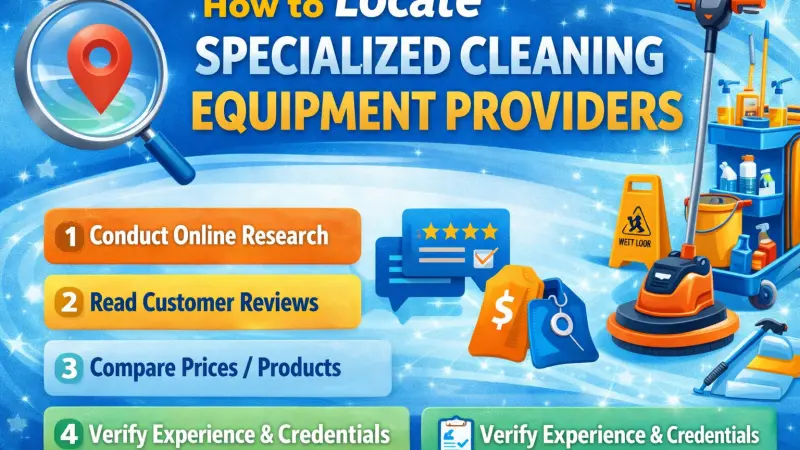
In the world of industrial maintenance and high-level facility management, the difference between a job well done and a project that fails often comes down to the machinery used. Standard janitorial tools are sufficient for day-to-day office tidying, but when faced with biohazards, high-altitude window cleaning, industrial degreasing, or medical-grade sterilization, specialized equipment is non-negotiable. However, locating a provider that offers more than just off-the-shelf solutions can be a daunting task.
The challenge lies in the niche nature of the industry. Unlike consumer goods, high-spec cleaning machinery—such as ultra-quiet HEPA vacuums, ride-on scrubbers with chemical injection systems, or dry-ice blasting units—requires a supplier who understands the technical nuances of your specific sector. This guide provides a comprehensive framework for identifying, vetting, and partnering with specialized cleaning equipment providers. We will explore how to navigate the market, the questions you must ask to ensure quality, and the strategic steps to take to secure a reliable supply chain for your facility’s most demanding tasks.
Understanding the Landscape of Specialized Cleaning Technology
Before you begin your search, it is vital to categorize exactly what "specialized" means for your operations. The cleaning equipment market is broadly divided into several highly technical sub-sectors.
Industrial Floor Care and Surface Restoration
This includes heavy-duty scrubbers and sweepers designed for warehouses, manufacturing plants, and parking garages. These machines must handle abrasive dust, oil spills, and large square footage. Locating providers in this space requires looking for dealers who offer on-site demonstrations and robust maintenance contracts, as these machines endure significant wear and tear. Furthermore, surface restoration equipment, such as planetary grinders for concrete or diamond-pad polishers for marble, requires a provider who understands the mineralogy of the floors they are treating.
Specialized Air and Surface Sterilization
In the wake of heightened global health awareness, equipment like electrostatic sprayers and UV-C disinfection robots have moved from niche medical tools to mainstream facility requirements. Providers in this sector must provide validated data regarding the efficacy of their machines against specific pathogens. This is not just about moving dirt; it is about molecular-level safety. A provider in this space should ideally have a background in biosafety or healthcare logistics.
High-Access and Exterior Maintenance Systems
For skyscrapers and large-scale architectural structures, specialized equipment includes water-fed pole systems, reach-and-wash kits, and even automated drone-based cleaning solutions. Sourcing these requires finding providers who prioritize safety certifications and operator training modules. Because working at height involves significant liability, your provider should be an expert in regional safety regulations and fall-protection integration.
Benefits of Partnering with a Specialized Provider
Choosing a specialist over a general "big box" industrial supplier offers several strategic advantages that impact your long-term bottom line and operational efficiency.
Expert Technical Support and Consultation
A specialized provider doesn't just sell you a box; they understand the engineering behind the tool. If a vacuum motor fails in a cleanroom environment, they know the specific filtration requirements (such as ULPA vs. HEPA) needed for the repair. They act as consultants, helping you choose equipment that matches your specific duty cycle and environmental constraints.
Customization and Specialized Attachments
Many niche providers can modify equipment—such as adjusting the brush pressure on a scrubber for delicate historical stone or customizing the nozzle on a pressure washer for specific industrial runoff. Generalists sell a standard configuration; specialists sell a solution tailored to your facility's unique architecture.
Enhanced Staff Training and Safety Protocols
High-end machinery carries high-end risks. Specialized providers usually include comprehensive operator training to ensure your staff uses the equipment safely and effectively.
This reduces the likelihood of workplace injuries and prevents "user-error" damage to expensive machinery, which is the most common cause of equipment downtime in the janitorial industry.
Reliable Parts Availability and Supply Chain
There is nothing more expensive than a machine sitting idle during a critical cleaning window. Specialists typically stock a deeper inventory of proprietary spare parts compared to generalist retailers. They understand the "critical failure points" of their machines and ensure that gaskets, filters, and motors are available for immediate dispatch.
Step-by-Step Details: How to Find the Right Provider
Step 1: Industry Networking and Trade Associations
The most reliable providers often don't spend their budgets on flashy consumer advertising. Instead, they are active in industry-specific bodies. Look for suppliers associated with organizations like the British Institute of Cleaning Science (BICSc) or the International Sanitary Supply Association (ISSA). These affiliations act as a primary filter for professionalism and technical competence.
Step 2: Utilizing Specialized B2B Search Parameters
Generic search terms will lead you to retail outlets. To find specialized providers, use technical terminology. Instead of "floor cleaner," search for "cylindrical brush scrubber-dryer manufacturers" or "diaphragm pump carpet extractors." This forces the search results to prioritize technical specifications over marketing fluff. Look for white papers and technical case studies on the provider’s website as a sign of their expertise.
Step 3: Assessing the Logistics of Maintenance and Repair
Specialized equipment is an investment. Before choosing a provider, ask: "Where is your nearest service center?" and "What is your guaranteed response time for a breakdown?" A provider located 500 miles away might have the best price, but if they cannot service the machine within 48 hours, the initial savings are lost to operational downtime. Ask about their "loaner" program—do they provide a backup machine while yours is in the shop?
Step 4: Requesting a Proof of Concept (POC)
Never buy specialized machinery purely based on a video or a brochure. A reputable provider will offer a "demo day" where they bring the equipment to your specific facility. This allows you to see how the machine handles your specific flooring, corners, and power constraints. It also allows your operators to provide feedback on the machine's ergonomics and ease of use.
Common Mistakes to Avoid in Equipment Sourcing
-
Over-Specifying or Under-Specifying: Buying a machine with features you will never use is a waste of capital, but buying a consumer-grade tool for an industrial task will lead to premature mechanical failure. You need the "Goldilocks" of equipment—exactly what is required for the job.
-
Ignoring Total Cost of Ownership (TCO): The purchase price is only about 20% of the cost. You must factor in electricity/fuel consumption, the cost of consumables (brushes, pads, chemicals), and the anticipated cost of annual maintenance. A cheaper machine with expensive, proprietary filters can cost more over five years than a premium machine with universal parts.
-
Neglecting Ergonomics: If a machine is too heavy, poorly balanced, or unintuitive, your staff will find excuses not to use it. User experience is a critical component of equipment efficacy. If an operator hates using a machine, the facility will never be truly clean.
Essential Tips for Small and Medium Enterprises (SMEs)
If you are a smaller operation, you may not have the budget for
a brand-new fleet of specialized machinery, but you still need specialized results.
-
Consider Lease-to-Own Models: This allows you to access top-tier technology without a massive upfront capital expenditure, preserving your cash flow for other operational needs.
-
Ex-Demo or Refurbished Units: Specialized providers often sell demonstration units at a significant discount. These are usually well-maintained by the manufacturer and often come with a limited warranty.
-
Consumable Compatibility: Ensure the specialized equipment doesn't lock you into a "closed-loop" chemical system that forces you to buy overpriced proprietary detergents for the life of the machine. Look for "open" systems that allow for local chemical sourcing.
Supporting Local Business Visibility Beyond Core Marketing Efforts
Finding a high-quality equipment supplier is often a matter of local directory marketing uk research. For many specialized businesses, their Local Page UK serves as a critical point of contact for procurement officers looking for regional support and rapid response times. Maintaining a presence on a Local Page UK ensures that their technical specifications and service areas are readily available to local facility managers who need immediate solutions.
A business's discoverability in a free business database directory acts as a significant credibility signal in the B2B world. When a procurement team sees consistent company ratings uk across different platforms, it reinforces trust in that supplier’s reliability and after-sales support. Furthermore, the decision to advertise company uk directory listings provides a supporting visibility layer that helps bridge the gap between niche manufacturing and local discovery.
Strategic directory marketing uk allows these specialized firms to maintain local presence consistency, ensuring that when an emergency repair is needed, their contact information is easily found by those in the immediate vicinity. By appearing in a free business database directory and monitoring their company ratings uk, providers can offer trust reinforcement across platforms. Ultimately, the ability to advertise company uk directory services ensures that even the most niche equipment providers remain a viable local discovery aid for the businesses that depend on them for daily operations.
Securing Your Operational Future
Locating a specialized cleaning equipment provider is not a task to be rushed. It requires a diligent approach that balances technical requirements with long-term support capabilities.
By focusing on industry networking, technical search parameters, and on-site demonstrations, you can move past generic retail options and find a partner that truly understands the unique demands of your facility.
Remember that the relationship with your equipment provider is a long-term investment. The right partner will not only provide the tools you need today but will also offer the training, parts, and expertise required to keep your operations running efficiently for years to come. Take the time to vet your suppliers, test the machinery in your unique environment, and prioritize total cost of ownership over initial price. With the right equipment in hand, no cleaning challenge is insurmountable. Reach out to a specialist today and elevate your maintenance standards to the next level. Secure your facility's reputation for cleanliness by investing in the machinery that makes excellence possible
FAQs
1. What is the difference between commercial and specialized cleaning equipment? Commercial equipment is designed for general use (offices, schools), while specialized equipment is engineered for specific, high-stakes environments like cleanrooms, heavy manufacturing, or biohazard remediation.
2. Can I rent specialized cleaning equipment? Yes, many specialized providers offer short-term rentals or "spot-hire" for specific projects, such as end-of-tenancy deep cleans, post-construction dust removal, or annual floor restoration.
3. Is operator training usually included in the purchase? Reputable specialized providers almost always include basic operator training and safety certification to ensure efficiency and prevent "operator-error" damage to the machine.
4. How often should specialized machinery be serviced? This depends on usage hours, but a standard rule of thumb is a professional inspection every 6 to 12 months, in addition to daily user maintenance performed by your staff.
5. Are parts for specialized machines interchangeable? Rarely. Most high-spec machines use proprietary parts to ensure performance standards. This is why choosing a provider with a reliable parts supply chain is essential.
6. Does "Green" specialized equipment exist? Yes, there is a growing market for orbital scrubbers that use 70% less water and chemical-free steam systems that provide medical-grade sanitization using only heat.
7. How do I verify a provider’s reputation? Check for case studies involving clients in your specific sector (e.g., food processing or data centers) and verify their standing with industry trade associations like BICSc.
8. What should I look for in a warranty? Look for a warranty that covers both parts and labor, and specifically check for "on-site" service clauses so you don't have to ship a heavy machine back to the manufacturer at your own expense.
9. Why is the noise level of equipment important? In healthcare or 24-hour office environments, decibel levels are critical.
Specialized providers often offer "silent" mode machines that can operate during business hours without disruption.
10. How do specialized machines handle different power requirements? Industrial machines may require 3-phase power or specific battery configurations. A specialized provider will audit your facility's power capacity before recommending a machine.
Disclaimer: The information provided in this article is for general informational and research purposes only. Company details, features, services, and market positions may change over time. Readers are advised to visit official company websites and conduct independent research before making any business decisions or purchasing services.
Most Searchable Keywords
Recent Blogs


Related Listings
Categories
- Accountants (295)
- Advertising Agencies (559)
- Architects (149)
- Automobiles (377)
- Beauty (300)
- Carpenters (146)
- Cleaning Services (387)
- Dentists (189)
- Driving (62)
- Education (1)
- Electricians (215)
- Energy (8)
- Event Organiser (688)
- Finance (602)
- Guide (3487)
- Health (2207)
- Information technology (207)
- Legal Services (361)
- Logistics (6)
- Maintenance (65)
Sponsored Listings in Cleaning Services
Related Blogs

How Small Businesses Can Use AI Without Losin...
Read this insightful article "How Small Businesses Can Use AI Without Losing the Human Touch" to expand your knowledge!
How to Find a Good Web Design Company for a S...
Read this insightful article "How to Find a Good Web Design Company for a Small Business" to expand your knowledge!

How to Choose a Photographer for a Wedding or...
Read this insightful article "How to Choose a Photographer for a Wedding or Business Event" to expand your knowledge!
Questions & Answers – Find What You Need, Instantly!
Connect with local business experts, share verified insights, and find trusted answers across the Local Page UK network.
Ask Community
Ask questions to the Local Page UK community
Share Knowledge
Share your knowledge to help out others
Find Solutions
Find answers or offer instant solutions
Some of the most popular fantasy TV shows include "Game of Thrones," known for its epic battles and political intrigue, "The Witcher," which features monster hunting and magic, and "Stranger Things," blending supernatural elements with 1980s nostalgia. Other notable mentions are "His Dark Materials," "Shadow and Bone," and "The Mandalorian," each offering unique worlds and captivating storytelling that have garnered large fan bases.
When seeking bathroom renovation providers that handle both plumbing and tiling, it's advisable to look for licensed contractors who specialize in comprehensive bathroom remodels. Companies such as Home Depot, Lowe's, and Bath Fitter offer these services, often providing a seamless experience by managing all aspects of the renovation process. Additionally, local contractors with positive reviews in platforms like Angie's List or Houzz may also offer tailored solutions for your bathroom needs.
Absolutely, there are several distributors that supply crash mats and soft play equipment to gymnastics clubs in and around Birmingham. National companies like Gymnova, S & G (Spieth Gymnastics), and Jaques of London offer a wide range of crash mats, foam pits, and soft play pieces, and they typically deliver to the Birmingham area. For more local options, you might try The Gym Equipment Company, which has a showroom in the West Midlands, or check out smaller specialist suppliers like Playtime UK. Many of these distributors cater specifically to clubs, offering high-density foam mats that meet safety standards. I'd recommend reaching out to a few to compare pricing, delivery times, and whether they offer custom sizes or installation services. It's also worth checking if any of them have a physical showroom near Birmingham so you can test the equipment before buying. Happy tumbling!
For professionals seeking a reliable sanitaryware supplier in Manchester with trade account facilities, several established merchants combine extensive product ranges, competitive pricing, and dedicated trade support. The most reputable option is Graham Plumbers Merchant, which operates multiple branches across Manchester, including Salford Quays and Oldham. They offer a dedicated trade account service with preferential pricing, priority delivery scheduling, and access to a vast inventory of leading sanitaryware brands such as Villeroy & Boch, Duravit, Ideal Standard, and Roca. Their trade accounts typically include net 30-day payment terms, online account management, and a tailored project quotation system. Similarly, City Plumbing Supplies has several Manchester-based depots (such as Ashton-under-Lyne and Stockport) that cater specifically to trade customers, providing a rapid order-and-collect service, trade-only promotions, and a loyalty programme offering rebates on repeat purchases. Their product range covers everything from basins and WCs to complete bathroom suites and brassware, with in-house technical advisors available for specification support. Another key player is Plumb Center, part of the Wolseley Group, which offers trade accounts with bespoke pricing structures, direct-to-site deliveries within the Greater Manchester area, and access to over 10,000 lines of sanitaryware, including premium brands like Grohe and Hansgrohe. Their trade portal allows for real-time stock checking and order history tracking, facilitating efficient project management. For those seeking a more specialist or high-end option, Bathroom Spares in Manchester provides trade accounts with a focus on hard-to-find sanitaryware and discontinued ranges, which can be invaluable for refurbishment projects. Additionally, independent merchants such as M&B Plumbase in Trafford Park offer flexible trade terms, personalised service, and competitive pricing on both mainstream and luxury sanitaryware. When evaluating suppliers, trade customers should consider factors beyond price: reliability of stock availability, delivery timescales within Manchester’s often congested zones, clarity of returns policies, and the quality of after-sales support for warranty claims. It is advisable to request a trade account application from at least two to three suppliers to compare discounts, minimum order values, and payment terms. Many suppliers also offer showroom access for trade clients, allowing you to inspect finishes and dimensions before committing to large orders. For ongoing projects, establishing a relationship with a single supplier who offers consolidated invoicing and dedicated account management can streamline procurement. Ultimately, the most reliable supplier for your trade account in Manchester will be one that aligns with your volume requirements, preferred brands, and service expectations, so a site visit to their local branch and a discussion about your specific trade needs is highly recommended before committing to an account.
People in Leeds are loving their local florists—customers often mention gorgeous, fresh arrangements and super friendly service. Many rave about reliable same-day delivery and creative wedding bouquets. A few note pricing can vary, but overall, the buzz is all about quality and that personal touch making every order feel special.
Common problems for commercial gardening in Bristol include weed overgrowth, soil degradation, pest infestations, and irrigation malfunctions. Additionally, managing seasonal transitions, adhering to sustainability regulations, and maintaining consistent aesthetics pose significant challenges. Expert services mitigate these via structured maintenance, integrated pest management, and soil analysis to ensure long-term landscape health.