
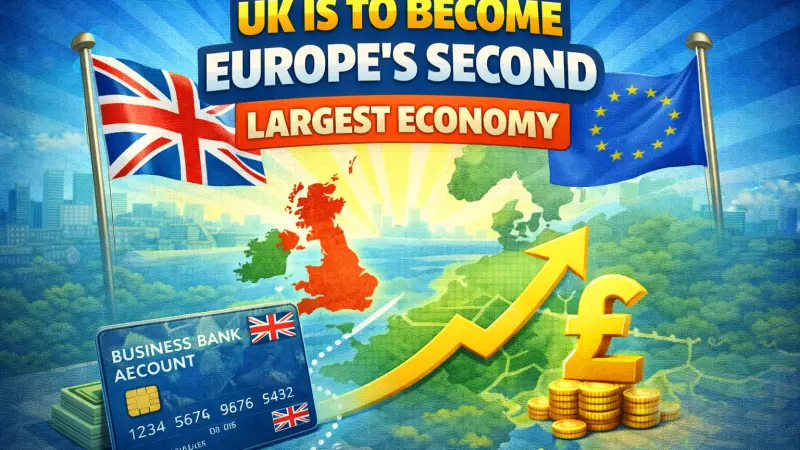
UK Set to Become Europe's Second Largest Economy
Meta Title: UK Set to Become Europe's Second Largest Economy in 2026: Full Analysis & FAQs

Meta Description: 2026 projections confirm the UK as Europe's second-largest economy by nominal GDP, behind Germany and ahead of France. Full breakdown of IMF forecasts, growth drivers, comparisons, business & investment implications, challenges, and 10 detailed FAQs on rankings, per capita GDP, future outlook, and policy effects.
Tags: UK economy 2026, Europe's second largest economy, UK GDP ranking Europe, IMF UK GDP forecast 2026, UK vs Germany France economy
UK Set to Become Europe's Second Largest Economy in 2026: Full Analysis
As of February 2026, the latest consensus economic forecasts — led by the International Monetary Fund (IMF) World Economic Outlook (October 2025 update with January 2026 revisions), OECD, PwC, Visual Capitalist, and StatisticsTimes — confirm a clear picture: the United Kingdom is set to rank as Europe's second-largest economy by nominal GDP in 2026, behind only Germany and ahead of France.
This position is not a sudden leap but a consolidation of trends seen since the mid-2010s. The UK has frequently held or regained second place in Europe post-Brexit, and 2026 projections show it maintaining that spot with a comfortable margin over France and no realistic challenge from Italy, Spain, Russia, or others in the near term.
2026 Nominal GDP Projections – Top European Economies
(All figures in current US dollars, nominal terms at market exchange rates – standard for international size rankings)
- Germany → $5.33 trillion (≈ €4.6 trillion) Europe's largest economy; projected real GDP growth 0.9–1.0% in 2026.
- United Kingdom → $4.23–$4.26 trillion (≈ €3.6 trillion) Solid second place; projected real GDP growth 1.2–1.3%.
- France → $3.56–$3.60 trillion Third place; similar growth trajectory but smaller base.
- Italy → $2.70–$2.75 trillion
- Russia → $2.51–$2.60 trillion (sanctions and commodity volatility)
- Spain → $1.80–$1.90 trillion
- Netherlands → $1.20–$1.30 trillion
- Switzerland → $0.95–$1.0 trillion
- Poland → $0.90–$0.95 trillion
Source consensus: IMF WEO (Jan 2026 revisions), Visual Capitalist (Jan 2026 ranking), House of Commons Library economic briefings (Feb 2026), OECD Economic Outlook, PwC UK Economic Outlook, StatisticsTimes, World Bank/Worldometers.
Nominal vs PPP Rankings
- Nominal GDP (market exchange rates) → UK firmly second in Europe.
- Purchasing Power Parity (PPP) → adjusts for cost of living; UK ranks lower (around 10th globally, third or fourth in Europe behind Germany and sometimes France/Italy due to higher UK prices).
Nominal remains the standard for "largest economy" headlines and policy comparisons.
Key Drivers Behind the UK's Position in 2026
- Services Sector Dominance ≈80% of UK GDP comes from services (finance, insurance, professional services, tech, creative industries, education exports). The City of London, fintech ecosystem, and global professional services generate high-value exports and attract FDI.
- Resilience Despite Headwinds Post-Brexit goods trade friction offset by strong services exports. Energy crisis (2022–2024) hit manufacturing harder in Germany than the UK's services-led model.
- Moderate Growth Outlook 2026 real GDP growth forecasts: UK 1.2–1.3% vs Germany 0.9–1.0%, France ≈1.2%. Inflation stabilised at ≈2%, Bank Rate easing supports consumer spending.
- Currency & Measurement Stability Sterling's relative strength in 2025–2026 helps maintain nominal rankings. Germany's export dependence makes it more sensitive to global slowdowns.
UK vs France – Why the Gap Persists
- 2026 gap ≈ $650–$700 billion (18–20% larger UK economy)
- UK advantages — Larger financial services sector, more dynamic tech/startup scene, higher per capita nominal GDP in recent years.
- France strengths — Stronger manufacturing (aerospace, luxury, automotive), but similar post-energy-crisis growth constraints.
- Population ≈68 million each — similar scale, but UK services productivity edges out in nominal terms.
Challenges & Risks to the Ranking
- Productivity stagnation — UK lags peers in output per hour since 2008.
- High public debt ≈100% of GDP limits fiscal flexibility.
- Trade barriers — Ongoing EU friction caps goods exports.
- Energy & net zero costs — Transition remains expensive.
- Global slowdown — If China/US weaken, UK services exports could suffer.
No immediate overtake by France is expected in 2026–2028, but long-term risks (AI disruption, demographics, climate costs) could narrow gaps.
Implications for Business, Investment & Policy
- Investor & FDI Appeal Second-place status reinforces the UK as a major, English-speaking market with global reach — attractive for fintech, AI, life sciences, professional services.
- Policy Leverage Strengthens negotiating position in trade deals (EU reset talks, CPTPP, India FTA progress).
- Non-Resident Directors For Delhi-based owners of UK companies, the large services-oriented economy offers opportunities in consulting, tech, finance.
- Per Capita Reality Total GDP second in Europe, but per capita ranking mid-tier (behind smaller high-income nations like Ireland, Switzerland, Netherlands) — highlights productivity and inequality challenges.
Outlook Beyond 2026
Medium-term (2027–2030): UK likely retains second place unless Germany surges or UK faces major downturn. Long-term structural shifts (AI, green transition, demographics) will influence rankings, but the UK's flexible, services-led model provides resilience.
10 Frequently Asked Questions (FAQs)
1. Is the UK officially Europe's second-largest economy in 2026? Yes — IMF, OECD, and consensus forecasts place the UK second by nominal GDP ($4.23–$4.26 trillion), behind Germany ($5.33 trillion) and ahead of France ($3.56 trillion).
2. What metric is used for "largest economy" rankings? Nominal GDP at current market exchange rates (USD) is the standard for size comparisons. PPP adjusts for living costs and ranks the UK lower.
3. Has the UK overtaken France permanently? The UK has held or regained second place multiple times since 2016. 2026 projections show a comfortable gap; no immediate reversal expected.
4. Why does Germany stay ahead despite its struggles? Germany's larger industrial base and export volume still produce higher nominal GDP, even with slower recent growth.
5. What is the UK's projected real GDP growth for 2026? 1.2–1.3%
(IMF/OECD/PwC consensus) — modest but stable, slightly ahead of Germany's 0.9–1.0%.
6. Does Brexit affect the ranking? Brexit reduced goods trade with the EU but services exports (less affected) helped maintain position. Overall impact on total GDP ranking has been limited.
7. How does the UK's per capita GDP compare in Europe? Mid-tier — behind smaller high-income nations (Ireland, Switzerland, Netherlands, Denmark) but ahead of larger peers like France/Italy in nominal terms.
8. Could France overtake the UK soon? Unlikely in 2026–2028. Gap ≈$650–$700 billion; France would need significantly stronger growth or sterling depreciation.
9. What does second place mean for business and investment? Reinforces the UK as a major market — boosts confidence for FDI, trade deals, and non-resident directors operating UK companies.
10. Where can I check the most up-to-date rankings? IMF World Economic Outlook database, Visual Capitalist rankings, House of Commons Library briefings, OECD Economic Outlook, or StatisticsTimes (updated monthly).
The projection that the UK is to become (or more precisely, remain) Europe's second-largest economy in 2026 is firmly supported by data from the IMF and other authoritative sources.
This ranking highlights the resilience of the UK's services-led model — finance, tech, professional services, and creative industries — in the face of Brexit, energy shocks, and global headwinds.
For business owners, investors, and policymakers — whether in London or Delhi — second place signals a large, sophisticated, English-speaking economy with global connectivity. Sustaining the position requires addressing productivity, skills, infrastructure, and trade relationships. The 2026 milestone is a platform, not a peak — the focus now shifts to policies that can drive stronger, more inclusive growth in the years ahead.

Disclaimer: The information provided in this article is for general informational and research purposes only. Company details, features, services, and market positions may change over time. Readers are advised to visit official company websites and conduct independent research before making any business decisions or purchasing services.
Most Searchable Keywords

Recent Blogs
-

Explore Fuel and Roadside Convenience Across Beckington Today
-
Explore Abergavenny Tyre Services with Expert Local Fitters
-
Claim Your HMRC UK Tax Refund Before Application Deadlines
-
Christmas Markets Near York Local Favourites Worth Visiting
-
AI for Small Businesses in the UK Free Tools to Grow Faster





Categories
- Accountants (295)
- Advertising Agencies (559)
- Architects (149)
- Automobiles (376)
- Beauty (300)
- Carpenters (146)
- Cleaning Services (386)
- Dentists (189)
- Driving (61)
- Electricians (215)
- Energy (7)
- Event Organiser (683)
- Finance (597)
- Guide (3358)
- Health (2205)
- Information technology (206)
- Legal Services (352)
- Logistics (6)
- Maintenance (65)
- Manufacturing (35)

Sponsored Listings in Event Organiser


Related Blogs
Explore Fuel and Roadside Convenience Across...
Read this insightful article "Explore Fuel and Roadside Convenience Across Beckington Today" to expand your knowledge!
Explore Abergavenny Tyre Services with Expert...
Read this insightful article "Explore Abergavenny Tyre Services with Expert Local Fitters" to expand your knowledge!

Claim Your HMRC UK Tax Refund Before Applicat...
Read this insightful article "Claim Your HMRC UK Tax Refund Before Application Deadlines" to expand your knowledge!
Questions & Answers – Find What
You Need, Instantly!
How can I update my business listing?
Is it free to manage my business listing?
How long does it take for my updates to reflect?
Why is it important to keep my listing updated?
