
Understanding Verified Business Attributes on Home Automation Listings
In the competitive landscape of modern smart home technology, the difference between a booked installation job and a missed opportunity often comes down to the smallest details in a business profile. Homeowners seeking to automate their living spaces are not just looking for technical skills; they are searching for reliability, specific service offerings, and trust signals that validate their choice. While many home automation businesses focus heavily on website design and portfolio images, a critical component often goes overlooked: verified business attributes on local listings. These specific data points, ranging from "wheelchair accessible" to "online estimates," act as digital shorthand for potential clients and search algorithms alike. They provide a layer of validation that standard text descriptions cannot match. This article delves into the mechanics of verified business attributes, exploring how they function within local search ecosystems and why they are essential for home automation companies aiming to secure high-value contracts in a digital-first marketplace.

The Concept of Verified Business Attributes
To leverage the power of local search, one must first understand the building blocks of a business profile. Attributes are descriptive features that highlight the unique qualities of a business. They appear on platforms like Google Business Profile (GBP), Bing Places, and various industry-specific directories.
Defining Attributes in a Technical Context
In the context of local SEO, attributes are structured data fields. Unlike a blog post or a service description, which are unstructured text, attributes are standardized labels chosen from a pre-defined list. For a home automation company, these might include labels such as "Smart home consultant," "Security system installation," or "Online appointments." When an attribute is "verified," it means the platform or the business has confirmed its accuracy, often through a verification process like postcard codes, video recording, or third-party validation.
The Distinction Between Basic and Advanced Attributes
Basic attributes cover fundamental logistics: hours of operation, address, and phone number. Advanced attributes, however, dig deeper into the operational ethos and service specifics. These might include:
- Service Options: "Onsite services," "Online consultations," "Curbside pickup."
- Accessibility: "Wheelchair accessible entrance," "Wheelchair accessible parking."
- Identity: "Women-led," "Veteran-led," "Family-owned."
- Payments: "Credit cards," "Debit cards," "NFC mobile payments."
For home automation professionals, the "Service Options" and "Identity" categories are particularly potent. A homeowner deciding between two integrators might subconsciously favor a "Family-owned" business, or practically require "Online consultations" due to a busy schedule.
Why Verified Attributes Matter for Home Automation
The home automation sector is unique. It sits at the intersection of construction, interior design, and information technology. This complexity means customers have specific, often granular, requirements before they even make a phone call.
Matching User Intent with Precision
When a user searches for "smart home installer near me," search engines filter results based on relevance. If a user applies a filter for "open now" or "online estimates," businesses lacking these verified attributes disappear from the view. By populating every possible relevant attribute, a home automation company ensures they remain visible across a wider array of search queries and filter combinations.
Building Trust Through Third-Party Validation
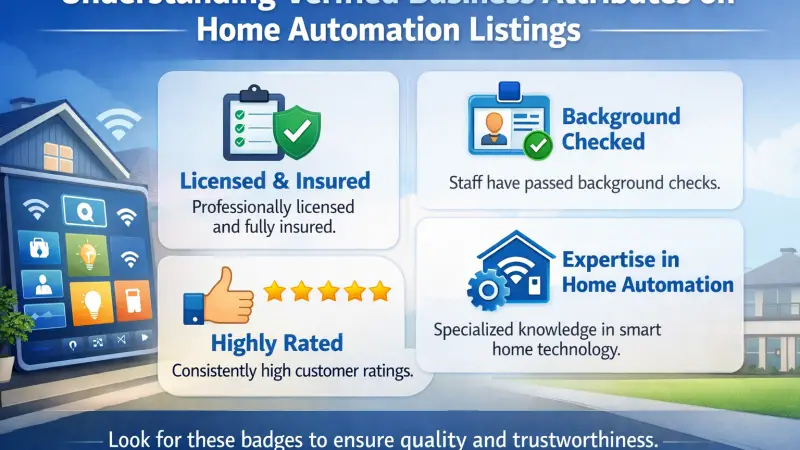
In an industry where technicians enter private homes to install sensitive equipment like cameras and smart locks, trust is the currency of trade. Verified attributes act as endorsements. A "Background checks performed on staff" attribute (where available) or "Identity verified" badge alleviates the anxiety of inviting a stranger into one's home. This third-party validation removes the onus of proof from the sales pitch and places it on the platform, allowing the business to focus on technical discussion rather than proving their legitimacy.
Enhancing Voice Search and AI Discovery
With the rise of smart speakers and voice assistants, search queries have become more conversational. A user might ask their smart device, "Find a women-led smart home company that offers online quotes." Search assistants rely heavily on structured data to answer these queries. Structured attributes allow the AI to match the specific request with the business data instantly. Without these attributes filled out, a business effectively silences itself from these modern discovery channels.
Strategic Implementation: A Step-by-Step Guide
Optimizing a listing is not about guessing; it is about a systematic approach to profile management. Here is how a home automation business can methodically enhance their attribute profile.
Step 1: Audit Current Listings
Before adding new information, assess the current state. Search for the business on Google Maps, Apple Maps, and relevant directories. Check what attributes are currently displayed. Are there gaps? For instance, if the business offers remote troubleshooting for software issues but the "Online appointments" attribute is missing, that is a gap in potential revenue.
Step 2: Categorize Services Correctly
Attributes are often tied to the primary and secondary categories of a business. If a company lists itself merely as "Electrician," they may miss out on attributes specific to "Home Automation Company." Changing or refining the primary category to "Home Automation Company" or "Security System Installer" unlocks a new set of relevant attributes, such as "Home theater installation" or "CCTV installation."
Step 3: Utilize the "From the Business" Descriptions
While not a clickable attribute, the business description allows for the elaboration of attributes. If the listing claims the business is "Veteran-led," the description should briefly mention the military background and how that discipline translates to installation quality.
This reinforces the attribute, moving it from a simple label to a part of the brand narrative.
Step 4: Verify and Re-verify
Platforms may periodically de-verify attributes or request re-verification to ensure the business still meets the criteria. It is crucial to monitor the email associated with the listing profile. Ignoring a verification request can lead to attributes—and sometimes the entire listing—being suspended. For home automation businesses that move locations or expand service areas, prompt re-verification is vital to maintain local rankings.
The SEO Impact of Attribute Consistency
Search Engine Optimization is often thought of in terms of keywords and backlinks. However, local SEO relies heavily on "citations"—mentions of the business across the web. Consistent attributes across these citations signal authority to search engines.
The Role of Structured Data in Ranking Algorithms
Google’s algorithm uses a "knowledge graph" to understand entities (businesses). Attributes are the edges connecting these entities to concepts (services, qualities). When a business consistently lists "Online estimates" across their Google Business Profile, their website, and other directories, the algorithm gains confidence in this fact. This confidence translates to higher rankings for searches specifically looking for online estimation services.
Reducing Bounce Rates Through Expectation Management
A common SEO issue is the "bounced visit." A user clicks a listing, realizes it doesn't offer what they need, and leaves immediately. This signals to search engines that the listing was irrelevant. Verified attributes manage expectations before the click. If a user sees "In-store shopping" but the business is strictly "Onsite services," a mismatch occurs. Accurate attributes ensure that the users who do click are highly qualified leads, improving engagement metrics and signaling relevance to search engines.
Common Mistakes to Avoid in Attribute Management
Even experienced marketers can fumble the details of local listings. Understanding these pitfalls can save a business from lost leads or, worse, penalties.
Misrepresentation of Identity Attributes
It can be tempting to check every box. However, claiming to be "Women-led" or "Black-owned" when the business does not meet the specific criteria for these designations is a serious breach of platform guidelines. These attributes are protected classes in many jurisdictions and misusing them for marketing advantage can lead to account suspension and reputational damage.
Ignoring Accessibility Attributes
Home automation is often pitched as a solution for aging in place or accessibility (e.g., voice-controlled lights for those with mobility issues). If a business neglects to mark their own office or showroom as "Wheelchair accessible," it sends a mixed message. For clients specifically seeking accessibility solutions, this omission can be a deal-breaker. Always audit physical premises to ensure accessibility claims are accurate.
Set-and-Forget Mentality
Business models evolve. A home automation company might start offering 24/7 emergency support for security system failures. If the "Hours" and "Service options" attributes are not updated to reflect this, the company loses out on emergency call-out work. Quarterly reviews of all listing attributes should be standard operating procedure.
Neglecting Payment Attributes
High-ticket installations often involve significant payments. If a business only accepts cash or check, but does not specify this, they might frustrate clients expecting to pay by credit card. Conversely, adopting and displaying modern payment attributes like "NFC mobile payments" positions the company as tech-forward—a crucial image for a smart home provider.
Advanced Optimization: Leveraging Attributes for Specific Niches
Home automation is broad. Companies often specialize. Attributes can be used to highlight these niches.
Focusing on Security vs. Entertainment
If a company specializes in home theaters, attributes related to "Audio-visual equipment" are priority. If they specialize in security, attributes like "Security guard service" (if applicable) or "Burglar alarm store" are more relevant. A common mistake is trying to cast a wide net by selecting every possible attribute. This dilutes the relevance signal. It is better to be the top result for "Home theater installation" with specific matching attributes than an average result for generic "Home automation."
The "Online" Pivot
Post-2020, the ability to offer remote support is a major selling point. Attributes such as "Online consultations" or "Virtual appointments" allow home automation companies to cast a wider geographic net. If the technical diagnostic can be done remotely, the service area can expand beyond the local city. This attribute effectively changes the business model from a local service to a regional or national consultant.
Health and Safety Attributes
While often overlooked, attributes regarding "Temperature check required" or "Staff wear masks" are still relevant in specific client sectors, particularly for elderly clients or medical facility installations.
Displaying that a business takes health and safety seriously reinforces the image of professionalism and care, which is paramount when entering private residences.
The Synergy Between Attributes and Visual Content
Attributes do not exist in a vacuum. They should be supported by the visual content on the profile.
Photos as Proof
If a listing claims "Wheelchair accessible entrance," the photo upload section should include a clear photo of the ramp or accessible door. If the attribute "Free Wi-Fi" is selected for a showroom, a photo of a comfortable waiting area reinforces this. For home automation, showcasing "Onsite services" should be accompanied by photos of technicians in branded uniforms working in elegant homes. The visual evidence corroborates the structured data attribute, cementing the trust in the user's mind.
Google Posts and Updates
Google Posts allow businesses to share updates directly on their profile. These posts can be used to highlight attributes. For example, a post could read: "Did you know we are a Veteran-led business? Learn how our military precision ensures your smart home is installed flawlessly." This links the attribute to a narrative, making it more memorable than a simple label.
The User Journey: From Attribute to Booking
Understanding the psychological pathway of the customer helps in selecting the right attributes.
The Filter Phase
The user often starts with broad intent and narrows down via filters. They search for "Smart home installer." The map shows ten options. The user filters by "Open Now" and "Online Estimates." Five businesses disappear because they didn't verify those attributes. The home automation company that has these boxes checked is now in the final consideration set without having to spend a dollar on ads.
The Comparison Phase
Now the user compares the remaining options. Business A has no identity attributes. Business B is "Family-owned and operated." For many homeowners, the "Family-owned" attribute suggests accountability and personal investment. They choose Business B. The attribute acted as the tie-breaker.
The Conversion Phase
The user clicks "Book Online" (an attribute/link functionality). Because the business verified the "Online booking" attribute, the transition from interest to action is seamless. No phone tag, no waiting for an email reply. The attribute streamlined the sales funnel.
Supporting Local Business Visibility Beyond Core Marketing Efforts
While attributes and on-platform optimization are central to a strong digital strategy, a robust online presence requires a multi-layered approach. Relying solely on a single platform limits a business's ability to control its narrative across the web. A comprehensive visibility strategy should incorporate broader directory presence to reinforce the trust signals built on primary search profiles.
Establishing a consistent presence on a Local Page UK allows home automation businesses to solidify their geographic relevance. This serves as a supporting citation that validates the location data found on major search engines. By utilizing a free company listing platform, businesses can ensure their core information—Name, Address, Phone number, and services—remains consistent across the broader digital ecosystem. Consistency is a key factor in how search algorithms evaluate authority; discrepancies in business details can harm ranking potential. Furthermore, platforms that allow companies to list services uk directory style provide an additional avenue for specific service discovery. When a business is featured on a respected business directory website, it gains a backlink and a citation that contributes to domain authority, acting as a vote of confidence in the eyes of search engines. Ultimately, securing a spot on a high-quality business listings site functions as a credibility signal for potential clients who use these directories to cross-reference businesses before making a high-value purchase decision. This holistic approach ensures that a company is not just visible, but verifiably established.
Verified Business
Verified business attributes are far more than administrative checkboxes; they are sophisticated digital signals that bridge the gap between a home automation company's capabilities and a homeowner's specific needs. In an industry defined by precision and trust, the accuracy of these attributes can determine whether a business appears in a search result or is filtered out of contention.
By meticulously selecting, verifying, and maintaining these attributes, smart home professionals can enhance their local SEO, manage client expectations, and streamline the path from discovery to booking. The digital landscape is crowded, but for those who master the details, the opportunities for growth are substantial. Take the time today to audit your listings, verify your attributes, and secure your position as a trusted leader in the home automation market.
Frequently Asked Questions (FAQs)
1. What exactly are verified business attributes? Verified business attributes are specific, standardized labels on search engines and directory listings that describe a business's features, services, or identity. "Verified" means the platform has confirmed the accuracy of these labels through a validation process.
2. Do business attributes really impact local SEO ranking? Yes. While they are not the only factor, attributes help search engines understand the relevance of a business to specific user queries. They directly influence whether a business appears in filtered search results (e.g., "Open now," "Wheelchair accessible").
3. How often should I update my home automation business attributes? You should review your attributes at least once a quarter or whenever there is a significant change in your business operations, such as offering a new service like online consultations or changing your payment methods.
4. Can I add custom attributes that aren't on the list? On most major platforms like Google Business Profile, you cannot create custom attributes. You must choose from the pre-defined list. However, you can use the business description field to highlight unique qualities that don't fit standard attributes.
5. What happens if I claim an attribute that isn't true? Misrepresenting your business can lead to your listing being suspended or removed by the platform. It can also lead to negative customer reviews if clients feel misled, damaging your reputation.
6. Are identity attributes like "Women-led" or "Veteran-led" important? These attributes are increasingly important for differentiation. Many consumers actively seek to support specific types of businesses, and these labels serve as powerful trust signals and emotional connectors.
7. How do attributes help with voice search? Voice assistants rely on structured data to answer questions. If someone asks for a "wheelchair accessible smart home installer," the assistant uses these attributes to provide the answer. Without them, your business might be invisible to voice search.
8. Is "Online appointments" a relevant attribute for installers? Absolutely. Modern consumers prefer convenience. Offering and highlighting online booking functionality can significantly increase conversion rates, especially among younger homeowners who prefer not to make phone calls.
9. What is the difference between a category and an attribute? A category is a broad classification of what your business is (e.g., "Home Automation Company"). An attribute is a specific detail about how you operate or what you offer (e.g., "Online estimates," "Free parking").
10. How do I verify attributes on my listing? Verification usually happens when you claim or edit your profile. Some attributes are self-verified by the business owner, while others may require video proof or third-party validation depending on the platform's current policies.
11. Do attributes show up on mobile maps? Yes, attributes are prominently displayed on mobile business profiles. They often appear as highlights or icons near the top of the profile, making them one of the first things a mobile user sees.
12. Can attributes be removed by users? Yes, users can suggest edits to attributes. If Google or the platform verifies the user's suggestion as accurate, the attribute can be changed or removed. It is important to monitor your listing to prevent incorrect user edits.
13. Why are accessibility attributes crucial for home automation? Home automation is frequently used to improve accessibility in homes. If a client seeking these solutions sees that your office is not accessible, they may doubt your expertise in accessibility technology. It is a consistency signal.
14. Should I mention payment attributes? Yes. Being transparent about payment options (e.g., accepting credit cards
or financing) removes a potential barrier to entry for clients planning expensive installations.
15. Can attributes help me rank in neighboring cities? While attributes alone won't make you rank in a city where you don't have a physical presence, service-area attributes (like "Onsite services") help clarify that you serve clients at their locations, which helps you rank for "near me" searches in your service area.

Disclaimer: The information provided in this article is for general informational and research purposes only. Company details, features, services, and market positions may change over time. Readers are advised to visit official company websites and conduct independent research before making any business decisions or purchasing services.
Most Searchable Keywords
Recent Blogs

Related Listings
Categories
- Accountants (295)
- Advertising Agencies (559)
- Architects (149)
- Automobiles (377)
- Beauty (300)
- Carpenters (146)
- Cleaning Services (386)
- Dentists (189)
- Driving (62)
- Electricians (215)
- Energy (8)
- Event Organiser (685)
- Finance (599)
- Guide (3365)
- Health (2207)
- Information technology (206)
- Legal Services (353)
- Logistics (6)
- Maintenance (65)
- Manufacturing (35)
Sponsored Listings in Locksmith Services

Related Blogs

Gen Z Political Reporters and News Creators i...
Read this insightful article "Gen Z Political Reporters and News Creators in the UK" to expand your knowledge!

Famous Female Social Media Influencers Across...
Read this insightful article "Famous Female Social Media Influencers Across the UK" to expand your knowledge!

Your UK Sponsor Licence 2026 Step by Step Gui...
Read this insightful article "Your UK Sponsor Licence 2026 Step by Step Guide" to expand your knowledge!
Questions & Answers – Find What
You Need, Instantly!
How can I update my business listing?
Is it free to manage my business listing?
How long does it take for my updates to reflect?
Why is it important to keep my listing updated?
