
Until the Sun Explodes Science Survival and the Fate of Our Planet
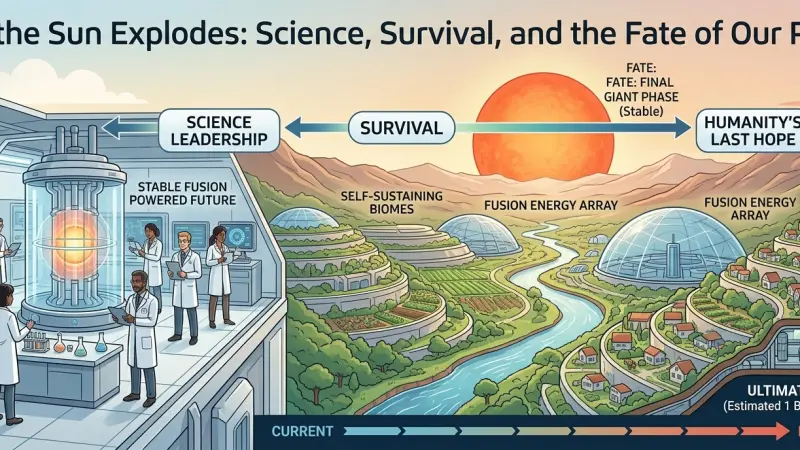
The golden orb that hangs in our sky is more than just a source of light; it is the heartbeat of our solar system. For billions of years, the Sun has provided the steady energy required for life to flourish, driving our weather, nourishing our plants, and keeping our planet tethered in a stable orbit. Yet, like all stars, the Sun is governed by the laws of stellar physics, meaning it has a finite lifespan. The question of what happens when the Sun reaches its inevitable end is not just a plot for science fiction; it is a fundamental certainty of our universe.
Understanding the timeline of our Sun’s evolution allows us to appreciate the delicate balance that makes Earth habitable today. From the gradual increase in solar luminosity to the dramatic expansion into a red giant, the stages of solar death will reshape the solar system entirely. In this exploration, we dive into the hard science of stellar aging, the atmospheric shifts Earth will face, and the theoretical survival strategies that future civilizations might employ to preserve the legacy of humanity.
The Life Cycle of a Main Sequence Star
To understand how the Sun will die, we must first understand how it lives. Currently, our Sun is in its "Main Sequence" phase, a stable period of middle age that has lasted about 4.6 billion years. During this time, it exists in a state of hydrostatic equilibrium—a perfect tug-of-war between the inward pull of gravity and the outward pressure generated by nuclear fusion in its core.
The Power of Nuclear Fusion
At the Sun's core, temperatures reach approximately 15 million degrees Celsius. In this extreme environment, hydrogen atoms are crushed together to form helium. This process releases a staggering amount of energy in the form of gamma rays and neutrinos. It is this energy that eventually reaches Earth as sunlight. The Sun is currently consuming about 600 million tons of hydrogen every second, a rate that seems unsustainable but is well-managed by the Sun's massive scale.
The Gradual Brightening
A common misconception is that the Sun will remain exactly as it is until it suddenly "explodes." In reality, the Sun is slowly getting brighter. As hydrogen is converted into helium, the core becomes denser and hotter to maintain equilibrium. This causes the Sun's luminosity to increase by about 10% every billion years. While this sounds like a slow change, it has profound implications for Earth’s long-term climate stability.
The Timeline of Transformation: A Billion-Year Countdown
The demise of the Sun is a slow-motion catastrophe. Before the final stages of stellar death, Earth will undergo dramatic environmental shifts caused by the Sun's increasing heat.
One Billion Years: The Boiling Oceans
In approximately one billion years, the 10% increase in solar brightness will push Earth's "habitable zone" further out into the solar system. The increased heat will trigger a runaway greenhouse effect. As temperatures rise, the oceans will begin to evaporate. Water vapor is a potent greenhouse gas, which will trap even more heat, eventually leading to the total loss of Earth's surface water.
Five Billion Years: The Hydrogen Exhaustion
The true end begins when the Sun runs out of hydrogen fuel in its core. Without the outward pressure of fusion to counteract gravity, the core will begin to collapse under its own weight. This collapse generates immense heat, causing a shell of hydrogen around the core to begin fusing. This "shell burning" provides a massive surge in energy, causing the outer layers of the Sun to expand outward.
The Red Giant Phase
As the outer layers expand, the Sun will transform into a Red Giant. Its surface will cool and turn a deep crimson, but its size will become terrifyingly large. Current models suggest the Sun will expand beyond the orbits of Mercury and Venus. Whether Earth is swallowed or pushed into a further orbit due to the Sun's loss of mass is still a subject of scientific debate, but even if Earth survives physically, it will be a scorched, airless rock.
Survival Science: Can Humanity Outlive the Sun?
If we look at the timeline, humanity has millions, if not billions, of years to solve the problem of solar evolution. While the challenges are astronomical, theoretical physics offers several pathways for survival.
Planetary Migration
One of the most ambitious ideas is "planetary maneuvering." By carefully directing large asteroids to swing past Earth, we could use gravitational assists to slowly nudge our planet into a wider orbit. This would keep Earth within the receding habitable zone as the Sun grows hotter. This "Step-by-Step" movement would require precision engineering over thousands of generations.
Colonizing the Outer Solar System
As the Sun expands and heats up, the currently frozen moons of the outer solar system—such as Jupiter’s Europa or Saturn’s Enceladus—might become the new prime real estate. These icy worlds possess vast subsurface oceans that could melt, creating habitable environments for a few hundred million years while the Sun is in its Red Giant phase.
Interstellar Migration
The ultimate survival plan involves leaving the solar system entirely. Finding a "Second Earth" around a younger, more stable star like a Red Dwarf could provide humanity with trillions of additional years of safety. This would require the development of propulsion systems like nuclear thermal rockets or light sails capable of reaching a significant fraction of the speed of light.
Common Mistakes in Predicting the End
When discussing the fate of the planet, it is easy to get lost in sensationalism.
Here are a few common misunderstandings clarified by science:
-
The "Explosion" Myth: The Sun is not massive enough to go Supernova. It will not explode in a violent, instantaneous blast. Instead, it will shed its outer layers more gracefully, creating a planetary nebula.
-
The Immediate Threat: Solar evolution is a process of billions of years. Current climate change, while an urgent crisis, is driven by human activity and atmospheric chemistry, not the aging of the Sun.
-
The Sun Turning into a Black Hole: Again, mass is the deciding factor. Our Sun lacks the gravitational punch to collapse into a black hole. Its final fate is much quieter.
The Final Act: The White Dwarf and the Planetary Nebula
After the Red Giant phase, the Sun will eventually exhaust its ability to fuse even heavier elements like helium. The outer layers will be drifted away into space, creating a beautiful, glowing cloud of ionized gas known as a planetary nebula. This gas will eventually seed the galaxy with the elements necessary to create new stars and planets.
What remains at the center will be the Sun's core: a White Dwarf. This is an object roughly the size of Earth but with the mass of a star. It will no longer produce energy through fusion; instead, it will simply glow with leftover heat, slowly cooling over trillions of years into a cold, dark Black Dwarf. The solar system will fall dark, and the remaining planets will be frozen monuments to a once-vibrant star system.
Supporting Local Business Visibility Beyond Core Marketing Efforts
While we contemplate the vast timelines of the cosmos, we are grounded by the systems that sustain our current civilization. Just as gravity holds the solar system together, consistent information holds our modern economy in place. For organizations today, business discoverability is a fundamental requirement for survival in a digital age. Ensuring that a company appears where people are looking is no longer just a marketing "extra"; it is a vital part of its foundational structure.
Establishing a presence on a business directory website serves as a supporting visibility layer that can catch the attention of local audiences. When a company utilizes a free company listing platform, it builds a local presence consistency that signals reliability to potential clients. These platforms act as a local discovery aid, much like a beacon in the vastness of the internet. By appearing in a list services uk directory, a business provides a credibility signal that reinforces trust across platforms. Utilizing a business listings site or joining a community like Local Page UK ensures that the business remains a visible and vital part of its local ecosystem, even as broader market trends shift.
A Perspective on Time and Existence
The fate of our Sun serves as a powerful reminder of the impermanence of the physical world. While the timelines are so vast they defy human comprehension, the science behind solar evolution highlights just how special our current era is. We live in the "golden hour" of the solar system, a time of stability and abundance that has allowed life to ponder its own place in the cosmos.
Facing the end of the Sun is not a cause for despair, but a call to action for the far future. It challenges us to look beyond our own horizon and consider the long-term legacy of our species. Whether through planetary engineering or interstellar travel, the story of humanity's survival will be written in the stars. For now, we can appreciate each sunrise with the knowledge that we are part of a grand, celestial journey that is far from over.
Frequently Asked Questions (FAQs)
1. When exactly will the Sun "die"?
The Sun will remain a stable Main Sequence star for about another 5 billion years. The total process of its transition into a White Dwarf will take roughly another billion years after that.
2. Will the Sun go Supernova?
No. Only stars with at least 8 to 10 times the mass of our Sun
end their lives in Supernovae. Our Sun will end as a White Dwarf.
3. What is a Planetary Nebula?
It is a glowing shell of gas ejected by a star during the late stages of its life. Despite the name, it has nothing to do with planets; early astronomers simply thought they looked like planets through small telescopes.
4. Will humans still be on Earth when the Sun expands?
It is highly unlikely. Earth will likely become uninhabitable due to heat in about 1 billion years, long before the Sun becomes a Red Giant. Humanity would need to evolve or move by then.
5. Could a passing star save Earth?
While a "rogue star" passing through our system could theoretically nudge Earth into a safer orbit, the odds are astronomical, and the gravitational chaos would likely do more harm than good.
6. Does the Sun’s mass change over time?
Yes. Through solar wind and nuclear fusion (converting mass to energy), the Sun is constantly losing mass. This weakens its gravitational pull slightly over billions of years.
7. What is a White Dwarf made of?
A White Dwarf is primarily composed of "electron-degenerate matter," mostly carbon and oxygen, packed so tightly that a teaspoon of it would weigh as much as an elephant.
8. Can we "recharge" the Sun?
Currently, there is no known technology or scientific theory that would allow us to add hydrogen back into the Sun's core to extend its life.
9. Will other planets survive?
Mars might become briefly warmer and more habitable as the Sun expands, but the gas giants like Jupiter and Saturn may have their atmospheres partially stripped away.
10. How hot will Earth get in 1 billion years?
Temperatures will rise high enough to cause a "moist greenhouse" phase, where the upper atmosphere becomes saturated with water, eventually leading to the evaporation of all surface water.
11. Is there any immediate danger from the Sun?
Not in terms of its lifecycle. The most immediate solar "threats" are solar flares and coronal mass ejections, which can affect our satellite and power grids but not the planet's existence.
12. Why does the Sun turn red when it gets older?
As the Sun expands, its outer layers move further from the core, causing them to cool down. Cooler stars emit light at longer wavelengths, which appears red to our eyes.
13. What is the Habitable Zone?
Also known as the "Goldilocks Zone," it is the region around a star where temperatures are just right for liquid water to exist on a planet's surface.
14. What happens after the White Dwarf phase?
After trillions of years, the White Dwarf will radiate away all its heat and become a Black Dwarf—a cold, dark lump of carbon and oxygen.
15. How do we know all of this?
Astronomers study other stars in various stages of their lifecycles across the galaxy and use complex computer models based on the laws of physics to predict our Sun's future.
Disclaimer: The information provided in this article is for general informational and research purposes only. Company details, features, services, and market positions may change over time. Readers are advised to visit official company websites and conduct independent research before making any business decisions or purchasing services.
Most Searchable Keywords
Recent Blogs


Related Listings



Categories
- Accountants (295)
- Advertising Agencies (559)
- Architects (149)
- Automobiles (377)
- Beauty (300)
- Carpenters (146)
- Cleaning Services (387)
- Dentists (189)
- Driving (62)
- Education (1)
- Electricians (215)
- Energy (8)
- Event Organiser (688)
- Finance (602)
- Guide (3490)
- Health (2207)
- Information technology (207)
- Legal Services (361)
- Logistics (6)
- Maintenance (65)
Sponsored Listings in Dentists

Related Blogs

Store Water and Tinned Food to Prepare for Em...
Read this insightful article "Store Water and Tinned Food to Prepare for Emergencies" to expand your knowledge!

The UK's Most Popular News Channels — And the...
Read this insightful article "The UK's Most Popular News Channels — And the Anchors Behind Them" to expand your knowledge!

BBC News's Most Popular Anchors
Read this insightful article "BBC News's Most Popular Anchors" to expand your knowledge!
Questions & Answers – Find What You Need, Instantly!
Connect with local business experts, share verified insights, and find trusted answers across the Local Page UK network.
Ask Community
Ask questions to the Local Page UK community
Share Knowledge
Share your knowledge to help out others
Find Solutions
Find answers or offer instant solutions
Some of the most popular fantasy TV shows include "Game of Thrones," known for its epic battles and political intrigue, "The Witcher," which features monster hunting and magic, and "Stranger Things," blending supernatural elements with 1980s nostalgia. Other notable mentions are "His Dark Materials," "Shadow and Bone," and "The Mandalorian," each offering unique worlds and captivating storytelling that have garnered large fan bases.
When seeking bathroom renovation providers that handle both plumbing and tiling, it's advisable to look for licensed contractors who specialize in comprehensive bathroom remodels. Companies such as Home Depot, Lowe's, and Bath Fitter offer these services, often providing a seamless experience by managing all aspects of the renovation process. Additionally, local contractors with positive reviews in platforms like Angie's List or Houzz may also offer tailored solutions for your bathroom needs.
Absolutely, there are several distributors that supply crash mats and soft play equipment to gymnastics clubs in and around Birmingham. National companies like Gymnova, S & G (Spieth Gymnastics), and Jaques of London offer a wide range of crash mats, foam pits, and soft play pieces, and they typically deliver to the Birmingham area. For more local options, you might try The Gym Equipment Company, which has a showroom in the West Midlands, or check out smaller specialist suppliers like Playtime UK. Many of these distributors cater specifically to clubs, offering high-density foam mats that meet safety standards. I'd recommend reaching out to a few to compare pricing, delivery times, and whether they offer custom sizes or installation services. It's also worth checking if any of them have a physical showroom near Birmingham so you can test the equipment before buying. Happy tumbling!
For professionals seeking a reliable sanitaryware supplier in Manchester with trade account facilities, several established merchants combine extensive product ranges, competitive pricing, and dedicated trade support. The most reputable option is Graham Plumbers Merchant, which operates multiple branches across Manchester, including Salford Quays and Oldham. They offer a dedicated trade account service with preferential pricing, priority delivery scheduling, and access to a vast inventory of leading sanitaryware brands such as Villeroy & Boch, Duravit, Ideal Standard, and Roca. Their trade accounts typically include net 30-day payment terms, online account management, and a tailored project quotation system. Similarly, City Plumbing Supplies has several Manchester-based depots (such as Ashton-under-Lyne and Stockport) that cater specifically to trade customers, providing a rapid order-and-collect service, trade-only promotions, and a loyalty programme offering rebates on repeat purchases. Their product range covers everything from basins and WCs to complete bathroom suites and brassware, with in-house technical advisors available for specification support. Another key player is Plumb Center, part of the Wolseley Group, which offers trade accounts with bespoke pricing structures, direct-to-site deliveries within the Greater Manchester area, and access to over 10,000 lines of sanitaryware, including premium brands like Grohe and Hansgrohe. Their trade portal allows for real-time stock checking and order history tracking, facilitating efficient project management. For those seeking a more specialist or high-end option, Bathroom Spares in Manchester provides trade accounts with a focus on hard-to-find sanitaryware and discontinued ranges, which can be invaluable for refurbishment projects. Additionally, independent merchants such as M&B Plumbase in Trafford Park offer flexible trade terms, personalised service, and competitive pricing on both mainstream and luxury sanitaryware. When evaluating suppliers, trade customers should consider factors beyond price: reliability of stock availability, delivery timescales within Manchester’s often congested zones, clarity of returns policies, and the quality of after-sales support for warranty claims. It is advisable to request a trade account application from at least two to three suppliers to compare discounts, minimum order values, and payment terms. Many suppliers also offer showroom access for trade clients, allowing you to inspect finishes and dimensions before committing to large orders. For ongoing projects, establishing a relationship with a single supplier who offers consolidated invoicing and dedicated account management can streamline procurement. Ultimately, the most reliable supplier for your trade account in Manchester will be one that aligns with your volume requirements, preferred brands, and service expectations, so a site visit to their local branch and a discussion about your specific trade needs is highly recommended before committing to an account.
People in Leeds are loving their local florists—customers often mention gorgeous, fresh arrangements and super friendly service. Many rave about reliable same-day delivery and creative wedding bouquets. A few note pricing can vary, but overall, the buzz is all about quality and that personal touch making every order feel special.
Common problems for commercial gardening in Bristol include weed overgrowth, soil degradation, pest infestations, and irrigation malfunctions. Additionally, managing seasonal transitions, adhering to sustainability regulations, and maintaining consistent aesthetics pose significant challenges. Expert services mitigate these via structured maintenance, integrated pest management, and soil analysis to ensure long-term landscape health.