
Upcoming NHS Changes UK: 10-Year Health Plan & 2025 Reforms
The National Health Service (NHS) is currently standing at its most significant crossroads since its inception in 1948. Following the publication of the Lord Darzi review in late 2024, the UK government has set in motion a series of radical transformations aimed at "fixing the foundations" of a system described as being in "critical condition."
For patients, clinicians, and stakeholders, understanding these upcoming NHS changes is not just about keeping up with policy; it is about navigating a new era of healthcare. From the 10-Year Health Plan to the introduction of "Neighbourhood Health Centres," the landscape of British medicine is about to become more digital, more community-focused, and more preventative than ever before.
The Core Vision of the 10-Year Health Plan
Shifting from Hospital to Community Settings
Introducing the Neighbourhood Health Centre Model
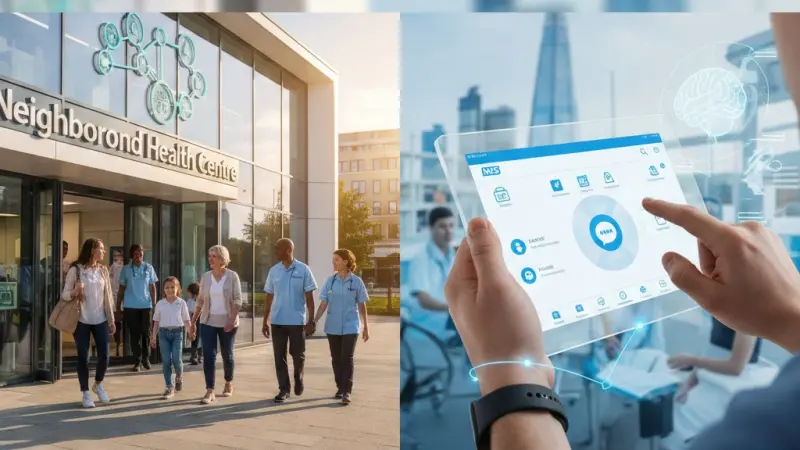
The most visible of the upcoming NHS changes is the move away from large, centralised hospital settings toward community-based care. The 10-Year Health Plan outlines a strategy to house GPs, nurses, physiotherapists, and mental health specialists under one roof in local "one-stop shops."
These Neighbourhood Health Centres are designed to reduce the physical distance between patients and specialists. By providing diagnostics and minor procedures in the community, the government aims to alleviate the immense pressure on overstretched Accident and Emergency departments.
Research Insight: The Lord Darzi review highlighted that the UK has been "hospital-centric," leading to inefficiencies. The 2025 strategy aims to redirect billions in capital investment to local clinics.
GP Contract Reforms and the End of the 8am Scramble
Modernising Primary Care Access for 2025
Mandatory Online Consultation Windows and Triage Tools
General Practice is undergoing a massive overhaul in 2025/26. One of the key upcoming NHS changes is the requirement for practices to keep online consultation tools open during all core hours. This move is designed to end the infamous "8am scramble" for appointments.
Furthermore, new GP Connect functionality will allow for seamless data sharing between community pharmacists and GPs. This ensures that when a pharmacist provides care under the "Pharmacy First" scheme, the patient's record is updated automatically without manual data entry by practice staff.
The Radical Overhaul of NHS Dentistry
Prioritising Urgent and Complex Oral Health
New Incentives for Long-Term Treatment Packages
NHS dentistry has faced a decade of decline, but the upcoming reforms scheduled for April 2026 aim to make urgent care a mandatory core service.
Dentists will be incentivised to offer "comprehensive packages" of care rather than simple, one-off treatments.
The government's "Dentistry Rescue Plan" also focuses on the youngest generation. Supervised toothbrushing for children aged 3 to 5 and the expansion of water fluoridation schemes are set to become pillars of public health policy to prevent decay before it requires invasive intervention.
Digital Transformation: From Analogue to AI
Empowering Patients via the NHS App
Integrating AI Virtual Assistants and Wearable Data
The government’s mantra for the next decade is "from analogue to digital." The NHS App is transitioning from a simple booking tool into a comprehensive "front door" for healthcare. Upcoming NHS changes include the introduction of AI-powered "virtual assistants" to provide immediate health advice.
By 2026, the app will likely integrate with wearable technology, allowing patients with chronic conditions like hypertension or diabetes to share real-time data with their clinicians. This "hospital-at-home" model aims to reduce bed occupancy by monitoring patients remotely.
The Shift from Treatment to Prevention
Tackling the Root Causes of Ill Health
New Restrictions on Junk Food Advertising and Alcohol Labelling
The NHS will no longer focus solely on treating the sick; it is becoming a service aimed at keeping people healthy. This involves a cross-government approach to public health. Expect to see stricter regulations on the advertising of less healthy foods and more transparent labelling on alcohol products.
This "preventative" shift also includes the expansion of NHS health checks and screening programmes. By catching conditions like cancer and cardiovascular disease earlier, the NHS hopes to save thousands of lives and reduce the long-term cost of care for the taxpayer.
Addressing the NHS Workforce Crisis
A New Deal for Health and Care Workers
Reforming Medical School Placements and Training Models
Staffing remains the biggest hurdle for the upcoming NHS changes. The 10-Year Workforce Plan is being "re-baselined" to focus on retention and productivity rather than just recruitment. This includes a major shift in clinical placements, moving more medical students into community settings rather than purely hospital wards.
To improve morale, the government is looking at "snapshot training" vs "movie training" models. The goal is to ensure clinicians follow
a patient’s journey more closely, reducing "failure to rescue" incidents and improving professional satisfaction through better-connected care teams.
Structural Changes: The Future of ICBs and NHS England
Abolishing Centralised Red Tape
Granting Greater Autonomy to High-Performing Trusts
Perhaps the most complex of the upcoming NHS changes is the legislative rewiring of the service. There are plans to move functions from NHS England back to the Department of Health and Social Care (DHSC), effectively "shortening the leash" on national bureaucracy.
Integrated Care Boards (ICBs) are expected to face significant budget cuts to their running costs, but with a trade-off: more flexibility. High-performing trusts will be allowed to reinvest their surpluses, moving away from the "use it or lose it" mentality that has historically plagued NHS finance.
Frequently Asked Questions
What are the biggest changes coming to the NHS in 2025?
The primary changes include the rollout of the 10-Year Health Plan, significant updates to GP contracts to improve digital access, and the expansion of the "Pharmacy First" service to include more conditions.
How will the "Neighbourhood Health Centres" affect me?
You may eventually visit a single local hub for your GP, blood tests, mental health support, and physiotherapy, rather than travelling to different clinics or a hospital.
Is the 8am GP phone queue really ending?
The goal is to move toward digital triage and mandatory online booking windows to reduce the volume of phone calls, though traditional phone access will remain for those who cannot use digital tools.
What are the changes to NHS dentistry?
From 2026, urgent dental care will be a mandatory service for all NHS practices, and there
will be a greater focus on preventative care for children, including fluoride varnish schemes.
Will I have to pay for more NHS services?
The core principle of the NHS remains "free at the point of use." There are currently no official plans to introduce new charges for standard medical or GP consultations.
How is the NHS using AI?
AI is being used to speed up diagnostic imaging (like X-rays and MRIs) and will soon be integrated into the NHS App as a virtual assistant to help with symptom checking and navigation.
What happens to my medical data under the new digital plans?
The NHS is moving toward a "Single Patient Record." This means your data will follow you across the NHS, so you don't have to repeat your history to different doctors. Security and privacy remain high priorities.
Will there be more strikes in the NHS in 2026?
While the government is working on a new "workforce deal," industrial action remains a possibility if pay and working conditions do not meet the expectations of unions like the BMA or RCN.
What is the "Hospital-at-Home" model?
It involves using wearable technology and remote monitoring to allow patients to recover from certain conditions in their own homes while still being under the clinical supervision of a hospital team.
How will the NHS tackle waiting lists?
The government aims to achieve a target where 65% of patients wait no longer than 18 weeks for elective treatment by March 2026, supported by increased surgical capacity and productivity gains.
A Future-Fit Health Service
The upcoming NHS changes represent a monumental shift in the philosophy of British healthcare. By moving from "hospital to community," "analogue to digital,"
and "sickness to prevention," the government hopes to create a service that is sustainable for the next 75 years.
While the challenges—funding gaps, crumbling infrastructure, and staff burnout—are significant, the 10-Year Health Plan provides a roadmap for recovery. For the public, these reforms promise a more accessible, integrated, and efficient NHS, provided the ambitious digital and structural targets are met.
Disclaimer: The information provided in this article is for general informational and research purposes only. Company details, features, services, and market positions may change over time. Readers are advised to visit official company websites and conduct independent research before making any business decisions or purchasing services.
Most Searchable Keywords
Recent Blogs
-

Pavel Durov — The Visionary Founder Behind Telegram Messenger
-
UK Exam Calendar 2026–2027: The Complete Guide to Every Upcoming Exam, Deadline & Results Day
-
How Much BBC Radio 4 Today Programme Hosts Really Earn
-
New UK Trade Union Access Rules for Employers in 2026
-
Winter Fuel Payment Eligibility and How Much You Could Get

Related Listings

Categories
- Accountants (295)
- Advertising Agencies (559)
- Architects (149)
- Automobiles (377)
- Beauty (300)
- Carpenters (146)
- Cleaning Services (387)
- Dentists (189)
- Driving (62)
- Education (1)
- Electricians (215)
- Energy (8)
- Event Organiser (686)
- Finance (602)
- Guide (3377)
- Health (2207)
- Information technology (206)
- Legal Services (357)
- Logistics (6)
- Maintenance (65)
Sponsored Listings in Business Services


Related Blogs

Pavel Durov — The Visionary Founder Behind Te...
Read this insightful article "Pavel Durov — The Visionary Founder Behind Telegram Messenger" to expand your knowledge!
UK Exam Calendar 2026–2027: The Complete Guid...
Read this insightful article "UK Exam Calendar 2026–2027: The Complete Guide to Every Upcoming Exam, Deadline & Results Day" to expand your...

How Much BBC Radio 4 Today Programme Hosts Re...
Read this insightful article "How Much BBC Radio 4 Today Programme Hosts Really Earn" to expand your knowledge!
Questions & Answers – Find What
You Need, Instantly!
How can I update my business listing?
Is it free to manage my business listing?
How long does it take for my updates to reflect?
Why is it important to keep my listing updated?
