
Water Purification Systems Types for UK Homes Explained
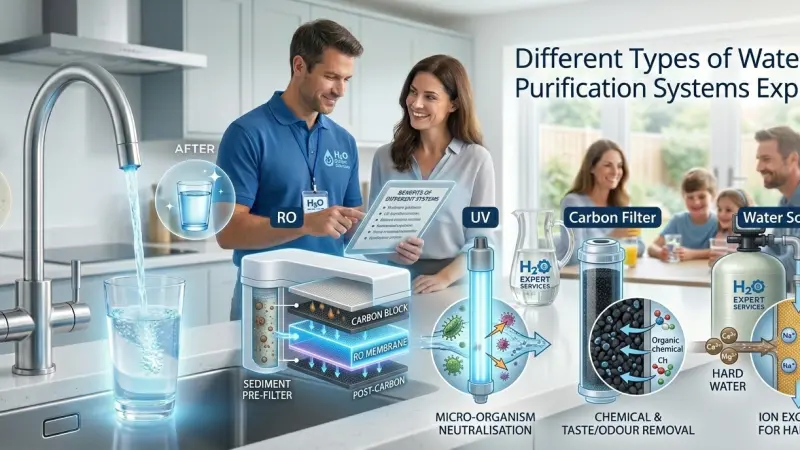
Have you ever paused to consider the complex journey your tap water undertakes before it reaches your glass? While the United Kingdom boasts some of the world's most stringent water quality standards, many homeowners still seek water purification systems to enhance the taste, remove specific mineral content, or ensure the absolute purity of their domestic supply. Whether you are dealing with the limescale challenges of "hard water" in the South East or simply wish to eliminate the faint scent of chlorine from your morning tea, understanding the various technologies available is the first step toward a healthier home environment.
An Overview of Modern Water Purification
The term "water purification" encompasses a broad spectrum of technologies designed to remove contaminants, ranging from visible sediment and microscopic bacteria to dissolved chemical compounds. In the British context, where municipal supplies are already treated to be potable, home systems are often referred to as "Point-of-Use" (POU) or "Point-of-Entry" (POE) solutions. These systems do not merely filter; they transform the chemical and physical profile of the water to meet specific household requirements.
1. Activated Carbon Filtration
Perhaps the most common type of domestic purification found in UK kitchens is the activated carbon filter. This technology relies on adsorption—a process where pollutant molecules are trapped inside the pore structure of a carbon substrate, typically derived from coconut shells or coal.
How it Works
Activated carbon is treated to have a massive surface area. A single gram of the material can have a surface area in excess of 500 square metres. As water passes through, organic compounds, VOCs (Volatile Organic Compounds), and chlorine adhere to the carbon surfaces. This significantly improves the organoleptic properties of the water—namely, its taste and smell.
- Carbon Block Filters: Compressed carbon that provides superior filtration for finer particles.
- Granular Activated Carbon (GAC): Loose granules that allow for higher flow rates but may be less effective at trapping very fine contaminants.
2. Reverse Osmosis (RO) Systems
For those seeking the highest possible level of purity, Reverse Osmosis is often the preferred choice. Originally developed for industrial applications and desalination, RO systems have been miniaturised for domestic use, typically fitting neatly under a kitchen sink.
The process involves forcing water through a semi-permeable membrane at high pressure. This membrane has pores so small that only water molecules can pass through, effectively stripping away up to 99% of dissolved solids, including nitrates, fluoride, lead, and even some viruses.
In the UK, RO is particularly popular in areas where high levels of dissolved minerals are present, providing "bottled-water quality" directly from the tap.
3. Ion Exchange and Water Softeners
While often categorised separately, ion exchange is a vital form of purification, specifically targeting the "hardness" minerals: calcium and magnesium. In large swathes of England, particularly the South and East, hard water is a significant nuisance, causing scale build-up in kettles, boilers, and showerheads.
The Ion Exchange Process
A water softener contains resin beads charged with sodium ions. As hard water passes through the tank, the calcium and magnesium ions "stick" to the beads, displacing the sodium ions into the water. The result is "soft" water that does not form scale and interacts more effectively with soaps and detergents. While this doesn't remove chemicals like chlorine, it is essential for protecting the longevity of British plumbing systems.
4. Ultrafiltration (UF)
Ultrafiltration sits between conventional carbon filtration and Reverse Osmosis in terms of pore size. It uses a hollow fibre membrane to mechanically filter out very small particles. One of the primary advantages of UF is that it can operate at standard UK mains pressure without requiring a pump or a storage tank. It effectively removes bacteria and protozoa while retaining healthy minerals that RO might otherwise strip away.
5. Ultraviolet (UV) Purification
UV purification is unique because it does not use a physical barrier or chemicals. Instead, it uses short-wavelength ultraviolet light to attack the DNA of microorganisms. This "disinfection" process renders bacteria, viruses, and cysts harmless by preventing them from reproducing.
In the UK, UV systems are most commonly installed in rural properties that rely on private water supplies, such as boreholes or springs. Because these supplies are not treated by a water utility company, a UV lamp provides a critical safety barrier against biological contamination without altering the water's taste.
6. Distillation
Distillation is one of the oldest methods of purification. It mimics the natural hydrologic cycle: water is boiled into steam, leaving contaminants behind, and then condensed back into liquid in a clean container.
While highly effective at removing heavy metals and minerals, it is a slow process and consumes a significant amount of electricity, making it less common for whole-house applications in the UK.
Key Factors When Choosing a System in the UK
Selecting the right purification method depends heavily on your local water profile and your specific goals. Here are several considerations:
- Water Hardness: Check your local water provider’s report. If you have "very hard" water, a softener should be your priority.
- Usage Volume: A jug filter may suffice for a single person, but a large family might require an under-sink RO system or a whole-house carbon filter.
- Maintenance: All systems require filter changes. Carbon filters usually need replacing every 6 months, whereas RO membranes can last 2 years.
- Wras Approval: Ensure the system is compliant with UK water regulations to prevent backflow or contamination of the mains supply.
Advanced Filtration: Multi-Stage Systems
Most modern premium products are actually multi-stage systems. For instance, a high-end UK under-sink unit might include a 5-micron sediment pre-filter, followed by a carbon block, an RO membrane, and finally a "polishing" filter to ensure a crisp taste. This layered approach ensures that the more expensive components (like the RO membrane) are protected from clogging by larger particles, extending the system's lifespan.
Environmental Impact of Home Purification
Switching to a home purification system significantly reduces a household's reliance on single-use plastic bottles. In the UK, millions of plastic bottles end up in landfills or the ocean every year. By purifying tap water, consumers can enjoy the convenience and safety of bottled water without the environmental footprint. Furthermore, modern RO systems have become much more water-efficient, with some models offering a 1:1 "waste-to-pure" ratio, a vast improvement over older industrial models.
Final Thoughts on Choosing the Right Solution
Investing in a water purification system is a decision that affects your health, your appliances, and your daily comfort. By identifying the specific issues with your local supply—whether it be hardness, chemical taste, or sediment—you can choose a targeted solution that provides the best value. In the modern age, having access to pristine water is no longer a luxury but a standard for the conscientious home.
For those looking to find reliable providers or installers of these systems, navigating the vast landscape of UK trade services is essential. Utilizing a business listing uk can help you locate reputable local engineers who specialise in water treatment. For businesses in the sector looking to reach more homeowners, securing a online business directory uk free listing on Local Page UK is an excellent way to improve online visibility and connect with customers searching for quality water purification solutions across the country.
Common FAQs
Does my UK tap water really need purifying?
Legally, UK tap water is safe to drink. However, "safe" and "palatable" are different. Many people purify their water to remove the taste of chlorine used in treatment, to prevent limescale, or as an extra precaution against lead pipes in older properties.
Will a water filter remove fluoride?
Standard carbon filters do not remove fluoride. If you wish to reduce fluoride levels, you will typically need a Reverse Osmosis system or a filter specifically containing activated alumina.
Is soft water safe to drink?
Softened water contains a slightly higher level of sodium. For most people, this is negligible. However, for those on a strictly low-sodium diet or for preparing baby formula, it is recommended to have at least one un-softened tap (usually the kitchen sink) for drinking.
How much does a water purification system cost in the UK?
Costs vary widely. A basic jug filter starts at £15, while a professional under-sink RO system might cost between £200 and £500. Whole-house systems and softeners can range from £600 to over £1,500 including installation.
Can I install these systems myself?
Many under-sink systems are designed for DIY installation with "push-fit" connectors. However, whole-house systems that require cutting into the
main rising pipe should generally be installed by a qualified plumber to ensure compliance with water bylaws.
Do filters remove healthy minerals?
Reverse Osmosis and distillation remove almost all minerals. Some people prefer this "clean slate," while others choose "re-mineralising" filters that add small amounts of calcium and magnesium back into the water after purification.
Disclaimer: The information provided in this article is for general informational and research purposes only. Company details, features, services, and market positions may change over time. Readers are advised to visit official company websites and conduct independent research before making any business decisions or purchasing services.
Most Searchable Keywords
Recent Blogs


Related Listings

Categories
- Accountants (295)
- Advertising Agencies (559)
- Architects (149)
- Automobiles (377)
- Beauty (300)
- Carpenters (146)
- Cleaning Services (387)
- Dentists (189)
- Driving (62)
- Education (1)
- Electricians (215)
- Energy (8)
- Event Organiser (687)
- Finance (602)
- Guide (3482)
- Health (2207)
- Information technology (206)
- Legal Services (361)
- Logistics (6)
- Maintenance (65)
Sponsored Listings in Plumbers
Related Blogs

Ghost Brokers Fake Car Insurance Scam Explain...
Read this insightful article "Ghost Brokers Fake Car Insurance Scam Explained" to expand your knowledge!

UK Baby Names Fastest Rising and Falling Name...
Read this insightful article "UK Baby Names Fastest Rising and Falling Names" to expand your knowledge!

How to Claim for Pothole Damage From Your Cou...
Read this insightful article "How to Claim for Pothole Damage From Your Council" to expand your knowledge!
Questions & Answers – Find What
You Need, Instantly!
How can I update my business listing?
Is it free to manage my business listing?
How long does it take for my updates to reflect?
Why is it important to keep my listing updated?
