
What Is the Timms Review and Could It Change Your PIP Next Year
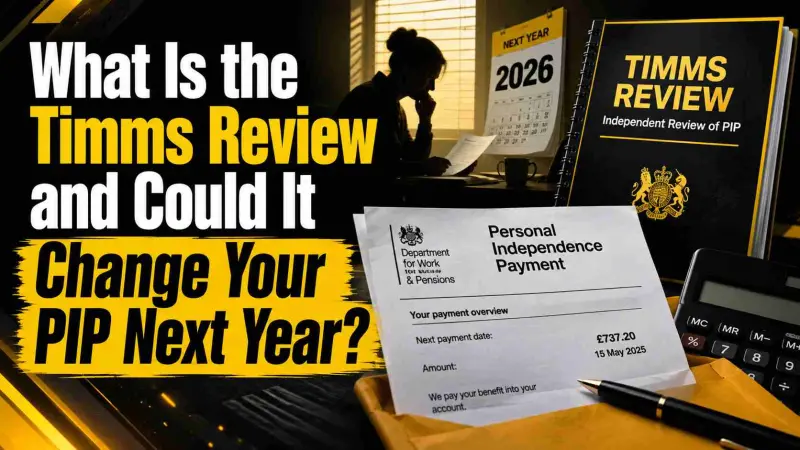
If you receive Personal Independence Payment (PIP), you may have heard the phrase “Timms Review” repeatedly in recent discussions about disability benefits. The name refers to a major government-led review of how PIP is assessed and whether the system remains fair and suitable for the future.
The review matters because PIP has been at the centre of significant proposed welfare changes. A controversial proposal would have required people to score at least four points in one daily living activity to qualify for the daily living component. However, that proposal was removed from the legislation in July 2025. The resulting Universal Credit Act 2025 does not introduce the four-point PIP rule.
That does not mean PIP will necessarily stay unchanged.
The Timms Review is examining the assessment system itself, including how activities and descriptors work and whether they properly reflect the reality of disability and long-term health conditions. Its interim report, published in July 2026, said PIP is widely valued but that the current system is not working as intended. The review is expected to make recommendations to the Secretary of State in autumn 2026.
So, could the Timms Review change your PIP next year?
Yes, it could lead to changes from 2027 onwards, but no final future PIP entitlement rules have yet been announced as a result of the Review. A review is not itself a change to the law. Any significant new eligibility rules or assessment criteria would need to be developed and implemented through the appropriate government and parliamentary processes.
Here is what the Review actually means, what has already changed, what could happen next and what current PIP claimants should do.
What the Timms Review Means for PIP and What Could Happen Next
What exactly is the Timms Review?
The Timms Review is the government's comprehensive review of Personal Independence Payment and its assessment system.
It is named after Sir Stephen Timms, the Minister for Social Security and Disability, who is one of the Review's co-chairs. The other co-chairs are Sharon Brennan and Dr Clenton Farquharson CBE. The Review is being carried out with disabled people, Disabled People's Organisations, carers, clinicians, experts, MPs and other stakeholders.
The government says the purpose is to ensure PIP is fair and fit for the future and continues to support disabled people with the additional costs associated with disability or long-term health conditions.
This is significant because PIP has been operating since 2013, and the Timms Review is the first comprehensive examination of the benefit since its introduction.
The Review is not simply looking at whether people should receive more or less money.
It is examining the wider assessment system, including whether the current way of measuring functional difficulties accurately reflects people's lives.
Why was the Timms Review launched?
The Review followed intense debate over proposed PIP reforms in 2025.
The original proposal would have introduced an additional eligibility condition requiring a claimant to score at least four points in at least one daily living activity to qualify for the daily living component.
That proposal generated substantial concern among disabled people, charities, MPs and campaign groups.
The government subsequently removed the PIP eligibility clause from the Bill. Parliament's House of Commons Library recorded that the government decided in July 2025 to remove the PIP provisions and instead examine possible changes through a comprehensive review of the PIP assessment.
That distinction is extremely important.
The four-point rule should not be described today as an automatic PIP rule coming into force in November 2026.
It was a proposal.
It was removed from the legislation.
The subsequent Universal Credit Act 2025 became law without that PIP eligibility provision.
The Timms Review is therefore the process that could eventually result in new PIP reforms.
What has the Timms Review found so far?
The Review published its interim report in July 2026.
The report was based on evidence gathered from disabled people, organisations and other participants. More than 38,000 responses were received through the Call for Evidence.
The Review's interim findings were critical of the current system.
The steering group said that while PIP is widely valued, the current system is not working properly for either disabled people or the government. It highlighted concerns about the design and delivery of PIP and the experience people have when going through assessment.
This does not mean that everyone receiving PIP will lose their benefit.
In fact, the Review's purpose is broader than simply reducing eligibility.
The eventual recommendations could involve changes to how assessments are conducted, how evidence is considered, how descriptors are written, how fluctuating conditions are treated and how the system responds to different types of disability.
Could the Timms Review change PIP in 2027?
Potentially, yes — but it is too early to say exactly how.
The Review is due to report its recommendations to the Secretary of State in autumn 2026. The government's official Timms Review collection confirms that the Review aims to report in autumn 2026 and that its outcomes will be reported to Parliament.
That creates an important timeline:
| Stage | Position |
|---|---|
| 2025 | Major PIP reform proposals announced |
| July 2025 | Proposed four-point PIP eligibility clause removed |
| 2025 | Timms Review established |
| March–May 2026 | Review gathered evidence |
| July 2026 | Interim report published |
| Autumn 2026 | Final recommendations expected |
| 2027 | Potential period for future reforms, depending on government decisions and legislation |
The word “potential” matters.
The Review can recommend changes, but recommendations do not automatically become law.
The government would have to decide what to accept, reject or modify. Depending on the nature of any proposed changes, further consultation, legislation, regulations or parliamentary approval could be required.
Is the four-point PIP rule coming in November 2026?
Not as the rule originally proposed in 2025.
This is one of the biggest points of confusion surrounding PIP.
The original proposal was that a claimant would need to score at least four points in one daily living activity to qualify for the daily living component.
The government initially intended the measure for November 2026, but the PIP clause was subsequently removed from the Bill. The Bill was renamed the Universal Credit Bill and became the Universal Credit Act 2025.
Therefore, it would be misleading to tell current readers:
“The four-point rule is definitely starting in November 2026.”
That is not the current legal position.
The important question now is what recommendations the Timms Review makes about PIP eligibility and assessment.
A future government decision could potentially revive a version of an additional threshold or introduce an entirely different approach, but that would be a new policy development rather than the original four-point rule simply taking effect automatically.
What does PIP currently assess?
PIP is based on how a person's health condition or disability affects their ability to perform specified activities, rather than simply on the diagnosis itself.
The assessment covers two broad areas:
- Daily living
- Mobility
The daily living component looks at activities such as preparing food, eating and drinking, managing medication or treatment, washing and bathing, managing toilet needs, dressing, communicating, reading, mixing with other people and making budgeting decisions.
The mobility component considers planning and following journeys and moving around.
Points are awarded according to the relevant descriptors.
Under the existing system, the total score determines whether someone qualifies for the standard or enhanced rate of the relevant component.
For example, someone might have significant difficulty preparing food but relatively little difficulty with other daily living activities. Another claimant may have moderate difficulties across several activities.
This is one reason why the wording of descriptors matters so much.
A change to a descriptor can affect people even when their underlying medical condition has not changed.
Why are PIP descriptors so important?
Descriptors translate a person's real-world difficulties into assessment points.
Suppose two people have the same diagnosis.
One may be able to prepare food independently but needs frequent prompting to manage medication. Another may be unable to prepare a meal safely without assistance.
Their diagnoses could be identical, but their PIP assessments may look very different.
This is why the Timms Review is examining the assessment framework rather than simply asking which medical conditions qualify.
A future reform could potentially change:
- The activities considered.
- The descriptors within those activities.
- The number of points attached to descriptors.
- How evidence is considered.
- How fluctuating conditions are assessed.
- How assessors interact with claimants.
- How assessments are conducted.
- How decisions are explained.
- How reviews and reassessments operate.
At this stage, however, readers should not assume that any particular reform has already been agreed.
Could the Review make PIP harder to claim?
It is possible that future recommendations could tighten some eligibility rules, but it would be premature to say that the Timms Review will definitely make PIP harder to receive.
The Review has a much broader remit.
The government says it wants a PIP system that is fair and fit for the future. The interim findings also highlight problems with the current system that could lead to improvements rather than simply tighter eligibility.
Potential changes could therefore move in different directions.
For example, a future system could potentially introduce clearer assessment rules while improving how fluctuating conditions are handled. It could alter descriptors while improving evidence requirements. It could change review procedures while attempting to reduce unnecessary reassessments.
The final recommendations will determine which direction the government chooses.
Could existing PIP claimants be affected?
This is one of the most important questions.
Being an existing PIP claimant does not mean that your award automatically changes because the Timms Review exists.
There is no automatic “Timms Review reassessment”.
Your existing PIP award continues according to the rules that apply to your claim unless the Department for Work and Pensions takes action under the existing system or future reforms are lawfully introduced.
The government has previously stated that people would not lose PIP simply because of the proposed reforms without being reassessed. However, the precise treatment of existing claimants under any future changes would depend on the legislation and transitional arrangements ultimately adopted.
This means you should be cautious about social media posts claiming that everyone currently receiving PIP must reapply because of the Timms Review.
That is not how the Review works.
What happens if your PIP award is due for review?
A scheduled PIP review is different from the Timms Review.
The Timms Review is a government policy review of the PIP assessment system.
A PIP award review is the process used to check an individual's entitlement.
If your award is due for review, the DWP can ask you for updated information about how your condition affects you.
Your task is to describe your current difficulties accurately.
Do not focus only on the name of your condition.
Instead, explain:
- What you cannot do.
- What you can do only with help.
- What takes substantially longer.
- What causes pain, fatigue, distress or risk.
- How often the problem happens.
- Whether your difficulties fluctuate.
- What assistance another person provides.
- What happens when you attempt the activity.
- What happens on better and worse days.
Evidence can help demonstrate your difficulties, but PIP is not simply a medical-document test.
The practical impact of your condition remains central.
How should you prepare if you are worried about future PIP changes?
You do not need to panic or change your claim simply because the Timms Review is underway.
A better approach is to keep your information organised.
1. Understand your current award
Check your latest PIP decision letter.
Know:
- Which components you receive.
- Whether they are standard or enhanced.
- When your award is due to end.
- Whether your award is subject to review.
This gives you a clear starting point.
2. Keep a record of real-life difficulties
A short diary can be useful if your condition fluctuates.
You might record:
Monday: Needed help getting dressed because of severe stiffness.
Wednesday: Could prepare food but needed someone nearby because of safety concerns.
Friday: Could not complete the task without assistance.
The purpose is not to manufacture evidence.
It is to help you remember what happens over time.
3. Collect relevant evidence
Depending on your circumstances, useful evidence may include information from:
- Doctors.
- Consultants.
- Occupational therapists.
- Physiotherapists.
- Mental health professionals.
- Social workers.
- Support workers.
- Carers.
- Family members.
The evidence should help explain how your condition affects your everyday functioning.
4. Do not assume a diagnosis guarantees points
PIP is based on functional impact.
A diagnosis can provide important context, but the assessment is concerned with how your condition affects specific activities.
5. Do not assume a previous score guarantees a future score
Your circumstances can change.
A condition may become better, worse or more unpredictable.
If your award is reviewed, describe your current situation honestly rather than trying to reproduce your previous answers.
What could change after the final Timms Review?
The Review's final recommendations could potentially affect several parts of the PIP system.
One possibility is changes to the assessment activities and descriptors.
Another could involve the way evidence is gathered and assessed.
There could also be changes to the experience of assessment itself.
The Review has already identified assessment as a major area of concern. Its interim findings described the process as stressful and highlighted concerns about the way people experience the system.
That could create pressure for reforms involving:
- Better assessment practices.
- More appropriate use of evidence.
- Improved treatment of fluctuating conditions.
- Greater consistency between assessments.
- Better explanations for decisions.
- Changes to review procedures.
- Improved accessibility.
- Better recognition of lived experience.
These are possibilities, not confirmed 2027 rules.
Why fluctuating conditions could be important
One of the difficult parts of disability assessment is that some conditions do not behave consistently.
A person might manage an activity on one day and be unable to do it safely on another.
That can create a problem if an assessment focuses too heavily on a snapshot.
The Timms Review has specifically identified fluctuating conditions as an area for further evidence gathering. The July 2026 update said the planned representative survey would examine fluctuating conditions alongside independent living, take-up and other issues.
This could be particularly relevant for people whose abilities vary substantially from day to day.
What does the Review mean for mental health conditions?
The Timms Review is not restricted to physical disabilities.
PIP is concerned with functional limitations resulting from physical or mental health conditions.
The key issue is how the condition affects the activities included in the assessment.
For example, a mental health condition may affect someone's ability to engage with other people, make journeys, manage treatment or carry out other daily activities.
A diagnosis alone does not determine an award.
The important question is what practical difficulties arise and how those difficulties meet the assessment criteria.
Future changes to descriptors could therefore affect people with mental health conditions, but it is too early to predict exactly how.
What about mobility PIP?
The proposed four-point rule was specifically about the daily living component, not the mobility component.
The original government proposal stated that the new requirement would not affect the mobility component.
However, because the Timms Review is examining the wider assessment system, future recommendations could potentially address broader parts of PIP.
That does not mean a change to mobility eligibility has been announced.
As of August 2026, readers should distinguish between:
Existing rules: the rules currently governing PIP.
Past proposals: ideas previously put forward but withdrawn or changed.
Timms recommendations: proposals expected later in 2026.
Future law: rules that may eventually be introduced after government decisions and the necessary legal process.
Keeping those four categories separate prevents a great deal of confusion.
Could PIP rates change because of the Timms Review?
The Timms Review is primarily concerned with the PIP assessment and wider functioning of the system.
That is different from the annual process of setting benefit rates.
Current PIP rates are published separately by the government. PIP is tax-free and is not means-tested, meaning income and savings do not determine the amount.
A future government could make changes to rates through separate policy decisions, but readers should not assume that the Timms Review itself automatically changes the weekly amount.
What does “fit for the future” actually mean?
The phrase matters because disability and the workplace have changed considerably since PIP was introduced.
The government has said the Review is considering whether PIP reflects changes in disability, health, society and employment.
The goal is therefore not simply to adjust a points table.
It is to consider whether the system still does what it was designed to do.
That includes an important balance.
PIP needs to provide meaningful help with additional disability-related costs while also having assessment rules that are understandable, consistent and sustainable.
The interim report suggests that the current system has problems on both sides of that equation.
What should you watch between now and 2027?
The most useful developments to follow are:
- The final Timms Review recommendations.
- The government's response to those recommendations.
- Any consultation on proposed PIP changes.
- New legislation or regulations.
- Official DWP guidance explaining implementation.
- Any transitional protections for existing claimants.
- Changes to PIP assessment descriptors or activities.
The official Timms Review collection on GOV.UK is the most reliable place to check new publications.
Avoid relying on headlines that say a rule is “definitely coming” unless the information is supported by an official announcement or legislation.
What is the most realistic outlook for PIP in 2027?
The safest prediction is that PIP is likely to remain under active reform discussion in 2027, but the exact form of change cannot yet be known.
The interim report is a strong indication that the government wants changes.
It describes substantial problems with the current system and says the steering group intends to be ambitious in developing recommendations.
But there is a major difference between recommending reform and implementing reform.
A likely sequence is:
Interim findings → final recommendations → government response → consultation and/or policy development → legislation or regulations where required → implementation.
That process can take time.
So if you are currently receiving PIP, there is no reason to assume that your payment will suddenly stop when 2027 begins.
A simple example of what future reform could mean
Imagine someone currently receives the standard daily living component because they score points across several
activities but does not have a particularly high score in any single activity.
Under the old proposed four-point rule, that person could have been at risk of losing the daily living component.
But that rule was removed from the legislation.
Now imagine the Timms Review recommends a different approach — perhaps changing descriptors, evidence rules or how multiple moderate difficulties are considered.
The person's future position could therefore be completely different from what the original four-point proposal suggested.
This example illustrates why it is too early to calculate someone's future PIP entitlement from headlines about the Review.
The final rules matter.
What should you do if your PIP is essential to your household budget?
If PIP contributes significantly to your household finances, it is sensible to understand your award and keep your records up to date.
But avoid making major financial decisions based on an unconfirmed future rule.
Instead:
- Check your current award period.
- Understand when a review may occur.
- Keep relevant evidence organised.
- Record significant changes in your daily difficulties.
- Read official DWP communications carefully.
- Seek specialist benefits advice if you receive a formal decision you disagree with.
- Challenge a decision when appropriate rather than assuming the decision is final.
The Timms Review itself does not require current claimants to submit a new PIP application.
The key distinction: Review versus reassessment
This is perhaps the simplest way to understand the whole issue.
Timms Review: examines how the PIP system works and recommends possible reforms.
PIP award review: examines an individual's entitlement.
Reassessment: involves looking again at an individual's circumstances and functional needs.
New PIP claim: is an application from someone seeking PIP.
These are four different things.
A person can have a PIP award review without the Timms Review having any direct involvement in their individual case.
What happens after the final report?
The final report is expected in autumn 2026.
After that, the government will need to consider the recommendations.
Some changes might require relatively straightforward administrative implementation.
More significant changes to eligibility could require legislation.
That means 2027 may become the year when people begin to see the practical consequences of decisions made after the Review, but the timing cannot yet be guaranteed.
The government's July 2026 update confirms that further evidence gathering and engagement is still taking place, including a representative survey and workshops designed to test and refine emerging recommendations.
In other words, the Review is not finished yet.
Future Outlook: What Could PIP Look Like After 2026?
The biggest development to watch is the final Timms Review report.
The steering group has already indicated that it wants to make bold recommendations, and its work is examining issues that go far beyond the abandoned four-point proposal.
Possible future areas include:
- A redesigned assessment framework.
- New or amended descriptors.
- Different treatment of fluctuating conditions.
- Changes in how evidence is used.
- Improved assessment experiences.
- Changes to award review procedures.
- Greater consistency between assessments.
- New approaches to eligibility.
However, these should be viewed as areas for potential reform rather than promises.
For claimants, the best preparation is not to guess what the future rules will be. It is to understand how the current system applies to your own circumstances and to follow official announcements as the Review moves into its final stage.
Key Insights
- The Timms Review is a major review of PIP assessment, not an automatic reassessment of everyone currently receiving PIP.
- The original four-point PIP rule was removed from the legislation in 2025, so it should not be presented as a confirmed November 2026 rule.
- The Review's interim report was published in July 2026 after more than 38,000 responses to its Call for Evidence.
- Final recommendations are expected in autumn 2026, after further evidence gathering and engagement.
- Changes could affect future PIP assessment rules, but the exact recommendations and implementation timetable are not yet known.
- PIP is assessed according to functional difficulties, rather than simply the diagnosis a person has.
- Current claimants should not assume their PIP will automatically stop or change in 2027.
- Official DWP and Parliament updates are more reliable than social-media claims about future PIP rules.
Frequently Asked Questions
1. What is the Timms Review of PIP?
The Timms Review is a government-led comprehensive review of Personal Independence Payment and its assessment system. It is examining whether PIP remains fair and fit for the future and is being conducted with disabled people, organisations, clinicians, experts and other stakeholders.
2. Could the Timms Review change my PIP in 2027?
It could lead to future changes, but nothing about your individual PIP award changes simply because the Review exists. Final recommendations are expected in autumn 2026, after which the government will decide whether and how to implement reforms.
3. Is the four-point PIP rule definitely coming in November 2026?
No. The proposed four-point eligibility requirement was removed from the Universal Credit and Personal Independence Payment Bill in 2025. The legislation that became the Universal Credit Act 2025 did not introduce that PIP rule.
4. Why was the four-point rule removed?
The government withdrew the PIP eligibility provisions during parliamentary consideration of the Bill. It subsequently moved towards a comprehensive review of the PIP assessment, led by Sir Stephen Timms, before considering future changes.
5. Will existing PIP claimants be reassessed because of the Timms Review?
No automatic Timms Review reassessment exists. Existing claimants continue under the applicable PIP system unless their individual circumstances trigger an existing review or future reforms introduce new arrangements through the proper legal process.
6. When will the final Timms Review report be published?
The Review is expected to present its recommendations to the Secretary of State for Work and Pensions in autumn 2026. The July 2026 interim update confirmed that further evidence gathering and engagement would continue before the final recommendations.
7. Does the Timms Review only affect people with physical disabilities?
No. PIP considers difficulties resulting from physical and mental health conditions. The important issue is how a condition affects the claimant's ability to carry out relevant daily living and mobility activities.
8. Could PIP descriptors change after the Timms Review?
Potentially. The Review is examining the assessment system, and future government decisions could result in changes to activities, descriptors or other assessment arrangements. However, no final set of new descriptors has been announced.
9. Will my PIP payment stop in 2027?
There is no general rule saying that PIP payments will automatically stop in 2027. Your award continues according to its existing terms unless a lawful decision changes your entitlement or future reforms introduce different arrangements.
10. Is PIP based on my medical diagnosis?
PIP is not awarded simply because someone has a particular diagnosis. The assessment considers the functional difficulties arising from a long-term health condition or disability and how those difficulties affect specified activities.
11. What should I do if my PIP review is due soon?
Complete the review based on your current circumstances. Explain what you can and cannot do, what help you need, how frequently difficulties occur and how your condition affects you in everyday situations. Relevant supporting evidence can also be useful.
12. Could fluctuating conditions be affected by the Review?
They could be an important area of future reform. The Review has specifically identified fluctuating conditions as an issue requiring further evidence and has included them in planned research and engagement.
13. Will the Timms Review change PIP rates?
Not automatically. The Review is primarily concerned with the assessment and operation of PIP. Benefit rates are handled through separate government processes, so readers should not assume that a Review recommendation automatically changes weekly payments.
14. Where can I check official Timms Review updates?
The GOV.UK Timms Review collection brings together the interim report, evidence-gathering information, Terms of Reference and co-chair updates. It is the best official starting point for checking developments.
15. What is the biggest PIP change to watch in 2027?
The biggest issue to watch is what happens after the final Timms Review recommendations. The government could propose changes to eligibility, descriptors, assessments or evidence requirements, but the exact outcome depends on the recommendations and subsequent government and parliamentary decisions.
Final Thoughts
The Timms Review could become one of the most significant developments in the history of PIP, but it is important to separate what has been proposed, what has been withdrawn and what may happen in the future.
The proposed four-point rule is the clearest example. It was widely discussed as a major November 2026 change, but the PIP clause was removed from the legislation in 2025. It is therefore inaccurate to tell current claimants that the original four-point rule is automatically coming into force.
What remains is a much broader review of the PIP assessment system.
The July 2026 interim report makes clear that the government and Review steering group believe the current system has serious problems. More than 38,000 responses have contributed to the evidence base, and further research and engagement are continuing.
For PIP claimants, the sensible approach is straightforward: do not panic, do not rely on
rumours and do not assume your award will automatically change in 2027.
Instead, understand your existing award, keep evidence of how your condition affects your everyday life and watch for the final Timms Review recommendations later in 2026.
Disclaimer: The information provided in this article is for general informational and research purposes only. Company details, features, services, and market positions may change over time. Readers are advised to visit official company websites and conduct independent research before making any business decisions or purchasing services.
Most Searchable Keywords
Recent Blogs


Related Listings
Categories
- Accountants (295)
- Advertising Agencies (559)
- Architects (149)
- Automobiles (377)
- Beauty (300)
- Carpenters (146)
- Cleaning Services (387)
- Dentists (189)
- Driving (62)
- Education (1)
- Electricians (215)
- Energy (8)
- Event Organiser (687)
- Finance (602)
- Guide (3394)
- Health (2207)
- Information technology (206)
- Legal Services (361)
- Logistics (6)
- Maintenance (65)
Sponsored Listings in Shopping



Related Blogs

High Income Child Benefit Charge: The Salary...
Read this insightful article "High Income Child Benefit Charge: The Salary Trap That Catches Parents" to expand your knowledge!
Carer’s Allowance £204 Earnings Limit Explain...
Read this insightful article "Carer’s Allowance £204 Earnings Limit Explained" to expand your knowledge!

Attendance Allowance: How to Claim Up to £114...
Read this insightful article "Attendance Allowance: How to Claim Up to £114.60 a Week" to expand your knowledge!
Questions & Answers – Find What
You Need, Instantly!
How can I update my business listing?
Is it free to manage my business listing?
How long does it take for my updates to reflect?
Why is it important to keep my listing updated?
