
5 Near-Perfect Hard Sci-Fi Shows on Netflix That Prioritize Scientific Rigor
 Previous

Science fiction has long served as a mirror to humanity’s deepest anxieties and wildest aspirations, but within its vast universe, hard sci-fi stands apart as a discipline that demands intellectual honesty. Unlike its softer counterparts, which lean on character drama and social commentary, hard science fiction anchors its narratives in plausible physics, biology, and technology — treating the laws of nature as characters in their own right. Netflix, despite being a treasure trove of genre content, has historically favored softer entries. Yet buried within its algorithm-driven depths are a handful of series that approach perfection by marrying rigorous scientific grounding with pulse-quickening storytelling. From time-warping German thrillers to mind-uploading animated cyberpunk, these five shows prove that the smartest sci-fi can also be the most thrilling.
‘3 Body Problem’ (2024–Present) — Ambitious Physics Meets Planetary Threat
David Benioff and D. B. Weiss, the showrunners behind Game of Thrones’ infamous final season, found themselves in dire need of a redemptive project. Enter 3 Body Problem, a sprawling adaptation of Liu Cixin’s celebrated Remembrance of Earth’s Past trilogy — a series that has been called the gold standard of 21st-century sci-fi literature. The show’s title refers to a classic physics conundrum involving the chaotic gravitational dance of three celestial bodies, but its narrative reaches far beyond the classroom. The story begins with a fateful decision made during China’s Cultural Revolution and spirals into a present-day conspiracy where a group of scientists, led by a detective, races to stop an existential threat from the stars.
What makes 3 Body Problem a standout in Netflix’s catalog is its unapologetic embrace of complex scientific concepts like quantum entanglement, nanofibers, and the titular n-body problem. Though the series inevitably introduces speculative elements as it progresses, its foundation rests on real, cutting-edge physics — a balance that is surprisingly rare in big-budget streaming productions. The cast, which includes Eiza González, Benedict Wong, and John Bradley, delivers performances that keep the intellectual weight from becoming ponderous. For fans craving a show that makes them feel smarter while keeping them on the edge of their seats, this is a near-perfect entry point.
‘Pantheon’ (2022–2023) — The Singularity, Animated and Unforgettable
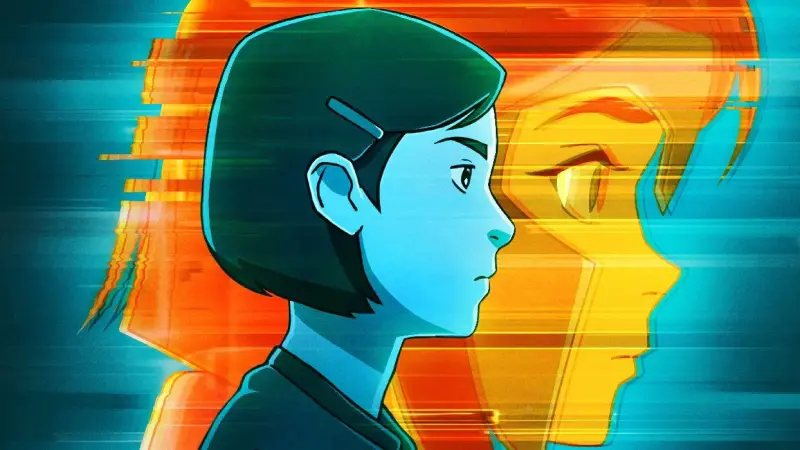
Adapted by Craig Silverstein from a series of short stories by Ken Liu, Pantheon is a cyberpunk thriller that tackles perhaps the most tantalizing concept in hard AI sci-fi: the technological singularity. The series follows Maddie, a teenage girl who receives cryptic messages from a phone number that appears to belong to her deceased father. As she digs deeper, she uncovers a vast conspiracy involving uploaded consciousness, corporate espionage, and the terrifying implications of minds existing beyond biology. Though originally produced for AMC+, the show was canceled after two seasons due to a tax write-down — a fate that makes its current availability on Netflix feel like a second chance for audiences to discover a hidden gem.
Pantheon stands as one of the most intellectually rigorous animated series of the 21st century. It doesn’t shy away from the philosophical and scientific debates surrounding consciousness, identity, and the ethics of digital immortality. While it takes creative leaps — as any good story must — it grounds its speculative technology in theoretical computer science and neuroscience. The animation style, sleek and moody, complements the cerebral tone, and the writing is tightly constructed, rewarding attentive viewers with layered revelations. For anyone fascinated by how close we might be to uploading our minds to the cloud, Pantheon offers a hauntingly plausible vision.
‘Scavengers Reign’ (2023) — Alien Ecology as a Character
It’s a cruel irony that Scavengers Reign, one of the most critically acclaimed animated sci-fi series in recent memory, was unceremoniously canceled after a single season. Originally commissioned by Max, the show was picked up by Netflix after its cancellation, but the streamer declined to order additional episodes. Despite its brevity, Scavengers Reign has already cemented itself as a landmark in hard sci-fi animation. The premise is deceptively simple: the crew of a damaged deep-space freighter crash-lands on a lush, alien planet and must survive its hostile — yet strangely beautiful — ecosystem. What follows is not a typical space opera but a meticulously crafted study in speculative biology.
The show’s hard sci-fi credentials lie in its attention to ecological plausibility. Every creature, plant, and environmental hazard on the planet Vesta feels like it evolved through a natural, albeit alien, logic. The series avoids the easy trope of “magic alien tech” and instead asks viewers to consider how life might adapt under different evolutionary pressures. It’s a masterclass in world-building that rewards patience and observation. While the narrative is character-driven, the scientific rigor applied to the alien ecosystem elevates Scavengers Reign into the realm of near-perfection. Its one season is a must-watch for any fan of thoughtful, grounded science fiction.
‘Black Mirror’ (2011–Present) — Anthology of Hard Sci-Fi Hits
Charlie Brooker’s Black Mirror has become synonymous with dystopian tech fables, but calling it a pure hard sci-fi show would be inaccurate — it’s a chameleon that shifts between soft and hard science fiction depending on the episode. What makes the series essential for hard sci-fi enthusiasts is its willingness to explore near-future technologies with unsettling realism. Episodes like “San Junipero” and “USS Callister” offer speculative technologies — digital consciousness and advanced virtual reality — that feel like logical extensions of today’s research. The anthology format allows Brooker to experiment with tone, but when the show commits to scientific plausibility, it produces some of the most riveting “what if” stories on television.
Since its move from Channel 4 to Netflix, Black Mirror has expanded its scope and budget, attracting A-list talent and delivering episodes that resonate with contemporary anxieties about AI, social media, and surveillance. While not every episode qualifies as hard sci-fi — some lean into psychological horror or satire — the series’ ability to ground its speculative tech in real-world science ensures that fans of rigorous storytelling will find plenty to admire. It remains a cultural touchstone, and its best episodes serve as a masterclass in how hard sci-fi can be both intellectually demanding and wildly entertaining.
‘Dark’ (2017–2020) — Time Travel as a Rigorous Science
When Dark premiered on Netflix, it was often compared to Stranger Things for its small-town mystery and supernatural undertones. But comparisons quickly fell apart as viewers realized this German thriller was operating on an entirely different intellectual plane. Created by Baran bo Odar and Jantje Friese, Dark is a time-travel saga that treats its central mechanic not as a convenient plot device but as a self-contained, logically consistent system. The show’s intricate timeline, spanning multiple generations and parallel realities, demands careful attention — and perhaps even a notebook — but rewards viewers with a deeply satisfying narrative that never cheats its own rules.
Debates among fans persist about whether Dark qualifies as hard sci-fi, given its philosophical and emotional weight. Yet the series consistently frames its time travel in the language of theoretical physics: Einstein’s relativity, wormholes, and the bootstrap paradox are woven into the fabric of the story. It treats causality with ruthless logic; every action has an inescapable consequence. This cold, deterministic approach, combined with the show’s atmospheric dread and rich character arcs, makes Dark a unique hybrid that pushes the boundaries of what hard sci-fi can achieve. For those willing to invest the mental energy, it is arguably the finest sci-fi series Netflix has ever produced — one that leaves fans marveling at how far a small, German production could push the genre.
The Future of Hard Sci-Fi on Netflix
As streaming platforms continue to chase mass appeal, the niche of hard science fiction remains a vital counterbalance — a reminder that speculative storytelling can be both thrilling and intellectually rigorous. Netflix’s catalog, while not overflowing with such gems, still offers a curated selection that proves the genre is far from extinct. Whether it’s the cosmic anxieties of 3 Body Problem, the existential dread of Pantheon, or the ecological wonder of Scavengers Reign, these shows demonstrate that when science and storytelling align, the result is something truly near-perfect. The challenge for Netflix now is to recognize that audiences hungry for substance are willing to invest time in complexity — and to greenlight more series that treat the laws of physics not as obstacles, but as partners in creation.
Disclaimer - All celebrity-related content, information, and images on this website are based on publicly available online sources and AI-generated insights/data. Information such as biography, age, career, personal details, and images may change without notice over time. While we strive for accuracy, we do not guarantee the accuracy, completeness, reliability, or timeliness of any information or imagery displayed on this website. This content is provided for general informational purposes only.
Top Trending News of Netflix
 👁️ 557 views
🔥 ‘Main Vaapas Aaunga’ OTT Home Revealed: Diljit Dosanjh, Vedang Raina & Sharvari’s Partition Love Story Heads to Netflix After Theatrical Run
Imtiaz Ali's Main Vaapas Aaunga starring Diljit Dosanjh, Vedang Raina, and Sharvari heads to Netflix after June 12 theatrical release. Get OTT details, Ektaa Kapoor's review, and why this Partition love story is Bollywood's most anticipated film of 2026.
 👁️ 373 views
🔥 ‘Passenger’ (2026) Horror Movie: Streaming Release Date, Theatrical Run, and Where to Watch the Supernatural Thriller
Is the 2026 horror movie 'Passenger' streaming on Netflix or Amazon Prime? Directed by André Øvredal, this supernatural thriller stars Jacob Scipio and Lou Llobell. Find out where to watch, digital release date, and Paramount+ streaming plans.









Details
Send Us an Enquiry
We'll get back to you as soon as possible.
Thank You!
Your enquiry has been submitted. We'll be in touch shortly.