
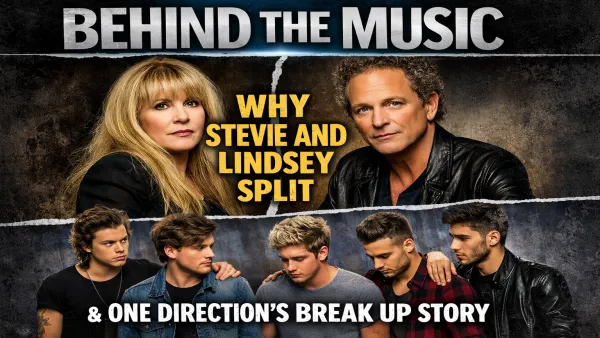
Behind The Music: Why Stevie And Lindsey Split & One Direction's Break Up Story
 Previous

There is a specific kind of ache that comes with the end of an era, particularly when that era is scored by the soundtrack of your life. If you have scrolled through your streaming queue lately, you might have noticed a pervasive, almost ghostly trend: we are obsessed with the "what could have been." From the massive resurgence of classic rock documentaries to the never-ending cycle of boy band reunion rumors, the current entertainment news cycle is fueled by nostalgia and the lingering heartbreak of iconic splits. It seems that everywhere we look—whether it’s a viral series dissecting the secrets of the seventies or a new Netflix release chronicling the rise and fall of pop giants—we are trying to solve the same puzzle: how can something that creates so much joy end in so much pain?
To understand this cultural moment, we have to look at two of the most devastating breakups in music history, separated by decades but united by the sheer magnitude of their fallout. We are talking, of course, about the seismic fracture between Stevie Nicks and Lindsey Buckingham of Fleetwood Mac, and the earth-shattering hiatus of One Direction. On the surface, these two stories seem incomparable. One is a rock and roll soap opera born in the haze of the 1970s California counterculture, and the other is a pop phenomenon manufactured in the sleek, high-pressure environment of 21st-century television. Yet, both represent the crushing weight of fame, the tragedy of timing, and the realization that sometimes, the only way to save the music is to stop the melody. As we dissect these splits, we find that the reasons are rarely simple; they are tangled webs of love, ego, exhaustion, and the suffocating expectations of millions of strangers.
The California Dreaming: Stevie and Lindsey
To understand why Stevie Nicks and Lindsey Buckingham split, you have to go back to the beginning, before the gold records and the sold-out stadiums. You have to picture two struggling artists in San Francisco, living in a humble house, eating macaroni and cheese because it was all they could afford, and dreaming of a future that seemed just out of reach. They were partners in every sense of the word—a romantic duo and a creative unit forging a sound that was distinctively theirs. But when they joined Fleetwood Mac in 1975, that delicate balance was thrown into a hurricane. The band didn’t just find success; they were swallowed by it. The transition from scraping by to navigating the stratosphere of rock stardom is a pressure cooker that few relationships can survive, and for Stevie and Lindsey, the heat was simply too high.
The creation of the Rumours album is the stuff of legend, a piece of entertainment news that has been retold so many times it feels like myth, but the pain behind it was undeniably real. Imagine having to go into a studio every day with the person you love most in the world, who has just shattered your heart, and being asked to harmonize with them. That was the reality for the couple. While Stevie was finding her independence and navigating new relationships, Lindsey was grappling with feelings of betrayal and abandonment. The songs they wrote during this period weren't just tracks; they were weapons. "Go Your Own Way" was Lindsey’s angry, jagged letter to Stevie, a desperate attempt to regain control. Stevie responded with "Dreams," a soft, haunting prophecy that reassured him that when the rain washes you clean, you'll know. The brilliance of Rumours is inextricably linked to their breakup. They poured their raw, bleeding hearts into the grooves of that record, creating a masterpiece that the whole world sang along to, even as the creators were falling apart.
But the split wasn't just about romance; it was about professional trajectory. As the years went on, the dynamic shifted. Stevie Nicks became a supernova—a global icon whose influence rippled through fashion and music culture. Lindsey Buckingham was the perfectionist architect, the musical genius who wanted to push the band into experimental, complex territories. Their visions, once aligned, began to diverge like tectonic plates shifting in opposite directions. There were power struggles, disagreements over direction, and the lingering residue of a romantic wound that never fully healed. When Lindsey Buckingham was fired from the band in 2018—an event that shook the rock world and sparked a massive streaming buzz as fans revisited the discography—it was the final, full stop on a sentence that had been written in fragments over forty years. It was the end of a conversation that started with love and ended with a lawsuit.
The Pop Machine: One Direction’s Unraveling
Fast forward to 2010, and the backdrop changes from sun-drenched California to the stark, bright lights of The X Factor stage. One Direction was never built on the premise of deep, romantic entanglements between members; they were a construct, a brilliant piece of pop engineering assembled by Simon Cowell. Yet, the bond they formed was no less intense. In many ways, the pressure on Harry, Liam, Louis, Niall, and Zayn was even more suffocating than what Fleetwood Mac faced. In the social media age, their lives were not just documented; they were dissected in real-time. There was nowhere to hide. The "trend" of constant surveillance created a pressure cooker that inevitably led to an explosion.
The narrative of One Direction’s breakup is often told through the lens of Zayn Malik’s departure in March 2015. It was the moment the spell broke. To use a striking metaphor, One Direction was like a high-speed train held together by sheer momentum. When one car (Zayn) detached because the strain was too much to bear, the physics of the rest of the journey changed forever. Zayn left citing a desire to live a "normal" life—a phrase that feels almost ironic given his solo career, but undoubtedly sincere in the moment. He was the first to jump ship, and his exit left a vacuum of anxiety among the remaining members and the fanbase. If the "cool, mysterious one" couldn't handle it, what hope did the rest have?
However, the seeds of the split were sown long before Zayn walked away. You could hear it in the music. The transition from the bubblegum euphoria of "What Makes You Beautiful" to the folk-rock introspection of Four and Made in the A.M. signaled a shift. The boys were growing up, and they were growing tired of the machine. They were writing their own songs, pushing for a sound that was grittier and more authentic, much like Lindsey Buckingham pushing for Tusk. They were overwhelmed by a schedule that would have broken seasoned veterans, let alone five young men in their early twenties. The narrative of the "hiatus"—that dreaded word that fans have come to despise—was a polite fiction. It was a band-aid over a deep wound. They didn't stop because they stopped liking each other; they stopped because they were exhausted. They stopped because they had achieved a level of fame that was unsustainable for human beings.
The Common Thread: Art vs. Artist
When we look at both Fleetwood Mac and One Direction through the lens of current trends, particularly the fascination with music documentaries and biopics, we see a common theme: the sacrifice of the self for the art. In recent years, we’ve seen a surge in this type of content on streaming platforms. Whether it’s a viral series breaking down the lyrics of a heartbreaking album or a new Netflix release that offers a behind-the-scenes look at a tour, audiences are hungry for the truth behind the gloss. We want to know that our favorite idols hurt just like we do. It makes the music feel more real.
For Stevie and Lindsey, the split allowed them to become the legends they are today. Stevie became the queen of rock, her solo career eclipsing even the massive success of the band. Lindsey became a revered producer and solo artist, respected for his technical brilliance. They had to divorce each other to save themselves. Similarly, the members of One Direction have all found success in their individual niches. Harry Styles became a rock-fusion superstar, channeling the spirit of the 70s bands that came before him. Niall Horan found his footing in soft rock. Louis Tomlinson embraced the indie punk ethos. Liam Payne and Zayn explored R&B and pop textures. Just like Fleetwood Mac, they had to dismantle the mothership to let the pilots fly.
But there is a lingering sadness. With Stevie and Lindsey, there is a palpable sense of "what if" whenever they share a stage, a bittersweet reminder that the chemistry is still there, buried under decades of baggage. With One Direction, the "will they, won't they" reunion narrative dominates entertainment news headlines every time the members are spotted together. It keeps the streaming buzz alive, ensuring that their numbers remain high even years after their last release. It is a testament to the power of what they built together. We cling to these stories because they represent our own lost loves and our own paths not taken. We see our own breakups reflected in the grand tragedy of our favorite bands.
The Cultural Conversation
Why does this matter now? Because we are in a moment of reckoning with the cost of fame. The conversation around mental health in the music industry is louder than ever. We look back at the 70s and see the rampant drug use and the toxic relationships that fueled creativity, and we shudder. We look at the 2010s and see the burnout and the exploitation of young stars, and we demand better. The stories of Stevie and Lindsey and One Direction are cautionary tales wrapped in incredible melodies. They remind us that the people behind the songs are human, fragile, and prone to breaking.
When we binge-watch a viral series about a band's rise and fall, or when we stream the Rumours album for the thousandth time, we are participating in a communal act of processing grief. We are learning that endings are often necessary for new beginnings. The split of Stevie and Lindsey gave the world Silver Springs and Go Your Own Way. The hiatus of One Direction gave the world Fine Line and Walls. These are gifts born of pain.
The Music Remains
In the end, the "why" behind these splits matters less than the "what happened next." We can dissect the arguments, the lawsuits, and the shady tweets until the cows come home, but the legacy is etched in vinyl and digital files alike. Stevie Nicks and Lindsey Buckingham taught us that you can love someone desperately, let them go, and still create something beautiful with them. One Direction taught us that brotherhood isn't defined by being in the same room, but by a shared history that no amount of time or distance can erase.
As we continue to navigate this era of content consumption, where the next biopic is always around the corner and the next viral moment is seconds away, these stories ground us. They remind us to be a little more gentle with the people we love, and a little more understanding of the pressures they face. Whether you are a fan of 70s rock anthems or 2010s pop bops, the feeling is the same. The music plays, the heart aches, and life goes on. And somewhere, in a quiet moment, Stevie probably still wonders what it would have been like if Lindsey had stayed, and Harry probably still misses the chaos of the tour bus. But the stage is set differently now, and the show, as they say, must go on.
FAQ
Q1: Were Stevie Nicks and Lindsey Buckingham ever married?
A: No, Stevie Nicks and Lindsey Buckingham were never married. They were in a committed romantic relationship for several years before joining Fleetwood Mac, but they split up shortly before or around the time the band recorded Rumours.
Q2: What song did Lindsey Buckingham write about Stevie Nicks?
A: Lindsey Buckingham wrote the hit song "Go Your Own Way" about his breakup with Stevie Nicks. The lyrics express his anger and frustration regarding their failed relationship and her desire for independence.
Q3: Why did Zayn Malik leave One Direction?
A: Zayn Malik left One Direction in March 2015, citing a desire to live a "normal" life away from the intense spotlight and fame. He has also spoken about struggling with anxiety and the pressures of being in the band.
Q4: Is One Direction permanently broken up?
A: While the band originally announced an "indefinite hiatus" in 2016, they have not reunited as a group since. All members have pursued successful solo careers, making a permanent reunion seem unlikely in the near future, though they never officially used the word "breakup" initially.
Q5: Did Fleetwood Mac break up after Lindsey Buckingham left?
A: No, Fleetwood Mac did not break up after firing Lindsey Buckingham in 2018. They replaced him with Mike Campbell (of Tom Petty and the Heartbreakers) and Neil Finn (of Crowded House) and continued to tour.
Q6: What is the "Silver Springs" drama about?
A: "Silver Springs" is a powerful song written by Stevie Nicks about Lindsey Buckingham. It was initially cut from the Rumours album and released as a B-side, causing tension between the two. It was later re-recorded for The Dance live album in 1997 and is famous for Stevie's intense vocal delivery directed at Lindsey.
Q7: How long were One Direction together?
A: One Direction were active as a band for roughly five years. They formed on The X Factor in 2010 and went on hiatus in late 2015/early 2016.
Q8: Are any of the One Direction members still friends?
A: Yes, various members have been spotted supporting each other at concerts and have spoken positively about one another in interviews. Harry Styles and Louis Tomlinson, in particular, have a complex history but have recently shown public support for one another.
Q9: What was the main reason for Stevie and Lindsey's final split?
A: The final split in 2018 was reportedly due to professional disagreements regarding the tour schedule and creative direction. Mick Fleetwood stated that Lindsey was given an ultimatum regarding the tour, which led to his dismissal.
Q10: Which One Direction member has the most successful solo career?
A: Harry Styles is widely considered to have the most commercially successful solo career, winning Album of the Year at the Grammys for Harry's House and selling out massive world tours.
Q11: Did Stevie Nicks write any songs about One Direction?
A: No, Stevie Nicks has not written songs about One Direction. However, the band covered her song "What's the Use" (incorrectly titled often by fans as "You Can't Fix This" in covers) or rather, they have expressed admiration for her. Actually, a viral moment involved Harry Styles and Nicks performing "Landslide" together at a concert, bridging the fanbases.
Q12: How did the fans react to One Direction's hiatus?
A: The reaction was devastated and massive. Social media was flooded with grief, trending hashtags worldwide, and emotional tributes from fans who had grown up with the band.
Q13: What album is "Dreams" on?
A: "Dreams" by Fleetwood Mac is on their 1977 album Rumours. It recently saw a resurgence in popularity due to a viral TikTok video featuring Nathan Apodaca.
Q14: Did the members of One Direction write their own songs?
A: Yes, as their career progressed, the members of One Direction became increasingly involved in writing their own music, contributing heavily to albums like Midnight Memories, Four, and Made in the A.M.
Q15: Is there a documentary about One Direction's breakup?
A: There is no documentary specifically focused solely on their breakup. However, the film This Is Us covers their rise, and various other documentaries explore their individual careers post-split.
Q16: What is the "Daisy Jones & The Six" connection to Fleetwood Mac?
A: Daisy Jones & The Six is a book and TV series that is heavily inspired by the story of Fleetwood Mac, specifically the dynamics of Stevie Nicks and Lindsey Buckingham during the Rumours era.
Q17: Will Lindsey Buckingham ever rejoin Fleetwood Mac?
A: While never saying never, Lindsey Buckingham has expressed hurt over his firing and the relationships remain strained. However, in the music industry, reunions are always a possibility, so fans remain hopeful.
Disclaimer - All celebrity-related content, information, and images on this website are based on publicly available online sources and AI-generated insights/data. Information such as biography, age, career, personal details, and images may change without notice over time. While we strive for accuracy, we do not guarantee the accuracy, completeness, reliability, or timeliness of any information or imagery displayed on this website. This content is provided for general informational purposes only.
Top Trending News of Stevie Nicks
 👁️ 165 views
🔥 Why Did Stevie Nicks And Lindsey Buckingham Break Up? The Real Story Behind Fleetwood Mac
Discover the life and career of Stevie Nicks. From Fleetwood Mac to solo stardom, explore her 2026 net worth, biography, and legendary music history.
👁️ 70 views
🔥 Behind The Music: Why Stevie And Lindsey Split & One Direction's Break Up Story
Explore the tragic yet fascinating reasons behind the breakups of Fleetwood Mac and One Direction. This feature delves into the tangled romance of Stevie Nicks and Lindsey Buckingham, alongside the overwhelming pressures that caused the world's biggest boy band to pause, revealing the human cost behind our favorite music.







Details
Send Us an Enquiry
We'll get back to you as soon as possible.
Thank You!
Your enquiry has been submitted. We'll be in touch shortly.