
Why Did Stevie Nicks And Lindsey Buckingham Break Up? The Real Story Behind Fleetwood Mac
 Previous


If you have spent any time scrolling through the endless abyss of TikTok over the past year, you have inevitably been swallowed by the streaming buzz surrounding a certain viral series about a fictional 1970s rock band. Daisy Jones & The Six captured the cultural zeitgeist, leaving millions of viewers rabidly Googling the real-life inspirations behind the music, inevitably landing on the most legendary, tumultuous, and spellbinding duo in rock history: Stevie Nicks and Lindsey Buckingham. In the fast-paced, ever-churning cycle of entertainment news, we are constantly bombarded with disposable pop-culture feuds and PR-engineered breakups, yet the dissolution of Nicks and Buckingham’s romantic partnership remains the gold standard of artistic tragedy. It is a story that has refuses to gather dust, continually finding new life with every new release from their respective solo catalogs and every nostalgic anniversary tour. But beneath the rhinestone-studded mythology, beneath the lingering stares caught on camera during live performances, lies a far more grounded, painfully human reality. The real story of why Stevie Nicks and Lindsey Buckingham broke up isn’t merely a cautionary tale about the corrupting influence of fame, drugs, and infidelity; it is a profound exploration of what happens when two twin flames are forced to choose between their survival as individuals and their survival as a collective, a choice that ultimately birthed one of the greatest albums ever made but left emotional scars that have never fully healed.
To understand the fracture, you have to understand the foundation, which was laid not in the glittering lights of Los Angeles, but in the unassuming, sun-bleached suburbs of Northern California. Before they were the mystical queen and the virtuoso king of Fleetwood Mac, they were just two starving artists named Lindsey and Stevie, sharing a one-room apartment in San Francisco, eating nothing but canned soup and driving each other absolutely insane in the most romantic way possible. They were a folk-rock duo, deeply devoted, pooling their meager resources to record a single, self-titled album at a dilapidated studio in 1973. When that album tanked commercially, the pressure of poverty began to warp their dynamic. Lindsey, a ferociously talented guitarist with a rigid, perfectionist streak, viewed their music as a serious craft that required absolute, uncompromising dedication. Stevie, equally talented but flowing with a more ethereal, intuitive energy, was writing poetry and channeling emotions that Lindsey often wanted to structurally contain. They were recruited into Fleetwood Mac in 1975 not as a packaged duo, but because Mick Fleetwood heard the raw, agonizing tension in their unpolished track "Frozen Love." From the very moment they stepped into the band, their relationship was a beautifully decorated pressure cooker. Their harmonies were like twin vines growing up the same decaying trellis, strangling each other for sunlight but utterly incapable of surviving apart. They moved into a house in Los Angeles with drummer Mick Fleetwood and his wife, a bohemian commune of excess where the boundaries between friendship, bandmates, and lovers dissolved into a haze of cocaine and cheap wine. It was within this chaotic petri dish that the rot began to set in, as the sheer exhaustion of trying to be perfect partners while surviving the grueling, unglamorous reality of a touring rock band started to chip away at the porcelain of their romance.
The actual breaking point didn't arrive with a dramatic, cinema-worthy scream in the rain, but rather through a slow, agonizing series of betrayals and growing resentments that culminated during the recording of 1977’s Rumours. By this time, the band had moved into the Record Plant in Sausalito, a cavernous, wood-paneled studio that smelled permanently of stale coffee, incense, and emotional decay. The environment was a hermetically sealed echo chamber of pain. While Stevie and Lindsey were actively ending their multi-year relationship, bassist John McVie and keyboardist Christine McVie were finalizing a vicious divorce, and Mick Fleetwood was discovering his wife’s affair with his best friend. It was an environment of shared psychosis. The reasons for the Nicks-Buckingham split were multifaceted, but the most fatal blow was Lindsey’s infidelity with a band employee, a devastating betrayal that shattered the fragile trust Stevie had placed in him. But to reduce their breakup solely to cheating is to miss the deeper, more insidious psychological undercurrent at play. Lindsey’s infidelity was, in many ways, a manifestation of his need for control; when Stevie began to blossom into a fully realized, fiercely independent songwriter—someone who no longer needed him to filter or arrange her ideas—he panicked. Think of it as the world’s most glamorous, high-stakes startup divorce: when the junior partner suddenly becomes an equal shareholder, the founding partner resorts to sabotage to maintain authority. Stevie responded to the betrayal not with quiet resignation, but by retreating into herself and wielding her pen like a scalpel. She wrote "Dreams" on a rented piano in the studio's empty room, a silky, devastatingly calm evisceration of Lindsey’s arrogance. Lindsey, humiliated and desperate to reclaim his narrative, wrote "Go Your Own Way," a snarling, frantic track that he later admitted was written while he was "shaking like a leaf" with rage. They were writing letters to each other that the entire world would eventually read, turning their private agony into the very engine of their commercial success. It was a profoundly masochistic process—spending twelve hours a day in a dark room, meticulously recording the sounds of your own heart breaking, forced to look at the person who broke it, knowing that the better the song sounded, the more money the band would make.
Yet, the true tragedy of their breakup wasn't the end of the romance, but the realization that the romance had been a cage for Stevie’s genius. As the Rumours tour wound down and the band transitioned into the recording of 1979’s Tusk, the nature of their split shifted from a lament to an exorcism. Lindsey had become increasingly tyrannical in the studio, pushing the band toward avant-garde, abrasive sonic landscapes while simultaneously attempting to micromanage Stevie’s contributions. He wanted to be the architect of her sound, effectively trying to keep her as a muse rather than accepting her as a peer. Stevie, exhausted by the emotional labor of performing heartbreak night after night and suffocating under Lindsey’s suffocating need for dominance, began to physically and emotionally detach. There is a well-documented, deeply chilling anecdote from this era where a frustrated Lindsey, during a heated argument over a song arrangement, physically backed Stevie into a corner of the studio, screaming at her. It was a terrifying moment of clarity for her; she realized that the boy she had followed to Los Angeles had mutated into a man who viewed her as an extension of his own ego. To save herself—to ensure she didn't completely disappear into the mythos of "Stevie and Lindsey"—she had to annihilate the duo. This led to her decision to record her debut solo album, Bella Donna, a move that Lindsey viewed as the ultimate treason. In his mind, the band was the ultimate vessel, and stepping outside of it was a failure of loyalty. In her mind, it was a literal matter of life or death, a desperate grab for artistic oxygen. When Bella Donna became a massive commercial juggernaut in 1981, outselling Fleetwood Mac’s Tusk, the power dynamic irrevocably shifted. She no longer needed him to validate her existence, and for a man who built his identity on being the smartest, most essential person in the room, her independence was an unforgivable offense.
The decades that followed were a masterclass in unresolved grief disguised as professional obligation. They couldn't live with each other, but as the current trend of retroactive pop-culture analysis proves, the public simply wouldn't let them live without each other. The tension that defined their breakup became the very product that Fleetwood Mac sold. Every subsequent reunion—the slick, MTV-polished Mirage era, the surprisingly tender 1997 The Dance reunion—was predicated on the unspoken promise that they would briefly resurrect the ghost of their romance for the cameras. The Dance tour is perhaps the most excruciatingly beautiful example of this. During a live performance of "Silver Springs"—a brutal, rejected Rumours outtake that Stevie had written as a final, furious curse upon Lindsey—the cameras caught them staring into each other’s souls, tears streaming down Stevie’s face, Lindsey looking as though he had been publicly disemboweled. It was a moment of pure, unadulterated entertainment news gold, instantly generating a massive viral buzz long before the internet was built to sustain it. But behind the staged melodrama, the actual relationship remained a barren wasteland. They had settled into a cold war, communicating through intermediaries, surrounded by an entourage of assistants and managers who ensured they never had to occupy the same room unless a microphone was present. The final, absolute nail in the coffin of their personal dynamic didn't come in the 1970s, but shockingly in 2018. When the band decided to embark on a new tour, Lindsey, ever the perfectionist, allegedly demanded that the tour be delayed so he could finish a solo album, and reportedly clashed with the band over their desire to use more contemporary pop production techniques. In a move that echoed the ruthlessness of their youth, Stevie, Mick, and Christine voted to fire him. Lindsey sued the band for breach of contract, resulting in a bitter, public legal battle that stripped away any remaining veneer of romance. It wasn't about a breakup anymore; it was about corporate survival and the harsh reality that in a band democracy, the tyrant eventually gets voted off the island.
Today, when we look back at the shattered remains of Stevie Nicks and Lindsey Buckingham, the "real story" isn't found in the sensationalized tales of drug-fueled benders or backstage screaming matches. Those were merely the symptoms. The real story is a profoundly relatable tale of two young people who loved each other with a terrifying intensity, but whose love was inextricably tangled with a toxic imbalance of power. Lindsey needed to break Stevie down to build her back up in his own image, and Stevie had to break Lindsey’s heart to ensure she didn't get broken in the process. They didn't just break up; they amputated a limb to save the body, and that body just happened to be Fleetwood Mac. In a modern cultural landscape where we obsessively dissect every celebrity relationship through the lens of therapy-speak and rigid moral absolutism, the Nicks-Buckingham saga remains stubbornly complex. There is no clear villain, only two brilliant, flawed people who burned their shared life to the ground to keep themselves warm. Their breakup is the reason we have "Dreams," "Go Your Own Way," and "The Chain." It is the reason a viral series about a fake band can still move millions to tears. They sacrificed their peace so that the rest of us could have a soundtrack for our own messy, beautiful, devastating heartbreaks. As Stevie herself once famously noted, they will always be connected by a chain—an unbreakable, rusted link of shared history and mutual devastation—but they ultimately learned the hardest lesson in rock and roll: sometimes, the only way to truly honor a profound love is to walk away from it and let it become art.
FAQ Section
1. When did Stevie Nicks and Lindsey Buckingham start dating? They began dating in 1968 after meeting at a high school party in Atherton, California, and quickly formed a musical and romantic duo.
2. How long were Stevie and Lindsey together? They were romantically involved for roughly six years, from 1968 until their tumultuous breakup during the recording of Rumours in 1976-1977.
3. Did Lindsey Buckingham cheat on Stevie Nicks? Yes. Buckingham admitted to having an affair with a woman named Sara Recor, who later became Mick Fleetwood's wife, which was the primary catalyst for their split.
4. What Fleetwood Mac album was recorded during their breakup? The iconic 1977 album Rumours was entirely written and recorded while Nicks and Buckingham, alongside John and Christine McVie, were going through devastating breakups.
5. Is "Dreams" about Lindsey Buckingham? Yes, "Dreams" was written by Stevie Nicks directly about her crumbling relationship with Buckingham and her realization that he would soon leave her.
6. Is "Go Your Own Way" about Stevie Nicks? Lindsey Buckingham wrote "Go Your Own Way" as an angry, frustrated response to Stevie Nicks leaving him, though he has admitted the lyrics were somewhat one-sided.
7. Why did Stevie Nicks start a solo career? Nicks launched her solo career with 1981's Bella Donna to assert her artistic independence and escape the controlling, suffocating dynamic she experienced with Buckingham in the studio.
8. Was Stevie Nicks physically abused by Lindsey Buckingham? While there are no widespread allegations of systematic domestic violence, multiple biographies and firsthand accounts detail intense physical altercations, including Buckingham backing Nicks into a wall and grabbing her during studio arguments.
9. Why was Lindsey Buckingham fired from Fleetwood Mac in 2018? Buckingham was fired over disagreements regarding the band's upcoming tour schedule and creative conflicts regarding their planned musical direction and production style.
10. Did Lindsey Buckingham sue Fleetwood Mac? Yes, shortly after being fired in 2018, Buckingham filed a lawsuit against the band for breach of fiduciary duty and breach of oral contract; the suit was later settled out of court for an undisclosed amount.
11. Are Stevie Nicks and Lindsey Buckingham friends today? No. Following the 2018 firing and subsequent lawsuit, their relationship is reported to be completely severed, with no current communication between them.
12. Did Stevie Nicks and Lindsey Buckingham ever get married? No, despite their deep emotional entanglement, they never married. Nicks has stated that she knew a marriage between them would have been destructive.
13. What is the significance of the song "Silver Springs"? "Silver Springs" is a brutal, rejected track from the Rumours era where Nicks explicitly outlines her anger at being used and discarded by Buckingham; it became a focal point of their unresolved tension during the 1997 reunion.
14. How did Fleetwood Mac form around Nicks and Buckingham? Mick Fleetwood heard the Nicks-Buckingham track "Frozen Love" and, needing a guitarist after Bob Welch's departure, invited Buckingham to join. Buckingham insisted that Nicks be included as a condition of his joining.
15. Is the show Daisy Jones & The Six based on them? While author Taylor Jenkins Reid draws inspiration from the general era of 1970s rock, the specific dynamic of Daisy and Billy is a widely acknowledged fictionalized homage to the Nicks-Buckingham relationship and the making of Rumours.
16. Did drugs play a role in their breakup? Absolutely. The rampant, excessive use of cocaine during the Rumours era amplified their paranoia, eroded their communication skills, and exacerbated their already volatile arguments.
Disclaimer - All celebrity-related content, information, and images on this website are based on publicly available online sources and AI-generated insights/data. Information such as biography, age, career, personal details, and images may change without notice over time. While we strive for accuracy, we do not guarantee the accuracy, completeness, reliability, or timeliness of any information or imagery displayed on this website. This content is provided for general informational purposes only.
Top Trending News of Stevie Nicks
👁️ 178 views
🔥 Why Did Stevie Nicks And Lindsey Buckingham Break Up? The Real Story Behind Fleetwood Mac
Discover the life and career of Stevie Nicks. From Fleetwood Mac to solo stardom, explore her 2026 net worth, biography, and legendary music history.
 👁️ 80 views
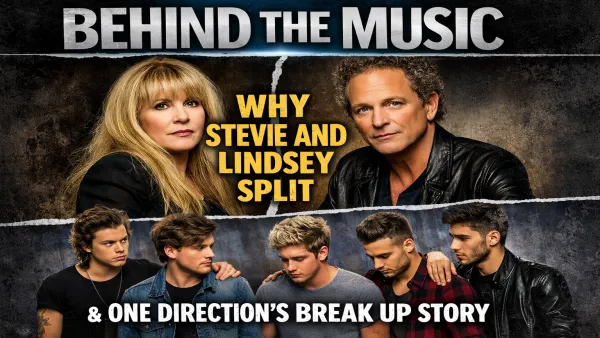
🔥 Behind The Music: Why Stevie And Lindsey Split & One Direction's Break Up Story
Explore the tragic yet fascinating reasons behind the breakups of Fleetwood Mac and One Direction. This feature delves into the tangled romance of Stevie Nicks and Lindsey Buckingham, alongside the overwhelming pressures that caused the world's biggest boy band to pause, revealing the human cost behind our favorite music.







Details
Send Us an Enquiry
We'll get back to you as soon as possible.
Thank You!
Your enquiry has been submitted. We'll be in touch shortly.