The University of York, established in 1963, stands as a beacon of academic brilliance and social progression in the heart of North Yorkshire, United Kingdom. As a proud member of the prestigious Russell Group, the university has cemented its reputation as a premier research-intensive institution. Founded with a visionary commitment to academic excellence and social equity, York has transitioned from a mid-century "plate glass university" into a global leader in higher education.
Operating through a distinctive collegiate system, the University of York provides much more than just a classroom experience; it offers a supportive, interdisciplinary community for its diverse student body. Guided by its mission to be a "university for public good," the institution drives cultural, social, and economic value through bold, creative thinking and world-class research.
Historical Foundations and Royal Charter
The university’s journey began on 09 July 1963, the date its Royal Charter (Registration Number: RC000679) was granted. The primary driving force behind its inception was John Bowes Morrell, whose dedication to expanding educational access in the North of England paved the way for the institution we see today.
Over the decades, the university has remained true to its founding principles while adapting to the needs of the 21st century. Today, it stands as a testament to how traditional scholarship can integrate with modern professional development to empower the next generation of global leaders.
Academic Prowess and Specializations
The University of York offers an extensive array of undergraduate degrees, postgraduate research opportunities, and online Masters courses. The institution is globally renowned for its high-impact research output, specifically within the following specializations:
-
Social Policy: Ranked consistently among the top departments in the UK for its influence on government policy and social welfare.
-
English Literature: A hub for literary criticism and creative writing, fostering a deep appreciation for the written word.
-
Archaeology: Utilizing state-of-the-art facilities like the YEAR (York Experimental Archaeology Research) Centre.
-
Health Economics: A world leader in evaluating healthcare systems and pharmaceutical efficiency.
-
Atmospheric Chemistry: Home to the Wolfson Atmospheric Chemistry Laboratories (WACL), tackling global climate and pollution challenges.
Through executive education and business consultancy, the university also bridges the gap between academia and the corporate sector, ensuring that its research translates into real-world solutions for global industries.
The Collegiate System: A Home Away from Home
One of York’s most defining features is its Collegiate Support System. Unlike many other universities, every student at York—whether living on or off-campus—is a member of one of its eleven colleges. This system fosters a sense of belonging, provides localized pastoral care, and encourages interdisciplinary collaboration.
The colleges act as the heartbeat of the campus, hosting social events, sports competitions, and academic workshops. This structure ensures that in a university of over 20,000 students, no one is ever just a number.
Campus Innovation and Facilities
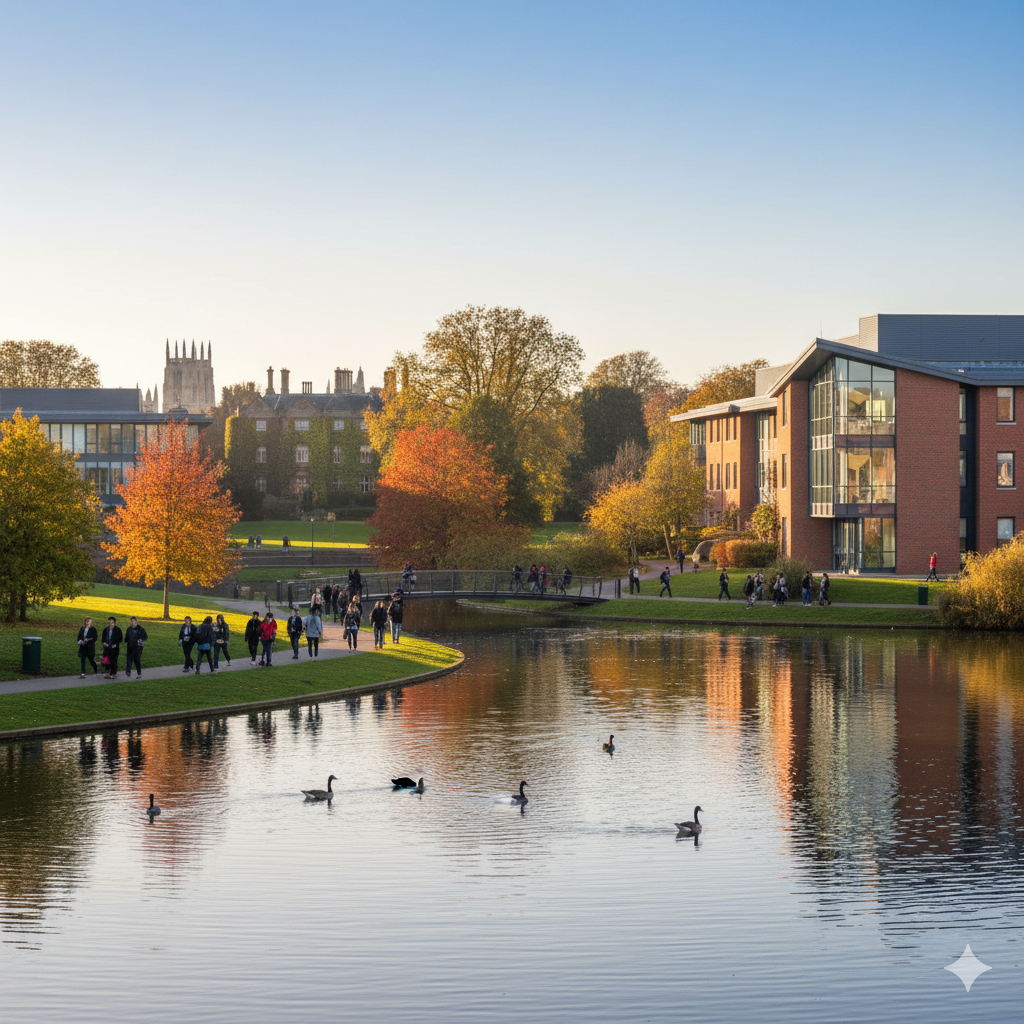
The University of York is physically situated in Heslington, York, YO10 5DD, centered around a beautifully landscaped 500-acre parkland. The campus is famous for its large plastic-bottomed lake, one of the largest in Europe, which serves as a unique landmark near Heslington Hall.
Amenities and Infrastructure:
-
24/7 Library Access: The JB Morrell Library and its extensions provide round-the-clock resources for rigorous scholarship.
-
Specialized Research Facilities: From the Hull York Medical School to the York Science Park, the infrastructure supports cutting-edge discovery.
-
York Sport Village: A multi-million-pound facility offering Olympic-sized swimming, high-tech fitness suites, and floodlit pitches.
-
High-Speed Wi-Fi: University-wide connectivity ensuring seamless access to digital resources and online learning platforms.
Economic Impact and Brand Association
The university is not just an educational hub; it is an economic powerhouse. With approximately 5,000 employees, it is one of the region's largest employers. Its brand associations, including York Conferences and York Science Park, contribute significantly to the local economy within a 50-mile service area radius.
The university fosters deep-rooted partnerships with local businesses and international organizations, facilitating knowledge exchange that drives regional growth. The York Science Park, in particular, provides a launchpad for high-tech startups and spin-off companies, reinforcing York’s status as an innovation hub.
Admissions and Practical Information
For prospective students and partners, the University of York maintains a transparent and accessible administrative structure.
-
Working Hours: Monday–Friday, 09:00 – 17:30 (Admin Hours).
-
Accepted Payment Methods: To facilitate ease of transactions for international and domestic students, the university accepts Bank Transfer, Online Student Portal Payments, and Credit/Debit Cards.
-
Language Supported: The primary medium of instruction and administration is English.
Contact Details:
-
Helpdesk/Phone: 01904320000
-
Email: enquiries@york.ac.uk
-
Website: https://www.york.ac.uk
-
LinkedIn: linkedin.com/school/university-of-york
Certifications and Affiliations
The University of York’s commitment to quality is validated by various prestigious affiliations and awards:
-
Russell Group Membership: Signifying its status among the UK's top 24 research-intensive universities.
-
Athena SWAN Awards: Recognition for its commitment to gender equality in higher education (holding various Bronze and Silver departmental awards).
-
Worldwide Universities Network (WUN): A global partnership facilitating international research collaboration.
Frequently Asked Questions
1. When was the University of York founded?
The university was established on 09 July 1963, when it received its Royal Charter.
2. Is the University of York part of the Russell Group?
Yes, the University of York is a prominent member of the Russell Group, representing the UK's leading research-intensive universities.
3. What is the "Collegiate System" at York?
The collegiate system divides the university into eleven distinct colleges. Every student belongs to a college, which provides a smaller, supportive community for socializing, support, and accommodation.
4. Where is the University of York located?
The main campus is located in Heslington, York, North Yorkshire, YO10 5DD, United Kingdom, near the historic Heslington Hall.
5. What are the university's strongest subjects?
York is particularly renowned for Social Policy, English Literature, Archaeology, Health Economics, and Atmospheric Chemistry.
6. Does the university offer 24/7 facilities?
Yes, the university provides 24/7 library access and high-speed Wi-Fi across the entire campus to support students' academic needs at any time.
7. How can I contact the University of York admissions team?
You can reach the helpdesk at 01904320000 or via email at enquiries@york.ac.uk.
8. What payment methods are accepted for tuition fees?
The university accepts Bank Transfers, Credit/Debit Cards, and payments through the Online Student Portal.
9. What kind of sports facilities are available?
The York Sport Village offers a wide range of amenities, including a 25m swimming pool, a 120-station gym, and various outdoor pitches and courts.
10. What is the university's mission?
The University of York defines itself as a "university for public good," focusing on research and education that creates positive social, cultural, and economic impact.
Shaping the Future
As the University of York moves forward, it continues to blend its rich heritage with a forward-thinking approach to global challenges. Whether you are a prospective student looking for an elite academic environment, a business seeking expert consultancy, or a researcher aiming to change the world, York offers the resources, community, and prestige to help you succeed. Its dedication to the "public good" ensures that every breakthrough made within its walls resonates far beyond the borders of North Yorkshire.
Top Categories
- Business Services 137
- Educational Services 93
- Event Organiser 45
- Health and Wellbeing 17
- Advertising Agencies 16
- Home and Garden 13
- Automotive 13
- Manufacturing Services 8
- Engineering 8
- Entertainment Services 5
- Legal Services 4
- Financial Services 4
- Gardening Services 4
- Accountants 2
- Cleaning Services 2
Top Viewed Articles




Spread the Word
Know someone who would love this? Share it with them!