
B and M vs Home Bargains Which Is Cheaper
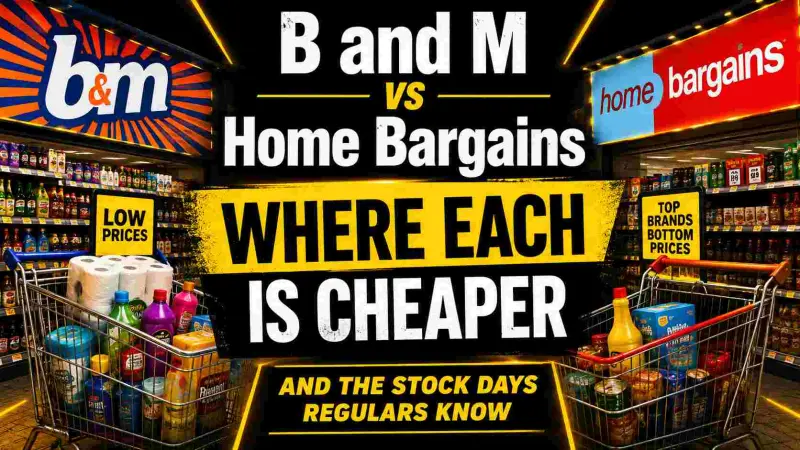
B&M and Home Bargains are two of the UK's most popular discount retailers, but asking which one is cheaper has a surprisingly complicated answer. There is no single winner across an entire weekly shop. One store can beat the other on branded groceries, while the other offers better value on cleaning products, homeware, seasonal goods or a particular special buy.
The bigger difference is how the two retailers build their ranges. B&M describes its model as an everyday-low-price operation with a tightly selected range of grocery and general merchandise, while its buying model also gives it considerable flexibility across homewares, gardening, toys, DIY and seasonal products. Home Bargains, operated by TJ Morris, similarly focuses on branded goods at low prices and carries food, health and beauty, household products, toys and other everyday categories.
That means the smartest bargain hunter does not simply ask, “Is B&M cheaper than Home Bargains?” The better question is: Which shop is more likely to be cheaper for the things I actually need today?
There is another part of the bargain-store puzzle: stock. Regular shoppers often have their own theories about the best day or time to visit. Some swear by weekday mornings; others wait for new seasonal ranges or clearance reductions. But there is no official nationwide “B&M restock day” or “Home Bargains delivery day” that guarantees a particular product will be on the shelf. B&M itself says new ranges land daily in stores and that it cannot check stock at individual branches because availability changes quickly.
This guide compares where each retailer tends to offer the strongest value, explains why prices vary, looks at how stock actually works and gives you a practical strategy for getting more from both stores.
Where B&M and Home Bargains Differ on Price and Stock
Which is cheaper overall: B&M or Home Bargains?
Neither store is consistently cheapest across every category. Home Bargains is often particularly competitive on branded everyday consumables, while B&M can be especially attractive for household goods, seasonal merchandise, toys, garden products and selected special offers.
That distinction matters because discount retailers do not operate like conventional supermarkets with huge ranges of competing brands in every category.
B&M says it deliberately focuses on best-selling products and maintains what it calls SKU discipline. Rather than trying to stock every possible variation, it concentrates purchasing power on selected lines. It also uses direct sourcing and changes its seasonal space throughout the year.
Home Bargains follows a similarly value-led philosophy. TJ Morris says its core principle is selling branded goods at the lowest possible prices and describes its range as spanning health and beauty, household goods, food, toys and more.
The result is that the cheapest shop depends heavily on your basket.
| Shopping category | B&M | Home Bargains | What to do |
|---|---|---|---|
| Branded groceries | Often competitive | Often very strong | Compare the exact pack size |
| Cleaning products | Strong | Strong | Check price per 100ml or litre |
| Toiletries | Strong on selected brands | Often competitive | Compare promotions |
| Homeware | Often excellent | Good | B&M can have more choice |
| Toys | Strong, especially seasonal | Strong | Compare branded lines |
| Gardening | Particularly strong | More variable | B&M is worth checking |
| DIY | Strong | More limited | Start with B&M |
| Seasonal products | Very strong | Strong | Shop early for choice |
| Clearance | Excellent | Branch-dependent | Check both stores |
| General grocery basket | Limited compared with supermarkets | Useful for top-up shopping | Do not assume either replaces a supermarket |
The important word in this table is exact.
A 500ml bottle and a 750ml bottle should not be compared simply because they look similar. Neither should two apparently identical household products if one is a concentrated formula or a different pack quantity.
Why B&M can be cheaper for home, garden and seasonal shopping
B&M's strength is not just cheap food. Its general merchandise operation is a major part of the business.
The retailer says its range includes homewares, electrical products, gardening, toys and DIY, with seasonal space typically accounting for around 20% of store floor space. Spring and summer bring more garden and outdoor products, while autumn and winter shift that space towards toys and Christmas merchandise.
That makes B&M particularly interesting when your shopping list goes beyond food.
For example, imagine a weekend shopping trip where you need:
- Storage boxes
- Kitchen utensils
- Laundry products
- Garden accessories
- Children's toys
- A few branded snacks
Home Bargains may be competitive on the consumables, but B&M could be the more useful single stop because of its broader general-merchandise proposition.
B&M's current offers also include dedicated Special Buys covering categories such as furniture, kitchenware, home décor, bedding, pets and laundry, alongside electrical products.
This is one reason regular B&M shoppers often visit without a precise product in mind. The store is designed partly around discovery: you go in for cleaning spray and come out with storage, a garden accessory or something for the kitchen.
That can save money when the unexpected item replaces a planned purchase elsewhere.
It can also do the opposite.
The hidden cost of the bargain-store “treasure hunt”
A cheap item is not automatically a saving.
Suppose you walk into B&M for £8 of cleaning products and leave with £30 of home accessories because they look like good value. You have not saved £22. You have spent £22 more than planned.
B&M itself acknowledges that its broad general-merchandise offer creates a “treasure hunt” shopping experience and can encourage impulse purchases.
That is not necessarily a criticism. It is simply something experienced bargain shoppers learn to control.
A useful rule is:
If it was not on your list, compare it with the cost of not buying it.
If you genuinely need it and the price is good, buy it. If you simply like the look of it because it is £3.99, leave it.
Where Home Bargains can have the edge
Home Bargains is particularly appealing for shoppers who want branded everyday products without doing a full supermarket shop.
Its stated range includes food, household products, health and beauty, toys and other everyday goods.
This makes it useful for a top-up trip involving products such as:
- Toiletries
- Cleaning products
- Laundry essentials
- Snacks
- Confectionery
- Drinks
- Household consumables
- Pet products
- Basic seasonal items
The key advantage is familiarity. You may find the branded product you already buy rather than having to choose between several private-label alternatives.
But price comparison still matters.
Home Bargains' online terms explicitly state that prices displayed online can differ from prices offered in stores. That means an online search should not automatically be treated as proof of what your local branch charges.
The same principle applies to B&M: the actual in-store offer can depend on availability and local stock.
Why identical products can have different prices
Discount retailers frequently source products through changing buying arrangements. Their ranges can include branded products, private-label merchandise, seasonal lines, special purchases and limited-time deals.
That means the price you see today may not be the price you see several weeks from now.
B&M explicitly describes an assortment built around selected best-selling SKUs and says its buying teams continuously monitor consumer trends and source products through its direct purchasing model.
It also uses markdowns to clear underperforming products before bringing in new lines.
This helps explain why bargain shopping is different from ordinary supermarket shopping.
A supermarket may have the same branded cereal sitting in the same location for months. A discount retailer may replace one product with another because the buying opportunity has changed.
What are the “stock days” at B&M?
There is no single official B&M restock day that applies to every store and every product.
In fact, B&M tells customers that its newest ranges can land daily in stores. It also says that, because of high demand, it cannot check product availability in specific stores.
That makes the idea of a guaranteed Tuesday or Thursday “stock day” misleading.
However, there are useful patterns.
New ranges can appear throughout the week
B&M's own app promotes new product launches and allows shoppers to save favourite products and stores.
The retailer also says new deals and offers are added in stores and online weekly.
So if you are hunting for a newly launched seasonal product, visiting regularly is more reliable than trying to identify one magical day.
Seasonal stock is easiest to find early
If you want Christmas decorations, summer garden products, outdoor entertaining items or Halloween merchandise, do not wait until the peak of the season.
B&M actively changes its floor space according to seasonal demand.
The trade-off is straightforward:
Visit early for choice; visit later for possible reductions.
The first approach is better when you need a particular product. The second is better if you are flexible.
What are the “stock days” at Home Bargains?
Home Bargains does not publish a universal weekly replenishment timetable that guarantees when a particular product will arrive at every branch.
Its help centre specifically addresses customers asking when an out-of-stock item will return and why the full stock range cannot always be found online.
That is an important clue about how to think about stock.
A product can be available in one branch but missing from another. It can also appear online without representing the complete range of merchandise in every store.
For regular shoppers, the most reliable approach is therefore to learn your local branch's rhythm, rather than relying on a national rumour.
How regular bargain hunters improve their chances of finding new stock
If a particular product matters to you, use a simple routine.
1. Learn your nearest two or three branches.
Do not assume the largest store is always best. A different branch may receive different stock or have less local demand.
2. Ask staff politely about delivery patterns.
Employees may be able to explain when stock is normally processed, although they cannot guarantee that a particular product will arrive.
3. Visit at different times initially.
If you are hunting for something repeatedly, try a weekday morning on one visit, an afternoon on another and a weekend visit another time.
You are effectively collecting your own data.
4. Check seasonal launches early.
The longer you wait, the greater the chance that popular lines disappear.
5. Do not rely on one social-media “stock day” rule.
A post saying “Home Bargains gets new stock every Wednesday” may describe one branch, one department or one person's experience. It is not evidence of a national rule.
B&M has a useful advantage for bargain hunters: its new app
B&M launched a new app in March 2026 with several features specifically aimed at shoppers looking for products and reductions.
The app can:
- Scan barcodes in-store to find current offers and reductions
- Highlight new product launches
- Save favourite stores
- Save favourite products
- Provide store-finder information and opening hours
The barcode function is particularly useful.
If you already own a B&M item and wonder whether it has been reduced, scanning it can provide more useful information than relying on a shelf label alone.
B&M also runs Manager's Specials, which it says refresh every four weeks, while its wider offers can change weekly.
That creates several different bargain-hunting opportunities rather than one fixed clearance day.
How B&M clearance works
B&M's Reduced to Clear events can be particularly worthwhile if you are flexible about what you buy.
The retailer has described reductions across grocery, cleaning, health and beauty, confectionery and soft drinks, with stock varying by store and products being cleared once they are gone.
Its current offers page also highlights Reduced to Clear and Manager's Specials, alongside seasonal and category-specific promotions.
This leads to an important distinction:
A clearance visit is not the same as a normal shopping trip.
If you need a specific washing detergent today, waiting for a clearance reduction may be a bad strategy. If you are happy to buy whichever suitable product is reduced, clearance hunting can work very well.
How Home Bargains online stock differs from store stock
Home Bargains' own terms provide an important warning for online shoppers: prices on the website can differ from prices in stores, and the full stock range is not necessarily available online.
That means online browsing is useful for discovering products, but it should not be treated as a perfect inventory system for your nearest branch.
Home Bargains also offers home delivery and collection arrangements, with its help centre providing separate guidance on Click+Collect, out-of-stock products and delivery.
If the product is urgently needed, confirm the exact purchasing option before making a special journey.
Which shop is better for a weekly household shop?
If by “weekly shop” you mean a complete supermarket-style grocery basket, neither B&M nor Home Bargains should automatically be treated as a replacement for a large supermarket.
Their ranges are deliberately selected rather than unlimited.
B&M describes its grocery operation as a targeted selection of branded convenience products that complements rather than replaces a fresh grocery shop.
Home Bargains can be useful for filling gaps, especially when you know which branded products are competitively priced.
A smart weekly strategy is therefore:
Supermarket for the core basket + B&M or Home Bargains for selected value lines.
For example, buy fresh meat, vegetables and a broad range of staples where your supermarket offers the best overall choice, then check the discounters for cleaning products, toiletries, branded snacks, household items and seasonal purchases.
The best way to compare prices
Do not compare shelf prices alone.
Use the unit price whenever it is available.
For example:
- £2 for 500ml = 40p per 100ml
- £2.50 for 750ml = about 33p per 100ml
The second product costs more at the till but is cheaper per 100ml.
The same principle applies to toilet rolls, washing detergent, dishwasher tablets, pet food and multipacks.
Also compare:
- Pack size
- Quantity per pack
- Concentration
- Brand and exact product variant
- Promotional conditions
- Shelf life
- Whether you actually need the larger quantity
The cheapest unit price is not always the cheapest useful purchase if half the product ends up unused.
A realistic B&M versus Home Bargains shopping strategy
If you have both stores nearby, you do not necessarily need to walk through every aisle of both.
Create three lists:
Buy at B&M
Use this for products where B&M has a clear advantage, particularly homeware, gardening, DIY, seasonal merchandise or a specific special buy.
Buy at Home Bargains
Use this for branded everyday consumables where you have already established that the local branch offers the better price.
Compare on the day
Put uncertain products here, particularly promotional items.
This avoids turning bargain hunting into a two-hour expedition.
What about B&M's current store expansion?
B&M continues to expand its UK store estate. Its FY2026 annual report says it opened 41 gross, or 22 net, new B&M UK
stores during the year, while the company has a longer-term target of operating at least 1,200 B&M UK stores.
That matters to shoppers because new and refurbished stores can change the local shopping experience.
B&M says its stores can operate in town centres and out-of-town locations, with larger out-of-town stores generally carrying a fuller product offering.
So two B&M branches are not necessarily interchangeable.
A larger store may be worth the extra journey for furniture, garden products, toys or seasonal ranges. A smaller town-centre store may be more convenient for toiletries, snacks and household top-ups.
What the future of discount shopping could look like
The future of B&M and Home Bargains is unlikely to be about simply being the cheapest shop on every product.
Instead, the competitive advantage is likely to come from a mixture of price, product discovery, availability, store convenience and speed of stock turnover.
B&M is already investing in digital tools that connect shoppers with new launches, reductions and store information.
At the same time, its business model continues to rely heavily on physical stores and carefully selected merchandise. Its latest corporate figures show 777 B&M UK stores in the group's operational overview.
Home Bargains is also continuing its physical expansion. TJ Morris says it has more than 500 stores and has ambitions to grow to 1,000. Its corporate homepage currently says it has over 575 stores.
The precise store count can therefore change as new branches open.
For shoppers, the broader trend is clear: discount retail is becoming more sophisticated without losing the physical “treasure hunt” element that makes these shops popular.
The winning habit will probably remain simple: know your normal prices, watch seasonal changes, compare like-for-like products and buy when the right item is genuinely good value.
Key Insights
- There is no universal winner: B&M and Home Bargains can each be cheaper depending on the product and pack size.
- B&M is particularly worth checking for homeware, gardening, DIY, toys and seasonal merchandise.
- Home Bargains is strong for branded everyday household, food, health and beauty products.
- Do not rely on a fixed “stock day”: neither retailer publishes a universal weekly replenishment day for every branch.
- B&M says new ranges can land daily, while offers and Manager's Specials operate on different refresh cycles.
- Compare unit prices rather than shelf prices, especially for cleaning products, toiletries, food and multipacks.
- Shop seasonal ranges early for choice and later for potential reductions.
- Use the B&M app's barcode scanner to check current offers and reductions when shopping in store.
FAQ
1. Is B&M cheaper than Home Bargains?
Not consistently. Both retailers are designed around low prices, but the cheapest option changes by product. B&M can be particularly competitive for homeware, gardening and seasonal products, while Home Bargains is often attractive for branded everyday consumables.
2. Is Home Bargains cheaper than B&M for food?
It can be, particularly on selected branded groceries, snacks, drinks and confectionery. However, prices change and ranges differ between branches. Compare the exact product, pack size and unit price rather than assuming one retailer always wins.
3. Which is better for cleaning products, B&M or Home Bargains?
Both are worth checking. The best price depends on the brand, formulation, pack size and promotion. For detergent, sprays and other liquids, compare the cost per litre or 100ml instead of simply choosing the product with the lowest shelf price.
4. Is B&M better for homeware?
B&M is often particularly strong for homeware because general merchandise is a major part of its offer. Its Special Buys include furniture, kitchen products, bedding, décor, bathroom products and other household categories.
5. Does B&M have a set restock day?
No universal restock day applies to every B&M store and product. B&M says its newest ranges can land daily in stores and also warns that it cannot check availability at individual branches because demand and stock change quickly.
6. What is the best day to visit Home Bargains for new stock?
There is no officially published national day that guarantees new stock at every Home Bargains branch. Local delivery and processing patterns can vary, so regular shoppers are better off learning the habits of their own branch.
7. Is B&M clearance worth shopping?
Yes, particularly if you are flexible about the exact product. B&M runs Reduced to Clear activity and says stock varies by store. Once clearance products are gone, they may not return.
8. Does Home Bargains online stock show everything in stores?
No. Home Bargains' help centre specifically explains that customers may not find the full stock range online. Online availability should therefore not be treated as a complete inventory of your local branch.
9. Are Home Bargains online prices the same as store prices?
Not necessarily. Home Bargains states in its online terms that product prices on its website may differ from prices offered in its stores.
10. Does B&M have a loyalty card?
B&M's current shopping proposition does not depend on a conventional points-based loyalty card. Its new app instead focuses on features such as new product discovery, barcode scanning for reductions, favourite stores and saved products.
11. How can I find B&M reductions?
Check the B&M offers pages, look for Reduced to Clear and Manager's Specials in store, and use the B&M app's barcode scanner. B&M says Manager's Specials refresh every four weeks, while wider deals and offers can change weekly.
12. Should I visit B&M early in the morning for bargains?
Morning shopping can be useful because shelves may have been replenished or tidied, but it is not a guaranteed national rule. The best time depends on your local store, the product you want and when deliveries are processed.
13. Is B&M or Home Bargains better for seasonal products?
Both can be excellent. B&M has a particularly structured seasonal approach, changing significant areas of its floor space between spring/summer and autumn/winter ranges. Shopping early generally gives you more choice.
14. How do I know whether a bargain is actually cheaper?
Compare the exact product and unit price. Check grams, litres, number of items, concentration and pack quantity. A £3 product is not necessarily cheaper than a £3.50 product if the latter contains significantly more.
15. Will B&M and Home Bargains keep getting bigger?
Both retailers have expansion ambitions. B&M says it is targeting at least 1,200 UK stores, while TJ Morris says Home Bargains plans to grow substantially from its current estate.
Final Thoughts
The B&M versus Home Bargains debate is less about finding one permanent winner and more about learning where each retailer earns a place on your shopping route.
For B&M, think homeware, garden, toys, DIY, seasonal ranges, special buys and clearance. For Home Bargains, think branded everyday products, household essentials, food, toiletries and convenient top-up shopping.
The stock-day question needs the same realistic approach. There is no secret nationwide Tuesday morning when every bargain suddenly appears. B&M says products can arrive daily, while Home Bargains acknowledges that online availability does not represent its entire store range.
The regulars who consistently find the best deals are not necessarily the people who visit at a magical hour.
They are the people who know their local branches, recognise normal prices, understand seasonal timing and know when a reduction is genuinely worth taking.
If you have both stores nearby, that is actually an advantage. Use B&M and Home Bargains as complementary discount shops rather than trying to crown one the cheapest retailer for everything. Build your shopping list first, compare only the products that matter and let the genuinely good bargains come to you—not the other way around.
Disclaimer: The information provided in this article is for general informational and research purposes only. Company details, features, services, and market positions may change over time. Readers are advised to visit official company websites and conduct independent research before making any business decisions or purchasing services.
Most Searchable Keywords
Recent Blogs

Related Listings
Categories
- Accountants (295)
- Advertising Agencies (559)
- Architects (149)
- Automobiles (377)
- Beauty (300)
- Carpenters (146)
- Cleaning Services (387)
- Dentists (189)
- Driving (62)
- Education (1)
- Electricians (215)
- Energy (8)
- Event Organiser (687)
- Finance (602)
- Guide (3477)
- Health (2207)
- Information technology (206)
- Legal Services (361)
- Logistics (6)
- Maintenance (65)
Sponsored Listings in Locksmith Services


Related Blogs

Greggs App Rewards Birthday Treats and Free S...
Read this insightful article "Greggs App Rewards Birthday Treats and Free Stamps" to expand your knowledge!
B and M vs Home Bargains Which Is Cheaper
Read this insightful article "B and M vs Home Bargains Which Is Cheaper" to expand your knowledge!

Too Good To Go How to Get the Best Magic Bags
Read this insightful article "Too Good To Go How to Get the Best Magic Bags" to expand your knowledge!
Questions & Answers – Find What
You Need, Instantly!
How can I update my business listing?
Is it free to manage my business listing?
How long does it take for my updates to reflect?
Why is it important to keep my listing updated?
