
Yellow Sticker Times at Tesco Asda and Sainsbury
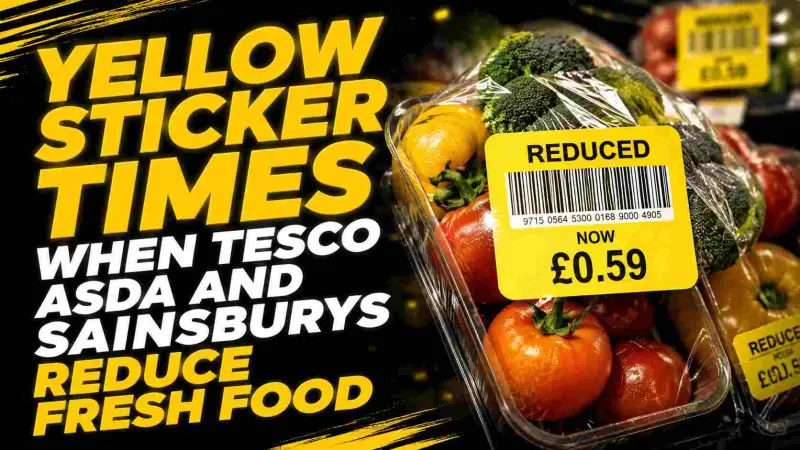
Yellow sticker shopping can turn an ordinary supermarket trip into a surprisingly cheap way to buy fresh meat, fish, bakery products, ready meals, dairy and other short-dated food. The catch is that there is no single national yellow sticker time for Tesco, Asda or Sainsbury’s. Reduction schedules can vary according to the individual store, staffing, stock levels, opening hours, day of the week and how quickly particular products need to be sold.
As a useful starting point, shoppers often report finding the strongest reductions in the late afternoon and evening, although some stores begin marking products down much earlier. Recent shopper reports suggest Tesco can have several reduction rounds, Sainsbury’s often has significant evening reductions, while Asda commonly sees stronger markdown activity later in the day. These are patterns rather than guaranteed timetables.
That distinction matters. Arriving at exactly 7pm does not guarantee a trolley full of bargains. You may find that another shopper got there first, the store reduced its stock earlier, or the products were redirected for donation rather than receiving another price cut.
This guide explains when to look for yellow stickers at Tesco, Asda and Sainsbury’s, why reduction times differ, which foods are worth buying, how to judge whether a bargain is genuinely good value, and how to handle reduced food safely at home.
When are the best yellow sticker times at Tesco, Asda and Sainsbury’s?
The most useful rule is simple: start checking from the afternoon onwards, then make another visit in the early evening if you are specifically hunting for deeper reductions.
There is no official chain-wide timetable published by Tesco, Asda or Sainsbury’s that guarantees a particular markdown at a particular minute. Published supermarket information focuses more on reducing waste, managing stock and food safety than promising shoppers a fixed yellow sticker schedule.
Current shopper reports and UK supermarket guides point towards these broad patterns:
| Supermarket | Typical useful period to check | When deeper reductions may appear | Main caveat |
|---|---|---|---|
| Tesco | Afternoon | Around early evening to later evening | Store-specific |
| Asda | Morning/afternoon in some stores | Often early evening | Varies significantly |
| Sainsbury’s | Afternoon | Often around evening reduction rounds | Store-specific |
Some recent guides put Tesco and Sainsbury’s first reductions around mid-afternoon, with stronger reductions later, while other reports indicate that individual Tesco and Asda stores can start much earlier.
The safest interpretation is therefore not "go at exactly 8pm", but rather:
- Learn your local store's routine.
- Check fresh-food areas during the afternoon.
- Return during the evening if the store has further reductions.
- Shop according to the use-by date rather than the sticker alone.
- Be prepared for the best bargains to disappear quickly.
Why yellow sticker times are not fixed
Supermarkets are managing thousands of products with different shelf lives.
A pack of fresh chicken reaching its use-by date tomorrow may need a reduction much sooner than a bakery product with a different shelf-life policy. A quiet store may have plenty of stock left at lunchtime, whereas a busy branch could sell most of it before the first reduction.
Staffing also matters. Reductions have to be completed alongside normal store operations, replenishment, customer service, cleaning and other tasks.
That is why online claims about "the exact yellow sticker time" should be treated as a useful observation rather than a promise.
What is a yellow sticker?
A yellow sticker is a supermarket price-reduction label placed on food that needs to sell quickly, often because it is approaching a relevant date.
The reduction helps the retailer recover some value from stock that might otherwise remain unsold, while giving customers an opportunity to buy it for less.
Asda has described its yellow "Reduced to Clear" labels as highlighting products nearing their use-by date and reduced in price.
Reduced food is therefore not necessarily damaged, inferior or unsafe. The important question is why it has been reduced and what date is printed on it.
Tesco yellow sticker times
Tesco is one of the supermarkets where shoppers commonly report multiple reduction rounds rather than one universal markdown.
Recent shopper discussions describe examples of reductions occurring in the morning, another round during the afternoon and a further, deeper round during the evening. One Tesco shopper reported a three-stage pattern of roughly 9am, 2pm–4pm and around 7pm, while also stressing that this was a rough guide rather than a universal rule.
Other guides place useful Tesco yellow sticker hunting around mid-to-late afternoon, with deeper reductions later in the evening.
So, if Tesco is your local supermarket, a sensible strategy is:
For choice: check in the afternoon.
For potentially deeper discounts: check again in the evening.
For your specific store: ask a colleague when reductions are normally carried out.
What should you look for at Tesco?
The most obvious areas include:
- Fresh meat and poultry
- Fish
- Chilled ready meals
- Sandwiches and salads
- Dairy
- Bakery products
- Desserts
- Fresh produce
Some stores have dedicated reduced sections, while others place stickers on products within their normal shelving.
Do not assume that every yellow-stickered product is in one location.
Asda yellow sticker times
Asda can be particularly interesting for shoppers because its reduction patterns vary between stores.
Some published guides report initial markdowns during the morning, followed by stronger reductions in the evening, while other reports put the main reduction activity later in the day.
That means an Asda shopper should not automatically ignore the store before 6pm.
If you are nearby anyway, an earlier visit can give you more choice. A later visit may provide better prices but fewer products.
Asda has also expanded other methods of dealing with surplus food. In 2024, it announced a rollout of Too Good To Go across nearly 1,000 sites, allowing customers to buy surplus food through Surprise Bags. These can include chilled products, ready meals, food-to-go items, bakery products and foods such as dairy, meat, fish and poultry.
That is useful context: not all surplus food necessarily reaches a yellow sticker.
Some food may be donated, redistributed or sold through other surplus channels.
Sainsbury's yellow sticker times
Sainsbury's is frequently associated with evening yellow sticker hunting.
Recent reports from shoppers suggest that some stores carry out significant reductions around 7pm or later, while individual employee reports show that reductions can happen at different times depending on the department and store.
A recent 2026 shopper discussion also included reports of final reductions around 7pm in one store and around two hours before closing in another.
That illustrates the key point: your local Sainsbury's schedule may be completely different from another branch.
Larger stores may have separate processes for meat, bakery, prepared foods and other chilled products. Smaller Sainsbury's Local stores can have a different rhythm because of their smaller footprint and different opening hours.
Which supermarket has the best yellow sticker time?
There is no reliable winner because the best time depends more on the individual store's reduction routine and stock than its brand.
A Tesco at 6pm might be excellent one day and empty the next. An Asda at 8pm could have heavily reduced meat in
one branch while another has already cleared its stock. A Sainsbury's might carry out its main reduction shortly before closing.
Think of yellow sticker shopping as a local pattern rather than a national schedule.
The most useful comparison is:
| Factor | Tesco | Asda | Sainsbury’s |
|---|---|---|---|
| Early reductions possible? | Yes | Yes | Yes |
| Afternoon reductions | Commonly reported | Commonly reported | Commonly reported |
| Evening reductions | Often important | Often important | Often important |
| Fixed national time? | No | No | No |
| Best approach | Track your store | Track your store | Track your store |
The 15-minute observation trick
If you regularly shop at one branch, spend a few visits watching what happens.
Suppose you notice:
- 3pm: first meaningful reductions
- 5pm: more chilled items reduced
- 7pm: second/deeper round
- 9pm: little stock remains
You have learned something much more valuable than a generic internet timetable.
You now know your supermarket.
Why supermarkets reduce fresh food
Yellow stickers are not simply a customer promotion.
Fresh food creates a difficult inventory problem. A supermarket wants enough stock available for customers, but too much stock creates a risk of unsold products.
Research into perishable inventory describes this basic tension as a trade-off between avoiding shortages and avoiding waste.
Markdowns can help move products before they become unsellable.
This is particularly relevant for:
- Meat
- Fish
- Prepared salads
- Sandwiches
- Ready meals
- Dairy
- Bakery products
- Short-life desserts
Reducing a £5 product to £2.50 may be better for the retailer than selling nothing and losing the entire retail value.
For shoppers, that creates the bargain.
For the supermarket, it creates another chance to sell the product.
For the food system, it can help prevent edible food from becoming waste.
How much can yellow sticker food actually save?
Discounts vary enormously.
You may see a modest reduction that saves only a few pence, while later markdowns can be much more substantial. Some third-party guides describe typical reductions ranging from around 30% to 75%, but these are observations rather than guaranteed Tesco, Asda or Sainsbury's discount levels.
The important calculation is not:
"How big is the percentage discount?"
It is:
"Would I buy this product at the reduced price?"
A £6 meal reduced to £4 is not necessarily a bargain if you would normally choose a £2.50 alternative.
Conversely, a £5 pack of quality meat reduced to £1.50 can be excellent value if you already have a plan for using or freezing it.
A simple value test
Before putting an item in your basket, ask:
- Would I normally eat this?
- Is the package intact?
- What is the use-by or best-before date?
- Can I use it in time?
- Can I freeze it safely before the use-by date?
- Is the reduced price genuinely cheaper than alternatives?
- Am I buying it because I need it or because the sticker looks exciting?
That last question matters.
Yellow stickers can encourage impulse buying just as easily as full-price promotions.
Which yellow sticker foods are usually worth buying?
The best bargains are usually products that fit easily into meals you already make.
Fresh meat and poultry
Reduced meat can offer excellent value, particularly if you already know how you will use it.
If the product has a use-by date approaching, plan to cook or freeze it appropriately before that date.
Do not buy five packs simply because the price is attractive unless you have enough freezer capacity and a realistic plan.
Bakery products
Bread, rolls, cakes and pastries can be particularly practical.
Bread freezes well, making it easier to take advantage of a substantial reduction without feeling pressured to eat an entire loaf immediately.
Ready meals
Ready meals can be useful when the discount is large and you need a quick dinner.
But compare the reduced price with cooking from basic ingredients. A 50% reduction does not automatically make a ready meal economical.
Fruit and vegetables
Reduced produce can be excellent when you plan to eat it quickly.
Soft fruit can be turned into:
- Smoothies
- Compotes
- Desserts
- Porridge toppings
- Sauces
Very ripe vegetables can often work well in soups, stews, curries or pasta sauces.
But do not buy produce that is already visibly spoiled simply because it is cheap.
What is the difference between use-by and best-before?
This is one of the most important parts of yellow sticker shopping.
Use-by is about food safety. Best-before is primarily about food quality.
The Food Standards Agency says consumers should never eat food after its use-by date, even if it looks or smells fine.
Food can be eaten until midnight on the use-by date, subject to proper storage and the relevant instructions.
A best-before date is different. Food may remain safe after that date if it has been stored correctly, although its quality may decline.
The FSA's recent Food & You research found that around 64% of respondents correctly identified the use-by date as the safety date, while 11% incorrectly selected best-before.
That confusion is precisely why yellow sticker shoppers should slow down before buying.
Can you freeze yellow sticker food?
Potentially, yes, but the use-by date and storage instructions matter.
The FSA advises that food can be frozen before its use-by date. It also says food with a use-by date should not simply be eaten after that date because it looks acceptable.
If you buy reduced chicken with a use-by date of today, for example, you should not assume you can leave it in the fridge for another two days and then cook it.
Follow the product instructions and food-safety guidance.
How to get the best yellow sticker bargains without wasting money
The best yellow sticker shopper is not necessarily the person who finds the lowest price.
It is the person who turns reduced food into meals without creating more waste at home.
Build your shopping around flexible ingredients
If you find reduced minced beef, you could use it for:
- Chilli
- Bolognese
- Burgers
- Cottage pie
- Tacos
That flexibility makes a reduction more useful.
If you find an expensive specialist product that you have never tried and have no plan for, the discount may not be meaningful.
Carry reusable freezer bags
A well-organised freezer makes yellow sticker shopping much easier.
But remember that freezing does not magically make food safe indefinitely. Freeze food before the use-by date and follow the package's instructions.
Shop at more than one time
If your local supermarket allows it, test:
Late morning → afternoon → evening
You may discover that your store's best selection appears earlier while its deepest reductions happen later.
There is a trade-off:
Earlier = more choice.
Later = potentially lower prices.
What days are best for yellow stickers?
There is no universal "best day".
Customer traffic, deliveries, promotions, seasonal events and stock levels can all change what is left to reduce.
Some shoppers find evenings particularly productive because products are approaching the end of their selling window. Others report strong bargains on Sundays because stores may have different opening hours and reduction cycles. Community reports suggest substantial variation between stores.
Rather than assuming Friday or Sunday is always best, keep a simple mental record of what you see.
If your local store consistently has a large amount of reduced bakery stock on Sunday afternoon, that is useful information.
Common yellow sticker mistakes to avoid
Chasing the biggest percentage
A 90% reduction sounds amazing.
But 90% off something you do not need is still unnecessary spending.
Ignoring the date
The sticker is not more important than the date.
Always check it.
Buying more than you can store
Five discounted packs of meat are not a bargain if three end up in the bin.
Assuming every yellow sticker means the same thing
Different products have different storage and date requirements.
Eating past a use-by date because it looks fine
This is specifically contrary to Food Standards Agency advice. Smell and appearance
are not a reliable substitute for a use-by date.
Blocking or pressuring staff
Reduction shopping can become competitive, particularly when a large batch of expensive food is being marked down.
Being patient is usually more productive. Staff have other responsibilities, and reduction timing can change.
Yellow stickers versus loyalty-card discounts
Yellow stickers are not the same thing as Tesco Clubcard Prices, Sainsbury's Nectar Prices or Asda Rewards offers.
A yellow sticker is generally a stock-specific markdown, whereas loyalty pricing is a promotional or member-linked price.
Tesco currently describes Your Clubcard Prices as selected discounts available through the Tesco app, with new offers released weekly.
Sainsbury's likewise offers Nectar Prices across categories including fresh produce, ready meals and other groceries.
This creates an interesting opportunity: compare the final yellow sticker price with the normal promotional price rather than assuming the yellow sticker automatically wins.
The future of supermarket reductions
The reduction system is likely to become increasingly data-driven.
Retailers already have detailed information about stock, sales rates, shelf life and customer demand. Better forecasting can help supermarkets order closer to what they expect to sell, while electronic systems can potentially make price changes faster and more targeted.
The direction of travel is also broader than stickers.
Asda, for example, has used food redistribution partnerships alongside its reduced-to-clear approach. Its Too Good To Go rollout shows how surplus food can be redirected through a digital marketplace rather than relying exclusively on traditional markdowns.
Food waste reduction will probably involve several approaches working together:
- Better demand forecasting
- Dynamic pricing
- Digital surplus-food platforms
- Food redistribution
- Improved date labelling
- Smaller or more flexible product ranges
- Consumer education
- Better stock rotation
The likely result is not that yellow stickers disappear. Instead, the way supermarkets decide what to reduce and when may become more sophisticated.
For shoppers, that could mean fewer predictable patterns and more personalised or dynamic reductions.
Key Insights
- There is no guaranteed national yellow sticker time at Tesco, Asda or Sainsbury’s.
- Afternoon and evening are generally the most useful periods to investigate, but individual stores differ.
- Earlier visits usually provide more choice, while later visits may provide deeper reductions.
- Ask staff about your local reduction routine rather than relying on an online timetable.
- Always check the use-by date, particularly on meat, fish, poultry and chilled ready-to-eat foods.
- Freeze suitable food before the use-by date and follow the packaging instructions.
- Compare the final reduced price with other offers, including loyalty-card pricing.
- The best bargain is food you will actually use, not simply the item with the biggest percentage reduction.
FAQ
1. What time do Tesco yellow stickers usually appear?
Tesco does not have one guaranteed yellow sticker time across every store. Shopper reports suggest reductions can occur in several rounds, including morning, afternoon and evening. For many stores, checking during the afternoon and again in the evening is a sensible strategy.
2. What time does Asda reduce fresh food?
Asda's reduction times vary by store. Some reports indicate early reductions, with another significant wave later in the day. Checking during the afternoon and early evening gives you a reasonable chance of finding reduced fresh food, but local patterns matter more than a national timetable.
3. What time does Sainsbury's put out yellow stickers?
Sainsbury's reduction times vary between branches. Shopper reports commonly mention afternoon and evening reductions, with some stores carrying out later markdowns around 7pm or afterwards. The exact routine depends on the store and its closing time.
4. Is there an exact yellow sticker time at supermarkets?
No. Supermarkets do not operate a universal customer-facing timetable that guarantees reductions at a particular time. Stock levels, staffing, store size, opening hours and product shelf life can all affect when reductions happen.
5. Are yellow sticker foods safe to eat?
A yellow sticker itself does not mean food is unsafe. Reduced food can be perfectly suitable to eat when purchased and stored correctly. However, the use-by date remains a food-safety limit, and the Food Standards Agency advises against eating food after that date.
6. Can I freeze yellow sticker meat?
You can generally freeze suitable food before its use-by date, provided the packaging and storage instructions allow it. Do not assume freezing food after its use-by date makes it safe. The FSA specifically advises freezing food before the use-by date.
7. Are yellow stickers cheaper than Clubcard or Nectar Prices?
Not necessarily. A yellow sticker is a specific markdown, while Clubcard Prices and Nectar Prices are promotional prices. Compare the actual final prices rather than the size of the advertised discount.
8. What foods are best for yellow sticker shopping?
Fresh meat, poultry, fish, bakery items, ready meals, dairy, desserts and some fruit and vegetables can all provide good opportunities. The best choice depends on the reduction, date and whether you can use the food in time.
9. Is evening the best time for yellow stickers?
Evening is often a productive period because more short-life products are approaching their selling deadline. However, later shopping also means fewer items may remain. If you want maximum choice, an afternoon visit may be better.
10. Are yellow sticker discounts always the same?
No. The reduction can depend on the product, its date, stock levels, demand and the supermarket's pricing process. Two identical products can also receive different reductions at different times.
11. Can supermarkets reduce food more than once?
Yes. Multiple reduction rounds are commonly reported by shoppers, particularly for short-life products. A first markdown may be followed by a deeper reduction if the item remains unsold.
12. Why do some supermarkets reduce food in the morning?
Some products may have short selling windows, while store-specific staffing and stock-management routines can also lead to earlier reductions. Smaller stores can have different schedules from larger branches.
13. Can you eat food after a best-before date?
Best-before dates primarily relate to quality rather than safety. Food may remain acceptable after the date when properly stored, although quality can decline. This is different from a use-by date, which relates to food safety.
14. What should I do if a yellow sticker will not scan?
Check that the sticker is attached correctly and that the reduced price is visible. If the till does not apply it correctly, ask a colleague for assistance rather than assuming the promotion has disappeared.
15. Will supermarkets still use yellow stickers in the future?
Probably, although the process may evolve. Retailers are increasingly combining markdowns with food redistribution, surplus-food apps, improved forecasting and other waste-reduction measures. Asda's partnership with Too Good To Go is one example of this wider approach.
Final Thoughts
Yellow sticker shopping is less about discovering a secret universal time and more about learning how your local supermarket behaves.
At Tesco, Asda and Sainsbury's, afternoon and evening visits can be productive, but the exact timing can shift from one branch to another. If you want the best selection, shop earlier. If your priority is the lowest possible price, a later visit may produce deeper reductions — but there is a much greater chance that the best products have already gone.
The smartest approach is to combine timing with common sense. Check the date, inspect the food, compare
the final price, and only buy what you can realistically use or freeze safely.
Most importantly, remember that the yellow sticker is only the beginning of the calculation. A genuinely good bargain is not the item with the biggest discount; it is the item you can safely turn into a meal without creating another piece of food waste.
Disclaimer: The information provided in this article is for general informational and research purposes only. Company details, features, services, and market positions may change over time. Readers are advised to visit official company websites and conduct independent research before making any business decisions or purchasing services.
Most Searchable Keywords
Recent Blogs

Related Listings

Categories
- Accountants (295)
- Advertising Agencies (559)
- Architects (149)
- Automobiles (377)
- Beauty (300)
- Carpenters (146)
- Cleaning Services (387)
- Dentists (189)
- Driving (62)
- Education (1)
- Electricians (215)
- Energy (8)
- Event Organiser (687)
- Finance (602)
- Guide (3477)
- Health (2207)
- Information technology (206)
- Legal Services (361)
- Logistics (6)
- Maintenance (65)
Sponsored Listings in Locksmith Services

Related Blogs

Greggs App Rewards Birthday Treats and Free S...
Read this insightful article "Greggs App Rewards Birthday Treats and Free Stamps" to expand your knowledge!
B and M vs Home Bargains Which Is Cheaper
Read this insightful article "B and M vs Home Bargains Which Is Cheaper" to expand your knowledge!

Too Good To Go How to Get the Best Magic Bags
Read this insightful article "Too Good To Go How to Get the Best Magic Bags" to expand your knowledge!
Questions & Answers – Find What
You Need, Instantly!
How can I update my business listing?
Is it free to manage my business listing?
How long does it take for my updates to reflect?
Why is it important to keep my listing updated?
