
Boots Advantage Card Points Value and Double Points
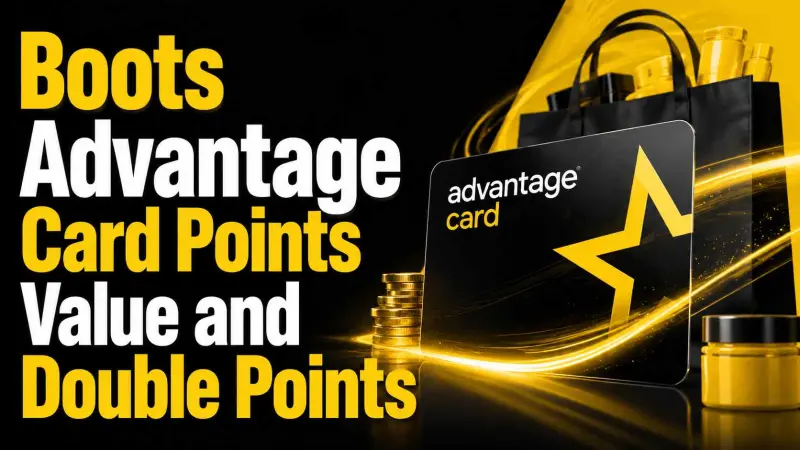
The Boots Advantage Card can look more generous than an ordinary supermarket loyalty scheme because the points balance is easy to understand: one Advantage Card point is worth 1p when you spend it at Boots. The standard earning rate is currently 3 points for every £1 spent on qualifying purchases, meaning £100 of eligible spending normally produces 300 points, or £3 of future spending power.
That sounds simple, but the real value comes from what happens around the basic rate. Boots regularly runs extra-points promotions, personalised offers and category-specific rewards. Some customers can also receive higher earning rates through schemes such as the Parenting Club, although those enhanced points rules have their own exclusions and conditions.
There is also an important change for regular Boots shoppers in 2026. From May, Boots continued with the standard three points per £1 while moving away from the previous 10% Boots own-brand discount for Advantage Card holders and putting greater emphasis on personalised offers delivered through the Boots app.
So, is the Advantage Card actually worth using? Usually, yes—especially if you already shop at Boots. But the smartest approach is not simply to collect points on every purchase. It is to combine the standard points with useful offers, time larger purchases around points events and avoid buying something you did not need simply because the reward looks attractive.
How much are Boots Advantage Card points really worth?
What is one Boots Advantage Card point worth?
One Boots Advantage Card point is worth 1p when redeemed at Boots. That means 100 points have a spending value of £1, while 1,000 points are worth £10. Boots itself gives the example that 1,234 points equals £12.34 to spend.
| Advantage Card balance | Spending value |
|---|---|
| 100 points | £1 |
| 250 points | £2.50 |
| 500 points | £5 |
| 1,000 points | £10 |
| 2,000 points | £20 |
| 5,000 points | £50 |
| 10,000 points | £100 |
The important distinction is that points do not become more valuable when you save them. There is no published standard conversion where 1,000 points suddenly become £15 or £20. Their basic redemption value remains 1p each.
That makes the calculation unusually straightforward.
What does 3 points per £1 actually mean?
The standard earning rate is 3 points per £1 on qualifying purchases. In percentage terms, that is effectively a 3% reward on eligible spending, provided you eventually redeem the points at their full 1p value.
For example:
- Spend £20 → 60 points → 60p future value
- Spend £50 → 150 points → £1.50 future value
- Spend £100 → 300 points → £3 future value
- Spend £250 → 750 points → £7.50 future value
- Spend £500 → 1,500 points → £15 future value
That is useful, but it is also why shoppers should not confuse a points balance with an immediate discount.
If you spend £100 and receive 300 points, you have not received £100 worth of value back. You have earned £3 of future Boots spending power.
Is 3% actually a good loyalty reward?
On its own, the standard rate is respectable but not extraordinary.
The bigger attraction is the combination of the base reward with promotional points, personalised offers and discounts that may appear in the Boots app. Boots says its current Advantage Card changes are intended to provide more personalised offers based on the products and brands customers regularly buy.
That means two customers can potentially receive different value from the same loyalty programme.
A person who buys toiletries, skincare, vitamins and other regular Boots products may find targeted offers particularly useful. Someone who visits Boots only once or twice a year is less likely to extract much additional value beyond the basic points.
How do Boots double points events work?
What does “double points” mean?
A double-points promotion normally increases the number of standard Advantage Card points you receive on eligible spending.
If your ordinary rate is 3 points per £1, a straightforward double-points promotion would mean 6 points per £1 on qualifying standard spend.
For example, a £100 qualifying purchase would normally earn 300 points. At double points, the standard points component would become 600 points, worth £6.
The exact terms matter, however. Boots' coupon conditions state that customers can sometimes use a threshold-spend coupon and a double-points coupon in the same transaction, but promotional points may not themselves be doubled.
Why the wording of an offer matters
This is where many shoppers overestimate their reward.
Suppose an offer gives you a fixed promotional number of points for purchasing a particular product. A separate double-points promotion does not necessarily mean every point associated with that product will be multiplied.
Boots explicitly states in its coupon terms that certain promotional points are not doubled when a double-points coupon is used.
The practical rule is simple:
Read the individual promotion rather than assuming “double points” means every point in the transaction is doubled.
This matters particularly when you are comparing two offers.
When is double points genuinely valuable?
Double points are most useful when you were already planning to make a sizeable qualifying purchase.
Imagine you need £150 of toiletries, skincare and household essentials.
At the standard rate:
£150 × 3 points = 450 points = £4.50.
At a straightforward double-points rate:
£150 × 6 points = 900 points = £9.
The extra reward is £4.50.
That is not life-changing, but if you shop at Boots regularly, several such transactions can build into a useful balance.
The mistake would be spending £150 merely to earn an extra £4.50.
A loyalty reward should influence when you make a necessary purchase, not convince you to make an unnecessary one.
How can regular Boots shoppers maximise their points?
1. Scan your Advantage Card every time
The easiest way to lose value is to forget to identify yourself as an Advantage Card customer.
Boots says points are generally added when qualifying purchases are made, and its terms specify that certain offers require the card to be presented during the transaction. Some offers will not be awarded retrospectively.
The Boots app can make this easier because you can keep your Advantage Card information and offers together.
For regular shoppers, there is little reason not to scan.
2. Check the app before shopping
The app is increasingly important to the current Boots loyalty proposition.
Boots says that from May 2026, personalised offers would be based on products and brands customers buy regularly. The company also moved away from the previous 10% Boots own-brand discount and towards more targeted offers.
That changes the best strategy.
Instead of assuming every Advantage Card member gets the same blanket benefit, check your account before you shop.
You may find:
- A product-specific points offer
- A discount on a regular brand
- A threshold-spend coupon
- A double-points promotion
- A targeted offer linked to your shopping history
If an offer applies to something you already intended to buy, it can materially improve the value of the transaction.
3. Combine ordinary shopping with points events
Regular Boots customers have an advantage because they have more opportunities to time purchases.
If you need several products and a points event is available, delaying a non-urgent purchase until the promotion may make sense.
For example, imagine a regular monthly Boots spend of £80.
At 3 points per £1:
£80 × 3 = 240 points = £2.40.
At a straightforward double-points rate:
£80 × 6 = 480 points = £4.80.
The difference is £2.40 for that shop.
Across several months, the additional points can become noticeable.
4. Prioritise offers on things you already buy
A 500-point offer sounds impressive until you realise it requires purchasing a product you would never normally buy.
The better calculation is:
Reward value minus unnecessary spending = real benefit.
If a product costs £20 and an offer gives you £5 worth of points, that is not automatically a £5 saving. You still spent £20.
But if the £20 product was already on your shopping list, the £5 reward is much more meaningful.
5. Use threshold offers carefully
Boots also uses threshold-based promotions. Its coupon terms explain that some offers require a particular spend in a single transaction, after applicable discounts have been applied.
These can be useful when your basket is already close to the threshold.
Suppose you have £47 of products and a coupon requires £50. Buying another £3 item you genuinely need could make sense.
Buying £20 of unnecessary products merely to unlock the offer probably does not.
The difference is small in theory but important in practice: a loyalty promotion should fit your spending rather than dictate it.
Which Boots purchases earn points—and which do not?
Are all Boots purchases eligible?
No. The standard three-points-per-pound rate applies to qualifying purchases, and Boots has several exclusions.
The Advantage Card terms state that points cannot be spent on certain categories and also identify purchases that do not qualify for points. Boots' general terms specifically state that points are not awarded on items such as infant milk for babies up to six months, prescription items, gift vouchers/cards and postage stamps.
There are also differences for services and specialist parts of the business.
For example, Boots states that Boots Opticians and Boots Hearingcare earn one point per £1, rather than the standard three points per £1.
This means you should not calculate your expected reward simply by multiplying your entire receipt by three.
What about spending points?
Points can be redeemed in-store and online at Boots, with one point worth one penny. However, there are exclusions.
Boots says points cannot be used for certain products and services, including prescription and selected dispensary items, pharmacy services, selected medicines, infant milk up to six months, gift cards, postage stamps, delivery charges and several specialist services.
You also cannot use points as a partial payment. Boots requires you to have enough points to cover the cost of the eligible product or service.
That makes it sensible to check the redemption rules before assuming your entire Boots basket can be paid with points.
Are Boots Advantage Card points better than an instant discount?
Points versus an immediate saving
The answer depends on the promotion.
A guaranteed £5 discount today is easier to value than 500 points that you will use later.
However, points can be attractive when they are earned on purchases you would make anyway.
| Reward type | Immediate value | Best use |
| Standard 3 points per £1 | 3% future value | Regular everyday shopping |
| Double standard points | Around 6% future value on eligible standard spend | Planned larger purchases |
| Fixed bonus points | Depends on offer | Products you already need |
| Personalised discount | Immediate saving | Regularly purchased products |
| Threshold coupon | Depends on terms | Baskets already near the threshold |
The most valuable promotion is not necessarily the one advertising the largest points number. It is the one that reduces the cost of something you actually intended to purchase.
How do higher-point Boots schemes fit in?
Parenting Club
Boots' Parenting Club is an example of how the value proposition can change for an eligible customer.
Boots says qualifying Parenting Club members can receive 8 points per £1 on baby products, subject to the relevant activation and exclusions.
At 1p per point, 8 points per £1 is equivalent to an 8% future reward on qualifying spend.
For £100 of eligible baby products, that would be 800 points, worth £8.
There are conditions, though. Boots says the 8-points offer must be activated and applies to qualifying baby products, with exclusions including infant milk up to six months and bundles.
It is also worth noting that Boots says the 8-points-per-pound rate is
not doubled or tripled during certain double/triple-points promotions.
That is a good example of why headline rates should never be multiplied automatically.
Other Advantage Card benefits
Boots also offers benefits for groups such as students and Over 60s Rewards members, with specific terms applying to each programme.
The structure can change over time, so regular shoppers should look at the current offer displayed in their account rather than rely on an old article or a promotion they remember from previous years.
What is the biggest mistake regular Boots shoppers make?
Chasing points instead of reducing spending
This is the central trap with almost every loyalty scheme.
Suppose Boots offers 1,000 bonus points when you spend £50.
The 1,000 points are worth £10.
If you already planned to spend £50, excellent.
If you spend £50 on things you do not need solely to obtain £10 in future Boots credit, you have not really “made” £10.
The same principle applies to double-points events.
A promotion should ideally change the timing of a purchase, not the size of your shopping list.
Forgetting exclusions
Another common mistake is assuming every product earns the same rate.
Specialist services, prescriptions, selected pharmacy items, gift cards and other excluded categories can change the calculation.
Ignoring personalised offers
Since Boots has shifted towards more personalised app-based offers, relying on the old assumption that every Advantage Card member gets the same blanket discount can mean missing savings.
Is the Boots app worth using?
For a regular Boots customer, yes, the app is increasingly useful, mainly because it brings together your Advantage Card, points balance and personalised offers.
The app also gives shoppers a practical way to check promotions before making a purchase.
That does not mean every app offer is valuable. You still need to judge whether the product and price make sense.
A good pre-shopping routine is:
- Open the Boots app.
- Check your Advantage Card balance.
- Look at available coupons and personalised offers.
- Check whether a points event is running.
- Make your normal shopping list.
- Compare the offers with the products you actually need.
- Activate relevant offers before paying if the terms require activation.
- Scan the Advantage Card during the transaction.
Boots' coupon terms specifically state that app-based offers may need to be activated before the transaction begins.
That last point is easy to overlook.
How much can a regular shopper realistically earn?
Consider someone who spends £75 a month on qualifying Boots purchases.
Annual spend:
£75 × 12 = £900.
At three points per £1:
£900 × 3 = 2,700 points.
That is £27 of future Boots spending value.
If some purchases qualify for additional points promotions, the annual total could be higher.
The important point is that the basic reward is not enormous. The value comes from consistency.
A shopper spending £20 every few months will accumulate points slowly. Someone who regularly buys toiletries, healthcare products, beauty products or baby items can build a more meaningful balance.
What should you do with a large points balance?
Save them for a planned purchase
There is nothing inherently wrong with saving points for a larger Boots shop.
Boots itself suggests that customers can save points for a bigger shop or treat.
For example, 2,000 points represent £20 of eligible spending value.
You might choose to keep them until you need:
- Skincare
- Toiletries
- Haircare
- Beauty products
- Selected healthcare items
- Other eligible Boots products
The key is remembering that points are not cash. They have restrictions on where and how they can be used.
How should you calculate the real value of a Boots promotion?
A simple formula helps:
Real reward value = points earned × £0.01
Then compare that value with any discount you would receive from another offer.
For example, if a promotion gives 600 points, its basic redemption value is £6.
If another promotion gives an immediate £7 discount on the same purchase, the £7 discount is worth more today.
But if the points promotion applies to a purchase that is otherwise £10 cheaper than the alternative product, the calculation changes.
Loyalty schemes are easiest to understand when you stop looking at the points number and convert everything into pounds.
What does the future look like for Boots Advantage Card?
Boots' 2026 changes suggest the programme is moving further towards personalised loyalty rather than one universal discount.
The company has said it is replacing the previous 10% Boots own-brand discount with more personalised offers and maintaining the standard three points per £1 rate.
That could make the app more important for regular customers.
The likely direction is a loyalty system where the most useful offers are increasingly linked to individual shopping habits. That is an observation about the direction of the programme rather than a guarantee about future promotions.
For shoppers, the practical lesson is already clear: checking the account before buying is becoming more valuable than relying on a fixed list of benefits remembered from previous years.
Boots also continues to advertise regular Advantage Card events and extra-points promotions, so promotional periods remain an important part of the programme.
Key Insights
- One Boots Advantage Card point is worth 1p, so 1,000 points represent £10 of eligible spending value.
- The standard earning rate is 3 points per £1 on qualifying purchases, equivalent to a 3% future reward.
- Double-points events can make planned purchases more rewarding, but promotional points are not necessarily doubled.
- The Boots app matters more under the current loyalty structure because Boots is using more personalised offers.
- Do not spend extra just to reach a points target unless the additional purchase is genuinely useful.
- Check exclusions carefully because not every Boots purchase earns or accepts Advantage Card points.
- Parenting Club members can receive higher points on qualifying baby products, but the enhanced rate has specific conditions and is not automatically doubled.
- The best way to maximise rewards is to combine normal shopping with relevant personalised offers and points events rather than buying unnecessarily.
FAQ
1. How much is 1 Boots Advantage Card point worth?
One Boots Advantage Card point is worth 1p when spent on eligible purchases at Boots. Therefore, 100 points are worth £1, 1,000 points are worth £10 and 5,000 points are worth £50.
2. How many Boots points do you get per £1?
The current standard rate is three Advantage Card points for every £1 spent on qualifying purchases. Some schemes, products and promotions can provide different rates, so the standard rate should not be applied to every transaction automatically.
3. Are Boots Advantage Card points worth real money?
Yes, but they are not cash. One point has a redemption value of 1p on eligible Boots purchases. Points cannot be exchanged for cash and restrictions apply to what you can buy with them.
4. What are 1,000 Boots points worth?
1,000 Boots Advantage Card points are worth £10 when redeemed against eligible purchases at Boots. You must have enough points to cover the relevant purchase because Boots does not generally allow points to be used as a partial payment.
5. How do Boots double points work?
A double-points promotion can increase the standard points earned on eligible spending. For example, three standard points per £1 could become six points per £1. The individual promotion's terms determine exactly which points are doubled.
6. Can you use a double-points offer with another Boots coupon?
In some cases, yes. Boots' coupon terms allow certain threshold-spend and double-points coupons to be used in the same transaction. However, promotional points may not themselves be doubled, so check the specific coupon terms.
7. Do Boots Parenting Club points get doubled?
Not necessarily. Boots states that the enhanced 8-points-per-£1 Parenting Club offer on qualifying baby products is not doubled or tripled during certain points promotions. Specific product and promotion exclusions also apply.
8. Do Boots points expire?
The safest approach is to check the current Advantage Card terms and your account rather than assume a balance will remain available indefinitely. Boots can amend scheme terms, so regular users should keep their account details up to date and review current conditions.
9. Can you use Boots points online?
Yes. Boots states that Advantage Card points can be spent on eligible purchases online at boots.com as well as in stores, subject to the applicable exclusions and account requirements.
10. Can you use Boots points on prescriptions?
No. Boots' Advantage Card terms exclude prescriptions and selected dispensary items and pharmacy services from point redemption. Other pharmacy-related exclusions can also apply.
11. Can you earn Boots points on gift cards?
Boots states that Advantage Card points are not awarded on gift vouchers or gift cards. This is one of the exclusions shoppers should remember when calculating the value of a transaction.
12. Do Boots points work at Boots Opticians?
Boots Opticians has a different earning rate. Boots currently states that purchases at Boots Opticians and Boots Hearingcare earn one point per £1 rather than the standard three points per £1.
13. Is the Boots Advantage Card worth having?
For someone who shops at Boots regularly, it is generally worthwhile because joining is free and the points provide future spending value. The benefit becomes more useful when you also use relevant personalised offers and points promotions.
14. Is the Boots app worth downloading for Advantage Card members?
For regular shoppers, it can be particularly useful because Boots uses the app for personalised offers and allows customers to access their Advantage Card information and promotions. Offers may need to be activated before shopping.
15. What is the best way to maximise Boots Advantage Card points?
Scan your card on qualifying purchases, check the app before shopping, activate relevant offers, use double-points events for purchases you already planned and avoid buying unnecessary products simply to earn bonus points.
Final Thoughts
The Boots Advantage Card is best understood as a 3% baseline reward that can become more valuable when used intelligently.
At the standard rate, three points per £1 is straightforward: spend £100 on qualifying purchases and you normally earn 300 points, worth £3. That alone is useful, but it is not enough to justify changing your shopping habits.
The bigger opportunity lies in the extras—personalised app offers, double-points events, targeted promotions and higher earning rates available through certain Boots schemes.
The smartest regular shopper therefore does not ask, “How many points can I collect?”
The better question is, “How much less will this purchase ultimately cost me?”
If you already shop at Boots, scan the card every time, check the app before making a purchase and understand the terms behind each promotion. Used that way, the Advantage Card can quietly return meaningful value over the course of a year without encouraging you to spend more than you otherwise would.
Disclaimer: The information provided in this article is for general informational and research purposes only. Company details, features, services, and market positions may change over time. Readers are advised to visit official company websites and conduct independent research before making any business decisions or purchasing services.
Most Searchable Keywords
Recent Blogs


Related Listings
Categories
- Accountants (295)
- Advertising Agencies (559)
- Architects (149)
- Automobiles (377)
- Beauty (300)
- Carpenters (146)
- Cleaning Services (387)
- Dentists (189)
- Driving (62)
- Education (1)
- Electricians (215)
- Energy (8)
- Event Organiser (687)
- Finance (602)
- Guide (3477)
- Health (2207)
- Information technology (206)
- Legal Services (361)
- Logistics (6)
- Maintenance (65)
Sponsored Listings in Locksmith Services


Related Blogs

Greggs App Rewards Birthday Treats and Free S...
Read this insightful article "Greggs App Rewards Birthday Treats and Free Stamps" to expand your knowledge!
B and M vs Home Bargains Which Is Cheaper
Read this insightful article "B and M vs Home Bargains Which Is Cheaper" to expand your knowledge!

Too Good To Go How to Get the Best Magic Bags
Read this insightful article "Too Good To Go How to Get the Best Magic Bags" to expand your knowledge!
Questions & Answers – Find What
You Need, Instantly!
How can I update my business listing?
Is it free to manage my business listing?
How long does it take for my updates to reflect?
Why is it important to keep my listing updated?
