
Council Tax Refund Scams: How to Spot the Call
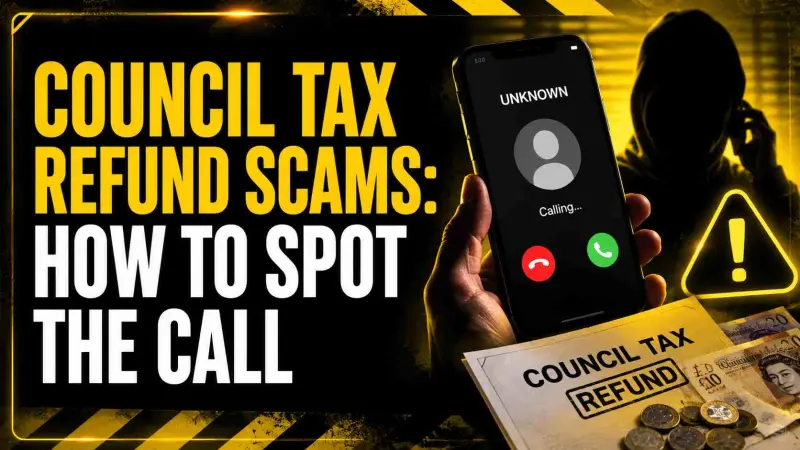
A phone call telling you that you are owed a Council Tax refund can sound convincing, particularly when the caller knows your name, address or council. The promise might be a refund of £150, £300 or even more. Then comes the request for your bank details, card information, an administration fee or an online verification code.
That is where the danger starts.
Council Tax refunds are real. If you have overpaid, your local authority may owe you money, and GOV.UK advises residents to contact their local council if they have overpaid and have not received an automatic refund. Council Tax bills, refunds and relief are dealt with by local authorities rather than the Valuation Office Agency (VOA).
The scam is not the existence of Council Tax refunds. It is the unexpected approach from somebody pretending to arrange one.
Government guidance warns that unexpected contacts offering refunds, rebates or unclaimed credits and asking for personal or financial information are potential scam indicators. The VOA also makes clear that it does not calculate or collect Council Tax bills and will not contact people unexpectedly to request money or financial information.
This guide explains how Council Tax refund scams work, why cold callers can appear genuine, which warning signs should make you hang up, and what you should do if you have already handed over information or money.
How Council Tax Refund Scams Work and What to Do About Them
What is a Council Tax refund scam?
A Council Tax refund scam is a type of impersonation fraud in which a criminal claims that you are entitled to money back from your Council Tax account.
The caller may pretend to represent:
- Your local council
- GOV.UK
- The Valuation Office Agency
- A government department
- A "Council Tax review team"
- A private company supposedly working with the council
- A claims or rebate service
The basic story is usually simple: you have overpaid Council Tax and the caller can help you recover the money.
The criminal then tries to obtain information or money.
They may ask for your:
- Bank account number and sort code
- Debit or credit card details
- Online banking information
- Passwords or security codes
- Date of birth
- Address and other identity information
- One-time passcodes
- An upfront administration or processing fee
Some scams stop after obtaining personal information. Others continue with attempts to access bank accounts, make payments, impersonate the victim or conduct further fraud.
The important distinction is that a genuine Council Tax refund can exist, but you do not need to trust an unexpected caller to obtain it.
Why do scammers use Council Tax refunds as bait?
Refunds are psychologically powerful because they sound like good news.
A caller saying, "We owe you £275," is likely to get more attention than somebody asking for money. The victim may initially think the call is helpful rather than suspicious.
There is another advantage for criminals: Council Tax is a familiar household expense. Most adults who pay it already know that their bill can change because of discounts, exemptions, household circumstances, payments or adjustments.
That gives a scammer a believable story.
For example, a caller might claim:
"Our records show that your Council Tax was incorrectly calculated and you're entitled to a refund."
The statement sounds official, but it does not prove anything.
A legitimate refund should be verified through your council using contact details you obtain independently. GOV.UK states that if you have overpaid Council Tax and have not received an automatic refund, you should contact your local council.
What does a typical Council Tax refund scam call sound like?
There is no single script, but many scams follow a familiar sequence.
Step 1: The unexpected call
The person introduces themselves as being from a council, government agency or refund department.
They may already know your name or address.
Do not assume that this information proves the caller is genuine. Personal details can be obtained from many sources, including previous data breaches, public records and information shared elsewhere.
Step 2: The refund claim
The caller tells you that you have been overcharged.
The amount may be deliberately attractive but believable.
For example:
"You are entitled to a £287 Council Tax refund."
The precise figure is designed to make the call sound as though somebody has checked your account.
Step 3: The verification request
The caller then asks for information "to confirm your identity".
This might begin with harmless-looking questions and progress to financial information.
A criminal may say:
"We just need your sort code and account number so we can process the refund."
Or they may request card details.
Step 4: The pressure
If you hesitate, the caller may create urgency.
You might be told:
- The refund expires today.
- Your application must be completed immediately.
- You will lose the money if you hang up.
- The council has introduced a new verification system.
- A processing fee must be paid first.
- You must confirm an online banking code.
This pressure is one of the strongest warning signs.
GOV.UK guidance specifically identifies unexpected contact, pressure to make a decision, short deadlines, requests for bank details and offers of refunds or rebates as signs that a communication could be fraudulent.
Could a genuine Council Tax refund really be available?
Yes.
This is what makes the scam particularly effective.
You might genuinely have a credit on your Council Tax account because you have:
- Paid too much
- Moved house
- Received a discount or exemption
- Had a Council Tax Support award applied
- Had your circumstances or liability changed
- Had an adjustment made to your account
The exact circumstances and refund process vary between councils.
For example, some councils allow residents to request refunds when their account is in credit, while certain credits may instead be used to reduce future instalments. Somerset Council says credits can arise when residents have overpaid and notes that Direct Debit customers may have refunds made automatically in appropriate circumstances.
The safest approach is therefore not to assume that every refund offer is fake. Instead, verify the refund independently.
Go to GOV.UK or your council's official website, find the council's genuine contact details and ask whether your account is actually in credit.
How can you tell if a Council Tax refund call is a scam?
Look for several warning signs rather than relying on one.
| Warning sign | Why it matters | Safer response |
|---|---|---|
| Unexpected call | You did not request contact | Hang up and verify independently |
| Caller promises a refund | Refunds are attractive bait | Check your Council Tax account |
| Request for bank details | Financial information can enable fraud | Do not provide it |
| Request for a card payment | A refund should not require an unexplained payment | Refuse and contact your council |
| Urgent deadline | Pressure reduces your chance to think | End the call |
| Caller asks for a security code | Codes can authorise transactions or account access | Never disclose it |
| Caller ID looks official | Numbers can be spoofed | Do not rely on caller ID |
| Caller asks you to install software | Could enable remote access | Refuse immediately |
| Caller sends an unexpected link | Could lead to a fake website | Do not click it |
The caller's telephone number is not reliable proof of identity. Government guidance warns that caller ID can be
spoofed, meaning a scammer can make a call appear to come from a trusted organisation.
What should you do if you receive a Council Tax refund cold call?
The safest response is surprisingly simple: do not deal with the refund during the unexpected call.
You can say:
"Thank you. I will contact my council directly."
Then end the call.
You do not need to prove to the caller that they are a scammer. You do not need to argue. You do not need to stay on the phone while they "transfer" you to another department.
After hanging up:
- Find your Council Tax bill.
- Identify the name of your local authority.
- Use GOV.UK or the council's official website to find its contact details.
- Contact the council yourself.
- Ask whether your account is in credit.
- Ask whether a refund is actually due.
- Follow the council's normal refund process.
GOV.UK confirms that Council Tax bills, refunds and relief are handled by the local authority.
What if the caller knows your name and address?
That does not make the call genuine.
Scammers often use personal information to create confidence. Knowing your name, postcode or even part of your address can make an impersonator sound much more convincing.
The key question is not:
"How did they know my details?"
It is:
"Can I independently verify that this person is authorised to discuss my Council Tax account?"
If the answer is no, stop the conversation.
A legitimate organisation should not require you to surrender sensitive information simply because the caller says they are official.
What if the caller asks for a small fee?
Treat this as a major warning sign.
A common fraud technique is to say that the victim must pay an administration, verification, release or processing fee before the refund can be issued.
For example:
"Your refund is £325, but there is a £25 verification charge."
The scammer may then ask for card details.
GOV.UK's scam guidance specifically identifies claims that you need to pay to apply for or receive a relief, refund or other benefit as a warning sign.
Even if the amount seems small, do not make the payment.
Contact your council through an independently sourced number instead.
What if the scammer asks for your bank details?
Do not provide them during an unsolicited call.
A sort code and account number do not always provide enough information by themselves to access an account, but that does not mean you should hand them to an unknown caller.
The bigger danger comes when the conversation expands into:
- Debit card numbers
- Card security codes
- Online banking passwords
- PINs
- One-time passcodes
- Authentication approvals
Never disclose these to someone who contacted you unexpectedly.
If you receive an authentication request that you did not initiate, do not approve it.
What if the caller asks you to move money?
End the call.
A genuine refund does not require you to transfer money to a "secure account" to receive your refund.
This type of instruction is a classic escalation tactic. The criminal may claim your account is at risk or that a payment is needed to "unlock" the refund.
Do not follow those instructions.
If you have already transferred money, contact your bank immediately.
What if the caller sends a link after the conversation?
Do not assume the link is safe because it contains words such as "council", "government" or "refund".
Scammers can create websites designed to look remarkably similar to official pages.
A safer method is to open your browser yourself and visit GOV.UK or your council's official website rather than using a link supplied by an unexpected caller.
Government guidance similarly warns people not to click links or provide financial information in suspicious communications.
Can the Valuation Office Agency call about a Council Tax refund?
Be particularly careful with claims involving the VOA.
The Valuation Office Agency deals with property valuation matters, including Council Tax banding in England and Wales. It does not calculate or collect your Council Tax bill.
GOV.UK states that the VOA will not tell you what you owe for Council Tax because those bills are worked out by your local council. It also says the VOA will not contact you without mentioning a specific property address and will not ask for money without a clear explanation.
So if somebody says:
"We are from the Valuation Office and need your bank details to process your Council Tax refund,"
stop and verify the claim independently.
What if you have already given the scammer your bank details?
Act quickly.
The correct response depends on exactly what you disclosed.
If you gave your bank account details
Contact your bank and explain that you provided information to a suspected fraudster.
Monitor your account for unusual activity.
If you gave card details
Contact your card provider immediately. Ask whether the card should be cancelled and replaced.
If you gave online banking credentials
Contact your bank urgently and change the affected credentials as instructed by the bank.
If the same password was used elsewhere, change it there too.
If you gave a one-time passcode
Tell your bank immediately what happened. Explain that the code was disclosed to a suspected scammer.
Do not assume that because no money has disappeared yet, everything is fine.
What if you have already lost money?
Contact your bank immediately.
Speed matters because your bank may be able to take steps to protect your account or attempt to recover funds depending on the circumstances.
You should also report the fraud to Report Fraud, the UK's national reporting centre for fraud and cyber crime. Report Fraud replaced Action Fraud as the national reporting service in December 2025.
Report Fraud accepts reports online and can also be contacted on 0300 123 2040.
If you are in Scotland, the reporting route differs and Police Scotland advises people to use 101 for crime reporting where appropriate.
Should you report a scam even if you did not lose money?
Yes.
A suspicious call can still be useful intelligence.
Report Fraud accepts information about suspicious approaches where fraud could have occurred but did not. Such reports can help authorities understand patterns and the types of fraud being attempted.
You can also report suspicious calls through the appropriate reporting channels and forward information to your phone provider where relevant.
Report Fraud's guidance explains that suspicious calls can be reported and that reports help phone networks identify and block malicious activity.
How genuine Council Tax refunds normally differ from scams
The biggest difference is control.
With a genuine refund, you can verify the information through your council and use an official process.
With a scam, the caller wants to control the conversation.
| Genuine process | Potential scam |
| You can verify through your council | Caller insists you stay on the phone |
| Information relates to your Council Tax account | Vague claims about "government refunds" |
| Official council contact details are available | Caller supplies a number and insists you use it |
| No unexplained urgency | "You must do this today" |
| No demand for secret security codes | Caller asks for passwords or one-time codes |
| Refund can be independently checked | Caller discourages independent verification |
| You control when and how you contact the council | Caller tries to keep control of the conversation |
The fact that a council genuinely can issue refunds is exactly why independent verification matters.
Can Council Tax Reduction be confused with a refund?
Yes, and scammers may exploit that confusion.
Council Tax Reduction, sometimes called Council Tax Support, is a scheme that can reduce the amount of Council Tax someone has to pay if they qualify. GOV.UK says eligibility and the amount available depend on factors including where you live, your income, household circumstances and the local council's scheme.
A reduction is not necessarily the same thing as a cash refund.
For example, a resident might qualify for a reduction that lowers future Council Tax payments. A scammer could deliberately describe this as a large "refund" to encourage the person to provide financial details.
If you think you may qualify for Council Tax Reduction, apply through your local council using the official GOV.UK route rather than responding to an unsolicited offer.
What should older people and vulnerable households watch for?
Anyone can fall victim to an impersonation scam.
However, people who are less comfortable with online banking, unfamiliar with Council Tax procedures or under financial pressure may find an unexpected refund call especially persuasive.
A useful household rule is:
No financial decision is made during an unexpected call.
If a family member receives a call, encourage them to hang up and discuss it with someone they trust before taking action.
There is no embarrassment in checking.
Scammers deliberately create situations in which victims feel they have to make an immediate decision. Taking five minutes to stop and verify the claim can prevent a much larger financial problem.
What are the most common mistakes people make?
The first mistake is believing the caller because they sound professional.
The second is trusting caller ID.
The third is allowing the caller to dictate the verification process.
The fourth is assuming that a small request is harmless.
For example, someone might refuse to give their bank password but still provide their full card number because the caller says it is only needed "to identify the refund account".
Another mistake is calling a number supplied by the caller to verify them.
Instead, find the council's contact details independently.
How can you protect yourself from future Council Tax scams?
A few habits make a significant difference.
Keep your Council Tax bill.
It gives you a reference point for your council, account information and payment arrangements.
Know your council.
If you receive an unexpected call, you will know which organisation should actually handle your bill.
Do not trust caller ID.
A familiar-looking number is not proof that the call is genuine.
Never disclose security codes.
Banks and other legitimate services have their own authentication procedures; an unexpected caller should not receive your codes.
Do not allow pressure to change your decision.
If the caller says you must act immediately, that is a reason to stop rather than comply.
Verify independently.
Use GOV.UK or your council's official website.
Talk to someone if you are unsure.
A second opinion can expose an obvious warning sign that is harder to see when you are under pressure.
What is likely to happen to Council Tax scams in the future?
The exact form of fraud is likely to keep changing.
The underlying tactic, however, is unlikely to disappear: impersonate a trusted organisation, offer an attractive financial outcome, create urgency and obtain money or information.
Technology may make these calls more convincing. Criminals can already spoof telephone numbers, create realistic websites and use information gathered from multiple sources to make an approach appear personalised. Government guidance specifically warns that caller ID can be falsified.
Artificial intelligence could also make scam conversations more polished, although the precise future use and scale are difficult to predict.
The best defence remains relatively low-tech:
Stop. Hang up. Verify independently.
A genuine refund will still be there when you contact the council through an official channel.
What is the safest way to check whether you are owed Council Tax money?
Start with your own Council Tax account.
If you believe you have overpaid, GOV.UK advises contacting your local council if you have not received an automatic refund.
Ask:
- Is my Council Tax account in credit?
- Why is there a credit?
- Am I entitled to a refund?
- Will the refund be automatic?
- What is the council's official refund procedure?
- Do I need to submit a refund request?
If the answer is no, you have lost nothing by checking.
If the answer is yes, you can follow the genuine process without dealing with the cold caller.
Key Insights
- Council Tax refunds are genuine, but unexpected refund calls can be scams. Verify any claimed refund directly with your local council.
- Never provide passwords, PINs, one-time passcodes or online banking security information to an unexpected caller.
- Do not trust caller ID. Telephone numbers can be spoofed to look as though a call comes from a trusted organisation.
- An administration or verification fee is a major warning sign, particularly when it is demanded during an unsolicited call.
- If you receive a suspicious call, hang up and contact the council yourself using independently sourced contact details.
- If you have shared financial information, contact your bank immediately and explain that you may have been targeted by fraud.
- Report suspicious activity even if you did not lose money. Report Fraud can collect information about attempted fraud and suspicious approaches.
- Do not let the promise of a few hundred pounds make you rush. A genuine refund can be checked through official channels.
FAQ
1. Are Council Tax refund calls genuine?
Some Council Tax refunds are genuine, but an unexpected call claiming that you are owed money should be treated cautiously. Verify the claim directly with your local council using contact details obtained independently.
2. Can someone call me about a Council Tax refund?
A council may contact residents in legitimate circumstances, but an unexpected request for bank details, card information, security codes or an upfront payment is a strong warning sign. Do not rely on the caller's identity or telephone number alone.
3. How do I know if I am owed a Council Tax refund?
Check your Council Tax account or contact your local council directly. GOV.UK says you should contact your local council if you have overpaid Council Tax and have not received an automatic refund.
4. Do councils ask for bank details over the phone?
Council refund procedures vary, so you should follow your own council's official instructions. If an unexpected caller asks for bank details, end the call and independently contact the council before providing anything.
5. Can scammers spoof a council telephone number?
Yes. Caller ID can be spoofed, meaning the number displayed on your phone may not represent the organisation that actually made the call. Government guidance specifically warns consumers not to rely on caller ID as proof of identity.
6. What should I do if a caller says I have a £300 Council Tax refund?
Do not provide information during the call. Hang up, find your council through GOV.UK or another trusted source and ask whether your account has a credit or refund available.
7. Is a Council Tax refund administration fee normal?
Do not assume that a fee requested by a cold caller is legitimate. GOV.UK identifies demands to pay to receive a relief or refund as a potential scam warning sign. Verify any fee independently with the council.
8. What if I gave a scammer my bank details?
Contact your bank immediately and explain exactly what information you disclosed. Monitor your account and follow your bank's instructions. You should also report suspected fraud to Report Fraud.
9. What if I gave the scammer my card number?
Contact your bank or card provider immediately. Explain that you provided the card details to a suspected scammer. The provider can advise whether the card needs to be blocked or replaced.
10. What if I gave a scammer a one-time passcode?
Contact your bank immediately. Tell them that you disclosed a security code during a suspected scam. Do not approve any unexpected authentication requests or payments.
11. Does the Valuation Office Agency issue Council Tax refunds?
No. The VOA deals with property valuation matters, while Council Tax bills, refunds and relief are dealt with by local councils. The VOA specifically warns people about fraudulent refund contacts made in its name.
12. Can Council Tax Reduction result in a refund?
Council Tax Reduction normally reduces the amount of Council Tax you need to pay if you qualify. It is not automatically the same as receiving a cash refund. Eligibility and rules depend on your council and circumstances.
13. Should I report a Council Tax scam call if I did not lose money?
Yes. Report Fraud accepts information about suspicious approaches where fraud was attempted or could have occurred but the victim did not lose money. Such reports can help authorities understand fraud patterns.
14. Where should I report a Council Tax scam in the UK?
Report suspected fraud to Report Fraud through its online reporting service or by calling 0300 123 2040. If you are in Scotland, different reporting arrangements may apply, including Police Scotland's 101 service.
15. What is the biggest warning sign of a Council Tax refund scam?
Pressure is one of the clearest warning signs. If somebody unexpectedly contacts you, promises a refund and insists that you provide financial information or act immediately, end the call and verify the claim independently.
Final Thoughts
Council Tax refund scams work because they combine something ordinary with something attractive: a familiar household bill and the promise of money back.
That combination can make an unexpected caller sound credible.
The safest response is not to try to work out whether the caller is genuine while you are still on the phone. Take control of the situation yourself. Hang up, find the council's official contact details and check your account directly.
Remember the simple rule: a genuine refund does not become invalid because you refuse to discuss it with a cold caller.
If you have overpaid Council Tax, your local authority can tell you what is actually owed and how a refund should be processed.
If somebody contacts you unexpectedly demanding bank details, security codes, a payment or immediate action, treat the call as suspicious.
And if you have already shared information or lost money, do not wait out of embarrassment. Contact your bank and report the incident as soon as possible. Early action can be far more valuable than trying to undo the damage later.
Disclaimer: The information provided in this article is for general informational and research purposes only. Company details, features, services, and market positions may change over time. Readers are advised to visit official company websites and conduct independent research before making any business decisions or purchasing services.
Most Searchable Keywords
Recent Blogs

Related Listings

Categories
- Accountants (295)
- Advertising Agencies (559)
- Architects (149)
- Automobiles (377)
- Beauty (300)
- Carpenters (146)
- Cleaning Services (387)
- Dentists (189)
- Driving (62)
- Education (1)
- Electricians (215)
- Energy (8)
- Event Organiser (687)
- Finance (602)
- Guide (3422)
- Health (2207)
- Information technology (206)
- Legal Services (361)
- Logistics (6)
- Maintenance (65)
Sponsored Listings in Plumbers


Related Blogs
Water Meter or Fixed Bill: Which Is Cheaper
Read this insightful article "Water Meter or Fixed Bill: Which Is Cheaper" to expand your knowledge!

ECO4 Free Insulation: What’s Still Available...
Read this insightful article "ECO4 Free Insulation: What’s Still Available in This Year" to expand your knowledge!
What It Costs to Run an Electric Fan Air Frye...
Read this insightful article "What It Costs to Run an Electric Fan Air Fryer or Tumble Dryer" to expand your knowledge!
Questions & Answers – Find What
You Need, Instantly!
How can I update my business listing?
Is it free to manage my business listing?
How long does it take for my updates to reflect?
Why is it important to keep my listing updated?
