
ECO4 Free Insulation: What’s Still Available in This Year
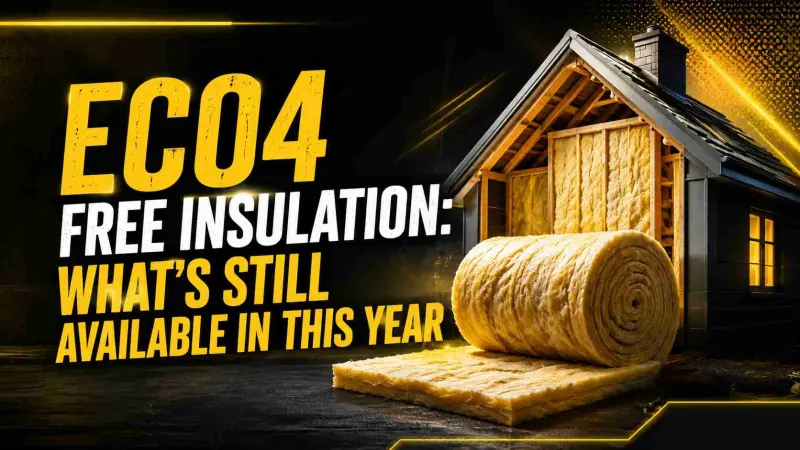
If you have seen adverts promising free insulation through ECO4 or the Great British Insulation Scheme, there is an important 2026 update you need to know before applying.
The Great British Insulation Scheme (GBIS) has now closed. Its official end date was 31 March 2026, and the government has confirmed that it will not be extended. However, ECO4 has been extended to 31 December 2026, giving eligible households more time to access energy-efficiency improvements through participating energy suppliers and installers.
That distinction matters because the two schemes were designed differently. GBIS generally focused on a single insulation improvement, while ECO4 takes a broader, whole-house approach and can combine insulation with other energy-efficiency or heating measures where the property and household qualify.
So, if you are looking for a free or heavily subsidised insulation upgrade today, ECO4 is the scheme that deserves your attention rather than assuming GBIS is still accepting new applications.
This guide explains how ECO4 works, who can qualify, what happened to GBIS, what types of insulation may be available, how ECO4 Flex works, what tenants need to know, and how to avoid misleading installer claims.
ECO4 and the Great British Insulation Scheme: What Is Available Now, Who Qualifies and How to Apply
Is the Great British Insulation Scheme still open?
No. The Great British Insulation Scheme closed on 31 March 2026. The government confirmed that there would be no extension to GBIS, even though ECO4 was extended by nine months.
This is one of the easiest points to get wrong because older webpages, advertisements and installer pages may still describe GBIS as an active programme.
The official GOV.UK service now says that its eligibility-checking service has closed, although some suppliers may still be dealing with existing applications. It also states that installations under GBIS had to be completed by 31 March 2026.
That means a household searching in August 2026 should not assume that a new application for GBIS can result in a new installation.
If someone contacts you claiming they can arrange a brand-new GBIS installation now, ask them to explain precisely which current government scheme they are using and which energy supplier is funding the work.
Why are ECO4 and GBIS often mentioned together?
The confusion comes from the fact that the schemes operated alongside one another.
Both were government-backed energy-efficiency programmes administered or overseen through the wider Energy Company Obligation framework. But they had different approaches.
GBIS was designed primarily around individual insulation measures. ECO4 is a broader whole-house scheme.
GBIS was introduced in April 2023, originally under the name ECO+, and targeted two broad groups: lower-income or vulnerable households and households meeting specific property criteria.
ECO4, meanwhile, is designed to improve the energy efficiency of qualifying homes through a package of measures where appropriate.
The difference can be summarised like this:
| Scheme | Position in 2026 | Main approach | Typical focus |
|---|---|---|---|
| ECO4 | Open until 31 December 2026 | Whole-house energy efficiency | Insulation, heating and other qualifying measures |
| GBIS | Closed on 31 March 2026 | Mainly single insulation measures | Cavity wall, loft, roof, floor and other insulation |
| ECO4 Flex | Available through participating arrangements | Wider local eligibility routes | Low-income or vulnerable households identified through Flex |
The government specifically decided to extend ECO4 but not GBIS.
What is ECO4?
ECO4 is the fourth phase of the Energy Company Obligation, a government energy-efficiency programme requiring larger energy suppliers to support qualifying improvements in homes.
The programme is intended to help improve energy efficiency, reduce energy consumption and support households that may otherwise struggle with energy costs.
The original ECO4 end date was 31 March 2026. Following a government consultation, the scheme was extended by nine months to 31 December 2026.
The extension is particularly relevant for households that might previously have assumed that all ECO4 funding had already disappeared.
It has not.
There is still time during 2026, but that does not mean every household will qualify or that every installer will have funding available.
Who can qualify for ECO4?
ECO4 eligibility is not based simply on being a homeowner or having an expensive energy bill.
Eligibility can depend on factors including:
- Household circumstances
- Benefits received
- Household income
- Property characteristics
- Existing energy efficiency
- Heating arrangements
- Energy Performance Certificate information
- Local authority or supplier Flex arrangements
- The improvements identified as suitable following assessment
One of the important features of ECO4 is that eligibility and suitability are not necessarily the same thing.
You might appear to qualify based on your household circumstances but still not receive a particular measure because an assessment determines that it is unsuitable or because the supplier does not take the project forward.
This is why a proper assessment matters.
What is ECO4 Flex?
ECO4 Flex allows participating local authorities and devolved administrations to identify households that may qualify even when they do not meet the standard benefit-related eligibility route.
Ofgem describes ECO4 Flex as a household referral mechanism that allows participating local authorities and devolved administrations to widen eligibility for households considered to be living in fuel poverty, on a low income or vulnerable to the effects of living in a cold home.
This can be particularly useful if your circumstances do not fit neatly into the standard criteria.
A local authority may have its own process for identifying eligible residents, so availability can vary between areas.
That means two households with similar incomes may have different routes into support depending on where they live and whether their local authority is participating.
Can you get free insulation through ECO4?
Potentially, yes. Eligible households may receive insulation and other energy-efficiency improvements with the cost funded partly or fully through ECO4, depending on the project.
But the phrase "free insulation" should be treated carefully.
There is no universal guarantee that every applicant will receive completely free work.
The actual contribution can depend on:
- Your eligibility.
- Your property.
- The measure proposed.
- The supplier or installer.
- The assessment.
- Available ECO4 funding.
- Whether additional contributions are required.
A reputable provider should explain the financial arrangements before work starts.
If someone says "you definitely qualify for free insulation" before checking your household circumstances or property, treat that claim cautiously.
What types of insulation could be available?
ECO4 can support a range of energy-efficiency measures, subject to the scheme rules and the property's needs.
Possible insulation measures can include:
- Loft insulation
- Cavity wall insulation
- Solid wall insulation
- Under-floor insulation
- Roof insulation
- Room-in-roof insulation
- Other qualifying energy-efficiency improvements
The exact measure should not be chosen simply because it is being promoted by an installer.
A proper assessment should establish what the property needs.
For example, a house with an already well-insulated loft may benefit more from addressing another part of the building envelope. Conversely, a poorly insulated loft can represent an obvious starting point.
The principle is simple: the measure should fit the property rather than the property being made to fit the advertised measure.
How does the ECO4 assessment work?
A property assessment is important because insulation can affect ventilation, moisture, heat loss and the overall performance of the building.
For ECO4 projects involving relevant retrofit measures, the scheme uses a whole-house approach and follows the domestic retrofit process associated with PAS 2035 requirements. Ofgem states that ECO4 also includes requirements concerning improvement to the property's SAP rating.
A typical process may involve:
Step 1: Initial eligibility check
The supplier or installer establishes whether your household and property appear to meet the relevant criteria.
Step 2: Property assessment
A qualified assessor examines the building and its existing energy-efficiency characteristics.
Step 3: Measure selection
The assessment identifies measures that may be suitable.
Step 4: Funding and approval
The supplier or delivery organisation determines whether the project can proceed under ECO4.
Step 5: Installation
Approved contractors carry out the agreed work.
Step 6: Verification
The work may be inspected or checked to ensure that it meets the required standards.
This process is one reason why a genuine ECO4 application is more involved than simply booking an insulation contractor.
Do you have to be with a particular energy supplier?
Not necessarily.
Ofgem's GBIS guidance explicitly stated that eligible households could contact obligated energy suppliers even if that supplier was not their current energy provider.
ECO4 also operates through obligated energy suppliers and their delivery arrangements rather than being restricted simply to the company that sends your current bill.
However, supplier participation, installer availability and funding arrangements can vary.
So if your existing supplier says it cannot help, that does not automatically mean you are ineligible for ECO4.
It may be worth checking other participating routes.
Can tenants receive ECO4 insulation?
Tenants can potentially benefit, but landlord permission may be required depending on the property and work involved.
Insulation is attached to the building rather than being something a tenant can simply take with them when moving out. Landlords therefore have an obvious interest in approving substantial works.
For schemes such as GBIS, Ofgem stated that applicants could be homeowners or tenants with the necessary permission from the landlord, including social housing situations.
The same practical principle applies when considering energy-efficiency work under ECO4: do not arrange substantial alterations to a rented property without establishing who has authority to approve them.
What happened to people who applied for GBIS before it closed?
If you made an application before the scheme ended, the situation is different from making a new application today.
The official GOV.UK guidance says that people with existing applications should contact the energy supplier they applied to. It also explains that an eligible applicant would have an assessment arranged and would be informed whether any contribution was required.
So if you already started a GBIS application, do not assume that it has simply disappeared.
Contact the supplier or organisation handling your application and ask:
- Whether your application was formally accepted
- Whether an assessment was completed
- Whether installation was approved
- Whether the project was completed
- Whether you are expected to contribute anything
- What happens if the original installer is no longer handling the project
Keep copies of emails, assessments, agreements and photographs of the property.
Why does the distinction between "eligible" and "approved" matter?
This is a small distinction that can prevent major misunderstandings.
Being eligible means that you appear to satisfy the scheme's criteria.
Being approved for a specific measure means the supplier or delivery process has accepted the proposed work.
These are not identical.
Ofgem states that GBIS eligibility did not guarantee that an energy supplier or installer would ultimately decide to install energy-efficiency measures.
The same principle is useful when assessing ECO4 claims.
A phone call saying "you qualify" is not the same thing as having a confirmed installation.
What should you check before accepting an ECO4 offer?
The safest approach is to slow down before agreeing to work.
Ask the installer or supplier:
Which scheme is funding this work?
In 2026, this question is particularly important because GBIS has closed.
Who is the obligated energy supplier?
Ask who is responsible for the funding arrangement.
What exact measure is being proposed?
Do not accept a vague promise of "government insulation."
Is the work completely funded?
Get confirmation in writing.
Will I have to pay anything?
Ask about deposits, contributions and any additional work.
Who is carrying out the installation?
Check the credentials and relevant registration.
What happens if the assessment finds another problem?
This can matter with insulation because damp, ventilation and building condition may affect what work is appropriate.
How can you spot misleading insulation adverts?
The end of GBIS has made outdated advertising particularly problematic.
Warning signs include:
- "GBIS is ending soon" adverts appearing after March 2026.
- Claims that everyone can get completely free insulation.
- Requests for large upfront payments before eligibility is established.
- Pressure to agree immediately.
- No explanation of which scheme funds the work.
- No clear assessment process.
- Vague claims about guaranteed savings.
- Refusal to identify the energy supplier funding the project.
- Requests for sensitive information without a clear reason.
An advert may be from a legitimate commercial insulation company without being an official government programme.
Those are two different things.
A company can offer insulation privately while using government-funded schemes for qualifying customers. The fact that a business advertises "ECO4" does not automatically make the business a government department.
What happened to GBIS overall?
GBIS delivered a significant number of insulation measures before its closure.
According to the government's May 2026 statistical release, 139,200 measures were installed in around 100,900 households up to the end of March 2026. Around 74,300 of those measures were delivered to households in the low-income eligibility group.
Those figures help put the scheme's scale into perspective.
GBIS was not simply a small pilot programme. It supported a substantial volume of domestic energy-efficiency work before reaching its planned end date.
The government's latest published statistics also note that the data remains provisional and subject to revision as processing and validation continues.
Why did the government extend ECO4 but not GBIS?
The 2025 consultation considered extending ECO4 because suppliers needed additional time to meet existing targets and deal with compliance and remediation issues.
The final decision was to extend ECO4 by nine months to 31 December 2026.
GBIS, however, was not extended. The government explicitly confirmed that it would close on 31 March 2026.
This creates an unusual situation for people searching for insulation support in 2026.
There is still an active route through ECO4, but one of the schemes most commonly associated with free insulation has already ended.
Can ECO4 pay for more than insulation?
Yes. ECO4 is broader than an insulation-only programme.
Its whole-house approach means eligible projects can involve multiple types of energy-efficiency and heating measures where appropriate.
That is one of the main differences between ECO4 and GBIS.
GBIS generally focused on one principal insulation improvement per home, whereas ECO4 can consider a wider package following an assessment.
For a household with several energy-efficiency problems, that distinction can be significant.
For example, a property might have poor insulation combined with an inefficient heating system. Rather than treating insulation as an isolated project, the ECO4 process can consider the wider performance of the home.
That does not mean every household receives every possible measure. The assessment and scheme requirements still determine what can be delivered.
What should you do if you think you qualify?
A sensible 2026 approach is:
- Check your household circumstances.
Look at benefits, income and any relevant vulnerability criteria. - Check your property.
Find your EPC information if available and consider the age and construction of the building. - Contact a legitimate ECO4 route.
Ask specifically about current ECO4 support rather than GBIS. - Ask about ECO4 Flex.
Your local authority may have a route for households that do not meet the standard criteria. - Request a proper assessment.
Do not choose insulation solely from an online advert. - Get funding details in writing.
Confirm whether anything is payable. - Check the installer.
Ask who is responsible for the installation and what standards apply. - Keep your paperwork.
Retain assessments, contracts, photographs and correspondence.
The earlier you start, the better. ECO4 is currently scheduled to end on 31 December 2026, so waiting until the final weeks could leave less time for assessment, approval and installation.
Does free insulation always mean you will save a lot of money?
No.
Better insulation can reduce heat loss, but the financial effect varies substantially between properties.
Savings depend on:
- Existing insulation levels
- Property size
- Building construction
- Heating system
- Indoor temperature
- Energy prices
- Household behaviour
- How much heat was previously being lost
A poorly insulated older property may have significant potential for improvement. A modern, already well-insulated home may see a much smaller change.
This is why promises such as "save hundreds every year" should be treated as estimates rather than guarantees.
The purpose of an assessment is to understand what the property actually needs.
What are the potential benefits of insulation?
The most obvious benefit is reduced heat loss.
Good insulation can help a home retain warmth for longer, potentially reducing the amount of energy required to maintain a comfortable temperature.
Other potential benefits include:
- More consistent indoor temperatures
- Reduced draught-related discomfort
- Improved thermal comfort
- Lower energy consumption
- Reduced carbon emissions
- Better overall energy efficiency
There can also be practical benefits that are difficult to express purely in pounds and pence.
A room that previously became cold quickly may feel noticeably more comfortable after suitable insulation improvements.
What are the risks of poorly installed insulation?
Insulation is not simply a matter of putting material into or onto a building.
Poorly designed or installed insulation can contribute to problems involving moisture, ventilation,
thermal bridging or defects in the building fabric.
This is particularly relevant because the government has acknowledged quality concerns relating to some solid wall insulation installed through GBIS and provides guidance for affected households.
That does not mean insulation itself is unsafe.
It means the design, assessment and installation quality matter.
If you already have damp, mould, penetrating moisture or serious defects, raise these issues before agreeing to insulation work.
What does ECO4 mean for households after 2026?
The immediate issue is that ECO4 is currently scheduled to end on 31 December 2026.
The government has not created a new successor obligation that allows ECO4 delivery to continue indefinitely. Its decision specifically stated that there would be no carry-over mechanism into a successor obligation.
That makes 2026 an important transition period.
Households should not assume that an ECO4-style offer will automatically remain available in 2027.
At the same time, the end of one scheme does not mean energy-efficiency policy disappears permanently. Governments can introduce new programmes, modify existing support or provide funding through different mechanisms.
However, future programmes should be judged on their actual published eligibility rules rather than assumptions based on ECO4.
What should homeowners prepare for next?
If you are interested in improving your home, 2026 is a sensible time to understand its current condition rather than waiting for another grant announcement.
Useful preparation includes:
- Finding your EPC.
- Checking your loft insulation.
- Looking for obvious draughts.
- Understanding your wall construction.
- Checking for damp or moisture problems.
- Reviewing your heating system.
- Keeping records of previous improvements.
- Checking your local authority's energy-efficiency support.
You do not necessarily need to undertake expensive work immediately.
The goal is to know what your home needs so that you can make a better decision if funding becomes available.
Future outlook for UK home insulation support
The direction of UK energy policy continues to place considerable emphasis on improving household energy efficiency, reducing energy consumption and tackling fuel poverty.
What happens after ECO4 is less certain than the immediate 2026 timetable.
The government has already made clear that ECO4 will end on 31 December 2026, while GBIS has already closed.
Future support could take different forms, including grants, local authority programmes, supplier obligations or other targeted assistance.
For homeowners, the practical lesson is not to build a financial plan around a grant that has not yet been announced.
If you need insulation and qualify for an available programme today, investigate it now. If you do not qualify, improving the property's energy performance independently may still make sense, provided the work is technically appropriate and financially worthwhile.
For renters, maintaining communication with the landlord will remain important because many substantial energy-efficiency improvements require the property owner's involvement.
The energy-efficiency market is also likely to place greater emphasis on whole-home performance rather than isolated products. That makes proper assessment increasingly valuable.
Key Insights
- GBIS is no longer open for new installations. The scheme ended on 31 March 2026.
- ECO4 remains available in 2026. Its end date has been extended to 31 December 2026.
- Do not confuse ECO4 with GBIS. ECO4 has a broader whole-house approach, while GBIS primarily focused on individual insulation measures.
- Free insulation is not automatically guaranteed. Eligibility does not necessarily mean a supplier will approve every measure.
- ECO4 Flex can widen access. Participating local authorities can refer certain low-income, fuel-poor or vulnerable households.
- Get funding terms in writing. Ask whether you have to pay anything before agreeing to work.
- Quality matters as much as eligibility. Insulation should be selected and installed according to the property's construction and condition.
- Do not wait until the end of 2026. ECO4 is currently scheduled to close on 31 December 2026.
FAQ
1. Is ECO4 still available in 2026?
Yes. ECO4 has been extended and is currently scheduled to end on 31 December 2026. Eligibility depends on household circumstances, property characteristics and the specific measures identified as suitable.
2. Is the Great British Insulation Scheme still open?
No. GBIS ended on 31 March 2026. The government decided not to extend it. Some suppliers may still be dealing with existing applications, but new GBIS installations cannot be treated as an ongoing 2026 programme.
3. Can I still get free insulation through ECO4?
Potentially. Eligible households may receive insulation funded partly or fully through ECO4, but "free" is not guaranteed for every applicant. The actual support depends on eligibility, the property assessment, the proposed measure and the funding arrangement.
4. Who is eligible for ECO4?
Eligibility can depend on household income, qualifying benefits, vulnerability, property characteristics, energy performance and other scheme requirements. ECO4 Flex can provide additional routes for some households through participating local authorities.
5. Can homeowners apply for ECO4?
Yes, homeowners can potentially qualify if their household and property meet the relevant criteria. Owning a property alone does not guarantee ECO4 funding.
6. Can tenants get ECO4 insulation?
Tenants can potentially benefit from qualifying energy-efficiency improvements, although landlord involvement or permission may be required depending on the work. Tenants should establish who is responsible for approving the installation before proceeding.
7. Do I have to use my current energy supplier?
Not necessarily. ECO4 operates through obligated energy suppliers and delivery arrangements, so eligibility is not simply determined by which company currently supplies your energy. Availability can vary between providers.
8. What is ECO4 Flex?
ECO4 Flex is a referral mechanism that allows participating local authorities and devolved administrations to identify households that may qualify under wider criteria, including some households experiencing low income, fuel poverty or vulnerability to living in a cold home.
9. What insulation can ECO4 provide?
Depending on eligibility and the property assessment, qualifying work can include measures such as loft, cavity wall, solid wall, roof and floor insulation. The precise measure depends on the property's needs and the scheme rules.
10. Is an EPC required for ECO4?
Property energy performance can form part of ECO4 eligibility and assessment, but requirements vary according to the route and circumstances. An installer or supplier should establish the relevant criteria rather than relying on a general EPC assumption.
11. Can I apply for GBIS now?
No new GBIS installation should be treated as available because the scheme closed on 31 March 2026. If you had already applied before closure, contact the supplier or organisation handling your application.
12. Does free insulation guarantee lower energy bills?
No. Insulation can reduce heat loss and energy demand, but actual savings depend on the property, heating system, energy prices and household behaviour. No responsible installer should present a guaranteed saving as a certainty.
13. Should I pay an installer upfront for ECO4 insulation?
Be cautious. Before making any payment, establish exactly what the charge covers, whether the work is government-supported and whether you are expected to contribute. Ask for the funding and payment terms in writing.
14. When does ECO4 end?
ECO4 is currently scheduled to end on 31 December 2026 following the government's decision to extend it by nine months.
15. What should I do if someone advertises GBIS as available now?
Ask them to identify the current government scheme, the funding supplier and the basis for their claim. Because GBIS closed on 31 March 2026, an advert describing it as a new, open scheme in August 2026 may be outdated or misleading.
Final Thoughts
The biggest mistake to avoid in 2026 is treating ECO4 and the Great British Insulation Scheme as though they are still the same active programme.
GBIS has finished. ECO4 has not.
If you are looking for help with insulation, the practical route now is to investigate whether you qualify for ECO4 or ECO4 Flex, rather than relying on old GBIS advertisements. Start with your household circumstances and the condition of your property, then seek a proper assessment and written confirmation of the funding arrangement.
Most importantly, do not accept the phrase "free insulation" at face value. Find out which scheme is paying, what measure is being proposed,
whether you have to contribute, who is installing it and what happens if the assessment identifies a problem.
With ECO4 currently scheduled to close at the end of December 2026, eligible households have a remaining opportunity to investigate support. But the clock is no longer at the beginning of the programme, so checking your options sooner rather than later is the sensible approach.
Disclaimer: The information provided in this article is for general informational and research purposes only. Company details, features, services, and market positions may change over time. Readers are advised to visit official company websites and conduct independent research before making any business decisions or purchasing services.
Most Searchable Keywords
Recent Blogs
Related Listings

Categories
- Accountants (295)
- Advertising Agencies (559)
- Architects (149)
- Automobiles (377)
- Beauty (300)
- Carpenters (146)
- Cleaning Services (387)
- Dentists (189)
- Driving (62)
- Education (1)
- Electricians (215)
- Energy (8)
- Event Organiser (687)
- Finance (602)
- Guide (3422)
- Health (2207)
- Information technology (206)
- Legal Services (361)
- Logistics (6)
- Maintenance (65)
Sponsored Listings in Plumbers
Related Blogs
Water Meter or Fixed Bill: Which Is Cheaper
Read this insightful article "Water Meter or Fixed Bill: Which Is Cheaper" to expand your knowledge!
ECO4 Free Insulation: What’s Still Available...
Read this insightful article "ECO4 Free Insulation: What’s Still Available in This Year" to expand your knowledge!
What It Costs to Run an Electric Fan Air Frye...
Read this insightful article "What It Costs to Run an Electric Fan Air Fryer or Tumble Dryer" to expand your knowledge!
Questions & Answers – Find What
You Need, Instantly!
How can I update my business listing?
Is it free to manage my business listing?
How long does it take for my updates to reflect?
Why is it important to keep my listing updated?
