
Octopus Agile vs Fixed Tariffs: Which Is Cheaper
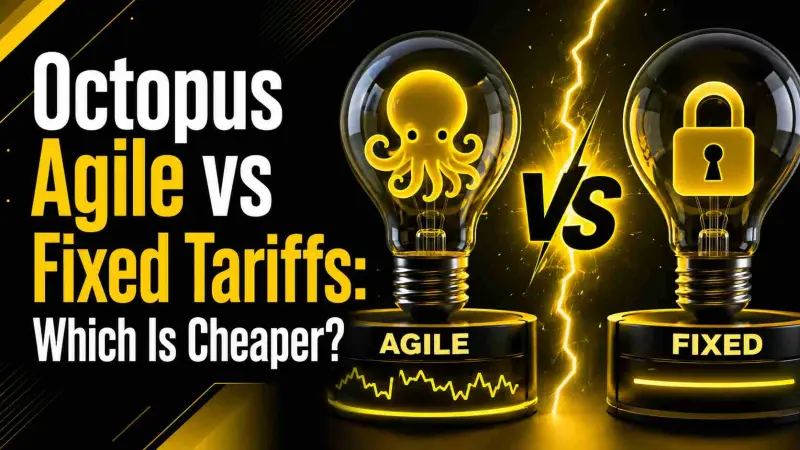
If you are choosing between Octopus Agile and a fixed electricity tariff, the cheapest option is not automatically the one with the lowest advertised rate. Agile can be exceptionally cheap when you can move electricity use into low-price periods, but it can also become expensive when you need power during high-demand periods. A fixed tariff offers much less uncertainty: you know your unit rate in advance and do not have to watch half-hourly prices.
That difference matters even more in 2026. Ofgem's electricity price cap for 1 July to 30 September 2026 averages 26.11p per kWh with a 57.19p daily standing charge for Direct Debit customers across England, Scotland and Wales. The cap does not apply to fixed tariffs, and actual rates vary by region.
Octopus says its Agile tariff can reach 100p per kWh, while cheap periods can fall dramatically when wholesale electricity prices are low. Agile therefore rewards households that can change when they use electricity. A fixed tariff does the opposite: it rewards certainty rather than flexibility.
So which works out cheaper for a real household? The answer depends less on whether you are an "Agile person" and more on when you use electricity, how much you can shift, whether you have flexible appliances, and how much price volatility you can comfortably tolerate.
Octopus Agile vs Fixed Tariffs: Which Works Out Cheaper for Real Households?
What is the real difference between Agile and a fixed tariff?
The simplest distinction is this:
Octopus Agile changes the price of electricity every 30 minutes, whereas a fixed tariff keeps your agreed unit rate stable for the duration of the deal.
Agile is a time-of-use tariff built around wholesale electricity prices. Octopus publishes the following day's half-hourly rates, allowing customers to see when electricity is expected to be cheap or expensive. Your smart meter then records how much electricity you use during each period.
A fixed tariff, by comparison, gives you a quoted unit rate and standing charge for the fixed period. Your bill can still rise if you use more electricity, but the price per unit does not fluctuate with the wholesale market.
That creates two very different approaches to saving money:
- Agile: save by changing when you consume electricity.
- Fixed: save or protect yourself by locking in what you pay per unit.
- Agile: potentially much cheaper during low-price periods.
- Fixed: predictable costs and less exposure to price spikes.
- Agile: best suited to flexible households.
- Fixed: easier for households with fixed routines.
The distinction is important because comparing one Agile rate with one fixed rate is misleading. Agile has no single electricity price for the day.
How does Octopus Agile actually work?
Agile uses 48 half-hourly pricing periods each day. The rates are based on wholesale electricity costs and can vary substantially from one period to the next.
Imagine your household uses 12 kWh on a particular day.
On a conventional fixed tariff, using those 12 kWh at 2pm, 6pm or 11pm makes no difference to the unit price.
On Agile, it can make a huge difference.
For example, suppose your illustrative Agile prices were:
| Time | Illustrative Agile rate | Household use |
|---|---|---|
| 7am–8am | 24p/kWh | 2 kWh |
| 12pm–1pm | 9p/kWh | 3 kWh |
| 4pm–5pm | 34p/kWh | 2 kWh |
| 6pm–7pm | 48p/kWh | 2 kWh |
| 10pm–11pm | 12p/kWh | 3 kWh |
The household could save substantially by moving flexible consumption from the expensive evening periods into cheaper periods.
Those rates are purely illustrative; actual Agile prices change according to market conditions.
Octopus currently says Agile prices can rise as high as 100p/kWh, although its tariff also includes periods where prices can become extremely low or even negative.
That is the attraction and the risk in one tariff.
Why can Agile sometimes beat a fixed tariff by a lot?
Agile is particularly interesting because wholesale electricity prices are not constant throughout the day.
Electricity demand tends to rise at predictable times, particularly when households return home, cook, heat their homes and use appliances. Octopus highlights the traditional 4pm to 7pm rush period as a key period when customers can save by reducing consumption.
At other times, especially when electricity generation is abundant and demand is lower, wholesale prices can fall sharply.
A household with an electric vehicle, battery, immersion heater, dishwasher and washing machine may therefore have considerably more control over its electricity consumption than someone who simply switches appliances on whenever needed.
This is where Agile becomes genuinely different from a normal tariff.
Who is most likely to save on Agile?
Agile tends to make the most sense for households that can move a meaningful share of their electricity consumption.
The strongest candidates include:
- EV owners who can delay charging.
- Homes with batteries.
- Households with smart appliances.
- People who can run washing machines and dishwashers overnight or during cheap periods.
- Homes with electric heating that can be pre-heated or scheduled.
- Households with solar panels and storage.
- People who are comfortable checking prices occasionally.
- Households that do not need large amounts of electricity during the evening peak.
Octopus specifically identifies EVs, storage heaters and other large flexible loads as suitable uses for Agile.
The key word is flexibility.
Having a smart meter alone does not make Agile automatically cheaper.
Who is better off choosing a fixed tariff?
A fixed tariff may be more suitable if your electricity use is difficult to move.
Consider a household with young children that cooks dinner at 6pm, heats the house in the evening, runs appliances after work and has little interest in checking electricity prices.
That household could struggle to take advantage of Agile's cheapest periods.
A fixed tariff may be preferable if:
- You want predictable pricing.
- You have little flexibility over when electricity is consumed.
- You are uncomfortable with price volatility.
- You have a tight household budget and cannot easily absorb expensive periods.
- You prefer to set your energy budget once rather than monitor prices.
- You expect wholesale prices to rise and value protection against that possibility.
There is no prize for choosing the more complicated tariff.
If a fixed tariff fits your lifestyle better, a modestly higher theoretical rate can still be worth paying for the certainty it provides.
How much can a real household actually save?
This is where many Agile-versus-fixed comparisons become unreliable.
The answer depends on the load profile, not simply annual consumption.
Two homes could each use 3,500 kWh of electricity a year and receive completely different results on Agile.
Household A: the inflexible home
Suppose most of its electricity is consumed:
- between 4pm and 9pm;
- during cooking;
- during evening heating;
- when people are home from work and school.
This household may repeatedly buy electricity during expensive periods.
Even if its annual consumption is moderate, Agile may not be particularly attractive.
Household B: the flexible home
Now consider a similar home with:
- an EV;
- a home battery;
- smart heating;
- flexible washing;
- overnight appliance use.
The family might shift several kWh away from expensive periods every day.
The two households use similar amounts of electricity, but Household B has much greater control over the price it pays.
That is why annual kWh alone is not enough to decide whether Agile is cheaper.
What does the current UK energy market mean for the decision?
The wider market matters because Agile is directly exposed to wholesale electricity conditions.
For July to September 2026, Ofgem's average price-cap electricity rate for Direct Debit customers is 26.11p/kWh, with a 57.19p daily standing charge. These are averages across England, Scotland and Wales rather than a universal household rate.
Ofgem also stresses that the price cap is not a cap on the total amount a household can pay.
It limits unit rates and standing charges on covered default tariffs; your actual bill still depends on consumption.
That distinction matters when comparing Agile with a fixed deal.
If a fixed tariff is priced below the relevant price-cap level, you are paying for certainty at a relatively attractive starting point.
Octopus said in May 2026 that its then-current 12-month Octopus Fixed tariff was around £1,780 for a typical dual-fuel household, approximately £82 below the July price-cap benchmark. That figure was a representative dual-fuel example, not a guarantee of what an individual household would pay.
Rates can change, so anyone switching should compare the live offer shown for their own property rather than relying on an old headline figure.
Is Agile cheaper than Octopus Fixed in 2026?
It can be, but there is no universal winner.
Octopus itself warns that Agile's variable nature makes future costs difficult to predict and says historical performance should not be treated as a forecast.
That is probably the most useful way to think about the comparison.
A fixed tariff effectively says:
"I would rather know my price than gamble on future wholesale conditions."
Agile says:
"I am willing to accept changing prices because I can change my consumption."
Neither approach is automatically financially superior.
The cheaper option for you depends on how effectively you can exploit the tariff.
What happens if Agile prices suddenly spike?
This is one of the biggest concerns for potential Agile customers.
Agile's price can increase sharply when wholesale electricity becomes expensive. Octopus currently states that Agile electricity rates have a 100p/kWh maximum under its Price Cap Protect mechanism.
That does not mean you will normally pay 100p/kWh.
It means the tariff's ceiling is much higher than a standard price-cap electricity rate.
Imagine using 5 kWh during a period priced at 80p/kWh. The electricity component alone would cost £4.
On a conventional tariff priced around 26p/kWh, the same consumption would be about £1.30.
That difference can become uncomfortable if your household cannot avoid expensive periods.
This is why Agile should not be treated as a simple "cheap tariff".
It is a risk-and-flexibility tariff.
What about negative Agile prices?
Negative prices are one of Agile's most eye-catching features.
When wholesale electricity prices fall below zero, Agile can sometimes produce negative unit rates. Octopus says its Plunge Pricing feature allows customers to benefit from these events, potentially receiving payment for electricity consumed during qualifying negative-price periods.
But negative pricing should not form the basis of your household budget.
These periods are not guaranteed, and the overall cost of electricity depends on all the periods in which you consume power.
A sensible Agile customer treats very cheap periods as an opportunity rather than assuming they will happen frequently enough to make the tariff profitable.
Does having solar panels make Agile better?
It can, but the answer is more complicated than simply saying "solar plus Agile equals cheap electricity."
A solar household may already consume less grid electricity during daylight hours. A battery can then store electricity and release it later.
Agile can potentially improve the economics by allowing the household to:
- Charge the battery during cheap periods.
- Avoid buying expensive electricity during peak periods.
- Use stored energy when Agile prices rise.
- Export surplus electricity when the export tariff makes that worthwhile.
Octopus says its export tariffs require half-hourly smart-meter readings, and its Agile export option also changes according to wholesale prices.
However, import and export rates are not automatically identical.
A solar household should therefore compare both import and export arrangements, rather than looking only at the Agile electricity rate.
What about EV owners?
EV owners are among the strongest candidates for time-of-use tariffs because car charging is often highly flexible.
Suppose you arrive home at 6pm.
On a fixed tariff, plugging the car in immediately makes no difference to the unit rate.
On Agile, you could potentially wait for a cheaper period later in the evening or overnight.
A smart charging system can make that easier.
The saving becomes more significant when the EV consumes several kWh per charging session.
For example, moving 20 kWh of charging from an illustrative 40p period to a 12p period changes the electricity cost from £8 to £2.40 — a £5.60 difference for that charging session.
Again, these are illustrative rates rather than a forecast of actual Agile prices.
Over dozens of charging sessions, however, the principle becomes clear: large flexible loads create much more opportunity than small ones.
What about heat pumps and electric heating?
Electric heating can make Agile either particularly attractive or particularly awkward.
The problem is that heating demand often occurs precisely when electricity is expensive.
If your heating system can be controlled intelligently, you may be able to warm the property ahead of an expensive period and reduce consumption when prices rise.
Octopus says its smart heating technology can work with Agile by avoiding expensive peaks and targeting cheaper periods.
But not every home can shift heating demand without affecting comfort.
A poorly insulated house with occupants who need constant heating may have
much less flexibility than a well-insulated property with thermal storage.
So the right question is not:
"Do I have electric heating?"
It is:
"How much of my electric heating can I move without making the house uncomfortable?"
Can Agile work for a household that does not want to monitor prices?
Yes, but it becomes less compelling.
You do not have to stare at the Octopus app every half hour. Prices are published ahead of time, and compatible smart devices can automate some consumption.
Still, the biggest savings generally come from households that either actively respond to price signals or use automation to do it for them.
If you want a tariff that requires almost no behavioural change, a fixed tariff is simpler.
How should you compare the two properly?
Do not compare headline unit rates alone.
Use your actual electricity consumption and, ideally, your half-hourly smart-meter data.
A practical comparison looks like this:
Step 1: Find your annual electricity consumption
Look at your previous 12 months of bills.
If you use 2,000 kWh, your situation is very different from someone using 6,000 kWh.
Step 2: Find your current fixed offer
Record:
- Electricity unit rate.
- Standing charge.
- Contract length.
- Exit fee.
- Any special conditions.
Step 3: Look at your consumption pattern
Ask when you normally use electricity.
Is most of it:
- overnight?
- during the day?
- 4pm–7pm?
- spread evenly?
Step 4: Identify flexible loads
Estimate how many kWh you can realistically move.
Your EV might be flexible.
Your kettle probably is not.
Your washing machine is flexible.
Your oven may be less so.
Step 5: Stress-test Agile
Do not only ask what happens if prices are cheap.
Ask what happens if electricity becomes expensive.
Could your household cope if several high-use periods cost substantially more than your fixed alternative?
Step 6: Compare the total annual cost
The useful calculation is:
Annual electricity cost = consumption cost + standing charges
For Agile, consumption cost must be calculated across the individual half-hourly rates.
For a fixed tariff, it is much simpler:
Annual cost = annual kWh × fixed unit rate + annual standing charges
This is why a household's own smart-meter data can be much more informative than generic "typical household" comparisons.
A simple household comparison
Consider three fictional households.
| Household | Electricity profile | Likely better fit |
| Flat with low, steady usage | Little flexibility | Fixed |
| Family with flexible appliances | Some flexibility | Either |
| EV + battery + smart heating | High flexibility | Agile |
The third household has the greatest opportunity to benefit because it can move large amounts of consumption.
The first has little opportunity to respond to price changes, so the simplicity of a fixed tariff may be worth more.
What are the biggest mistakes people make with Agile?
Mistake 1: Assuming cheap overnight electricity is guaranteed
Agile is dynamic.
Tomorrow's prices are not the same as yesterday's.
Mistake 2: Looking only at the cheapest periods
The average cost of your electricity matters, not the cheapest headline price you see.
Mistake 3: Ignoring the 4pm–7pm peak
For many households, this is where poor load shifting can undermine the savings.
Mistake 4: Treating the 100p cap as a normal price
The 100p/kWh figure is a ceiling, not a typical Agile rate.
Mistake 5: Assuming a smart meter automatically saves money
A smart meter enables tariffs such as Agile; it does not guarantee lower bills.
Mistake 6: Comparing a fixed tariff with Agile using only one unit rate
Agile needs to be assessed against your actual usage pattern.
Does the Ofgem price cap protect Agile customers?
Not in the same way it protects customers on standard variable tariffs.
Ofgem's price cap applies to default tariffs. It does not mean an Agile customer is protected by the same maximum unit rate.
Agile has its own pricing structure and its own maximum price mechanism.
This is an important distinction for anyone considering switching.
If price certainty is your priority, do not assume Agile provides the same type of protection as a conventional capped tariff.
What does the future look like for Agile and fixed tariffs?
Dynamic pricing is unlikely to disappear.
The UK's electricity system is becoming more dependent on technologies that can respond to supply and demand: electric vehicles, batteries, heat pumps, solar generation and smart appliances.
That creates a stronger case for tariffs that reward customers for changing when they use electricity.
At the same time, fixed tariffs are likely to remain attractive because households will always value predictable bills.
The more interesting future may be the growth of automated flexibility.
Instead of asking consumers to manually check prices, software could increasingly decide when to charge an EV, heat a home or charge a battery.
That would make dynamic tariffs easier for ordinary households.
The important caveat is that this is a direction of travel, not a promise of future savings. Wholesale prices, network charges, regulation and tariff formulas can all change.
Ofgem's price-cap regime itself is reviewed every three months. The next cap covering October to December 2026 is scheduled to be published by 26 August 2026.
That means anyone making a long-term tariff decision should avoid assuming today's market conditions will remain unchanged.
Key Insights
- Agile is not automatically cheaper than fixed. Your consumption pattern determines the result.
- Flexibility is the biggest advantage. EVs, batteries, smart heating and schedulable appliances create more opportunities to save.
- Fixed tariffs buy certainty. They can suit households that cannot shift much electricity use or dislike price volatility.
- Agile prices can become expensive. Octopus currently has a 100p/kWh electricity ceiling, far above the current average Ofgem electricity price-cap rate.
- Annual consumption alone is not enough. Two households using the same number of kWh can get very different results.
- Do not budget around negative prices. They are an opportunity, not a guaranteed source of savings.
- Use your smart-meter data before switching. Your actual half-hourly usage profile is the best evidence of whether Agile fits.
- Compare live tariffs before committing. Octopus rates and market conditions change, so historical examples should not be treated as today's quotation.
FAQ
Is Octopus Agile cheaper than a fixed tariff?
It can be, particularly for households that shift substantial electricity consumption into cheaper half-hourly periods. However, Agile can also cost more during expensive periods. The cheapest option depends on your actual usage pattern and tolerance for price volatility.
Is Octopus Agile suitable for an average household?
It can be, but an average household does not automatically have the flexibility needed to benefit. Agile becomes more attractive when you can move appliances, EV charging, heating or battery charging away from expensive periods.
Can Agile electricity prices really reach £1 per kWh?
Yes. Octopus currently states that Agile electricity prices can rise to a maximum of 100p/kWh under its Price Cap Protect mechanism. That is a ceiling rather than a normal rate.
Can Octopus Agile prices go below zero?
Yes. Agile can experience negative electricity prices during periods when wholesale electricity prices fall sufficiently low. Octopus describes these events as Plunge Pricing and says customers can potentially be paid to consume electricity during qualifying periods.
Do I need a smart meter for Octopus Agile?
Yes. Agile relies on half-hourly electricity consumption data, so you need a suitable smart meter capable of providing the required readings. Octopus says customers without a suitable meter may be able to arrange installation.
Is Octopus Agile good for EV owners?
Usually, EV owners are among the households best placed to benefit because charging can often be moved to cheaper periods. The larger the amount of charging you can shift away from expensive periods, the greater the potential benefit.
Is Agile good for homes with batteries?
It can be. A battery can potentially charge when Agile prices are low and supply stored electricity when prices rise. The economics depend on battery efficiency, usage patterns, solar generation and the applicable import and export tariffs.
Is a fixed Octopus tariff safer than Agile?
A fixed tariff generally provides greater price certainty because the agreed unit rates do not fluctuate with wholesale electricity prices during the fixed period. It does not guarantee a lower total bill because your consumption can still change.
Can I leave Octopus Agile if prices become too expensive?
Octopus's current information says Agile customers can move to other standard tariffs, and its 2026 guidance says Agile has no exit fee. Check the terms attached to your specific tariff before switching because tariff conditions can change.
Does the Ofgem price cap apply to Octopus Agile?
The Ofgem price cap applies to default tariffs, not all tariffs. Agile has its own variable pricing structure and separate price ceiling. Customers should not assume the standard price-cap unit-rate limit applies to Agile.
What is the best time to use electricity on Agile?
There is no permanently cheapest time because Agile prices change every day. The best approach is to check the next day's half-hourly prices and shift flexible consumption into the lower-priced periods whenever practical.
Is Agile worth it if I cannot change my electricity usage?
It may be less attractive. If most of your electricity demand happens when you need it and cannot be moved, you lose much of Agile's main advantage. A fixed or conventional tariff may be easier to manage.
Can solar panels make Agile cheaper?
Potentially. Solar can reduce grid imports, while batteries can provide additional flexibility. But you should compare both electricity import and export arrangements because export payments and import prices are separate parts of the household's overall calculation.
Should I choose Agile or fixed before winter?
There is no universal answer. Agile exposes you to wholesale-price movements, while a fixed tariff provides greater certainty. If your budget cannot comfortably handle price spikes, certainty may be more valuable than potential Agile savings.
How can I tell which tariff is actually cheaper for my home?
Use your actual annual consumption and, ideally, half-hourly smart-meter data. Compare the cost of your real usage pattern under Agile with the unit rate and standing charge offered by the fixed tariff. This is much more reliable than comparing headline rates alone.
Final Thoughts
The most useful way to think about Octopus Agile vs fixed tariffs is not as a competition between a "smart" tariff and a "safe" tariff.
They are designed for different behaviours.
Agile gives you an opportunity to reduce electricity costs by responding to the market. If you own an EV, battery or flexible heating system, that opportunity can be substantial. If you can regularly avoid expensive periods and take advantage of cheap ones, Agile may work out cheaper than a fixed deal.
A fixed tariff takes the opposite approach. You surrender some potential upside in exchange for knowing what your electricity unit rate will be during the agreed period.
For a household that values certainty, has limited flexibility or would struggle with a sudden increase in electricity costs, that predictability can be worth paying for.
The smartest decision is therefore not to ask "Which tariff is cheapest?"
Ask instead:
"Which tariff matches the way my household actually uses electricity?"
Check your smart-meter data, calculate how much consumption you can move, compare the live fixed offer available to
your property, and then stress-test the Agile option against expensive periods as well as cheap ones.
That approach gives you something far more useful than a generic tariff ranking: a decision based on your home, your electricity habits and your ability to control when you consume power.
Disclaimer: The information provided in this article is for general informational and research purposes only. Company details, features, services, and market positions may change over time. Readers are advised to visit official company websites and conduct independent research before making any business decisions or purchasing services.
Most Searchable Keywords
Recent Blogs
Related Listings

Categories
- Accountants (295)
- Advertising Agencies (559)
- Architects (149)
- Automobiles (377)
- Beauty (300)
- Carpenters (146)
- Cleaning Services (387)
- Dentists (189)
- Driving (62)
- Education (1)
- Electricians (215)
- Energy (8)
- Event Organiser (687)
- Finance (602)
- Guide (3422)
- Health (2207)
- Information technology (206)
- Legal Services (361)
- Logistics (6)
- Maintenance (65)
Sponsored Listings in Plumbers

Related Blogs
Water Meter or Fixed Bill: Which Is Cheaper
Read this insightful article "Water Meter or Fixed Bill: Which Is Cheaper" to expand your knowledge!

ECO4 Free Insulation: What’s Still Available...
Read this insightful article "ECO4 Free Insulation: What’s Still Available in This Year" to expand your knowledge!

What It Costs to Run an Electric Fan Air Frye...
Read this insightful article "What It Costs to Run an Electric Fan Air Fryer or Tumble Dryer" to expand your knowledge!
Questions & Answers – Find What
You Need, Instantly!
How can I update my business listing?
Is it free to manage my business listing?
How long does it take for my updates to reflect?
Why is it important to keep my listing updated?
