
DWP Text Scams: Fake Cost of Living Messages
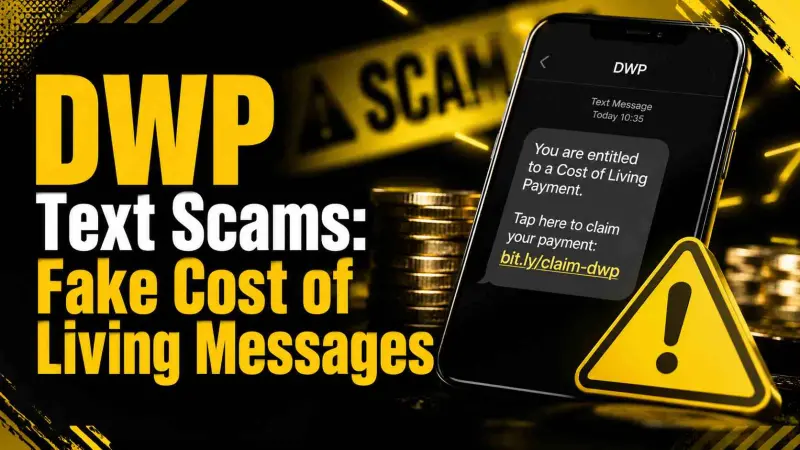
A text message claiming to be from the Department for Work and Pensions (DWP) can look convincing, particularly when it promises a cost of living payment at a time when household budgets are already under pressure. The problem is that scammers know this. They use the language of government support, urgent deadlines and apparently official links to persuade people to hand over information they would normally protect.
There is an especially important point for anyone receiving a message about a new Cost of Living Payment in 2026: the government says there will be no Cost of Living Payment for 2026, and no more payments are planned in the future. The DWP's official guidance also says its Cost of Living Payments from 2022 to 2024 were automatic for eligible recipients, meaning people did not need to apply for them.
That makes a modern text saying you need to "claim", "register", "verify" or "apply" for a new DWP Cost of Living Payment particularly suspicious.
This guide explains how these scams work, what genuine DWP communications look like, the warning signs to watch for, what to do if you have clicked a fraudulent link, and how to report the message. It also explains an important distinction: receiving a suspicious text is not the same as losing money, and there are sensible steps you can take at each stage.
How DWP Text Scams and Fake Cost of Living Payment Messages Work
Why are scammers using Cost of Living Payment messages?
Scammers rarely invent a completely random story. They choose subjects that people already recognise and care about.
Government benefits are particularly effective bait because recipients may already be familiar with DWP terminology, Universal Credit, Pension Credit, Personal Independence Payment (PIP), Jobcentre Plus and other official services.
A fraudulent message might claim:
"You are eligible for a Cost of Living Payment. Confirm your details to receive your payment."
Another version could say that a payment is "waiting", that an application must be completed before a deadline, or that bank information needs to be confirmed.
The basic objective is usually phishing: getting the recipient to visit a fraudulent website and provide information.
The information requested could include:
- Full name and address
- Date of birth
- National Insurance number
- Bank account details
- Debit or credit card information
- Online banking credentials
- Passwords or security information
- One-time verification codes
Some scams go further. Once a victim has submitted information, the criminal may call them pretending to be a government official, bank employee or fraud investigator. The original text is then only the first stage of the deception.
Is there a new DWP Cost of Living Payment in 2026?
No. There is no Cost of Living Payment scheduled for 2026. GOV.UK currently states that there will be no Cost of Living Payment for 2026 and no further payments are planned.
The previous Cost of Living Payment programme covered payments made between 2022 and 2024. The DWP says those payments were made automatically to people who met the relevant eligibility conditions; recipients did not need to submit a separate application.
That does not mean there is no financial support available in 2026. The government's wider cost of living guidance continues to cover benefits, allowances, bills, childcare, housing and other forms of support. But a message promising a fresh DWP Cost of Living Payment should not be treated as genuine simply because it uses government branding.
What did the genuine Cost of Living Payment involve?
Understanding the real scheme makes fake messages easier to identify.
The previous programme included several types of payment. For example, the means-tested benefit Cost of Living Payment was paid in three instalments of £301, £300 and £299 during 2023 and early 2024. There were also separate disability and pensioner payments.
Crucially, eligibility was established by the relevant government department. People generally did not need to fill in an online form to "unlock" their payment.
That is very different from a scam message saying:
"Click here to apply before midnight."
A request for urgent registration is one of the strongest warning signs.
What does a fake DWP text usually contain?
There is no single scam template. Criminals change wording, links and sender details frequently.
However, common characteristics include:
1. A promise of unexpected money
The message may say you have been selected for a payment or that you are owed money.
The amount might be presented as a specific figure to make the message look official.
2. A request to click a link
The link may lead to a website designed to resemble GOV.UK, a government benefits portal or another trusted service.
The website may contain official-looking colours, logos and legal wording.
Those visual details do not prove authenticity.
3. A deadline
Scammers often introduce urgency:
- "Claim within 24 hours"
- "Your payment will expire"
- "Final reminder"
- "Application closes today"
- "Failure to respond will result in cancellation"
The purpose is to stop you from taking time to verify the claim.
4. A request for personal or financial information
This is often the real goal.
A fake form might ask for your National Insurance number before moving on to bank details or card information.
5. An unfamiliar web address
The text may use a domain that contains words such as "gov", "benefit", "payment" or "DWP" without actually being an official government website.
A familiar-looking word inside a web address is not evidence that the site belongs to the government.
Can a scam text appear to come from a genuine DWP sender?
Yes. The displayed sender name should not be treated as proof.
Fraudsters can manipulate the way messages appear on phones, and sophisticated SMS scams can exploit weaknesses in mobile networks and messaging systems. In June 2026, Report Fraud reported a conviction involving an "SMS Blaster" operation that used specialist equipment to send fraudulent messages while bypassing some safeguards designed to block malicious sender names and links.
This means the right question is not simply:
"Does the sender name say DWP?"
Instead ask:
"Does the message make sense when checked against official information?"
That second test is much harder for scammers to defeat.
How can you tell whether a DWP text is genuine?
The safest approach is to avoid using the message itself as your source of verification.
If a text claims to be from the DWP, do not click its link to check whether it is genuine. Instead, open your browser separately and go directly to GOV.UK.
Look for the relevant benefit or support information there.
The government's Cost of Living Payment guidance specifically warns that a message asking you to apply or contact someone about the payment might be a scam.
Useful warning signs include:
| Warning sign | Why it matters |
|---|---|
| Unexpected payment offer | You may not have applied for anything |
| "Apply now" request | Previous DWP Cost of Living Payments were automatic |
| Urgent deadline | Pressure discourages independent checking |
| Link to a strange website | Could be a phishing page |
| Request for bank details | A major fraud warning sign |
| Request for passwords | Government payment messages should not require this |
| Poor spelling or awkward wording | Often associated with fraudulent messages |
| Threat of losing money | Designed to create panic |
| Request for a fee | A supposed benefit payment should not require you to pay to receive it |
| Sender name looks official | Sender identity can be spoofed |
No single spelling mistake proves a message is fraudulent. Equally, perfect spelling does not prove that it is genuine. Modern phishing campaigns can be professionally written.
Why do these scams work so well?
The strongest scams combine authority, money and urgency.
The DWP is a trusted institution. A payment sounds financially attractive. A deadline creates pressure.
Together, those elements can cause someone to react before thinking.
Imagine receiving a message while travelling home from work:
"DWP: You have been approved for £300. Confirm your bank details today to prevent your payment being cancelled."
The natural reaction may be excitement followed by concern about missing the deadline.
That is exactly the emotional sequence a scammer wants.
A better response is deliberately slower:
Stop → Check → Verify → Act
Take a screenshot if necessary. Put the phone down. Open GOV.UK separately. Check whether the payment actually exists.
A few extra minutes can prevent a much bigger problem.
What should you do if you receive a suspicious DWP text?
If you have received a suspicious message but have not interacted with it, the situation is relatively straightforward.
Step 1: Do not click the link
Do not open the website simply because you want to "see what it says".
Even if you intend to investigate, the safest approach is to use an independent route to the organisation.
Ofcom's current guidance says not to click links, reply to suspicious texts, press buttons or share personal or financial details.
Step 2: Do not reply
Do not respond with "STOP", "NO" or another message unless you have independently established that the communication is legitimate.
Replying can confirm that your number is active.
Step 3: Check GOV.UK separately
Open your browser and type GOV.UK yourself, rather than following the link.
Check the government's current Cost of Living Payment information and the relevant benefit guidance.
The official guidance currently says there is no Cost of Living Payment for 2026.
Step 4: Report the text
Suspicious SMS messages can be forwarded to 7726, free of charge. This alerts your mobile provider so the message can be investigated and potentially blocked.
Step 5: Delete it
Once reported, delete the message.
Do not keep returning to the link out of curiosity.
What if you clicked the link but did not enter anything?
This situation is different from giving scammers your information.
If you clicked a suspicious link but did not enter personal, banking or login details:
- Close the website.
- Do not download anything it offered.
- Do not install an app or browser extension prompted by the site.
- Run appropriate security checks on your device.
- Report the suspicious text to 7726.
- Report a suspicious website to the National Cyber Security Centre where appropriate.
The NCSC says scam text messages commonly attempt to direct victims to websites used to steal passwords or personal information, and it provides a reporting route for suspicious messages and websites.
If the site asked you to download software or you actually installed something, take the incident more seriously and consider getting specialist technical help.
What if you entered your bank details?
Act quickly.
Contact your bank or building society using the number on your bank card, official banking app or another trusted source.
Tell the bank exactly what happened.
Do not use a phone number contained in the suspicious text.
Depending on what you disclosed, the bank may recommend changing credentials, cancelling a card, monitoring transactions or taking additional protective measures.
If you gave away an online banking password that you use elsewhere, change it on those accounts too. Ideally, use a unique password for each important account.
What if you gave away your National Insurance number?
Do not panic, but do take the incident seriously.
A National Insurance number alone does not automatically give someone access to your bank account. However, combined with other personal information, it can contribute to identity fraud.
Record exactly what information you provided.
If you also supplied financial information, passwords, security codes or identity documents, tell the relevant organisations.
Keep an eye out for unexpected correspondence, account activity or benefit-related communications.
What if money has already been taken?
Contact your bank immediately.
Speed matters because the bank may have steps available to stop or limit further transactions.
You should also report the fraud.
In England, Wales and Northern Ireland, the current national reporting service is Report Fraud. It replaced Action Fraud as the reporting service in late 2025. Report Fraud provides online reporting and can be contacted on 0300 123 2040.
In Scotland, fraud and cybercrime should be reported to Police Scotland.
The important thing is not to feel embarrassed. Scam victims often delay reporting because they believe they should have spotted the deception earlier. That hesitation can make the consequences worse.
Should you contact the DWP directly?
If you are genuinely concerned about your benefits, use official DWP or GOV.UK contact routes rather than any telephone number or link contained in the suspicious message.
The DWP's guidance explains that Cost of Living Payments were identified and paid automatically where eligibility conditions were met.
The distinction matters.
If a text says:
"Click here and provide your bank details to claim."
Do not follow it.
Instead, independently access the official government website and find the appropriate benefit service.
What genuine DWP texts can look like
It would be a mistake to conclude that every DWP text message is fraudulent.
Government departments can use text messages for legitimate administrative purposes.
For example, DWP's Fraud and Error Prevention Service may send text messages as reminders to return forms or report changes in circumstances. GOV.UK says these messages are informational and recipients are not asked to reply by text.
This is why blanket rules such as "the government never sends texts" are unreliable.
The safer rule is:
Do not judge a message solely by the fact that it is a text. Judge what the message asks you to do and independently verify the request.
How do scammers make fake government websites look real?
A phishing website can be surprisingly convincing.
It may contain:
- Government-style colours
- Familiar logos
- Privacy notices
- Fake reference numbers
- Official-looking forms
- Professional typography
- Claims about eligibility
- A fake customer-service telephone number
Some even display a convincing GOV.UK-style layout.
Do not assume that visual quality equals authenticity.
The website address is more useful, but even that should be assessed carefully. The safest approach is still to reach government services through GOV.UK independently rather than trusting a link inside an unsolicited message.
What information should you never provide through an unsolicited text link?
Treat requests for the following information with particular caution:
- Online banking usernames
- Banking passwords
- Card PINs
- Full card details
- Security codes
- One-time passcodes
- Passwords
- Copies of identity documents
- Security answers
A genuine-looking logo does not justify providing sensitive information.
If you are unsure, stop the conversation and independently contact the organisation.
What common mistakes make these scams worse?
The first mistake is clicking the link "just to check".
The second is replying to the sender.
The third is searching the telephone number or website shown in the message and trusting the first result without checking the organisation independently.
The fourth is continuing a conversation with someone who claims to be a government representative.
The fifth is waiting after money has been taken.
Another common mistake is deleting the evidence before reporting it. Where possible, keep a screenshot and relevant details until you have completed your reports.
What should families tell older relatives about DWP scams?
Older people and benefit recipients can be attractive targets because scammers may assume that government-payment messages will be trusted.
A useful family rule is simple:
No one should make a financial decision from a text message alone.
If a relative receives a message about a benefit payment, encourage them to show it to someone they trust before clicking anything.
You can also help them set up practical protections:
- Enable spam filtering on their phone.
- Keep operating systems updated.
- Use strong, unique passwords.
- Enable two-factor authentication where available.
- Save official government websites as bookmarks.
- Explain that urgency is a warning sign.
- Encourage reporting rather than embarrassment.
The goal is not to make someone frightened of every message. It is to give them a repeatable process for checking suspicious ones.
Are these scams only sent by SMS?
No.
The same fraud can appear through:
- Facebook Messenger
- Social media advertisements
- Phone calls
- Fake websites
- Search advertisements
- Letters
- Messages inside other online services
The delivery method changes, but the underlying tactic remains similar: impersonate a trusted organisation and persuade the victim to surrender information or money.
Ofcom's guidance covers suspicious calls, SMS and messages across different communication services, while Report Fraud also provides reporting routes for suspicious social media messages and websites.
How does the current scam environment affect benefit recipients?
Benefit fraud and error are a significant concern for the government. DWP's financial year ending 2026 estimates put total benefit expenditure overpaid because of fraud and error at £9.9 billion, equivalent to 3.2% of total benefit expenditure. That figure covers fraud and error in the benefit system broadly; it should not be interpreted as the amount caused by text scams.
The distinction is important.
A statistic about benefit-system fraud does not tell us how many people received a fake DWP text or how much money those particular scams stole.
What it does demonstrate is why fraud prevention remains a significant issue around the benefits system and why official verification matters.
What is changing about scam texts?
Scammers are becoming more technically capable.
Traditional phishing messages often contained obvious spelling errors or strange formatting. Those
clues can still be useful, but they are no longer enough.
Criminals can use convincing branding, personal information, spoofed sender identities and sophisticated infrastructure.
The 2026 prosecution involving an SMS Blaster operation illustrates how technology can be used to make fraudulent texts appear more credible.
AI may also make scam writing more polished. That does not mean every well-written text is dangerous, but it does mean readers should rely less on grammar alone.
The strongest defence remains behavioural:
Stop. Verify independently. Never disclose sensitive information because a message creates urgency.
What should you do if you are unsure whether a message is real?
You do not need to solve the mystery yourself.
If you cannot establish that a message is genuine, do not act on it.
Use this checklist:
- Stop and avoid clicking.
- Read the request carefully.
- Ask what the message wants from you.
- Check whether the claimed government scheme actually exists.
- Open GOV.UK separately.
- Never provide banking passwords or security codes through an unsolicited link.
- Forward suspicious SMS messages to 7726.
- Report fraud through Report Fraud if you have been affected.
- Contact your bank immediately if financial details or money are involved.
That process is deliberately boring. And boring is exactly what you want when dealing with fraud.
What is the future of DWP and government-payment scams?
Government support schemes will continue to attract fraud attempts because financial assistance creates a strong emotional hook.
Future scams are likely to become more personalised and more convincing rather than simply more obvious.
Criminals may combine leaked or publicly available personal information with AI-generated messages, cloned branding and increasingly sophisticated websites. SMS delivery itself may also continue to evolve as criminals exploit weaknesses in mobile communications.
For consumers, this means the old fraud checklist of "look for spelling mistakes" is not enough.
The more useful long-term habit is independent verification.
If a payment exists, you should be able to find authoritative information about it without relying on the message that alerted you to it.
For businesses, charities, councils and community organisations, the same principle applies. Clear public information about genuine government schemes can make it easier for residents to distinguish legitimate support from fake offers.
The government's current Cost of Living guidance provides an especially important example: it explicitly states that there is no Cost of Living Payment for 2026.
So, for anyone receiving a text in 2026 claiming to offer a new DWP Cost of Living Payment, the safest assumption is not "I should claim this quickly."
It is:
"I should verify this before doing anything."
Key Insights
- There is no new DWP Cost of Living Payment for 2026. GOV.UK says no such payment is planned for 2026 or in the future.
- Previous Cost of Living Payments were generally automatic. Eligible people did not need to complete an online application to receive them.
- Never trust a payment link simply because the message looks official. Sender names, logos and websites can be manipulated.
- Do not reply to suspicious texts. Forward them to 7726 instead so your mobile provider can investigate.
- If you have shared bank details, contact your bank immediately. Use an official number or your banking app, not the suspicious message.
- If you have lost money, report it. Report Fraud handles fraud reporting in England, Wales and Northern Ireland; Scotland uses Police Scotland.
- Good spelling does not prove authenticity. Modern scams can be professionally written and visually convincing.
- Independent verification is your strongest defence. Start with GOV.UK or another trusted source rather than following instructions inside an unsolicited message.
Frequently Asked Questions
1. Is there a DWP Cost of Living Payment in 2026?
No. GOV.UK currently states that there will be no Cost of Living Payment for 2026 and that no more payments are planned. Other benefits and forms of financial support may still be available depending on your circumstances.
2. Are DWP Cost of Living Payment text messages scams?
A message about a new 2026 Cost of Living Payment should be treated as suspicious because the government says no such payment is planned. Previous payments were generally made automatically to eligible recipients.
3. Does DWP ask people to apply for Cost of Living Payments by text?
No. The previous DWP Cost of Living Payments were identified and paid automatically where eligibility requirements were met. A text telling you to apply through a link is therefore a major warning sign.
4. What should I do if I receive a fake DWP text?
Do not click the link or reply. Forward the message to 7726, report it where appropriate, and delete it after preserving any information needed for reporting.
5. What does 7726 do?
7726 is a free reporting service used by mobile providers for suspicious calls and text messages. Forwarding a scam text helps your provider investigate the sender and potentially block malicious activity.
6. Can a scam text use the DWP name?
Yes. The displayed sender identity is not sufficient proof that a message is genuine. Criminals can manipulate sender information and use sophisticated methods to make fraudulent messages look legitimate.
7. What if I clicked a DWP scam link?
Close the website and do not enter further information or download anything. If you entered personal or financial information, take additional protective steps, including contacting the relevant organisation and your bank where appropriate.
8. What if I gave a scammer my bank details?
Contact your bank immediately using a trusted telephone number or your banking app. Explain that your details were disclosed to a suspected scammer and follow the bank's instructions.
9. What if I gave away my National Insurance number?
A National Insurance number by itself does not give someone direct access to your bank account, but it can contribute to identity fraud when combined with other information. Record what you disclosed and monitor for suspicious activity.
10. Should I reply "STOP" to a suspicious DWP text?
Generally, no. Ofcom advises against replying to suspicious texts because doing so can confirm that your number is active. Report the message through 7726 instead.
11. Can genuine DWP messages contain links?
Some government services can use text messages for legitimate administrative purposes, so the presence of a link alone does not establish that a message is fraudulent. However, unsolicited requests for financial information should be treated with extreme caution.
12. Does DWP ever send text messages?
Yes. DWP-related services can use text messages for certain administrative purposes. For example, GOV.UK says Fraud and Error Prevention Service centres may send reminder texts, but recipients are not asked to reply by text.
13. How do I report a DWP scam text?
Forward a suspicious SMS to 7726. If you have lost money or suffered fraud, you can report the incident through Report Fraud in England, Wales or Northern Ireland.
14. Is Action Fraud still the UK fraud-reporting service?
Report Fraud replaced Action Fraud as the national reporting service in late 2025. Its current service provides online reporting and telephone support on 0300 123 2040.
15. How can I check whether a government payment is genuine?
Do not use the link in the message. Open GOV.UK independently and search for the payment or benefit. If the scheme cannot be verified through an authoritative government source, do not provide information or make a payment.
Final Thoughts
Fake DWP text messages work because they exploit something very real: people need financial help, and government benefits can make a significant difference to household budgets.
That is why a message promising a payment can feel urgent and believable.
But the current facts provide a strong reason to pause. There is no Cost of Living Payment for 2026, according to GOV.UK, and the previous Cost of Living Payment scheme did not require eligible recipients to complete an application through a text-message link.
If you receive a message claiming otherwise, don't let the promise of money push you into a rushed decision. Do not click, do not reply and do not provide personal or banking information. Verify the claim independently through GOV.UK, report suspicious texts to 7726, and contact your bank immediately if you have disclosed financial information.
The best protection against these scams is not spotting one particular wording or sender name.
It is developing the habit of stopping before acting and checking through a trusted channel.
For official information about cost of living support, start with GOV.UK's Cost of Living guidance rather than any link contained in an unexpected message.
Disclaimer: The information provided in this article is for general informational and research purposes only. Company details, features, services, and market positions may change over time. Readers are advised to visit official company websites and conduct independent research before making any business decisions or purchasing services.
Most Searchable Keywords
Recent Blogs
Related Listings


Categories
- Accountants (295)
- Advertising Agencies (559)
- Architects (149)
- Automobiles (377)
- Beauty (300)
- Carpenters (146)
- Cleaning Services (387)
- Dentists (189)
- Driving (62)
- Education (1)
- Electricians (215)
- Energy (8)
- Event Organiser (687)
- Finance (602)
- Guide (3422)
- Health (2207)
- Information technology (206)
- Legal Services (361)
- Logistics (6)
- Maintenance (65)
Sponsored Listings in Plumbers
Related Blogs
Water Meter or Fixed Bill: Which Is Cheaper
Read this insightful article "Water Meter or Fixed Bill: Which Is Cheaper" to expand your knowledge!

ECO4 Free Insulation: What’s Still Available...
Read this insightful article "ECO4 Free Insulation: What’s Still Available in This Year" to expand your knowledge!

What It Costs to Run an Electric Fan Air Frye...
Read this insightful article "What It Costs to Run an Electric Fan Air Fryer or Tumble Dryer" to expand your knowledge!
Questions & Answers – Find What
You Need, Instantly!
How can I update my business listing?
Is it free to manage my business listing?
How long does it take for my updates to reflect?
Why is it important to keep my listing updated?
