
EV Charging Costs Home vs Public Chargers and Where the Money Adds Up
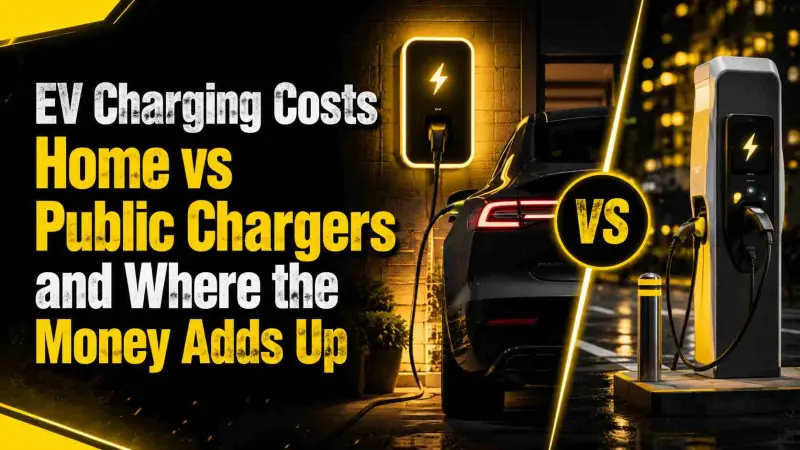
For many electric car drivers, the biggest surprise is not how little an EV can cost to run, but how much the charging price can change depending on where you plug in. Charging at home overnight can be dramatically cheaper than using a rapid charger on a motorway, while destination and on-street chargers sit somewhere in between.
As of July 2026, Ofgem's average electricity unit rate under the default tariff cap is 26.11p per kWh for households paying by Direct Debit in England, Scotland and Wales. Meanwhile, Zapmap's July 2026 Price Index puts the average public PAYG price at 54p/kWh for standard and standard-plus chargers and 80p/kWh for rapid and ultra-rapid chargers.
That difference matters because an EV's charging bill is driven by more than the size of its battery. Your electricity tariff, charging location, charging speed, vehicle efficiency, payment method and how often you rely on public rapid charging can all change the final figure.
So, where does the money actually add up? And is installing a home charger worth it?
How Much Does EV Charging Cost at Home Compared With Public Chargers?
The simplest answer is that home charging is usually the cheapest option, while rapid and ultra-rapid public charging are generally the most expensive.
A useful way to compare them is by looking at the cost of adding 50 kWh to an EV battery:
| Charging option | Illustrative rate | Cost for 50 kWh | Typical use |
|---|---|---|---|
| Home, standard tariff | 26.11p/kWh | £13.06 | Everyday charging |
| Home, low-cost EV tariff | 8p/kWh | £4.00 | Scheduled overnight charging |
| Public standard/standard-plus | 54p/kWh | £27.00 | Streets, destinations, car parks |
| Public rapid/ultra-rapid | 80p/kWh | £40.00 | Motorway and long-distance journeys |
The home figures need an important qualification. The 26.11p/kWh figure is Ofgem's average electricity unit rate under the July–September 2026 default tariff cap, not a universal home-charging price. Individual tariffs vary, and EV-specific time-of-use tariffs can be considerably cheaper at selected times.
Zapmap's July 2026 data provides a useful public-charging benchmark: 54p/kWh for standard and standard-plus chargers and 80p/kWh for rapid and ultra-rapid chargers. These are weighted PAYG averages, so individual networks and locations can be cheaper or more expensive.
Why the price per kWh matters
Electricity is sold in kilowatt-hours, or kWh. Think of a kWh as the unit of energy your car receives.
If your EV consumes around 0.30 kWh per mile, a home electricity price of 26.11p/kWh works out at roughly:
0.30 × £0.2611 = about 7.8p per mile
At 54p/kWh, the same efficiency would cost approximately:
0.30 × £0.54 = 16.2p per mile
At 80p/kWh:
0.30 × £0.80 = 24p per mile
Actual efficiency varies considerably between vehicles and driving conditions, so these calculations are best treated as illustrations rather than promises.
What does a full EV charge cost?
There is no single answer because EV batteries range from relatively small packs to large batteries exceeding 100 kWh.
For example, putting 60 kWh into a battery would cost approximately:
- £15.67 at 26.11p/kWh
- £32.40 at 54p/kWh
- £48.00 at 80p/kWh
- £4.80 at 8p/kWh
The last figure illustrates why a suitable smart EV tariff can transform the economics of home charging. Octopus Energy currently advertises scheduled Intelligent Octopus Go charging from 8p/kWh, although eligibility, tariff terms and rates can change.
Why public charging costs more than electricity alone
It is tempting to look at a public charging price and assume the difference from a domestic electricity tariff is simply profit. The reality is more complicated.
A public charging operator has to account for:
- Electricity procurement
- Network and connection costs
- Chargepoint installation
- Land or parking costs
- Hardware
- Maintenance
- Software and payment systems
- Customer support
- Repairs and replacement
- Site operation
- Business rates and other operating expenses
- Investment in increasingly powerful equipment
A rapid charger also requires significantly more expensive infrastructure than a domestic wallbox.
This is why the price displayed on a public charger should not be compared directly with your household electricity unit rate without considering the service being provided.
Where the biggest cost difference appears
The largest gap is usually between overnight home charging and motorway rapid charging.
Suppose an EV uses 18 kWh to travel 60 miles.
At 26.11p/kWh, the energy cost would be about £4.70.
At 54p/kWh, it would be about £9.72.
At 80p/kWh, it would be about £14.40.
That does not mean you should avoid rapid chargers. If you're driving 250 miles on a holiday journey, paying more for a 20-minute or 30-minute charging stop can be entirely reasonable.
The important point is to use expensive charging strategically rather than automatically.
What is the cheapest way to charge an EV?
For a driver who has suitable off-street charging and access to a competitive EV tariff, the cheapest mainstream option is generally scheduled home charging during a low-price period.
A sensible charging hierarchy is:
- Home charging during a cheap tariff period.
- Home charging on a normal electricity tariff.
- Low-cost destination or workplace charging where available.
- Public standard/standard-plus charging.
- Rapid or ultra-rapid charging when speed is more important than price.
This is not an absolute ranking because tariffs and public networks vary. A promotional public charger can sometimes beat a household tariff, while a poorly chosen home electricity tariff can make domestic charging less attractive.
How much can you save by charging at home?
Consider an EV that uses approximately 0.30 kWh per mile and travels 10,000 miles a year.
Its theoretical electricity requirement would be:
10,000 × 0.30 = 3,000 kWh
At 26.11p/kWh, that is around £783 per year before accounting for charging losses and assuming all energy is purchased at that rate.
At 54p/kWh, the equivalent energy cost would be around £1,620.
At 80p/kWh, it would be around £2,400.
The difference becomes substantial when repeated over several years.
However, don't assume every EV driver will save exactly those amounts. Real consumption depends on the car, temperature, speed, traffic, terrain and use of heating or air conditioning. Charging also involves some energy loss between the electricity supply and the battery.
Home charging losses are easy to overlook
The electricity drawn from the grid isn't necessarily identical to the energy ultimately stored in the battery.
Some energy is lost through:
- Electrical resistance
- Charging equipment
- Battery management
- Thermal management
- Conversion processes
That means a calculation based purely on battery capacity can underestimate the amount of electricity you actually purchase.
For personal budgeting, your best measurement is the electricity consumed by the
charging system rather than simply the battery's advertised capacity.
What is the difference between slow, fast, rapid and ultra-rapid charging?
Charging speeds are another major factor.
The UK government's April 2026 statistics recorded 119,080 public EV chargers, including 27,372 rated rapid or above at 50 kW or more. Half of public chargers were in the 3 kW to below-8 kW category, while 12% were rapid and 11% ultra-rapid.
Broadly:
- Slow/standard charging is useful when the car can remain parked for hours.
- Fast charging is useful at destinations where you may stay for a while.
- Rapid charging is designed to replenish significant energy during longer journeys.
- Ultra-rapid charging is aimed at reducing waiting time as much as the vehicle can support.
The fastest charger isn't automatically the cheapest.
In fact, the opposite is often true.
Why rapid charging can become an expensive habit
Rapid charging is extremely useful when you're travelling.
The problem occurs when drivers start using motorway-style charging for everyday local driving simply because it is convenient.
Imagine that you need 30 kWh every few days.
At 26.11p/kWh, 30 kWh costs about £7.83.
At 80p/kWh, it costs £24.
Do that repeatedly and the difference becomes hundreds of pounds over a year.
The smarter approach for many drivers is to arrive at long journeys with a reasonably charged battery and use rapid charging only for the additional energy needed to complete the trip.
Public charging prices are not all the same
"Public charging" is not one price category.
A supermarket charger, council-owned charger, hotel charger, motorway service station and independent charging hub may all have different tariffs.
Zapmap's August 2026 update reports that its July 2026 weighted PAYG average was 54p/kWh for standard/standard-plus charging and 80p/kWh for rapid/ultra-rapid charging. It also notes substantial variation between operators. For example, it reported lower rapid/ultra-rapid PAYG prices from some networks and an average of 46p/kWh for Tesla drivers using the Tesla Supercharger network.
That is why checking the price before starting a session can make a meaningful difference.
Membership plans can change the calculation
Some operators offer memberships or subscriptions that reduce the price per kWh.
These can make sense for frequent users.
But a membership is not automatically cheaper.
Before subscribing, calculate:
Monthly membership cost ÷ expected monthly kWh
Then add the discounted charging price.
For example, if a membership costs £8 per month and you only buy 20 kWh from that network each month, the membership effectively adds 40p to every kWh before considering the discounted rate.
If you buy hundreds of kWh every month, the same membership fee becomes much less significant per unit.
The best charging plan is therefore based on your actual charging behaviour, not simply the advertised discount.
What about charging at work?
Workplace charging can sit in an interesting middle ground.
Some employers provide free charging as an employee benefit. Others charge employees a fixed or variable rate.
If workplace charging is available at a competitive price, it can reduce the amount of energy you need to purchase at home or from public rapid chargers.
But don't assume "free" means unlimited. Employers may introduce:
- Usage limits
- Time restrictions
- Parking charges
- Idle fees
- Booking systems
- Employee-only access
Always check the actual workplace policy.
What does a home EV charger cost to install?
Buying an EV is only part of the home-charging equation.
You may need to pay for a dedicated home chargepoint and installation. The total cost depends on the charger, electrical installation, cable route, consumer-unit requirements, property layout and other site-specific factors.
Government support is available for eligible households under current EV chargepoint grant schemes. From April 2026, the government says eligible renters and flat owners can receive 75% of the cost of buying and installing a socket, up to £500.
The government also states that the current chargepoint grant schemes have been extended for a final year, with the relevant schemes running until 31 March 2027.
Is a home charger worth the upfront cost?
For a driver who charges frequently, it often can be.
The calculation is straightforward:
Annual public charging cost − annual home charging cost = potential annual energy saving
Then:
Home charger installation cost ÷ annual saving = approximate payback period
For example, if switching from frequent public charging saves £500 a year and your net installation cost is £1,000, the energy-cost difference alone would imply roughly a two-year payback.
That is only an illustration. Your real result depends on your tariff, annual mileage, charging mix and installation price.
A home charger can also save time because you can plug in when you arrive home rather than make a separate trip to a charging station.
What if you don't have a driveway?
This is one of the biggest practical challenges for EV ownership.
Drivers with on-street parking may not be able to install a conventional driveway charger. The government has support schemes for eligible households with on-street parking and has funded thousands of public charging installations through local authorities.
The UK public network is also expanding. As of 1 April 2026,
official figures recorded 119,080 public EV chargers across the UK.
For drivers without home charging, the objective should be to build a low-cost public charging routine rather than simply using the fastest charger available.
That might involve:
- Overnight on-street charging
- Supermarket charging
- Workplace charging
- Destination charging
- Local council chargers
- Lower-priced network memberships
- Rapid charging only for long trips
How much does charging add to the cost of a long journey?
Suppose you drive 300 miles and your EV averages 0.30 kWh per mile.
You would need roughly:
300 × 0.30 = 90 kWh
At 26.11p/kWh, that represents about £23.50 of electricity.
At 54p/kWh, approximately £48.60.
At 80p/kWh, approximately £72.
Real-world charging could be somewhat higher because of charging losses and because you may not start or finish with an empty battery.
This example shows why route planning matters. If you can do most of the journey using a reasonably priced chargepoint and only use a rapid charger for a short top-up, you can significantly reduce the cost.
Don't confuse charging cost with total EV running cost
Charging is only one part of vehicle ownership.
Your overall EV running costs may include:
- Insurance
- Vehicle finance
- Depreciation
- Servicing
- Tyres
- MOT costs where applicable
- Vehicle taxation
- Home charger installation
- Public charging
- Electricity standing charges
An EV can still have attractive running costs even if public rapid charging is expensive.
Likewise, a cheap charging rate does not automatically make an expensive vehicle financially cheaper overall.
The right comparison is total cost of ownership, not simply the price displayed at a charger.
Home charging and solar panels
Solar panels can make the calculation more interesting.
If you already generate electricity at home, charging an EV with surplus solar generation can reduce the amount of electricity you need to buy from the grid.
However, solar generation does not automatically mean every EV charge is free.
Solar output varies with:
- Time of day
- Season
- Weather
- Panel size
- Household electricity demand
- Battery storage
A driver who leaves home during the day may generate solar electricity when the car isn't there.
That is why smart energy management can matter as much as simply owning solar panels.
Common mistakes that increase EV charging costs
Several charging habits can quietly push bills higher.
Charging wherever is closest
Convenience has a price. Before starting a session, check the tariff if you have alternatives nearby.
Using rapid chargers for routine charging
Rapid charging is designed to save time. Using it for every everyday top-up can be unnecessarily expensive.
Ignoring charging losses
Budgeting based purely on battery capacity can make your calculations look slightly better than reality.
Paying for memberships you barely use
A monthly subscription only makes financial sense when the savings exceed the membership cost.
Focusing only on the advertised p/kWh rate
Look for minimum charges, connection fees, parking costs, idle fees and other conditions.
For example, Clackmannanshire Council's published 2026/27 tariff includes a minimum charge and different rates for standard, fast and rapid charging, demonstrating how a public charging bill can contain more than one pricing component.
How should you calculate your own EV charging cost?
Use this simple process.
Step 1: Find your real efficiency
Check your vehicle's trip computer or charging history.
Step 2: Record your home electricity rate
Use the actual unit rate on your electricity bill, not a generic national figure.
Step 3: Record your public charging prices
Look at the networks you actually use.
Step 4: Separate charging types
Keep home, destination, standard public and rapid charging separate.
Step 5: Calculate annual energy consumption
A simple estimate is:
Annual miles × kWh per mile
Step 6: Add charging losses
Use your actual electricity consumption from your charger or meter where possible.
Step 7: Compare scenarios
Work out what happens if you move 20%, 50% or 80% of your charging to home or low-cost charging.
This gives you a much more realistic picture than asking, "How much does it cost to charge an EV?"
What does the future of EV charging look like?
The UK's charging network is continuing to expand, with public infrastructure becoming more diverse in both location and power output. Official data recorded more than 119,000 public EV chargers in April 2026, including more than 27,000 rated at 50 kW or above.
The likely direction of travel is not simply "more rapid chargers". Drivers are likely to see a broader mix of:
- Home smart charging
- Time-of-use electricity tariffs
- Workplace charging
- Destination charging
- Local on-street charging
- High-power motorway charging
- Better route planning
- Vehicle-to-home and vehicle-to-grid technologies
- More integrated energy management
The economics may also become more dynamic. Smart chargers can move electricity consumption toward cheaper periods, while charging networks may use pricing to balance demand.
For drivers, that means the cheapest charging strategy may increasingly depend on when you charge as much as where you charge.
One thing is already clear: the public network is becoming large enough that EV drivers have more choice than they did a few years ago. But having more chargers does not necessarily mean every charger will have the same price.
The practical strategy for keeping EV charging costs down
For most drivers, the answer isn't to avoid public chargers altogether.
Instead, build a charging mix.
Use home charging for the majority of routine energy whenever it is practical. Take advantage of a suitable off-peak or EV tariff if the numbers work for your household. Use destination and workplace charging when it is competitively priced. Save rapid and ultra-rapid chargers for situations where their speed has genuine value.
That approach separates cheap energy from valuable convenience.
And that is really where the money adds up.
Key Insights
- Home charging is generally the cheapest routine option, particularly when you can access an off-peak EV electricity tariff.
- Public charging varies substantially by charger type and operator. Zapmap's July 2026 weighted PAYG averages were 54p/kWh for standard/standard-plus chargers and 80p/kWh for rapid/ultra-rapid chargers.
- Rapid charging should usually be treated as a convenience purchase, rather than the default way to charge every day.
- Your electricity tariff can matter as much as your charger. A suitable smart tariff can reduce the unit price significantly during scheduled charging periods.
- Membership plans only make financial sense if you use them enough to recover the subscription cost.
- A home charger has an upfront cost, but frequent public charging can make the investment worthwhile over time.
- Drivers without driveways need a different strategy, combining affordable on-street, workplace and destination charging where available.
- The cheapest charging plan is personalised. Calculate costs using your actual mileage, vehicle efficiency, electricity tariff and charging habits.
FAQ
1. Is it cheaper to charge an EV at home or in public?
Home charging is generally cheaper, particularly when you use an off-peak EV tariff. Public standard charging typically costs more, while rapid and ultra-rapid charging can cost substantially more per kWh.
2. How much does it cost to charge an EV at home in the UK?
It depends on your electricity tariff and how much energy your car needs. At Ofgem's average 26.11p/kWh electricity rate for July–September 2026, 50 kWh would cost about £13.06 before considering charging losses.
3. How much does public EV charging cost in the UK?
Prices vary by network and charger. Zapmap's July 2026 weighted PAYG averages were 54p/kWh for standard/standard-plus chargers and 80p/kWh for rapid/ultra-rapid chargers.
4. Are rapid EV chargers more expensive?
Generally, yes. Rapid and ultra-rapid chargers tend to have higher prices because they provide much faster charging and require more expensive infrastructure. Zapmap recorded an 80p/kWh weighted PAYG average for rapid and ultra-rapid charging in July 2026.
5. What is the cheapest way to charge an electric car?
For many drivers, the cheapest approach is home charging during a low-cost electricity period. A suitable EV-specific time-of-use tariff can reduce the cost further, depending on the supplier and eligibility.
6. Is it worth installing a home EV charger?
It can be, particularly if you drive regularly and currently depend heavily on public charging. Compare the installation cost against the annual difference between your existing public charging expenses and expected home charging costs.
7. Can I charge an EV without a driveway?
Yes. Options include public on-street chargers, workplace charging, destination charging and other local facilities. Government schemes also support certain households with on-street parking.
8. Does a bigger EV battery mean higher charging costs?
A larger battery can cost more to fill completely because it requires more kWh. However, the more useful measure is energy consumption per mile because battery size does not directly determine how efficiently the car travels.
9. Are public EV charging memberships worth it?
They can be worthwhile for frequent users of a particular network. Compare the subscription fee and discounted rate against what you would spend using PAYG charging before joining.
10. Why does public charging cost more than electricity at home?
Public charging prices help cover electricity, infrastructure, land, maintenance, payment systems, customer support, repairs and other operating costs. Rapid charging equipment also requires significant investment.
11. Does charging speed affect the price?
Often it does. Faster chargers commonly have higher per-kWh prices, although pricing varies between operators. The quickest charger is therefore not necessarily the most economical.
12. How much does it cost to drive 100 miles in an EV?
The answer depends on efficiency and electricity price. An EV using 0.30 kWh per mile would need around 30 kWh for 100 miles. That would cost about £7.83 at 26.11p/kWh, £16.20 at 54p/kWh or £24 at 80p/kWh.
13. Can solar panels reduce EV charging costs?
Yes. Solar generation can reduce the electricity you need to purchase from the grid when you can use surplus solar energy for charging. The financial benefit depends on your generation, household demand and charging schedule.
14. How many public EV chargers are there in the UK?
Official figures recorded 119,080 public EV chargers in the UK as of 1 April 2026, including 27,372 chargers rated at 50 kW or above.
15. Will EV charging become cheaper in the future?
It is possible, but not guaranteed. Greater competition, smart tariffs, renewable generation and better utilisation could create cheaper charging opportunities, while infrastructure, electricity and operating costs will continue to influence prices.
Final Thoughts
EV charging costs are not determined by the car alone. The biggest difference often comes from where and when you charge.
A driver who relies heavily on rapid public charging can face a very different electricity bill from someone who charges overnight at home on a low-cost tariff. Yet public charging still has an important role: it provides the speed and convenience needed for people who travel long distances or cannot install a home charger.
The most cost-effective strategy is therefore not simply "charge at home" or "never use rapid chargers." It is to understand your own driving pattern,
compare the real prices available to you and reserve expensive charging for situations where the extra convenience is worth paying for.
With the UK's public network continuing to expand and smart charging becoming increasingly important, EV owners have more opportunities to control where their money goes. The best savings often come from something surprisingly simple: charge cheaply when you have time, and pay for speed only when you actually need it.
Disclaimer: The information provided in this article is for general informational and research purposes only. Company details, features, services, and market positions may change over time. Readers are advised to visit official company websites and conduct independent research before making any business decisions or purchasing services.
Most Searchable Keywords
Recent Blogs


Related Listings

Categories
- Accountants (295)
- Advertising Agencies (559)
- Architects (149)
- Automobiles (377)
- Beauty (300)
- Carpenters (146)
- Cleaning Services (387)
- Dentists (189)
- Driving (62)
- Education (1)
- Electricians (215)
- Energy (8)
- Event Organiser (687)
- Finance (602)
- Guide (3458)
- Health (2207)
- Information technology (206)
- Legal Services (361)
- Logistics (6)
- Maintenance (65)
Sponsored Listings in Legal Services

Related Blogs
EPC Ratings Explained Landlord Rules and Impr...
Read this insightful article "EPC Ratings Explained Landlord Rules and Improvements" to expand your knowledge!

Rent Deposit Rules Five Week Cap and Full Ref...
Read this insightful article "Rent Deposit Rules Five Week Cap and Full Refund" to expand your knowledge!

Section 21 Evictions End New Landlord Rules
Read this insightful article "Section 21 Evictions End New Landlord Rules" to expand your knowledge!
Questions & Answers – Find What
You Need, Instantly!
How can I update my business listing?
Is it free to manage my business listing?
How long does it take for my updates to reflect?
Why is it important to keep my listing updated?
