
How Our Platform Verifies Home Automation Business Credentials
The home automation industry is currently experiencing a "gold rush" phase. As smart technology transitions from a luxury niche to a standard household requirement, a flood of new service providers has entered the market. While this competition drives innovation, it also creates a significant challenge for homeowners: how do you distinguish a highly trained systems integrator from a generalist who has simply watched a few online tutorials? The physical and digital security of a home is too important to be left to chance.
At our core, we believe that trust is not something that should be granted automatically; it must be documented, verified, and maintained. Our platform has developed a comprehensive multi-stage verification framework designed to peel back the layers of marketing hype and reveal the actual technical and legal standing of home automation businesses. This guide provides a transparent look at how we verify credentials, the standards we uphold, and why this process is essential for the longevity of the smart home ecosystem.
The Philosophy of Professional Vetting
In the world of smart technology, a "credential" is more than just a piece of paper. It is a representation of a business's commitment to safety, interoperability, and ethical data management. Our verification philosophy is built on three pillars: technical competence, legal compliance, and historical reliability.
Moving Beyond Self-Reporting
Many online platforms allow businesses to self-report their skills. A contractor might check a box saying they are "Certified in Lighting Control," but without a third party verifying that certificate, the claim is meaningless. Our platform acts as that third-party auditor, requiring direct evidence and cross-referencing that evidence with issuing bodies.
The Lifecycle of a Verified Status
Verification is not a one-time event. Technology evolves, licenses expire, and business structures change. Our process is designed to be a living record, requiring periodic updates to ensure that the information we provide to consumers is as accurate today as it was the day the business first joined the platform.
The Multi-Stage Verification Framework
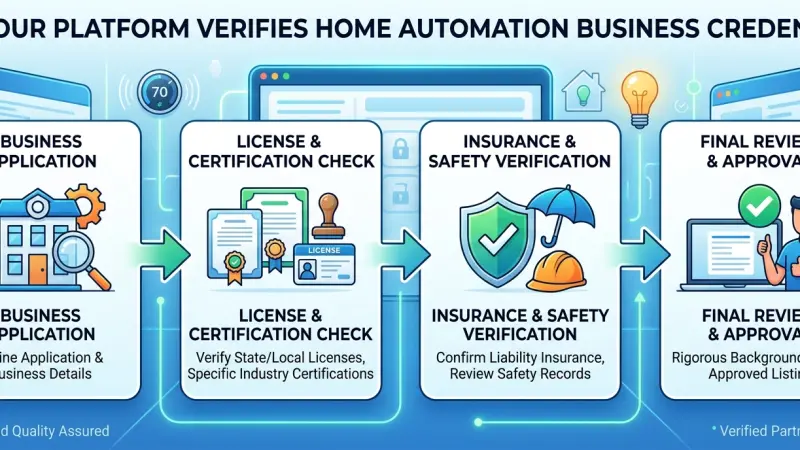
To ensure the highest level of integrity, we utilize a tiered approach to vetting home automation businesses. Each stage is designed to catch different types of risk.
Stage 1: Identity and Legal Entity Authentication
The first step is confirming that the business is a legitimate legal entity. We verify registration documents, tax identification numbers, and physical business addresses. We specifically look for "shell" companies or businesses that operate solely through disposable virtual offices, as these can be a red flag for a lack of long-term accountability.
Stage 2: Trade License and Insurance Audit
Home automation often intersects with high-voltage electrical work and structural modifications. We require businesses to submit current copies of their trade licenses and insurance policies. Our team manually checks the expiration dates and the scope of the coverage to ensure that if something goes wrong during a complex install, the homeowner is protected.
Stage 3: Technical Certification Cross-Referencing
This is the most granular part of our process. We collect certificates from major industry organizations like CEDIA or specific manufacturer training programs from brands like Control4, Crestron, or Lutron. We then verify these directly through the issuing organization's database to ensure the credentials are valid and held by the specific individuals working for the firm.
Stage 4: Reputation and Performance Analysis
Finally, we look at the business's track record. We analyze historical data, looking for patterns of consistent performance. We specifically look for "ghosting" incidents or unresolved safety complaints that might indicate a professional who has the technical knowledge but lacks the business ethics required for our platform.
Benefits of a Standardized Verification Process
A rigorous vetting process creates a "win-win" environment for both high-quality service providers and discerning homeowners.
-
Elimination of the "Trust Gap": Homeowners can start a project with confidence, knowing that the basic legal and technical "homework" has already been done on their behalf.
-
Protection of Manufacturer Warranties: By ensuring contractors are authorized dealers, we help protect the consumer's right to warranty support on expensive hardware.
-
Cybersecurity Assurance: Verified businesses are more likely to follow network security protocols, reducing the risk of a "botnet" infestation or data leak from poorly configured IoT devices.
-
Market Leveling: It allows small, highly qualified boutiques to compete on equal footing
with large corporations by proving their technical parity through documented credentials.
Step-by-Step: What Businesses Must Submit
For businesses seeking a verified status, the following steps represent the standard path through our vetting process.
-
Submission of Corporate Documentation: Proof of incorporation and VAT/Tax status.
-
Evidence of Professional Indemnity: Detailed insurance documents covering both physical damage and professional errors.
-
Individual Technician Certifications: A roster of the team’s current certifications to ensure the expertise is "on the ground" and not just in the owner's office.
-
Portfolio of Completed Work: Photographs and technical descriptions of past projects to demonstrate a history of successful integration.
-
Adherence to the Code of Conduct: Signed agreement to uphold specific standards regarding data privacy and customer communication.
Common Mistakes Businesses Make During Verification
Even legitimate businesses sometimes fail the verification process due to avoidable errors.
-
Expired Documentation: Submitting a license that expires in two weeks often results in a "Pending" status until the renewal is proven.
-
Mismatched Entity Names: The name on the insurance policy must match the name on the business registration exactly. Mismatches suggest a lack of administrative rigor.
-
Vague Service Descriptions: Claiming to "do everything" without specific certifications to back up high-stakes areas like security or electrical work can lead to a rejection of those specific categories.
Supporting Local Business Visibility Beyond Core Marketing Efforts
The role of a verification platform extends beyond just vetting; it is about creating an environment where excellence is rewarded with visibility. In the home automation sector, local expertise is irreplaceable because every home’s infrastructure is unique to its region. For a specialist to thrive, they need more than just technical skill; they need a system that supports their business discoverability in a crowded marketplace. This is where a local page UK provides a strategic advantage, serving as a trusted landing point for regional consumers.
Highly qualified contractors often leverage a free company listing platform to ensure that their verified credentials are seen by a wider audience. When a firm chooses to list services UK directory style, they are essentially creating a credibility signal that reinforces their professional standing. Maintaining an accurate presence on a business directory website ensures local presence consistency, which is a critical factor for trust reinforcement across platforms. Ultimately, utilizing a business listings site acts as a supporting visibility layer and a local discovery aid, allowing the most competent professionals to stand out through the quality of their verified credentials rather than the size of their advertising budget.
Setting the Standard for Smart Home Trust
The complexity of home automation demands a higher level of scrutiny than standard home repairs. As our homes become more connected, the risks of hiring unvetted providers grow from simple inconveniences to significant security and safety threats. By implementing a rigorous, multi-stage verification process, we provide the clarity required to make informed decisions.
Verification is not just about checking boxes; it is about building a foundation of transparency that supports the entire industry. When homeowners know exactly who they are inviting into their digital lives, and when businesses have a clear path to prove their excellence, the entire smart home market becomes more stable and resilient. Trust is the ultimate smart home feature, and through rigorous credentialing, we ensure it is a feature every homeowner can afford.
FAQs About Business Credential Verification
1. Does "Verified" mean the platform takes responsibility for the work?
No. Verification confirms that the business has the legal, technical, and insurance credentials they claim to have. It is a risk-reduction tool, not a guarantee of future work quality.
2. How often do you re-verify a business?
We perform an automated check on insurance and licenses annually, with a deeper technical audit every two to three years depending on the tier of the business.
3. Can a business with a single bad review still be verified?
Yes. Verification is about credentials and legal standing. However, a pattern of unresolved complaints can lead to a "Under Review" status or removal from the platform.
4. What happens if a business’s insurance expires mid-project?
Our system flags expiring insurance 30 days in advance. If a business fails to provide a renewal, their verified status is automatically suspended until the new document is verified.
5. Are background checks included in the verification?
While we verify the legal status of the business and the credentials of the lead technicians, individual criminal background checks are often handled at the local level or through specific high-security certifications like those required for alarm installers.
6. Do you verify the brands a contractor claims to install?
Yes. We cross-reference their business name with the "Authorized Dealer" lists of the major manufacturers they claim to support.
7. Can a new business get verified?
Yes, provided they have all the legal requirements (insurance, licenses) and can prove the individual technical certifications of their staff.
8. What is the difference between a "Verified" and a "Premium" listing?
A "Verified" status is purely about credentials. A "Premium" listing may offer more visibility, but a business cannot buy a "Verified" badge without passing the vetting process.
9. Why was my favorite local contractor not verified?
They may not have applied, or they may have failed to provide one of the mandatory documents, such as proof of professional indemnity insurance.
10. Do you verify the physical location of the business?
Yes. We use a combination of digital map verification and documentation checks to ensure the business is not a "shell" company.
11. Is this verification process the same for all trades?
No. The home automation process is specifically tailored to the unique technical and digital security requirements of the smart home industry.
12. Can I see the actual documents the business submitted?
For privacy and security reasons, we do not share the raw documents. We provide a summary of what was verified and the expiration dates of the key credentials.
13. What should I do if I find out a verified business lied?
Please report it to us immediately. We have a zero-tolerance policy for fraudulent credentials and will remove the business and potentially pursue legal action.
14. Does verification include checking if they are VAT registered?
Yes, for businesses in applicable regions, we verify their tax and VAT standing as part of the legal authentication stage.
15. Is there a fee for businesses to be verified?
Most platforms have a nominal administrative fee to cover the manual work required to verify documents with third-party issuing bodies, ensuring the process remains thorough and unbiased.
Disclaimer: The information provided in this article is for general informational and research purposes only. Company details, features, services, and market positions may change over time. Readers are advised to visit official company websites and conduct independent research before making any business decisions or purchasing services.
Most Searchable Keywords
Recent Blogs


Related Listings

Categories
- Accountants (295)
- Advertising Agencies (559)
- Architects (149)
- Automobiles (377)
- Beauty (300)
- Carpenters (146)
- Cleaning Services (387)
- Dentists (189)
- Driving (62)
- Education (1)
- Electricians (215)
- Energy (8)
- Event Organiser (689)
- Finance (602)
- Guide (3492)
- Health (2207)
- Information technology (207)
- Legal Services (361)
- Logistics (6)
- Maintenance (65)
Sponsored Listings in Information Technology


Related Blogs

Creamfields Daresbury: Impact on Local Reside...
Read this insightful article "Creamfields Daresbury: Impact on Local Residents" to expand your knowledge!

UK High Street Businesses in 2026-27: Which S...
Read this insightful article "UK High Street Businesses in 2026-27: Which Sectors Are Growing?" to expand your knowledge!

Why Complete Business Listings Matter More Th...
Read this insightful article "Why Complete Business Listings Matter More Than You Think" to expand your knowledge!
Questions & Answers – Find What You Need, Instantly!
Connect with local business experts, share verified insights, and find trusted answers across the Local Page UK network.
Ask Community
Ask questions to the Local Page UK community
Share Knowledge
Share your knowledge to help out others
Find Solutions
Find answers or offer instant solutions
Some of the most popular fantasy TV shows include "Game of Thrones," known for its epic battles and political intrigue, "The Witcher," which features monster hunting and magic, and "Stranger Things," blending supernatural elements with 1980s nostalgia. Other notable mentions are "His Dark Materials," "Shadow and Bone," and "The Mandalorian," each offering unique worlds and captivating storytelling that have garnered large fan bases.
When seeking bathroom renovation providers that handle both plumbing and tiling, it's advisable to look for licensed contractors who specialize in comprehensive bathroom remodels. Companies such as Home Depot, Lowe's, and Bath Fitter offer these services, often providing a seamless experience by managing all aspects of the renovation process. Additionally, local contractors with positive reviews in platforms like Angie's List or Houzz may also offer tailored solutions for your bathroom needs.
Absolutely, there are several distributors that supply crash mats and soft play equipment to gymnastics clubs in and around Birmingham. National companies like Gymnova, S & G (Spieth Gymnastics), and Jaques of London offer a wide range of crash mats, foam pits, and soft play pieces, and they typically deliver to the Birmingham area. For more local options, you might try The Gym Equipment Company, which has a showroom in the West Midlands, or check out smaller specialist suppliers like Playtime UK. Many of these distributors cater specifically to clubs, offering high-density foam mats that meet safety standards. I'd recommend reaching out to a few to compare pricing, delivery times, and whether they offer custom sizes or installation services. It's also worth checking if any of them have a physical showroom near Birmingham so you can test the equipment before buying. Happy tumbling!
For professionals seeking a reliable sanitaryware supplier in Manchester with trade account facilities, several established merchants combine extensive product ranges, competitive pricing, and dedicated trade support. The most reputable option is Graham Plumbers Merchant, which operates multiple branches across Manchester, including Salford Quays and Oldham. They offer a dedicated trade account service with preferential pricing, priority delivery scheduling, and access to a vast inventory of leading sanitaryware brands such as Villeroy & Boch, Duravit, Ideal Standard, and Roca. Their trade accounts typically include net 30-day payment terms, online account management, and a tailored project quotation system. Similarly, City Plumbing Supplies has several Manchester-based depots (such as Ashton-under-Lyne and Stockport) that cater specifically to trade customers, providing a rapid order-and-collect service, trade-only promotions, and a loyalty programme offering rebates on repeat purchases. Their product range covers everything from basins and WCs to complete bathroom suites and brassware, with in-house technical advisors available for specification support. Another key player is Plumb Center, part of the Wolseley Group, which offers trade accounts with bespoke pricing structures, direct-to-site deliveries within the Greater Manchester area, and access to over 10,000 lines of sanitaryware, including premium brands like Grohe and Hansgrohe. Their trade portal allows for real-time stock checking and order history tracking, facilitating efficient project management. For those seeking a more specialist or high-end option, Bathroom Spares in Manchester provides trade accounts with a focus on hard-to-find sanitaryware and discontinued ranges, which can be invaluable for refurbishment projects. Additionally, independent merchants such as M&B Plumbase in Trafford Park offer flexible trade terms, personalised service, and competitive pricing on both mainstream and luxury sanitaryware. When evaluating suppliers, trade customers should consider factors beyond price: reliability of stock availability, delivery timescales within Manchester’s often congested zones, clarity of returns policies, and the quality of after-sales support for warranty claims. It is advisable to request a trade account application from at least two to three suppliers to compare discounts, minimum order values, and payment terms. Many suppliers also offer showroom access for trade clients, allowing you to inspect finishes and dimensions before committing to large orders. For ongoing projects, establishing a relationship with a single supplier who offers consolidated invoicing and dedicated account management can streamline procurement. Ultimately, the most reliable supplier for your trade account in Manchester will be one that aligns with your volume requirements, preferred brands, and service expectations, so a site visit to their local branch and a discussion about your specific trade needs is highly recommended before committing to an account.
People in Leeds are loving their local florists—customers often mention gorgeous, fresh arrangements and super friendly service. Many rave about reliable same-day delivery and creative wedding bouquets. A few note pricing can vary, but overall, the buzz is all about quality and that personal touch making every order feel special.
Common problems for commercial gardening in Bristol include weed overgrowth, soil degradation, pest infestations, and irrigation malfunctions. Additionally, managing seasonal transitions, adhering to sustainability regulations, and maintaining consistent aesthetics pose significant challenges. Expert services mitigate these via structured maintenance, integrated pest management, and soil analysis to ensure long-term landscape health.