
How to Become a Driving Instructor UK
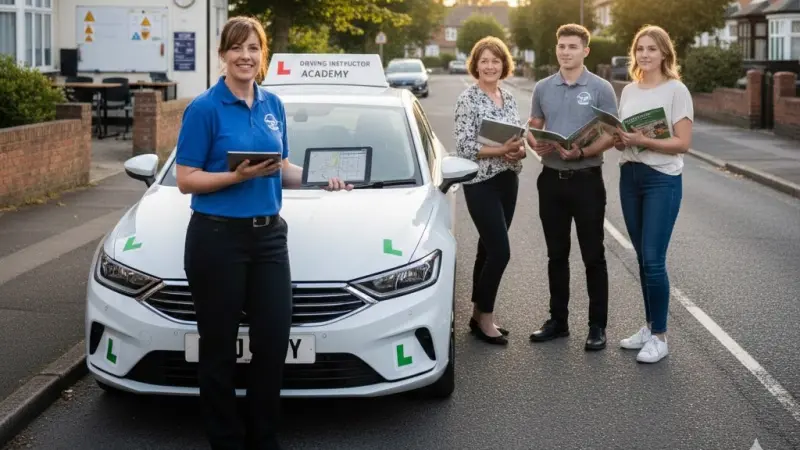
How to Become a Driving Instructor in the UK: The Definitive 2026 Career Guide
Published by LocalPage.uk Senior Content Architecture Team • Last Updated: February 2026

Entering the driver training industry in the United Kingdom is a pursuit that offers profound professional autonomy, social value, and financial stability. As we move through 2026, the demand for Approved Driving Instructors (ADIs) remains at a historic high, driven by a persistent backlog of learners and a significant demographic shift in the workforce. However, the journey from an experienced driver to a qualified professional is governed by rigorous standards set by the Driver and Vehicle Standards Agency (DVSA) and, in Northern Ireland, the Driver & Vehicle Agency (DVA).
39,000 Qualified ADIs currently operate in the UK, yet annual learner demand exceeds 1.6 million, creating a premium for high-quality instruction (Department for Transport, 2025).
Assessing Your Eligibility for the ADI Register
Before embarking on the technical training, one must satisfy the fundamental legal requirements. These are not merely administrative hurdles but are designed to ensure the safety of vulnerable road users and the integrity of the profession.
Legal Pre-requisites and the Enhanced DBS Check
To apply, you must have held a full UK or European Union manual driving licence for at least three of the last six years. Furthermore, your licence must be relatively clean; the DVSA will scrutinise any previous disqualifications or excessive penalty points. A pivotal component is the Enhanced Disclosure and Barring Service (DBS) check. In Scotland, this is handled via Disclosure Scotland, while AccessNI manages the process in Northern Ireland. Any serious criminal record or sexual offences will lead to an immediate rejection to protect the public.
Personal Attributes for Professional Instruction
Whilst technical proficiency is vital, successful instructors possess exceptional patience and communication skills. You are not just teaching a mechanical skill; you are managing the anxiety and cognitive load of a learner. The ability to remain calm whilst a student stalls at a busy roundabout in Birmingham or navigates the narrow rural lanes of the Cotswolds is what defines a professional.
Determining Your Fit
Ensure you can read a standard number plate from 26.5 metres (with glasses or contacts if necessary). Physical fitness is also required to sit for long periods and maintain constant vigilance.
The Three-Stage Qualification Process Explained
The qualification route is split into three distinct examinations. Each must be passed in order, and you have a maximum of three attempts for Part 2 and Part 3 before you are forced to wait for your theory certificate to expire and start again.
Part 1: Theory and Hazard Perception
This is significantly more demanding than the standard learner theory test. It consists of 100 multiple-choice questions across four categories: road procedure, traffic signs and signals, mechanical knowledge, and instructional techniques. You must score at least 85% overall and 80% in each sub-section. The Hazard Perception element involves 14 video clips, requiring you to identify developing hazards with a higher threshold for success than that required for new drivers.
Part 2: Driving Ability and Advanced Vehicle Control
Often referred to as the 'Expert Driving Test', this 60-minute examination requires a near-flawless performance. You are allowed no more than six minor faults and zero serious or dangerous faults. It covers diverse road conditions, manoeuvres, and an 'independent driving' section. In 2025, the DVSA updated the criteria to include more emphasis on eco-driving and the use of modern Driver Assistance Systems (ADAS).
Precision is Paramount
Unlike a standard test, the examiner expects you to demonstrate "advanced" road craft, including proactive planning, smooth gear changes, and exemplary mirror work.
Mastering Part 3: Instructional Ability
This is where most candidates struggle. It is a 45-minute observation of you delivering a real lesson to a pupil. The examiner sits in the back, assessing your ability to manage the lesson, identify faults, and provide effective feedback.
Client-Centred Learning (CCL) Principles
Modern UK driver training has shifted away from "telling" to "coaching". You must engage the pupil in their own learning process. For instance, if a pupil in Cardiff is struggling with lane discipline on the A48, you should ask them why they think they are drifting rather than simply shouting instructions. This methodology is now the gold standard across England, Wales, and Scotland.
Fault Identification and Remediation
It is not enough to see a mistake; you must understand the "why" behind it. Is it a lack of knowledge, a lack of skill, or a poor attitude?
Your ability to adapt your teaching style to the individual's needs is what the DVSA inspector will be grading on a scale of 0 to 51 (with a minimum of 43 required for a Grade A).
Professional Tip: Record your mock lessons. Reviewing your own communication style often reveals "filler words" or missed opportunities for praise that can make the difference between a pass and a fail in Part 3.
The Trainee Licence Route: Earning Whilst Learning
Once you pass Part 2, you can apply for a Trainee Licence (often called a "Pink Badge"). This allows you to charge for lessons while preparing for Part 3.
Conditions of the Trainee Licence
To hold a trainee licence, you must be sponsored by a driving school and complete 40 hours of mandatory training. You must also receive 20% supervision while giving lessons or complete an additional 5 hours of training. In Northern Ireland, the DVA maintains slightly different administrative oversight, but the principle of supervised practice remains consistent.
The Risks and Rewards of the Pink Badge
The reward is immediate cash flow and real-world experience. The risk is that if you do not pass Part 3 within the six-month validity of the licence, you may find yourself without a source of income. 72% of successful ADIs in 2025 utilised the trainee licence route to build their confidence before the final exam.
Managing Pupil Expectations
You must legally display your trainee licence in the window. Be transparent with your pupils; many value the fresh perspective of a trainee who is up-to-date with the latest DVSA standards.
Strategic Business Models: Franchise vs Independent
Upon qualification, you must decide how to structure your business. This choice dictates your work-life balance and your net income.
Joining a National or Regional Franchise
Franchises (like BSM, AA, or regional giants like Red) provide the car, the branding, and the pupils in exchange for a weekly fee (usually £150–£300). This is highly effective for those in Scotland or the North East where marketing costs can be high. The franchise takes care of the "back office," allowing you to focus on teaching.
Establishing an Independent Driving School
Being independent means 100% of the lesson fee stays with you. However, you must fund your own vehicle, insurance (which is specialised and expensive for instructors), and marketing. With 76% of UK consumers researching local businesses online (Ofcom, 2025), an independent instructor in 2026 must be proficient in local SEO and social media management.
£38-£55 The average hourly rate for driving lessons in the UK as of 2026, with London and the South East commanding the higher end of the spectrum.
Financial Obligations and Tax Compliance
Becoming an ADI means becoming a business owner. You must register with HMRC and understand your obligations regarding National Insurance and Income Tax.
HMRC Registration and Self-Assessment
Most instructors operate as Sole Traders. You must keep meticulous records of your mileage, fuel, vehicle maintenance, and home office costs. The "Making Tax Digital" (MTD) initiative is fully active in 2026, requiring you to use compatible software for your quarterly updates.
Insurance and Professional Indemnity
Standard car insurance is invalid for driving instruction. You require a policy that includes "Hire and Reward" and "Professional Indemnity". This protects you if a student is involved in an accident or if a claim is made regarding your professional advice. Organizations like the MSAGB (Motor Schools Association of Great Britain) offer discounted rates for members.
The Northern Ireland Context
In Northern Ireland, business rates for home-based offices may differ. Consult with your local authority to ensure your "business from home" status is correctly registered for non-domestic rates where applicable.
Vehicle Selection and Maintenance Standards
Your vehicle is your office and your primary teaching tool. In 2026, the shift towards
Electric Vehicles (EVs) has accelerated, influenced by both government policy and learner demand.
Manual vs Automatic vs Electric
Whilst manual licences still dominate, the demand for automatic instruction has risen by 40% since 2024. Furthermore, as the UK moves toward the 2030 targets, many instructors are opting for EVs. However, be aware that a pupil passing in an EV or automatic will be restricted to those vehicles unless they take a separate manual test.
Dual Controls and Safety Equipment
He-Man Dual Controls are the industry standard in the UK. You must ensure they are fitted by a certified engineer. Additionally, your car must be fitted with an extra interior mirror for your use and "L" plates (or "D" plates in Wales) that are clearly visible from the front and rear.
Maintaining Your Professional Status
Qualification is not the end of the journey. The DVSA ensures standards remain high through periodic "Standards Checks".
The DVSA Standards Check
Every 2-4 years, an examiner will observe a lesson. Failure to meet the required grade can lead to removal from the ADI register. This ensures that an instructor qualified in 1995 is still teaching the modern, safer methods required in 2026.
Continuing Professional Development (CPD)
Top-tier instructors engage in CPD, such as fleet training, skid pan courses, or advanced coaching qualifications. In Wales, Business Wales offers specific mentorship programs for small business owners looking to diversify their instructional services into specialized areas like disability driving or eco-efficiency.
Voice Search: Quick Answers for Future Instructors
"Hey Google, how long does it take to become a driving instructor?"
On average, it takes 6 to 12 months to pass all three parts. This depends on your study speed and the availability of DVSA test slots in your local region.
"Alexa, how much does driving instructor training cost in the UK?"
Expect to invest between £1,500 and £3,000 for a comprehensive training package. This usually includes all three parts and the necessary study materials.
Navigating Regional Variations in the UK
While the core driving laws are consistent, the administrative and operational landscape varies across the four nations.
England and the North-South Divide
In London and the South East, higher operational costs are offset by the ability to charge premium rates. Conversely, in the North of England, instructors often report higher pupil loyalty but must contend with lower average hourly rates. Using Local Enterprise Partnerships (LEPs) can help English instructors find small business grants for EV transitions.
Scotland and the Rural Challenge
For instructors in the Highlands or Islands, travel time between pupils is a significant factor. Scottish Enterprise provides resources for rural businesses to help manage these logistics. Additionally, the theory and practical tests in Scotland include specific awareness for driving on single-track roads and encountering livestock.
Wales and Bilingual Instruction
In many parts of Wales, providing instruction in the Welsh language is a significant competitive advantage. Under the Welsh Language Standards, many public bodies require services to be available in both languages, and being a bilingual ADI can open doors to local authority contracts and school programs.
Northern Ireland and the DVA
Northern Ireland operates under the DVA rather than the DVSA. The registration process involves the "Approved Driving Instructor (ADI) Register NI". Ensure you use the specific NI portals for your DBS checks (AccessNI) and test bookings to avoid administrative delays.
Ready to Start Your Journey?
Join thousands of successful UK business owners by listing your services on LocalPage.uk
Create Your Free Business Profile
Frequently Asked Questions
Can I become a driving instructor if I have points on my licence?
It depends on the number and nature of the points. Generally, if you have more than 6 penalty points, your application may be rejected. The DVSA considers each case individually, but serious offences like drink-driving or dangerous driving usually result in a mandatory refusal of entry to the register.
Do I need to own a car to start my ADI training?
No, you don't necessarily need your own car for Part 1 or Part 2 training, as many trainers provide vehicles. However, for the Part 3 exam and your subsequent career, you will need a dual-controlled vehicle that meets DVSA requirements. Most trainees choose to lease or buy a car once they reach the 'Pink Badge' stage.
What is the pass rate for the ADI Part 3 exam?
Historically, the Part 3 pass rate is approximately 35-40%. It is widely considered the most difficult part of the process. Success requires more than just knowing how to drive; it requires a deep understanding of educational psychology and the ability to coach different personality types effectively under pressure.
How much can a UK driving instructor earn annually in 2026?
A full-time instructor working 35-40 hours a week can gross between £45,000 and £65,000. After expenses (fuel, car, insurance, tax), net profit typically ranges from £30,000 to £45,000. Specialist instructors (automatic, disability, or advanced) often earn at the higher end of this scale due to reduced competition.
Are there any age limits for becoming an instructor?
There is no upper age limit, provided you meet the medical fitness standards and can read a number plate at the required distance. You must be at least 21 years old and have held your licence for three years. Many people enter the profession as a second career in their 40s or 50s.
Can I teach my own family members to drive for money while training?
You can only charge for driving lessons if you hold a valid Trainee Licence (Pink Badge) or are a fully qualified ADI (Green Badge). Providing paid instruction without one of these is a criminal offence. You can, however, supervise family members for free as any other experienced driver would.
Is the ADI process different in Scotland compared to England?
The qualifying process (Parts 1, 2, and 3) and the DVSA oversight are the same. The main differences are regional, such as using Disclosure Scotland for your criminal record check and different local business support networks like Scottish Enterprise for financial planning.
What happens if I fail one of the ADI tests three times?
If you fail Part 2 or Part 3 three times, you must wait until your Part 1 (Theory) certificate expires (which lasts two years) before you can start the entire process again from the beginning. This highlights the importance of professional training rather than attempting a 'DIY' approach.
Do I need an accountant for my driving school business?
Whilst not legally required, it is highly recommended. A specialist accountant can help you navigate the "Making Tax Digital" requirements and ensure you
are claiming all allowable expenses, such as dual-control installation, car cleaning, and a portion of your home utility bills.
Is there a high demand for female driving instructors?
Yes, there is a significant and consistent demand for female instructors. Many learners feel more comfortable with a female teacher for personal or cultural reasons. Female ADIs often find they can build a full diary of pupils much faster than the national average.

Disclaimer: The information provided in this article is for general informational and research purposes only. Company details, features, services, and market positions may change over time. Readers are advised to visit official company websites and conduct independent research before making any business decisions or purchasing services.
Most Searchable Keywords

Recent Blogs
-

Explore Supermarkets in Chepstow and the Surrounding Wye Valley
-
Elite Guide to Taxi and Private Hire Services in Hereford
-
Explore Fuel and Roadside Convenience Across Beckington Today
-
Explore Abergavenny Tyre Services with Expert Local Fitters
-
Claim Your HMRC UK Tax Refund Before Application Deadlines




Categories
- Accountants (295)
- Advertising Agencies (559)
- Architects (149)
- Automobiles (376)
- Beauty (300)
- Carpenters (146)
- Cleaning Services (386)
- Dentists (189)
- Driving (61)
- Electricians (215)
- Energy (7)
- Event Organiser (683)
- Finance (597)
- Guide (3358)
- Health (2205)
- Information technology (206)
- Legal Services (352)
- Logistics (6)
- Maintenance (65)
- Manufacturing (35)

Sponsored Listings in Accountants

Related Blogs

Explore Supermarkets in Chepstow and the Surr...
Read this insightful article "Explore Supermarkets in Chepstow and the Surrounding Wye Valley" to expand your knowledge!

Elite Guide to Taxi and Private Hire Services...
Read this insightful article "Elite Guide to Taxi and Private Hire Services in Hereford" to expand your knowledge!

Explore Fuel and Roadside Convenience Across...
Read this insightful article "Explore Fuel and Roadside Convenience Across Beckington Today" to expand your knowledge!
Questions & Answers – Find What
You Need, Instantly!
How can I update my business listing?
Is it free to manage my business listing?
How long does it take for my updates to reflect?
Why is it important to keep my listing updated?
