
How to Claim Tax Relief on Your Work Uniform Tools and Home Working
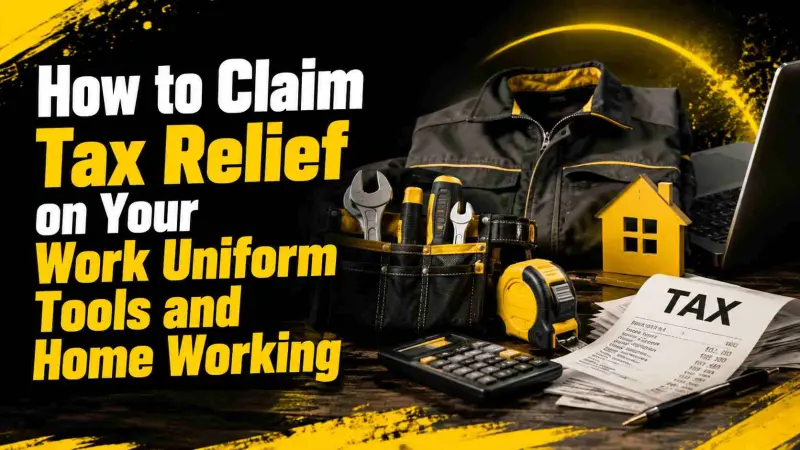
Buying work clothes, replacing tools, washing a specialist uniform or working from home can leave employees paying expenses directly from their own pockets. The good news is that some employment-related costs qualify for UK tax relief. The less obvious part is that not every expense connected with your job is allowable, and the rules differ depending on what you bought, why you bought it and whether your employer reimbursed you.
For uniforms and specialist work clothing, HMRC may allow tax relief on cleaning, repairing or replacing eligible items. Employees may also qualify for relief on certain small tools they need for their job. However, ordinary clothing, even clothing bought specifically for work, normally does not qualify.
Working from home is more complicated in 2026. From 6 April 2026, employees can no longer claim an Income Tax deduction from HMRC for unreimbursed additional household expenses incurred while working from home. Claims may still be possible for eligible previous tax years. Employers can also continue to make certain tax-free homeworking payments where the conditions are met.
This guide explains what you can claim, what you cannot claim, how flat-rate expenses work, what evidence you need, how to claim through HMRC, and what has changed for homeworking.
What tax relief can you claim for work uniforms, tools and home working?
Employees can potentially claim Income Tax relief when they personally pay certain employment expenses and those expenses meet HMRC's conditions.
For work clothing and tools, eligible expenses can include:
- Cleaning, repairing or replacing an eligible uniform or specialist work clothing.
- Certain small tools required for your job.
- Some qualifying flat-rate expenses agreed for particular occupations.
- Eligible employment expenses that your employer does not reimburse.
The rules are narrower than many people assume. Buying a suit for an office job, for example, does not generally become tax-deductible simply because your employer expects you to look smart.
HMRC says employees may claim relief for a uniform that identifies them with a particular occupation, as well as specialist clothing such as overalls or safety boots. However, ordinary everyday clothing is excluded even where it is required for work.
For homeworking, the position is now different. Employee deductions for additional household expenses were removed from 6 April 2026, although eligible claims for earlier tax years remain available.
What does tax relief actually mean?
Tax relief does not normally mean HMRC gives you the entire amount you spent.
Instead, an allowable expense reduces the amount of income on which you pay tax.
For example, suppose an employee has £100 of qualifying expenses and pays Income Tax at 20%. A £100 deduction could reduce their tax by £20, assuming the full expense qualifies and the employee has sufficient taxable income.
At a 40% tax rate, the same £100 deduction could reduce tax by £40.
This distinction matters because a £100 tax deduction is not normally a £100 cash refund.
Who can claim employment expense tax relief?
Generally, the employee must have paid the expense themselves and the expense must meet HMRC's rules.
A useful starting point is to ask three questions:
- Did I personally pay for it?
- Was it necessary for my employment?
- Is it an expense HMRC allows?
If your employer has already reimbursed the full cost, you generally cannot claim tax relief on the same amount.
HMRC's general job-expense guidance explains that employees may be able to claim where they use their own money for things they must buy for their job and where the conditions for relief are satisfied.
Which work uniforms and clothing qualify for tax relief?
The strongest claims usually involve clothing that is clearly connected with the employee's occupation rather than ordinary clothing.
Uniforms that identify your occupation
A qualifying uniform can be clothing that identifies you as performing a particular occupation.
Examples can include occupational uniforms worn by:
- Nurses and healthcare workers
- Police officers
- Certain transport workers
- Hospitality employees with identifiable uniforms
- Other workers whose clothing is specifically associated with their occupation
HMRC specifically describes a uniform as clothing that identifies someone as having a particular occupation.
The exact eligibility and available flat-rate amount can depend on the occupation.
Specialist protective or work clothing
Specialist clothing can qualify even if it does not identify your occupation.
Examples may include:
- Overalls
- Safety boots
- Protective workwear
- Certain specialist clothing required to perform particular duties
The key distinction is that the clothing needs to have a genuine work-specific function rather than simply being suitable for work.
Can you claim for ordinary work clothes?
Usually, no.
This is one of the most common misunderstandings about employment expense tax relief.
If you buy:
- A business suit
- A shirt
- Trousers
- A smart jacket
- Ordinary shoes
- A dress suitable for the office
you generally cannot claim tax relief merely because you wear those items while working.
HMRC's guidance specifically excludes everyday clothing, even where an employer requires a particular design or colour.
So, for example, if an employer tells an employee to wear a black shirt and black trousers, those items do not automatically become tax-deductible.
The fact that you would not have bought the clothes without your job is not, by itself, enough.
Can you claim tax relief for washing or repairing a uniform?
Yes, potentially.
HMRC allows relief for cleaning, repairing or replacing eligible uniforms and specialist clothing when the relevant conditions are met.
This can be particularly useful for employees who regularly wash specialist clothing at home.
However, you cannot claim simply because you wash ordinary work clothes.
What if your employer offers a laundry service?
If your employer provides a free laundering service for your qualifying uniform or specialist clothing and you choose not to use it, HMRC says you cannot claim tax relief for laundering that clothing yourself.
This prevents an employee from creating a personal deductible expense by voluntarily choosing a private alternative when their employer already provides the service.
Flat-rate laundry expenses
Some employees can use agreed flat-rate expenses instead of calculating their actual costs.
HMRC's published guidance includes a £60 annual laundry amount for employees not covered by a nationally agreed occupation-specific flat rate, subject to the applicable rules.
Occupation-specific rates can differ, so it is sensible to check HMRC's current flat-rate list rather than assuming the £60 figure applies to everyone.
Can you claim tax relief for tools you buy for work?
Potentially, yes.
HMRC says employees may be able to claim tax relief for repairing or replacing small tools they need to perform their job.
Examples include tools such as scissors or an electric drill.
The important issue is whether the tool is genuinely required for the employment and whether the expenditure satisfies the relevant tax rules.
Examples of potentially qualifying tools
Depending on the occupation, these could include:
- Hand tools
- Specialist trade equipment
- Small electrical tools
- Professional instruments
- Equipment used directly in performing employment duties
A hairdresser, electrician, engineer, technician or tradesperson may have very different allowable expenses from an office worker.
What about expensive equipment?
Do not automatically assume that an expensive piece of equipment can be treated in exactly the same way as a small tool.
Larger equipment can involve different tax rules, including rules concerning capital expenditure and employment equipment.
If the item is expensive, has significant private use, or is also used outside your employment, check the specific HMRC rules before making a claim.
What if you use a tool privately as well?
Private use can affect the amount you can claim.
Tax relief is generally focused on the employment-related element rather than giving relief for personal spending.
For example, if you purchase equipment for £500 and genuinely use it for both employment and private activities, claiming the entire £500 without considering the private element could result in an incorrect claim.
Keep evidence of how the item is used and take professional advice if the amount is significant or the circumstances are complicated.
How do flat-rate expenses work?
A flat-rate expense is an agreed amount that can be claimed for certain qualifying employment expenses without providing receipts for the individual purchases.
HMRC explains that flat-rate expenses are fixed amounts intended to cover certain costs associated with clothing and tools.
For example, if an employee is entitled to a £60 flat-rate expense and pays Income Tax at 20%, the tax saving would normally be £12.
At 40%, the potential tax saving would be £24.
| Expense method | What you claim | Evidence generally needed |
|---|---|---|
| Flat-rate expense | HMRC-approved fixed amount | Usually no receipts |
| Actual expense | Amount actually spent | Receipts or other evidence |
| Employer reimbursement | Employer pays eligible expense | Check whether any personal claim remains |
| Homeworking household costs from 2026/27 | Employee deduction no longer available | Previous-year rules may still apply |
The flat-rate amount is the expense deduction, not the cash refund.
Should you claim the flat rate or actual costs?
That depends on your circumstances.
If you have an agreed flat-rate expense, it can be simpler because you do not normally need to keep receipts for that particular flat-rate claim.
If your actual qualifying expenses are significantly higher and HMRC allows an actual-cost claim, claiming the actual amount may produce greater tax relief.
However, you need evidence to support an actual-cost claim.
HMRC says that when claiming actual amounts for uniforms, work clothing and tools, employees should provide receipts or other evidence showing what was purchased and that they paid for it.
Example: flat rate versus actual spending
Imagine a qualifying employee has an agreed £60 annual flat-rate expense.
They could potentially claim the £60 without submitting receipts.
Alternatively, suppose they have £150 of genuine allowable expenses and are entitled to claim actual costs under the applicable rules. If properly evidenced, the actual-expense route could produce a larger deduction.
The right choice depends on the expense category and HMRC's rules for that employment.
What changed for working from home in 2026?
This is the part of the rules that many employees need to pay particular attention to.
From 6 April 2026, employees can no longer claim an Income Tax deduction from HMRC for additional household expenses incurred while working from home.
That means the old employee claim for costs such as additional household electricity and gas used because you had to work from home has been removed for the 2026/27 tax year.
The change applies to unreimbursed household expenses.
Can you still claim homeworking expenses for previous years?
Yes, eligible employees can still make claims for previous tax years covered by the rules.
HMRC states that employees can claim for the current and previous four tax years where eligible, but the specific homeworking service explains that from 6 April 2026 no new deduction is available for the 2026/27 year itself.
This creates an important distinction:
2025/26 and earlier: eligible employees may still have a claim for qualifying homeworking costs.
2026/27 onwards: employees cannot claim an Income Tax deduction from HMRC for additional household expenses under the old homeworking deduction rules.
What was the old £6-a-week rule?
Before the 2026 change, eligible employees could claim tax relief based on £6 per week without calculating their exact additional household costs, or potentially claim actual qualifying costs with supporting evidence.
The £6 figure was an amount on which tax relief was calculated; it was not a £6 weekly cash payment from HMRC.
For a basic-rate taxpayer, £6 of deductible expense could mean £1.20 of tax relief per week.
HMRC's guidance confirms that the £6 weekly amount applied to eligible employees under the previous rules.
Can your employer still pay homeworking expenses tax-free?
Yes, the removal of the employee deduction does not mean employers are prohibited from making qualifying tax-free homeworking payments.
HMRC states that the change does not affect the rules allowing employers to reimburse eligible homeworking costs without Income Tax and National Insurance deductions where the relevant conditions are satisfied.
This distinction is important:
Employee tax deduction: removed for additional household costs from 6 April 2026.
Qualifying employer reimbursement: can continue under the relevant exemption.
If you work from home regularly, check your employer's expenses policy before assuming that you must personally absorb every cost.
What homeworking costs could previously qualify?
Under the previous rules, qualifying additional household expenses could include certain additional costs caused by working at home.
HMRC guidance referred to costs such as additional gas and electricity associated with the work area and certain business telephone costs.
However, expenses had to meet the applicable conditions.
Employees generally could not simply claim a proportion of their entire household spending.
For example, the previous rules did not generally allow employees to treat ordinary rent or broadband costs as deductible merely because they worked from home. HMRC's current guidance specifically identifies private and mixed-use costs such as rent and broadband as excluded from the employee homeworking deduction.
What about computers, desks and office equipment?
Do not confuse the removal of the homeworking household-expense deduction with every possible employment-equipment claim.
Tax treatment can differ depending on what you purchase, whether it is necessary for your employment, whether your employer provides it, and whether it has private use.
For example, an employee may need a computer to perform their duties, but that does not automatically mean they can buy any laptop they want and claim the entire cost from HMRC.
Where an employer provides equipment for work, that is often the cleaner route.
If you personally purchase significant equipment, check the specific employment-expense rules before claiming.
What evidence should you keep?
Good records can make a tax claim much easier to support.
For actual expenses, keep:
- Receipts
- Invoices
- Purchase dates
- Descriptions of items
- Evidence that you personally paid
- Employer expense policies
- Evidence showing why the item was needed for work
- Records of any employer reimbursement
- Relevant employment documentation
For previous homeworking claims, evidence may also be needed to establish that you were required to work from home rather than simply choosing to do so.
HMRC says evidence may include an employment contract or other documentation showing that working from home was required.
A simple digital folder containing receipts and supporting documents can be extremely useful.
How do you claim tax relief from HMRC?
The process depends on your circumstances.
Step 1: Identify the expense
Separate your expenses into categories such as:
- Uniform and specialist clothing
- Laundry
- Tools
- Other qualifying employment expenses
- Previous-year homeworking costs
Do not combine everything into one figure.
Step 2: Check whether the expense qualifies
Ask whether the cost is genuinely employment-related and falls within an HMRC-approved category.
This is particularly important for clothing because everyday clothing is generally excluded.
Step 3: Check whether your employer reimbursed you
If your employer paid you back, you need to account for that when determining what remains claimable.
You should not claim tax relief on costs that your employer has already fully reimbursed.
Step 4: Decide between a flat rate and actual expenses
Where HMRC provides a flat-rate option, compare it with the actual eligible cost if an actual-cost claim is permitted.
Remember that actual-cost claims require supporting evidence.
Step 5: Make the claim
Eligible employees can use HMRC's online job-expense service.
If you complete a Self Assessment tax return, employment expenses are generally claimed through that return instead. HMRC confirms that Self Assessment taxpayers should claim through their tax return.
Postal claims can also be made in circumstances where HMRC's process permits it, including using form P87.
Step 6: Check your tax code or repayment
If HMRC accepts a claim for an appropriate ongoing expense, it may adjust your tax code.
For previous tax years, HMRC may adjust your tax code or issue a tax refund depending on the circumstances.
Common mistakes employees make
Claiming ordinary clothing
A shirt or suit bought for the office does not become allowable merely because an employer requires employees to dress professionally.
Treating tax relief as a full refund
If you claim £200 of qualifying expenses, you do not normally receive £200 back.
The tax saving depends on your tax rate and circumstances.
Claiming expenses already reimbursed
If your employer has paid you back, do not claim the same expense again.
Claiming homeworking costs under the old rules for 2026/27
This is particularly relevant now.
The employee deduction for additional household expenses ended on 6 April 2026. Claims for eligible previous years can
still be possible, but the old £6-per-week employee deduction cannot simply be carried forward into 2026/27.
Assuming every tool is automatically deductible
The fact that something is useful at work does not automatically establish eligibility.
The employment purpose, type of expense and relevant tax rules matter.
A practical example: a tradesperson
Imagine an employee electrician who personally buys qualifying small tools and specialist safety footwear.
The employee should first establish:
- Whether the tools are required for the employment.
- Whether the safety footwear qualifies as specialist work clothing.
- Whether the employer reimburses any of the costs.
- Whether an agreed flat-rate expense applies.
- Whether actual expenses can be claimed and what evidence is available.
If the employee also buys ordinary trousers for work, those should not automatically be added to the claim simply because they are worn on site.
The strongest claim is one based on clearly identifiable qualifying expenses rather than an attempt to include every purchase connected with the job.
A practical example: an office employee
Consider an office employee who works from home three days a week.
Before 6 April 2026, an eligible employee who was required to work from home could potentially claim relief for qualifying additional household costs under the homeworking rules.
For the 2026/27 tax year, however, the employee cannot claim the old HMRC deduction for unreimbursed additional household expenses. They should instead check whether their employer provides qualifying homeworking reimbursement.
If the same employee purchases a specialist tool or qualifying work clothing for another aspect of their employment, that expense needs to be assessed separately.
How can employees maximise legitimate tax relief?
The best approach is not to claim as many expenses as possible. It is to identify every expense that genuinely qualifies and support it properly.
A practical system is:
- Save receipts immediately.
- Categorise expenses by type.
- Separate work expenses from private spending.
- Record whether your employer reimbursed anything.
- Check HMRC's flat-rate list.
- Keep evidence supporting unusual or high-value claims.
- Review previous tax years where claims may still be available.
- Check the rules again when your employment or tax circumstances change.
This approach is more reliable than relying on assumptions or internet lists of supposedly "tax-deductible work expenses."
What does the future of employee expense claims look like?
The removal of the employee deduction for additional homeworking household costs from April 2026 represents a significant change in the way home-based employment expenses are treated. HMRC's policy documentation confirms that the government removed the employee deduction mechanism while retaining the separate rules that allow employers to make certain qualifying payments.
The broader direction is likely to involve greater reliance on employer-provided equipment and reimbursed expenses, rather than employees independently claiming household costs from HMRC.
For employees, that means company expense policies may become more important.
Someone starting a hybrid role should ask their employer:
- What equipment is provided?
- What expenses are reimbursed?
- Is there a homeworking allowance?
- Are work tools reimbursed?
- Is specialist clothing supplied?
- What happens when equipment needs replacing?
The tax rules can change, so employees should check current HMRC guidance when making claims rather than relying on an old article, social-media post or previous year's tax advice.
Key Insights
- Qualifying uniforms and specialist clothing can attract tax relief, particularly where the clothing identifies an occupation or is specialist protective workwear.
- Ordinary everyday clothing is generally not deductible, even when an employer requires a particular colour or style.
- Small tools required for employment may qualify, but expensive equipment and mixed-use items need closer consideration.
- Flat-rate expenses can simplify claims because eligible employees generally do not need receipts for the fixed amount.
- Actual-expense claims require evidence, so keep receipts and proof that you personally paid.
- The old employee homeworking deduction ended on 6 April 2026 for additional household expenses.
- Eligible previous-year homeworking claims may still be available, subject to the relevant rules and time limits.
- Employer reimbursement remains important, because qualifying tax-free homeworking payments can still be made where the conditions are satisfied.
FAQ
1. Can I claim tax relief for a work uniform?
Yes, potentially. Tax relief may be available for a qualifying uniform or specialist work clothing, including certain occupational uniforms, overalls and safety footwear. Ordinary everyday clothing does not normally qualify simply because you wear it for work.
2. Can I claim tax relief for washing my work uniform?
Potentially. Cleaning qualifying uniforms or specialist work clothing can qualify. However, you generally cannot claim for laundering an eligible uniform yourself if your employer provides a free laundry service that you choose not to use.
3. Can I claim tax relief for a suit I wear to work?
Usually not. A normal business suit is considered everyday clothing rather than specialist occupational clothing. Even if your employer requires you to wear a suit, that requirement does not normally make the purchase tax-deductible.
4. Can I claim tax relief on tools I buy for my job?
You may be able to claim for repairing or replacing qualifying small tools that you need for your employment. HMRC specifically gives examples such as scissors and electric drills. The precise treatment depends on the expense and your circumstances.
5. Do I need receipts for a flat-rate work expense?
Generally, no. If you are claiming an HMRC-agreed flat-rate expense, you normally do not need to provide receipts for the individual purchases. Actual-expense claims require evidence supporting what you spent.
6. How much money do I get back from tax relief?
Tax relief is normally based on the amount of tax you would otherwise have paid on the allowable expense. For example, £100 of qualifying deductions could produce £20 of tax relief for someone paying tax at 20%, rather than a £100 cash refund.
7. Can I claim tax relief for working from home in 2026/27?
No, employees can no longer claim an Income Tax deduction from HMRC for additional household expenses incurred while working from home from 6 April 2026. Eligible claims for previous tax years remain possible.
8. Can I still claim the £6 a week working-from-home allowance?
Not as an employee deduction for the 2026/27 tax year. The £6-per-week employee deduction applied under the previous rules. From 6 April 2026, that deduction was removed, although employers can still make certain qualifying homeworking payments.
9. Can my employer still pay me for working from home?
Yes. The removal of the employee deduction does not remove the separate rules under which employers can make qualifying homeworking payments without Income Tax and National Insurance deductions.
10. Can I claim tax relief for broadband when I work from home?
Under the previous employee homeworking deduction rules, mixed private and work costs such as broadband were generally restricted. For 2026/27, the employee deduction for additional household expenses has been removed altogether. Employer reimbursement should be considered separately.
11. Can I claim tax relief for PPE?
Employees generally cannot claim tax relief for PPE through the uniform and work-clothing claim. HMRC says that where PPE is required, the employer should provide it or reimburse the employee's cost.
12. Can I claim tax relief if my employer pays part of my uniform costs?
Potentially, but you cannot normally claim relief on an amount that has already been reimbursed. Any claim should reflect the qualifying amount that you personally bear under the applicable rules.
13. Can I claim previous years' uniform and tool expenses?
Potentially. HMRC states that eligible employees can claim for the current tax year and the previous four tax years for uniforms, work clothing and tools, subject to the applicable rules.
14. How do I claim employment expense tax relief?
You can generally use HMRC's online job-expense service for eligible claims. If you complete a Self Assessment tax return, employment expenses should normally be claimed through that return. Postal claims can also be made where HMRC's process allows it.
15. Should I claim actual costs or a flat-rate expense?
Where both options are available, compare them. A flat-rate expense is simpler and generally does not require receipts, while an actual-cost claim may produce a larger deduction if you have significant qualifying expenses and good evidence. Always check which method HMRC permits for your particular expense.
Final Thoughts
Tax relief on employment expenses can be useful, but the rules reward accuracy rather than aggressive claiming. A qualifying uniform is not the same as ordinary work clothing, a small work tool is not automatically equivalent to expensive equipment, and a tax deduction is not the same thing as a cash refund.
The biggest change for employees in 2026 is homeworking. From 6 April 2026, the employee deduction for unreimbursed additional household expenses was removed. If you are checking an older tax year, however, you may still have an eligible claim, so do not assume that the rule applies retrospectively to every year.
For current expenses, start with the simplest question: what did I personally pay for that
I genuinely needed for my employment, and does HMRC specifically allow it?
Keep your receipts, check whether your occupation has a flat-rate expense, account for employer reimbursements and use HMRC's current guidance before submitting a claim. If an expense is unusually large, partly private or difficult to classify, getting professional tax advice can be safer than guessing.
Disclaimer: The information provided in this article is for general informational and research purposes only. Company details, features, services, and market positions may change over time. Readers are advised to visit official company websites and conduct independent research before making any business decisions or purchasing services.
Most Searchable Keywords
Recent Blogs

Related Listings

Categories
- Accountants (295)
- Advertising Agencies (559)
- Architects (149)
- Automobiles (377)
- Beauty (300)
- Carpenters (146)
- Cleaning Services (387)
- Dentists (189)
- Driving (62)
- Education (1)
- Electricians (215)
- Energy (8)
- Event Organiser (687)
- Finance (602)
- Guide (3422)
- Health (2207)
- Information technology (206)
- Legal Services (361)
- Logistics (6)
- Maintenance (65)
Sponsored Listings in Plumbers

Related Blogs
Water Meter or Fixed Bill: Which Is Cheaper
Read this insightful article "Water Meter or Fixed Bill: Which Is Cheaper" to expand your knowledge!

ECO4 Free Insulation: What’s Still Available...
Read this insightful article "ECO4 Free Insulation: What’s Still Available in This Year" to expand your knowledge!

What It Costs to Run an Electric Fan Air Frye...
Read this insightful article "What It Costs to Run an Electric Fan Air Fryer or Tumble Dryer" to expand your knowledge!
Questions & Answers – Find What
You Need, Instantly!
How can I update my business listing?
Is it free to manage my business listing?
How long does it take for my updates to reflect?
Why is it important to keep my listing updated?
