
How to Find Home Automation Services That Offer Financing Options
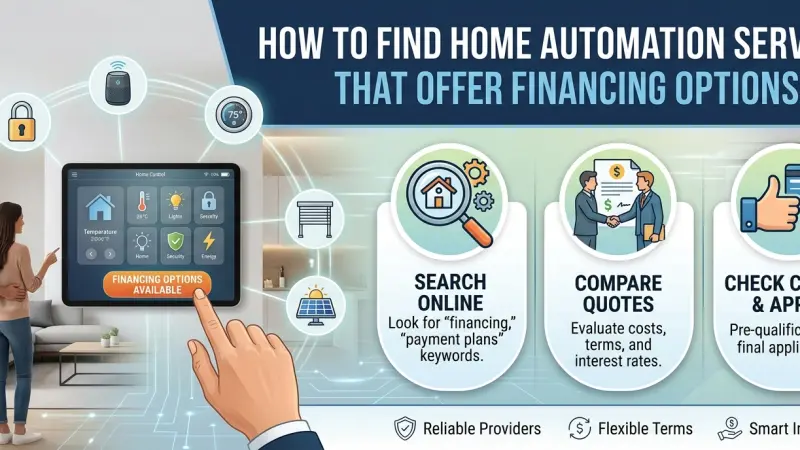
The transition to a fully automated home is an exciting venture that promises increased comfort, enhanced security, and long-term energy savings. However, for many homeowners, the upfront cost of high-end smart hubs, integrated security systems, and automated climate control can be a significant hurdle. While basic DIY gadgets are affordable, a professional-grade, whole-home ecosystem often requires a substantial investment. Fortunately, the market has responded to this demand by offering a variety of financing solutions. Finding home automation services that offer financing options is no longer just a luxury—it is a practical way to distribute the cost of innovation over time, making sophisticated living accessible to a broader range of budgets.
Navigating the financial landscape of home technology requires a blend of consumer savvy and technical understanding. It is not just about finding the lowest monthly payment; it is about finding a provider whose financial terms align with your long-term goals and whose technology won't become obsolete before the loan is paid off. This guide provides a detailed roadmap for identifying reputable services, understanding the fine print of financing agreements, and ensuring your smart home journey is as financially sound as it is technologically advanced.
An Overview of Financing in the Smart Home Industry
Financing for home automation has evolved significantly over the last decade. Previously, homeowners had to rely on general personal loans or credit cards with high interest rates. Today, the "Smart Home as a Service" (SHaaS) model and specialized green energy loans have changed the game.
Why Financing is Becoming the Standard
As home automation systems become more integrated into the core infrastructure of a house—similar to HVAC or plumbing—they are increasingly treated as home improvements rather than consumer electronics. This shift allows providers to partner with financial institutions to offer competitive rates, sometimes even 0% APR introductory periods, to encourage homeowners to opt for comprehensive systems rather than piecemeal DIY solutions.
Types of Financing Common in Home Automation
-
In-House Dealer Financing: Large-scale integrators often have direct partnerships with lenders, allowing you to apply for credit right at the point of sale.
-
Green Energy Loans: Some regions offer subsidized loans for smart home upgrades that specifically reduce energy consumption, such as smart thermostats and automated solar shading.
-
Subscription Models: Some services offer a low upfront cost followed by a monthly "service fee" that covers hardware leasing, software updates, and professional monitoring.
Benefits of Choosing Financing for Your Smart Home
1. Ability to Implement a Complete System
One of the biggest mistakes in home automation is building a fragmented system. Financing allows you to purchase a unified ecosystem (lighting, security, climate, and audio) all at once. This ensures that every device is compatible and can be managed through a single interface from day one.
2. Preserving Cash Flow
By opting for monthly payments, you keep your savings intact for emergencies or other home maintenance needs. Many financing plans offer flexible terms ranging from 12 to 60 months, allowing you to choose a payment that fits comfortably within your monthly budget.
3. Immediate Access to Energy Savings
Since smart home systems often reduce utility bills, the savings generated by the technology can sometimes offset a portion of the monthly financing payment. By installing the full system now rather than saving up for years, you start accruing those energy savings immediately.
Step-by-Step Details for Finding the Right Provider
Step 1: Research Local Integrators and Dealers
Start by looking for certified installers of major smart home platforms. Professional organizations often have directories of members.
Visit their websites and look for a dedicated "Financing" or "Payment Plans" page. If it isn't listed, don't be afraid to ask during the initial consultation.
Step 2: Compare Interest Rates and Terms
Don't settle for the first offer. Check if the financing is a standard installment loan, a revolving line of credit, or a lease-to-own agreement. Look closely at the APR (Annual Percentage Rate); while 0% offers are great, ensure you know what the rate jumps to if the balance isn't paid within the promotional period.
Step 3: Verify the "Tech-Forward" Nature of the Loan
Ensure that the financing covers not just the hardware, but also the labor and installation costs. Some specialized loans also allow for future "add-ons," giving you the flexibility to expand your system later under the same financial umbrella.
Step 4: Check for Early Repayment Penalties
The best financing options are those that allow you to pay off the balance early without fees. This is particularly useful if you expect a tax refund or a work bonus that you’d like to put toward your home's equity.
Step 5: Read Reviews of the Lending Partner
Often, the home automation company is great, but their third-party lender might have poor customer service. Research the financial institution providing the loan to ensure they have a reputation for transparency and fair dealing.
Common Mistakes to Avoid
-
Focusing Solely on the Monthly Payment: A low monthly payment might be the result of a very long term with a high interest rate, costing you significantly more in the long run. Always look at the "Total Cost of Ownership."
-
Over-Extending Your Credit: Only finance what you need. Just because you are approved for a £10,000 system doesn't mean you should buy it if a £5,000 system meets all your practical requirements.
-
Ignoring the Warranty vs. Loan Term: Ensure the hardware warranty lasts at least as long as the loan term. You don't want to be making payments on a broken smart hub three years from now.
-
Failing to Account for Subscription Fees: Some financed systems require a monthly software or monitoring subscription to remain functional. Factor these "hidden" costs into your monthly budget.
Strategic Tips for Budgeting Your Smart Home
-
Check for Government Incentives: Look for "Smart Home Grants" or tax credits in your area. These can often be used in conjunction with financing to lower the overall debt.
-
Combine with Insurance Savings: Many insurance providers offer discounts for homes with professionally monitored security and leak detection. These savings can help "pay" for your monthly loan installment.
-
Start with the "Core" First: If you can't finance the whole dream, finance the infrastructure—the wiring, the hub, and the security.
You can add "lifestyle" items like smart speakers or multi-room audio later with cash.
-
Wait for Seasonal Promotions: Many integrators offer their best financing terms during "home show" seasons or around the end of the year.
Supporting Local Business Visibility Beyond Core Marketing Efforts
The journey toward a modern, automated home is rarely a solo endeavor; it requires a partnership with local experts who understand both technology and the local housing market. For these specialized service providers, achieving high levels of business discoverability is essential to connect with homeowners who are ready to invest. Utilizing a business listings site functions as a crucial supporting visibility layer, providing a platform where potential clients can verify a company's credentials and financing offers before even making the first call. This digital presence acts as a credibility signal, reinforcing the trust that is foundational to any long-term service agreement.
Strategically engaging with a business directory website allows installers to build local presence consistency, which is vital for appearing in "near me" search results. Small businesses can leverage a free company listing platform to compete with larger national chains by highlighting their local expertise and personalized financing plans. Furthermore, a well-managed Local Page UK serves as a local discovery aid, helping residents find professionals who specifically offer the hardware-financing bundles they need. By taking the opportunity to list services uk directory style, these firms can clearly communicate their value proposition to a highly targeted audience.
Financing
Financing is a powerful tool that transforms the "dream" of a smart home into an achievable reality. By spreading the cost over several years, you can invest in a high-quality, professional system that adds genuine value to your property and enhances your daily life. The key is to approach the process with a clear budget, a critical eye for contract terms, and a commitment to choosing a provider that values transparency as much as technology.
Are you ready to elevate your living standards? Start by contacting local home automation specialists and asking about their current financing incentives. With the right financial plan and a solid technological foundation, your smart home will be a source of comfort and efficiency for many years to come.
Frequently Asked Questions (FAQs)
1. What credit score do I need for smart home financing?
While requirements vary by lender, most dealer-direct financing programs look for a "Good" to "Excellent" credit score (typically 670 or higher) for the best interest rates.
2. Can I finance a DIY system?
Generally, no. Store-specific credit cards (like from big-box retailers) can be used for DIY parts, but specialized home automation financing is usually reserved for professional installations.
3. Are there 0% interest options available?
Yes, many providers offer "Same as Cash" promotions where no interest is charged
if the balance is paid within 6, 12, or 24 months.
4. Is the financing secured against my home?
Some "Green Energy" loans or Home Equity Lines of Credit (HELOCs) are secured by your property, but most dealer-direct financing for automation is an unsecured personal loan.
5. Can I include the cost of a smart security subscription in the financing?
Usually, the financing covers the hardware and labor, while the ongoing monitoring or cloud storage fees are paid separately on a monthly basis.
6. What happens if I sell my house before the loan is paid off?
Depending on the contract, you may need to pay off the remaining balance from the proceeds of the house sale, or in some cases, the loan can be transferred to the new owner (though this is rare for unsecured loans).
7. Does financing cover software updates?
The loan covers the purchase and installation. Software updates are typically provided by the manufacturer for free or as part of a separate subscription service.
8. Can I add more devices to my financed plan later?
Some lenders allow you to "add-on" to an existing line of credit, while others may require a new application for additional significant upgrades.
9. Are there any tax benefits to financing home automation?
If the automation is part of an energy-efficiency upgrade (like smart HVAC or solar integration), you may qualify for local or national tax credits.
10. How long do these loans usually last?
Standard terms are 24, 36, or 60 months, though shorter terms are available for smaller projects.
11. Can I finance smart home tech as a renter?
It is difficult to get specialized "home improvement" financing as a renter, but personal loans or store credit cards remain an option for portable smart devices.
12. Do I need a down payment?
Some plans require 10-20% down, while others offer $0 down for well-qualified applicants.
13. What is the average interest rate?
Rates typically range from 5.99% to 19.99% based on creditworthiness, though promotional rates can be lower.
14. Is it better to use a credit card or a home automation loan?
Dedicated home automation loans usually offer lower interest rates and more structured repayment terms than a standard credit card.
15. Can I bundle automation with my mortgage?
If you are buying or refinancing a home, some "renovation mortgages" allow you to include the cost of smart home upgrades in the primary loan.
Disclaimer: The information provided in this article is for general informational and research purposes only. Company details, features, services, and market positions may change over time. Readers are advised to visit official company websites and conduct independent research before making any business decisions or purchasing services.
Most Searchable Keywords
Recent Blogs


Related Listings



Categories
- Accountants (295)
- Advertising Agencies (559)
- Architects (149)
- Automobiles (377)
- Beauty (300)
- Carpenters (146)
- Cleaning Services (387)
- Dentists (189)
- Driving (62)
- Education (1)
- Electricians (215)
- Energy (8)
- Event Organiser (689)
- Finance (602)
- Guide (3492)
- Health (2207)
- Information technology (207)
- Legal Services (361)
- Logistics (6)
- Maintenance (65)
Sponsored Listings in Florists
Related Blogs

Creamfields Daresbury: Impact on Local Reside...
Read this insightful article "Creamfields Daresbury: Impact on Local Residents" to expand your knowledge!

UK High Street Businesses in 2026-27: Which S...
Read this insightful article "UK High Street Businesses in 2026-27: Which Sectors Are Growing?" to expand your knowledge!

Why Complete Business Listings Matter More Th...
Read this insightful article "Why Complete Business Listings Matter More Than You Think" to expand your knowledge!
Questions & Answers – Find What You Need, Instantly!
Connect with local business experts, share verified insights, and find trusted answers across the Local Page UK network.
Ask Community
Ask questions to the Local Page UK community
Share Knowledge
Share your knowledge to help out others
Find Solutions
Find answers or offer instant solutions
Some of the most popular fantasy TV shows include "Game of Thrones," known for its epic battles and political intrigue, "The Witcher," which features monster hunting and magic, and "Stranger Things," blending supernatural elements with 1980s nostalgia. Other notable mentions are "His Dark Materials," "Shadow and Bone," and "The Mandalorian," each offering unique worlds and captivating storytelling that have garnered large fan bases.
When seeking bathroom renovation providers that handle both plumbing and tiling, it's advisable to look for licensed contractors who specialize in comprehensive bathroom remodels. Companies such as Home Depot, Lowe's, and Bath Fitter offer these services, often providing a seamless experience by managing all aspects of the renovation process. Additionally, local contractors with positive reviews in platforms like Angie's List or Houzz may also offer tailored solutions for your bathroom needs.
Absolutely, there are several distributors that supply crash mats and soft play equipment to gymnastics clubs in and around Birmingham. National companies like Gymnova, S & G (Spieth Gymnastics), and Jaques of London offer a wide range of crash mats, foam pits, and soft play pieces, and they typically deliver to the Birmingham area. For more local options, you might try The Gym Equipment Company, which has a showroom in the West Midlands, or check out smaller specialist suppliers like Playtime UK. Many of these distributors cater specifically to clubs, offering high-density foam mats that meet safety standards. I'd recommend reaching out to a few to compare pricing, delivery times, and whether they offer custom sizes or installation services. It's also worth checking if any of them have a physical showroom near Birmingham so you can test the equipment before buying. Happy tumbling!
For professionals seeking a reliable sanitaryware supplier in Manchester with trade account facilities, several established merchants combine extensive product ranges, competitive pricing, and dedicated trade support. The most reputable option is Graham Plumbers Merchant, which operates multiple branches across Manchester, including Salford Quays and Oldham. They offer a dedicated trade account service with preferential pricing, priority delivery scheduling, and access to a vast inventory of leading sanitaryware brands such as Villeroy & Boch, Duravit, Ideal Standard, and Roca. Their trade accounts typically include net 30-day payment terms, online account management, and a tailored project quotation system. Similarly, City Plumbing Supplies has several Manchester-based depots (such as Ashton-under-Lyne and Stockport) that cater specifically to trade customers, providing a rapid order-and-collect service, trade-only promotions, and a loyalty programme offering rebates on repeat purchases. Their product range covers everything from basins and WCs to complete bathroom suites and brassware, with in-house technical advisors available for specification support. Another key player is Plumb Center, part of the Wolseley Group, which offers trade accounts with bespoke pricing structures, direct-to-site deliveries within the Greater Manchester area, and access to over 10,000 lines of sanitaryware, including premium brands like Grohe and Hansgrohe. Their trade portal allows for real-time stock checking and order history tracking, facilitating efficient project management. For those seeking a more specialist or high-end option, Bathroom Spares in Manchester provides trade accounts with a focus on hard-to-find sanitaryware and discontinued ranges, which can be invaluable for refurbishment projects. Additionally, independent merchants such as M&B Plumbase in Trafford Park offer flexible trade terms, personalised service, and competitive pricing on both mainstream and luxury sanitaryware. When evaluating suppliers, trade customers should consider factors beyond price: reliability of stock availability, delivery timescales within Manchester’s often congested zones, clarity of returns policies, and the quality of after-sales support for warranty claims. It is advisable to request a trade account application from at least two to three suppliers to compare discounts, minimum order values, and payment terms. Many suppliers also offer showroom access for trade clients, allowing you to inspect finishes and dimensions before committing to large orders. For ongoing projects, establishing a relationship with a single supplier who offers consolidated invoicing and dedicated account management can streamline procurement. Ultimately, the most reliable supplier for your trade account in Manchester will be one that aligns with your volume requirements, preferred brands, and service expectations, so a site visit to their local branch and a discussion about your specific trade needs is highly recommended before committing to an account.
People in Leeds are loving their local florists—customers often mention gorgeous, fresh arrangements and super friendly service. Many rave about reliable same-day delivery and creative wedding bouquets. A few note pricing can vary, but overall, the buzz is all about quality and that personal touch making every order feel special.
Common problems for commercial gardening in Bristol include weed overgrowth, soil degradation, pest infestations, and irrigation malfunctions. Additionally, managing seasonal transitions, adhering to sustainability regulations, and maintaining consistent aesthetics pose significant challenges. Expert services mitigate these via structured maintenance, integrated pest management, and soil analysis to ensure long-term landscape health.