
How to Use Local SEO to Improve Your Freight Listings
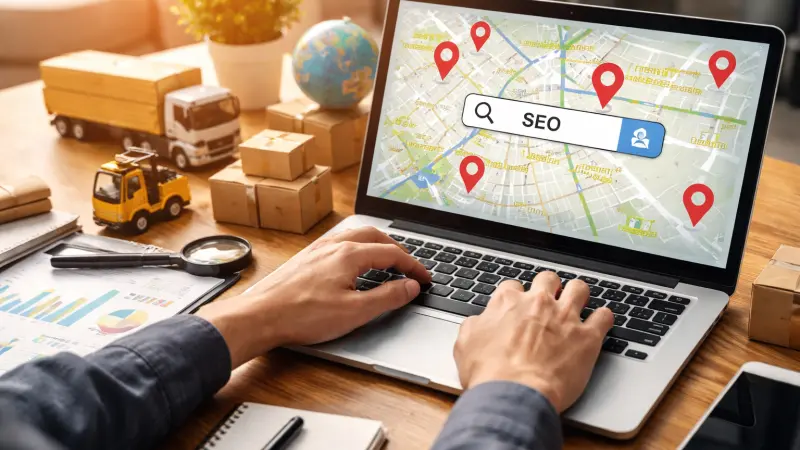
Imagine a procurement manager at a manufacturing firm in Coventry spending ten minutes on Google, searching for a reliable freight forwarder to handle regular shipments to Rotterdam. She clicks through the top three results, reviews their listings, checks their reviews, and makes two phone calls — all within the same session. If your logistics business does not appear on that first page, you were never in the running.
This is the everyday reality of how B2B clients find freight and shipping services today. Local SEO for freight listings is no longer a peripheral concern — it is a core component of winning new business. Whether you operate from a single office in the Midlands or run a multi-branch freight forwarding operation across the UK, the principles of local search optimisation determine how visible your business is to the clients most likely to need you.
This guide provides a comprehensive, practical breakdown of how to use local SEO to improve your freight listings, attract qualified enquiries, and build lasting digital visibility in a competitive market.
Understanding Local SEO in the Context of Freight and Logistics
Local SEO refers to the process of optimising your online presence so that your business appears prominently when people search for services in a specific geographic area. For freight forwarders and logistics companies, this means ensuring your business surfaces when potential clients search for terms such as "freight forwarder in Bristol," "customs clearance agent Leeds," or "LCL sea freight services near me."
Unlike general SEO — which focuses on ranking for broad, often national or international keyword terms — local SEO targets searches with geographic intent. Google's algorithm uses a range of signals to determine which businesses to display in local results, including proximity to the searcher, the relevance of your listing to the query, and the overall prominence of your business online.
For freight companies, all three of these factors are directly actionable. You cannot change where your office is located, but you can significantly improve your relevance and prominence through deliberate optimisation of your listings, website, and wider online presence.
Why Local Search Matters Even for International Freight Services
A common misconception among freight forwarders is that local SEO is irrelevant to their business because they operate internationally. In practice, even companies that manage global trade lanes tend to acquire clients locally. A shipper in Glasgow does not typically search for a freight agent in London — they look for someone accessible, accountable, and ideally local.
Local search visibility gives you the first-mover advantage with businesses in your region, many of whom represent repeat, high-value accounts. Getting local SEO right means these clients find you first, before they ever consider your competitors.
The Core Pillars of Local SEO for Freight Listings
1. Your Google Business Profile
The single most impactful action any freight forwarding business can take for local SEO is creating and fully optimising a Google Business Profile. This free listing controls how your business appears in Google Search and Google Maps — including in the prominently positioned "local pack" that appears at the top of search results for location-based queries.
To maximise the value of your profile, ensure the following:
- Business name: Use your exact trading name consistently — do not add keywords or location terms to your business name, as this violates Google's guidelines.
- Primary category: Select "Freight Forwarding Service." Add secondary categories such as "Customs Broker," "Logistics Service," or "Warehousing" where applicable.
- Address and service area: Enter your registered or operating address accurately. If you serve clients across a broader region without a customer-facing premises, configure your service area settings accordingly.
- Phone number: Use a local UK landline number where possible, as this reinforces local relevance signals.
- Business description: Write a concise, informative description (up to 750 characters) that includes your primary services and key locations served. Incorporate relevant keyword terms naturally.
- Opening hours: Keep these accurate and update them for public holidays and seasonal variations.
- Photos: Upload a professional logo, cover image, office or warehouse photographs, and team images. Profiles with photos consistently attract more engagement.
- Services: List every service you offer with brief descriptions. Include terms like "FCL sea freight," "air freight forwarding," "customs clearance," and "dangerous goods handling" where relevant.
Once your profile is verified and complete, maintain it actively. Publish regular posts, respond to reviews promptly, and monitor the Q&A section to ensure accurate information is visible to searchers.
2. NAP Consistency Across All Listings
NAP — Name, Address, and Phone number — consistency is one of the foundational principles of local SEO. Search engines use your NAP data as a trust signal: the more consistently this information appears across different online platforms, the more confident Google becomes that your business is legitimate and accurately represented.
For freight forwarders, inconsistencies often arise when businesses change office locations, update phone numbers, or rebrand without auditing all their existing online listings.
Even minor discrepancies — such as "St." versus "Street," or a missing postcode — can dilute your local search authority.
Conduct a thorough audit of your NAP details across:
- Your website (footer, contact page, and about page)
- Google Business Profile
- Bing Places for Business
- Industry-specific directories (BIFA, UKWA, freight forwarding portals)
- General UK business directories
- Social media profiles (LinkedIn, Facebook, Twitter/X)
- Any trade press or editorial mentions that include contact details
Correct all discrepancies to ensure uniformity, and establish a process for updating all platforms simultaneously whenever your contact details change in future.
3. Citation Building Through Directory Listings
In local SEO terminology, a citation is any online mention of your business's NAP details, regardless of whether it includes a link to your website. Citations from reputable directories signal to search engines that your business exists, is active, and is recognised across the web.
For freight forwarders, citations should be built across a layered range of platforms:
- Tier 1 — Major data aggregators: Platforms such as Yell, Thomson Local, and Bing Places, which distribute business data to dozens of other directories.
- Tier 2 — Industry-specific directories: BIFA's member directory, freight forwarding association listings, logistics trade portals, and supply chain directories.
- Tier 3 — General UK business directories: Regional and national directories that cover all business types, many of which offer free local SEO listings in the UK.
The combined effect of consistent citations across these platforms builds your business's authority in the eyes of search engines, which in turn supports higher rankings in local search results. This is why maintaining a presence in a free small business directory UK platform is genuinely worthwhile — not because any single listing dramatically moves the needle, but because the accumulation of consistent, accurate citations across many platforms compounds over time.
4. On-Page Local SEO for Your Website
Your website plays a central role in your local search performance. The signals Google extracts from your site — including the keywords used, the geographic references made, and the quality of the content — directly influence how well you rank for local freight-related queries.
Key on-page optimisation actions for freight forwarding websites include:
Location-Specific Pages
If your business serves multiple regions or operates from multiple offices, create dedicated location pages for each. A page titled "Freight Forwarding Services in Birmingham" with unique, detailed content about your operations in that area will rank far better for Birmingham-specific searches than a generic services page that mentions the city in passing.
Title Tags and Meta Descriptions
Each page on your website should have a unique title tag that includes your primary keyword and, where appropriate, a geographic modifier. For example: "Sea Freight Services Manchester | [Your Company Name]." Meta descriptions should be compelling and informative, as they influence click-through rates from search results even if they do not directly affect rankings.
Structured Data Markup
Implementing LocalBusiness schema markup on your website provides search engines with structured, machine-readable information about your company — including your name, address, phone number, business category, and operating hours. This reinforces your NAP details and can improve the appearance of your listing in search results through rich snippets.
Content That Addresses Local Search Queries
Develop content — service pages, blog articles, FAQs — that directly addresses the questions your local clients are searching for. Topics such as "customs clearance procedures for UK importers," "how to choose a freight forwarder in [city]," or "sea freight from [UK port] to [destination]" all target specific, high-intent queries that are likely to drive qualified traffic.
5. Building and Managing Online Reviews
Reviews are one of the most heavily weighted factors in Google's local ranking algorithm. More importantly, they are a primary trust signal for the B2B buyers who research freight services before making contact.
A systematic approach to review acquisition and management involves:
- Asking consistently: Develop a repeatable process for requesting reviews from clients after successful shipments or project completions. A brief, personalised email with a direct link to your Google review page removes friction and increases the likelihood of a response.
- Responding to all reviews: Reply to every review — positive or negative. For positive reviews, a brief and personalised acknowledgement demonstrates engagement. For negative reviews, a professional, measured response that offers to address the issue offline is far more effective than silence or defensiveness.
- Diversifying review platforms: Whilst Google reviews carry the most weight for local SEO, reviews on platforms such as Trustpilot, Bing, and industry-specific portals also contribute to your overall online reputation.
- Never incentivising or fabricating reviews: Fake or incentivised reviews violate Google's policies and, if detected, can result in penalties that significantly damage your visibility. Build your review profile organically through genuine client relationships.
Advanced Local SEO Strategies for Freight Companies
Leveraging Local Link Building
Backlinks — links from other websites pointing to yours — remain one of the strongest ranking signals in both organic and local SEO. For freight forwarders, locally relevant backlinks are particularly valuable.
Opportunities for local link acquisition include:
- Membership of local chambers of commerce and trade associations, which typically include a link to member websites in their directories.
- Sponsorship of local business events, industry conferences, or trade exhibitions, which often generate links from event websites.
- Contributing expert commentary or case studies to regional business publications, freight industry trade press, or logistics news platforms.
- Partnerships with complementary local businesses — warehousing firms, packaging suppliers, trade finance providers — who may link to your site from their partner or supplier pages.
Each high-quality, relevant backlink strengthens your domain authority and contributes to improved rankings across all search queries, including local ones.
Optimising for Voice Search and Mobile
An increasing proportion of local searches are conducted via mobile devices, and voice search — through tools such as Google Assistant and Siri — is growing in use among professionals on the move. Voice queries tend to be more conversational and question-based than typed searches, which has implications for how you structure your content.
Optimise for voice and mobile by:
- Ensuring your website loads quickly on mobile devices (Google's PageSpeed Insights tool provides actionable recommendations).
- Structuring FAQ content with direct, concise answers to common questions, as these are frequently pulled into voice search responses.
- Using natural, conversational language in your content alongside more formal keyword terms.
Using Google Posts to Signal Activity
Regularly publishing posts through your Google Business Profile keeps your listing active and can improve engagement metrics. For freight forwarders, suitable post types include:
- Operational updates (new trade lane capabilities, port of call additions)
- Industry news relevant to your clients (customs regulation changes, port congestion alerts, trade agreement updates)
- Educational content (guides to Incoterms, documentation checklists, customs compliance tips)
- Awards, accreditations, or industry recognition
Posts appear directly on your Google listing and can drive additional engagement from searchers who are already viewing your profile.
Monitoring and Measuring Local SEO Performance
Effective local SEO requires ongoing monitoring to identify what is working, where improvements are needed, and how your performance compares to competitors. Key metrics and tools include:
- Google Business Profile Insights: Tracks how many people found your listing, what search queries triggered it, how many clicked through to your website, and how many called or requested directions.
- Google Search Console: Provides data on the organic search queries driving traffic to your website, including click-through rates and average ranking positions.
- Google Analytics: Reveals how visitors from local search interact with your website — which pages they visit, how long they stay, and whether they convert into enquiries.
- Rank tracking tools: Platforms such as BrightLocal, Whitespark, or Moz Local allow you to track your local keyword rankings and monitor the health of your citation profile over time.
Establish a regular review cadence — monthly at a minimum — to assess your performance and make informed adjustments to your strategy.
Common Local SEO Mistakes Freight Businesses Make
Targeting Only Broad, National Keywords
Many freight forwarding websites focus their SEO efforts on highly competitive national terms such as "freight forwarder UK" or "international shipping services." Whilst these terms are worth pursuing in the long run, they are exceptionally difficult to rank for and
do not capture the high-intent local searches that typically lead to direct enquiries. A balanced strategy targets both local and national terms, with local queries prioritised in the early stages of your SEO programme.
Neglecting Secondary Search Engines
Google dominates the UK search market, but Bing still accounts for a meaningful share of searches — particularly among older business users and those using Windows devices with Edge as their default browser. Claiming and optimising your Bing Places for Business listing is a quick, free step that many freight companies overlook entirely.
Ignoring the Mobile Experience
If your website is difficult to navigate on a smartphone — slow to load, hard to read, or requiring pinch-and-zoom to access contact details — you are losing potential clients before they have even read about your services. Google's mobile-first indexing means the mobile version of your site is the primary basis for its ranking assessment. A poor mobile experience is a direct ranking liability.
Treating Local SEO as a One-Time Task
Local SEO is not a project with a defined completion date — it is an ongoing discipline. Search algorithms evolve, competitors improve their own visibility, and client search behaviour shifts over time. Businesses that invest consistently in maintaining and improving their local presence will outperform those that treat it as a box to tick.
Building a Sustainable Local Presence for Your Freight Business
The most effective local SEO strategies for freight forwarders combine technical rigour with consistent, authentic engagement. Getting your Google Business Profile right is the essential first step. Building out a strong citation profile across industry and general directories, producing genuinely useful content for your target clients, acquiring relevant local backlinks, and maintaining an active review profile together create a self-reinforcing system of local authority that compounds over time.
It is also worth considering that the digital landscape for freight businesses extends beyond Google alone. Being listed across a broad range of reputable online directories — including both industry-specific platforms and broader business listing sites — contributes to the citation signals that underpin local search performance. For freight forwarders and logistics operators looking to strengthen their online footprint, exploring options such as a free UK company database or business listing uk platforms is a practical and cost-efficient step. Local Page UK is one such platform where UK businesses, including those in freight and logistics, can create a listing to support their local online visibility. Adding your business to free local SEO listings of this kind helps reinforce your NAP consistency and extends the breadth of your digital presence without additional marketing expenditure.
Service-Related Questions & Answers
What is local SEO and why is it important for freight forwarders?
Local SEO is the practice of optimising your online presence to appear in search results when people search for services in a specific geographic area. For freight forwarders, it is important because most clients — even those requiring international logistics services — tend to search for providers in their local region first. Strong local search visibility increases the volume of qualified enquiries your business receives from nearby companies.
How long does it take for local SEO improvements to show results?
Local SEO is a medium-to-long-term investment. Some improvements — such as fully completing your Google Business Profile or correcting NAP inconsistencies — can produce visible results within a few weeks. More substantial improvements in local search rankings typically take three to six months of consistent effort to materialise. The timeline varies depending on the competitiveness of your local market and the current state of your online presence.
How many directory listings does a freight forwarder need?
There is no single definitive number, but quality and consistency matter more than volume. A freight forwarder should aim to be listed on all major data aggregators (Yell, Thomson Local, Bing Places), relevant industry directories (BIFA, logistics trade portals), and a range of reputable general UK business directories. Twenty to forty consistent, accurate citations across well-regarded platforms provides a solid foundation for most businesses.
Do online reviews affect my local search ranking for freight services?
Yes. Google's local ranking algorithm takes into account the quantity, recency, and overall rating of reviews on your Google Business Profile. A business with a higher number of positive, recent reviews will generally outrank a comparable business with fewer or lower-rated reviews. Beyond rankings, reviews also directly influence whether potential clients choose to make contact, making them doubly important for freight businesses.
What is NAP consistency and why does it matter for freight SEO?
NAP stands for Name, Address, and Phone number. Consistency of these details across all online platforms — your website, Google Business Profile, directories, and social media — is an important local SEO signal. Discrepancies confuse search engines and can reduce your authority in local results. For freight forwarders who have relocated offices or changed phone numbers, auditing and correcting all existing listings is an important remedial step.
Should freight forwarders create separate location pages on their website?
Yes, if you operate from multiple offices or serve distinct geographic regions. Dedicated location pages — each with unique, relevant content about your services in that area — allow you to rank for location-specific searches independently. A page optimised for "freight forwarding services in Sheffield" can rank for Sheffield-based searches even if your head office is in another city.
Is paid advertising necessary for local freight SEO?
Paid search advertising (such as Google Ads) can complement local SEO but is not a prerequisite. Organic local SEO — achieved through a well-optimised Google Business Profile, consistent citations, quality content, and strong reviews — can generate substantial visibility and enquiries without paid advertising. Many freight forwarders find that a well-executed organic strategy delivers a strong return relative to the effort invested, particularly once rankings are established.
Can local SEO help freight forwarders attract specific industries or cargo types?
Yes. By targeting niche keyword combinations — such as "pharmaceutical freight forwarder Manchester" or "hazardous goods shipping agent Teesside" — you can attract clients from specific industries or with particular cargo requirements. This targeted approach often yields higher-quality enquiries than broad, generic traffic, as the searcher is already seeking a specialist matching your exact capabilities.
What is structured data and should freight forwarding websites use it?
Structured data (also known as schema markup) is code added to your website that provides search engines with explicit, structured information about your business — such as your name, address, business type, and operating hours.
Implementing LocalBusiness schema on your freight forwarding website reinforces your NAP details and can improve how your site appears in search results. It is a technical but worthwhile optimisation step for any serious local SEO strategy.
How do I track whether my local SEO efforts are working for my freight business?
The primary tools for monitoring local SEO performance are Google Business Profile Insights, Google Search Console, and Google Analytics. Together, they provide data on how your listing is being found, what queries are driving traffic, how visitors behave on your site, and how many enquiries your digital presence is generating. For a more comprehensive view of your local ranking positions and citation health, dedicated local SEO platforms such as BrightLocal or Whitespark offer detailed tracking and reporting capabilities.
Disclaimer: The information provided in this article is for general informational and research purposes only. Company details, features, services, and market positions may change over time. Readers are advised to visit official company websites and conduct independent research before making any business decisions or purchasing services.
Most Searchable Keywords
Recent Blogs


Related Listings

Categories
- Accountants (295)
- Advertising Agencies (559)
- Architects (149)
- Automobiles (377)
- Beauty (300)
- Carpenters (146)
- Cleaning Services (387)
- Dentists (189)
- Driving (62)
- Education (1)
- Electricians (215)
- Energy (8)
- Event Organiser (687)
- Finance (602)
- Guide (3482)
- Health (2207)
- Information technology (206)
- Legal Services (361)
- Logistics (6)
- Maintenance (65)
Sponsored Listings in Electricians


Related Blogs

Ghost Brokers Fake Car Insurance Scam Explain...
Read this insightful article "Ghost Brokers Fake Car Insurance Scam Explained" to expand your knowledge!

UK Baby Names Fastest Rising and Falling Name...
Read this insightful article "UK Baby Names Fastest Rising and Falling Names" to expand your knowledge!

How to Claim for Pothole Damage From Your Cou...
Read this insightful article "How to Claim for Pothole Damage From Your Council" to expand your knowledge!
Questions & Answers – Find What
You Need, Instantly!
How can I update my business listing?
Is it free to manage my business listing?
How long does it take for my updates to reflect?
Why is it important to keep my listing updated?
