
ISA Allowance: How the £20,000 Limit Works
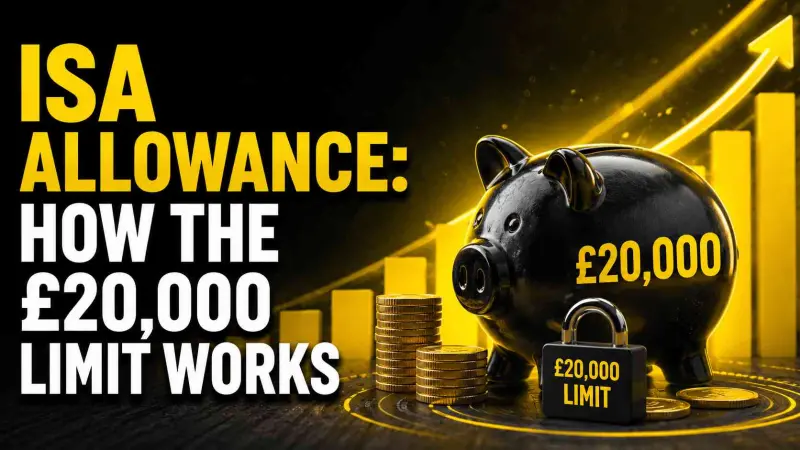
The ISA allowance is one of the simplest ways to shelter savings and investments from UK tax, but the £20,000 limit is often misunderstood. It does not mean you can put £20,000 into a Cash ISA and another £20,000 into a Stocks & Shares ISA in the same tax year. Instead, most adult ISA contributions share an overall annual allowance of £20,000.
For the 2026/27 tax year, which runs from 6 April 2026 to 5 April 2027, you can subscribe up to £20,000 across eligible adult ISAs. You can put the entire amount into one type or divide it between different types, subject to the rules applying to each account.
That distinction matters if you have money sitting in a savings account, want to invest for the long term, or are considering moving some of your cash into investments.
There is also an important change coming. From 6 April 2027, the government plans to introduce a £12,000 annual Cash ISA subscription limit for people under 65, while the overall ISA allowance remains £20,000. People aged 65 and over will retain a £20,000 Cash ISA limit.
This guide explains how the allowance works today, how Cash ISAs compare with Stocks & Shares ISAs, how the £20,000 can be divided, what happens to unused allowance, how transfers work, and what the 2027 changes could mean for your savings strategy.
How Does the £20,000 ISA Allowance Work Across Cash and Stocks & Shares ISAs?
The basic rule is straightforward: the £20,000 is an overall annual subscription limit for adult ISAs, not a separate £20,000 allowance for every ISA account.
For 2026/27, eligible adults can contribute up to £20,000 into one or more of the following:
- Cash ISA
- Stocks & Shares ISA
- Innovative Finance ISA
- Lifetime ISA, subject to its own £4,000 annual contribution limit
The government confirms that the £20,000 can be split between different ISA types. For example, you could contribute £15,000 to a Cash ISA and £5,000 to a Stocks & Shares ISA.
What exactly counts towards the £20,000 limit?
New money you subscribe into your adult ISAs during the tax year normally counts towards your annual allowance.
For example:
| Your ISA contributions | Amount |
|---|---|
| Cash ISA | £12,000 |
| Stocks & Shares ISA | £8,000 |
| Total | £20,000 |
You have used the full annual allowance.
You cannot then add another £5,000 to either account during the same tax year simply because the accounts are different.
The same principle applies if you use several providers. Opening three Cash ISAs with different banks does not create three separate £20,000 allowances.
Can you put the full £20,000 into a Cash ISA?
For the 2026/27 tax year, yes, subject to the provider's own terms and eligibility requirements.
You could put:
- £20,000 into a Cash ISA, or
- £20,000 into a Stocks & Shares ISA, or
- split the £20,000 between eligible ISA types.
The important point is that your total new subscriptions must stay within the applicable annual limit.
Can you have more than one ISA?
Yes. Having multiple ISA accounts does not itself breach the rules.
For example, during 2026/27 you could have:
- £8,000 in one Cash ISA
- £4,000 in another Cash ISA
- £8,000 in a Stocks & Shares ISA
That totals £20,000 of new subscriptions.
HMRC's guidance specifically provides examples where an individual splits the allowance between more than one Cash ISA and a Stocks & Shares ISA.
The important distinction is between having accounts and subscribing new money. The annual limit concerns subscriptions, rather than the total value of everything you have accumulated in ISAs over your lifetime.
Does interest or investment growth use up your ISA allowance?
No.
Once money is inside an ISA, interest, dividends and investment gains can accumulate without using additional annual subscription allowance.
For example, suppose you invest £20,000 in a Stocks & Shares ISA and it eventually grows to £26,000. The £6,000 growth does not count as a new £6,000 subscription.
Likewise, if £20,000 in a Cash ISA earns £800 interest, that interest does not consume another £800 of your annual allowance.
ISA interest, income and capital gains are generally tax-free, and ISA income and gains do not normally need to be declared on a tax return.
Cash ISA or Stocks & Shares ISA: which should you choose?
The right choice depends on what the money is for, when you expect to need it and how comfortable you are with investment risk.
| Option | Best suited to | Main advantage | Main limitation |
| Cash ISA | Shorter-term savings | No investment-market exposure | Returns may be lower than long-term investment growth |
| Stocks & Shares ISA | Long-term investing | Potential for capital growth and investment income | Investments can fall in value |
| Lifetime ISA | First-home or later-life saving | 25% government bonus | Specific eligibility and withdrawal rules |
| Innovative Finance ISA | Eligible alternative finance investments | Tax wrapper for qualifying investments | Higher complexity and investment risk |
A Cash ISA is generally easier to understand: you deposit money and receive interest.
A Stocks & Shares ISA is an investment wrapper. Your money may be invested in shares, funds, investment trusts, exchange-traded funds and other qualifying assets. The value can rise and fall.
That makes the two accounts fundamentally different despite sharing the same broader ISA tax advantages.
How should you split £20,000 between cash and investments?
There is no universal percentage that works for everyone.
Suppose you have £20,000 available.
Example 1: You need the money soon
You may decide that preserving capital and maintaining access to your money are more important than seeking investment growth.
A possible approach could be:
- £20,000 Cash ISA
- £0 Stocks & Shares ISA
This could make sense for money earmarked for a near-term purchase, although you should compare interest rates and withdrawal terms.
Example 2: You have both short- and long-term goals
You might divide the allowance:
- £10,000 Cash ISA
- £10,000 Stocks & Shares ISA
The cash portion could support shorter-term goals, while the investment portion could be intended for a longer time horizon.
Example 3: You are investing for the long term
Someone with an appropriate emergency fund outside the ISA and a long investment horizon might choose to put most or all of the annual allowance into a Stocks & Shares ISA.
That does not guarantee a profit. Investments can lose value, sometimes substantially.
The key question should not be "Which ISA is better?" but rather "What job does this money need to do?"
What happens if you do not use your full £20,000 allowance?
The annual ISA allowance generally cannot simply be carried forward to the next tax year.
If you contribute £12,000 during 2026/27, you cannot normally add the unused £8,000 to your £20,000 allowance for 2027/28.
This is why the tax-year deadline can matter.
The ISA tax year runs from 6 April to 5 April.
For someone who has £20,000 available and intends to use an ISA, delaying contributions without a reason can mean losing the opportunity to use that year's allowance.
That said, you should not invest money simply to avoid "wasting" an allowance.
Your financial circumstances, emergency savings, debt position, time horizon and attitude to investment risk should come first.
What is the difference between ISA subscriptions and ISA transfers?
This distinction is particularly important.
An ISA subscription is generally new money being paid into an ISA.
An ISA transfer moves money that is already held within an ISA from one provider or ISA type to another using the appropriate transfer process.
A transfer does not normally mean you have made a new contribution equal to the amount transferred.
For example, suppose you have £15,000 in an existing Cash ISA from previous tax years. You may be able to transfer it to another ISA provider without treating the £15,000 as a new £15,000 subscription.
HMRC says you can transfer all or part of an ISA to another provider and, in many circumstances, to a different type of ISA.
However, the transfer should normally be arranged through the ISA providers.
If you simply withdraw the money yourself and then pay it into another ISA, you can create an unnecessary tax-year allowance problem.
Why should you use the official ISA transfer process?
Suppose you have £10,000 in an old Cash ISA and want to move it to a new provider offering a better rate.
The safer approach is usually:
- Choose the new ISA provider.
- Check that it accepts transfers.
- Complete its ISA transfer request.
- Let the providers handle the transfer.
- Keep the money within the ISA wrapper.
GOV.UK warns that if you withdraw money rather than using the transfer process, you may not be able to reinvest that part of your tax-free allowance.
Transfer times can also vary. GOV.UK states that Cash ISA transfers should take no longer than 15 working days, while other ISA transfers should generally take no longer than 30 calendar days.
What happens when you withdraw money from an ISA?
The answer depends partly on whether your ISA is flexible.
A flexible ISA may allow you to withdraw money and replace it during the same tax year without that replacement counting towards your annual subscription allowance, subject to the provider's terms and the specific flexible-ISA rules.
Not every ISA is flexible.
That means you should check the account's terms before assuming that withdrawing £5,000 gives you another £5,000 of contribution room.
This is one of the easiest areas to get wrong.
How does the Lifetime ISA fit into the £20,000 allowance?
A Lifetime ISA, or LISA, has a separate annual contribution limit of £4,000.
However, the £4,000 counts towards the overall £20,000 ISA allowance.
For example:
- £4,000 Lifetime ISA
- £10,000 Cash ISA
- £6,000 Stocks & Shares ISA
Total: £20,000.
You do not get £20,000 plus £4,000.
The government currently allows up to £4,000 a year into a Lifetime ISA, with the government bonus and withdrawal rules applying separately.
What about a Junior ISA?
A Junior ISA is separate from the adult ISA allowance.
For 2026/27, the Junior ISA subscription limit is £9,000.
A parent or guardian can help manage a Junior ISA, but the money belongs to the child.
A child can have a Cash Junior ISA, a Stocks & Shares Junior ISA, or both, subject to the rules.
The £9,000 Junior ISA allowance is therefore not an extra £9,000 that an adult can put into their own ISA.
What tax advantages do Cash and Stocks & Shares ISAs provide?
The biggest attraction is the ISA tax wrapper.
With a Cash ISA, interest is generally tax-free.
With a Stocks & Shares ISA, qualifying investment income and capital gains are sheltered from UK tax within the ISA.
For investors, that distinction can become increasingly valuable as portfolios grow.
Consider a simplified example.
You invest £15,000 into a Stocks & Shares ISA and it eventually increases to £22,000. The £7,000 increase is investment growth. Provided the investments and account remain within the ISA rules, that gain does not become a personal Capital Gains Tax bill simply because the investment has risen in value.
Similarly, dividends and other qualifying investment income inside the ISA benefit from the tax wrapper.
Outside an ISA, the tax treatment can be more complicated because savings interest, dividends and capital gains may be taxable depending on the individual's circumstances and available allowances.
Does the £20,000 limit include old ISA savings?
No, not in the sense that your entire existing ISA balance is counted against the annual subscription limit.
Imagine you have accumulated:
- £30,000 from previous years in a Cash ISA
- £25,000 from previous years in a Stocks & Shares ISA
Your existing ISA holdings total £55,000.
You could still have a new annual subscription allowance of up to £20,000 for 2026/27, assuming you meet the eligibility requirements and have not already used any of it.
The annual limit applies to the relevant subscriptions during the tax year, not the lifetime value of your ISA portfolio.
This is one reason ISA savings can build significantly over time.
Can you transfer a Cash ISA into a Stocks & Shares ISA?
Generally, yes, ISA rules allow transfers between different ISA types, subject to the specific rules and provider arrangements.
However, there is an important distinction between transferring existing ISA money and withdrawing Cash ISA money and then making a new investment.
A proper transfer preserves the ISA status of the money.
If you are considering moving cash into investments, check:
- Whether the receiving provider accepts ISA transfers.
- Whether the investment you want is ISA-eligible.
- Whether the provider charges fees.
- How long the transfer may take.
- Whether you are comfortable with investment risk.
Do not assume that moving from cash to investments is automatically better. You are changing the risk profile of your savings.
What is changing for Cash ISAs from April 2027?
This is one of the most significant developments for people planning their ISA strategy.
From 6 April 2027, the government has announced that people under 65 will have a £12,000 annual Cash ISA subscription limit.
The overall ISA allowance remains £20,000.
This means someone under 65 could potentially use:
- Up to £12,000 in a Cash ISA
- Up to £8,000 in other eligible ISA types
The exact allocation will depend on the person's circumstances and the rules applying at the time.
For people aged 65 and over, the Cash ISA limit will remain £20,000. The government says eligibility for the higher limit will apply from the start of the tax year in which an individual turns 65.
The reforms are designed partly to encourage greater retail investment while retaining tax-efficient saving options.
Does the 2027 change reduce the overall ISA allowance to £12,000?
No.
This is a common misunderstanding.
The announced change is a Cash ISA limit, not a reduction of the overall adult ISA allowance.
The overall allowance remains £20,000.
For someone under 65, the new structure is intended to mean that no more than £12,000 of that annual allowance can be subscribed to Cash ISAs, while the remaining allowance can potentially be used through other eligible ISA types.
Can you still put £20,000 into a Stocks & Shares ISA after April 2027?
The government's announced reforms state that the £20,000 overall ISA limit will remain, and the Stocks & Shares ISA limit will remain at £20,000.
Therefore, assuming the rules take effect as announced, an eligible investor could still use the full £20,000 annual allowance through a Stocks & Shares ISA.
That does not mean every investor should do so.
Stocks and Shares ISAs involve investments whose value can fall, and they are generally more appropriate for money that can remain invested for a sufficiently long period.
Will you be able to move money from a Stocks & Shares ISA into a Cash ISA after April 2027?
The announced 2027 reforms include restrictions on transfers from non-Cash ISAs into Cash ISAs for people under 65.
The government has specifically stated that transfers from non-Cash ISAs into Cash ISAs will not be permitted for people under 65 under the new arrangements, while transfers from Cash ISAs to non-Cash ISAs will remain possible.
This makes planning more important for people who expect to switch between cash and investments.
The precise implementation should always be checked against the legislation and HMRC guidance applicable when the change takes effect.
What should savers do before the 2027 changes?
There is no need to rush into an investment decision simply because the rules are changing.
Instead, consider your objectives.
If you prefer cash and regularly use a large proportion of your annual ISA allowance, the new £12,000 Cash ISA limit could affect how you save from April 2027.
If you are a long-term investor, the continued £20,000 overall allowance may provide greater scope to use Stocks & Shares ISAs.
Before changing anything, consider:
- How much emergency cash you need.
- When you expect to need the money.
- Whether you have expensive debt.
- Whether you are comfortable with investment losses.
- Whether your current Cash ISA rate remains competitive.
- Whether your investments are diversified.
- Whether ISA transfers could improve your existing arrangements.
What are the most common ISA allowance mistakes?
Several mistakes occur repeatedly.
Mistake 1: Treating every ISA as having a £20,000 allowance
The allowance is generally shared across adult ISA subscriptions.
Mistake 2: Confusing ISA transfers with new contributions
Moving an existing ISA correctly is different from withdrawing money and paying it into another ISA.
Mistake 3: Assuming unused allowance carries forward
The annual ISA allowance is generally use-it-or-lose-it.
Mistake 4: Ignoring the tax-year deadline
The ISA tax year runs from 6 April to 5 April.
Mistake 5: Choosing investments solely for tax reasons
An ISA removes or reduces certain tax complications, but it does not remove investment risk.
Mistake 6: Forgetting the Lifetime ISA limit
The £4,000 LISA contribution limit forms part of the wider £20,000 allowance.
Mistake 7: Assuming every ISA is flexible
Flexibility depends on the specific account.
How can you make better use of your ISA allowance?
A sensible approach starts with your financial goals rather than the £20,000 number.
Step 1: Establish your short-term cash needs.
Keep appropriate emergency savings and money needed soon in suitable low-risk accounts.
Step 2: Identify money that can stay invested.
If you have a long investment horizon and accept market fluctuations, a Stocks & Shares ISA may be worth considering.
Step 3: Check your existing ISAs.
Look at interest rates, investment charges, performance, fund choices and provider terms.
Step 4: Use transfers when moving existing ISA money.
Do not automatically withdraw and redeposit money when a formal ISA transfer is available.
Step 5: Track your current-year subscriptions.
Keep a simple record of how much you have paid into each adult ISA during the tax year.
Step 6: Review before 5 April.
Do not leave important ISA decisions until the final day if you can avoid it.
What is the future of the ISA allowance?
The ISA system is becoming more complex rather than simply increasing the annual allowance.
For 2026/27, the adult ISA subscription limit remains £20,000. The government has also stated that the £20,000 overall annual limit will remain until April 2031, while Junior ISAs and Lifetime ISAs have their own stated limits.
The major near-term change is the planned Cash ISA restriction from April 2027.
The government has also announced measures concerning cash held within non-Cash ISAs. Under the announced reforms, interest paid on cash held in non-Cash ISAs will face a 22% charge paid by ISA managers, and restrictions will apply to arrangements designed to use non-Cash ISAs as a substitute for Cash ISAs.
These are policy developments rather than a reason to predict investment returns.
The practical lesson is more straightforward: ISA planning should become part of an annual financial review rather than a once-a-year scramble to use £20,000.
Key Insights
- The adult ISA allowance is £20,000 for 2026/27, not £20,000 per ISA type.
- You can split your allowance between Cash, Stocks & Shares and other eligible adult ISAs.
- A £4,000 Lifetime ISA contribution counts towards the £20,000 overall allowance.
- Investment growth, qualifying dividends and interest inside an ISA do not use additional annual allowance.
- Existing ISA balances from previous years do not simply count against the current year's £20,000 subscription limit.
- Use the formal ISA transfer process when moving existing ISA money between providers or ISA types.
- From 6 April 2027, the planned Cash ISA limit for people under 65 will be £12,000, while the overall ISA allowance remains £20,000.
- The best split between cash and investments depends on your time horizon, financial goals and tolerance for investment risk.
Frequently Asked Questions
1. Is the ISA allowance really £20,000?
Yes. For the 2026/27 tax year, the overall adult ISA subscription limit is £20,000. This is a combined allowance across eligible adult ISA types rather than a separate £20,000 allowance for every account.
2. Can I put £20,000 into a Cash ISA and £20,000 into a Stocks & Shares ISA?
No. For 2026/27, your total new subscriptions across eligible adult ISAs generally cannot exceed £20,000. You could split £20,000 between Cash and Stocks & Shares ISAs instead.
3. Can I have multiple Cash ISAs?
You can hold multiple ISA accounts, but opening additional accounts does not create additional annual allowances. Your relevant subscriptions must remain within the annual ISA limit and provider rules.
4. Can I have a Cash ISA and Stocks & Shares ISA at the same time?
Yes. You can hold both types. For example, you could subscribe £12,000 to a Cash ISA and £8,000 to a Stocks & Shares ISA during 2026/27, provided you meet the relevant rules.
5. Does ISA interest count towards the £20,000 allowance?
No. Interest earned inside an ISA does not use additional annual subscription allowance. The same principle applies to qualifying investment growth and income within a Stocks & Shares ISA.
6. What happens if I only use £10,000 of my ISA allowance?
You generally cannot carry the remaining £10,000 forward into the next tax year. The ISA allowance applies separately to each tax year.
7. Does transferring an ISA use my annual allowance?
A properly arranged ISA transfer generally moves existing ISA money without treating the transferred amount as a new subscription. Use the provider's ISA transfer process rather than withdrawing and redepositing the money yourself.
8. Can I move money from a Cash ISA to a Stocks & Shares ISA?
ISA rules generally permit transfers between different ISA types, subject to the relevant restrictions and provider procedures. A formal transfer can preserve the ISA status of the money.
9. Is a Stocks & Shares ISA better than a Cash ISA?
Neither is universally better. Cash ISAs avoid investment-market fluctuations, while Stocks & Shares ISAs offer investment exposure and potential long-term growth but carry the risk of losses.
10. What is the Lifetime ISA limit?
The Lifetime ISA contribution limit is £4,000 per tax year. That £4,000 forms part of the wider £20,000 annual ISA allowance rather than being added on top.
11. What is the Junior ISA allowance?
The Junior ISA allowance is £9,000 for the 2026/27 tax year. It is separate from the £20,000 adult ISA allowance.
12. What happens to the Cash ISA limit in 2027?
From 6 April 2027, the announced Cash ISA subscription limit will be £12,000 for people under 65. The overall adult ISA allowance remains £20,000. People aged 65 and over will retain a £20,000 Cash ISA limit.
13. Can I still invest £20,000 in a Stocks & Shares ISA after 2027?
The announced reforms retain the £20,000 overall allowance and the Stocks & Shares ISA limit at £20,000. Individual eligibility, provider rules and the final legislation should still be checked when making a contribution.
14. Can I withdraw money from my ISA and replace it later?
It depends on whether the ISA is flexible. A flexible ISA may allow certain withdrawals to be replaced during the same tax year without using additional allowance, while non-flexible ISAs do not provide the same treatment.
15. Should I use my full £20,000 ISA allowance every year?
Not necessarily. Using an ISA can be tax-efficient, but you should not put money into investments or lock money into unsuitable savings arrangements simply to use an allowance. Your financial goals, emergency fund, debts, time horizon and risk tolerance should come first.
Final Thoughts
The £20,000 ISA allowance is best understood as a shared annual subscription limit, not a £20,000 pot for every type of ISA. During 2026/27, you can divide the allowance between eligible Cash, Stocks & Shares and other adult ISAs, subject to the individual rules that apply.
The most important distinction is between saving and investing. A Cash ISA may suit money you need to keep relatively stable and accessible, while a Stocks & Shares ISA can be useful for longer-term investment goals where you can tolerate market volatility.
Existing ISA money can also be moved between providers using the appropriate transfer process, and investment growth or interest inside an ISA does not consume additional annual allowance.
Looking ahead, the planned April 2027 reforms make the picture more important to understand. For people under 65, the
Cash ISA limit is set to fall to £12,000 while the overall ISA allowance remains £20,000.
So rather than asking simply, "How do I use my £20,000 ISA allowance?", a better question is: "How should I divide my tax-efficient savings between cash and investments to match my financial goals?"
Disclaimer: The information provided in this article is for general informational and research purposes only. Company details, features, services, and market positions may change over time. Readers are advised to visit official company websites and conduct independent research before making any business decisions or purchasing services.
Most Searchable Keywords
Recent Blogs
Related Listings

Categories
- Accountants (295)
- Advertising Agencies (559)
- Architects (149)
- Automobiles (377)
- Beauty (300)
- Carpenters (146)
- Cleaning Services (387)
- Dentists (189)
- Driving (62)
- Education (1)
- Electricians (215)
- Energy (8)
- Event Organiser (687)
- Finance (602)
- Guide (3420)
- Health (2207)
- Information technology (206)
- Legal Services (361)
- Logistics (6)
- Maintenance (65)
Sponsored Listings in Plumbers

Related Blogs

What It Costs to Run an Electric Fan Air Frye...
Read this insightful article "What It Costs to Run an Electric Fan Air Fryer or Tumble Dryer" to expand your knowledge!
Octopus Agile vs Fixed Tariffs: Which Is Chea...
Read this insightful article "Octopus Agile vs Fixed Tariffs: Which Is Cheaper" to expand your knowledge!
Old Energy Supplier Owes You Money Claim a Re...
Read this insightful article "Old Energy Supplier Owes You Money Claim a Refund" to expand your knowledge!
Questions & Answers – Find What
You Need, Instantly!
How can I update my business listing?
Is it free to manage my business listing?
How long does it take for my updates to reflect?
Why is it important to keep my listing updated?
