
Smart Meters: Pros, Cons and Dumb Mode Explained
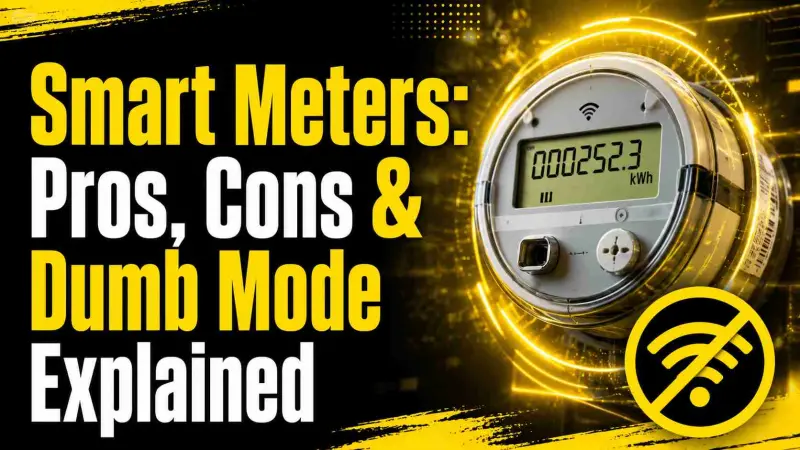
Smart meters are supposed to make energy billing simpler. They automatically send meter readings, show households how much energy they are using and can open the door to tariffs that reward people for shifting electricity use to cheaper times.
But there is a less convenient side to the story: sometimes a smart meter stops communicating with the supplier and effectively becomes what is commonly called a “dumb” meter.
That sounds more serious than it usually is.
If a smart meter goes into traditional or “dumb” mode, it normally continues to measure your gas or electricity consumption. The problem is that it may stop sending readings automatically to your supplier. You may then have to submit readings yourself until the connection is restored. Ofgem confirms that a smart meter operating outside smart mode should still accurately record energy use.
So are smart meters actually worth having?
For most households, the answer is yes — but not because the meter magically cuts your bill. A smart meter is primarily a measurement and communication tool. It can help you understand where your energy is going and make some tariffs and services available, but saving money still depends on your tariff, consumption and behaviour.
The real question is therefore not simply whether smart meters are good or bad. It is whether the benefits outweigh the potential frustrations — and what you should do if yours stops behaving like a smart meter.
The honest pros and cons of smart meters — and what really happens when one goes “dumb”
What is a smart meter?
A smart meter is a digital gas or electricity meter that can record consumption and communicate readings to an energy supplier.
Unlike a traditional meter, where you normally have to read the display and submit the numbers yourself, a smart meter can automatically transmit readings.
In Great Britain, newer SMETS2 meters communicate through the national smart metering communications infrastructure operated by the Data Communications Company (DCC). Older SMETS1 meters used different communications arrangements and have historically been more likely to lose some smart functionality after a supplier switch.
A smart meter is normally accompanied by an in-home display (IHD). This separate device can show information about your energy consumption, often in near real time.
That distinction matters.
Your meter and your in-home display are not the same thing.
If the display stops working, your meter may still be communicating perfectly with your supplier. Conversely, your meter can lose its smart connection while the physical meter itself continues recording consumption.
What does “dumb mode” actually mean?
“Dumb mode” is an informal term rather than the technical name for a separate type of meter.
It generally means a smart meter is no longer operating in smart mode — specifically, it is not automatically communicating meter readings to the supplier.
Ofgem says there are several possible reasons, including a lost connection with the supplier, a loss of functionality following a supplier switch, or installation issues involving the national communications system.
The key point is this:
A smart meter in dumb mode is normally still a functioning meter.
It continues measuring energy use. What has been lost is the automatic communication function.
That means you may need to take readings manually and give them to your supplier, just as you would with a traditional meter. Smart Energy GB similarly states that a meter operating in dumb mode should continue recording energy use accurately.
Does dumb mode mean your meter is broken?
Not necessarily.
There are two different issues that are often confused:
- The meter itself is not measuring correctly.
- The meter is measuring correctly but cannot communicate automatically.
The second situation is what many people mean when they say their smart meter has “gone dumb”.
This distinction is important because losing the communications connection does not automatically mean your energy consumption has stopped being recorded.
How common are smart meters in Great Britain?
Smart meters are now a major part of the UK's energy system rather than a niche technology.
Government statistics published in 2026 show that the rollout has reached tens of millions of meters across Great Britain. At the end of September 2025, Ofgem reported that around 70% of meters were smart or advanced meters. Of those smart meters, 91.7% were operating in smart mode, leaving 8.3% operating in traditional mode.
Government data for March 2025 similarly showed 37 million domestic smart meters across Great Britain, representing about 68% of domestic meters when smart meters operating in either smart or traditional mode were included.
The rollout is therefore substantial, but the experience is not identical for everyone.
Ofgem's supplier-level performance data also shows that smart-mode performance varies between suppliers. At the end of December 2025, for example, the percentage of smart meters operating in smart mode ranged from around 88% to 98% among the larger suppliers listed by Ofgem.
That is why stories about smart meters can sound contradictory. Millions of people have a smooth experience, while a smaller but significant group encounter communication, switching or display problems.
What are the biggest advantages of a smart meter?
The strongest argument for a smart meter is convenience and better information.
Automatic meter readings
The most obvious benefit is that you normally do not have to remember to submit readings every month.
When the meter is operating correctly in smart mode, readings are automatically sent to your supplier.
That can reduce the risk of estimated bills and remove one of those irritating household jobs that is easy to forget.
For someone who has previously received estimated bills because they forgot to submit readings, this can be a meaningful improvement.
Better visibility of energy consumption
The in-home display can show how much electricity or gas you are using.
This can change the way people think about energy.
A kettle, television or laptop might not seem particularly significant individually. But seeing consumption change when you turn appliances on and off can make energy use much more tangible.
That information can help you identify obvious waste.
For example, if a household notices unusually high electricity consumption overnight, it can investigate whether an immersion heater, storage heater, appliance or other device is running when it should not be.
Access to smart and time-of-use tariffs
Smart meters can also enable tariffs where the price of electricity changes according to time or market conditions.
This is particularly relevant for households with:
- Electric vehicles
- Home batteries
- Solar panels
- Electric heating
- Large appliances that can be operated flexibly
Instead of simply asking, “How can I use less electricity?”, a household can also ask, “Can I use electricity at a cheaper time?”
That distinction is becoming increasingly important as the electricity system incorporates more renewable generation and flexible demand.
Ofgem describes smart meters as an important enabler of flexible tariffs and a more flexible energy system.
Easier switching with newer meters
A common fear is that getting a smart meter will trap you with your current supplier.
It does not.
You can switch energy supplier with a smart meter. Newer SMETS2 meters are designed to retain smart functionality when customers switch suppliers.
Older SMETS1 meters have historically caused more problems because some lost smart functionality after switching. However, many first-generation meters have been migrated to the national smart communications network, reducing this problem over time.
Useful information for households with prepayment meters
Smart prepayment meters can provide additional convenience because customers can manage top-ups and access information digitally.
There can still be technical problems, particularly when communications fail, but smart prepayment functionality can be considerably more convenient than relying solely on traditional key or card arrangements.
If a top-up fails to appear, Smart Energy GB advises that most top-ups should appear within an hour and that suppliers can provide alternative assistance when necessary.
What are the disadvantages of smart meters?
The disadvantages are less about the physical meter and more about technology, communication and customer service.
A smart meter does not automatically save money
This is probably the biggest misconception.
Installing a smart meter does not, by itself, reduce the price of your electricity or gas.
Your bill still depends primarily on how much energy you use and the tariff you are on.
A smart meter can help you identify waste. It can also make some flexible tariffs available. But if you install one and continue using exactly the same amount of energy on exactly the same tariff, there is no automatic guarantee that your bill will fall.
Citizens Advice makes the same basic point: a smart meter does not automatically save money; consumers need to use the information it provides to change their energy consumption where possible.
Connectivity can fail
This is the issue behind many complaints.
A smart meter depends on communications infrastructure. If the meter cannot establish or maintain the appropriate connection, automatic readings may stop.
The physical meter can continue recording consumption while the communication function fails.
That can leave customers wondering why their supposedly “smart” meter is suddenly asking them to behave like they have a traditional meter.
Older meters can create switching headaches
SMETS1 meters are the main source of the familiar “my smart meter stopped being smart after I switched supplier” problem.
This does not happen to every first-generation meter, and the situation has improved as meters have been migrated to the national network.
Still, if you have an older installation, it is worth checking whether it is operating correctly after changing supplier.
The in-home display can be unreliable
Another common misconception is that a broken IHD means the smart meter itself has stopped working.
It does not.
The in-home display is effectively a separate interface.
If the screen goes blank or stops showing data, the meter may still be sending readings correctly to the supplier.
Citizens Advice recommends checking the display's power supply and connection, and contacting the supplier if it does not reconnect.
Privacy concerns can worry some households
Smart meters produce more detailed information about energy consumption than traditional meters.
That naturally raises questions about who receives the information and how it is used.
The important distinction is between energy consumption data and personally identifiable information. Smart metering operates within a regulated framework, and suppliers have rules governing data collection and use.
If privacy is a major concern, customers should ask their supplier what data is being collected, how frequently it is being collected and what choices they have regarding data access.
A sensible approach is to understand the data settings rather than assuming that every smart meter automatically sends an unlimited stream of personal information.
Can a smart meter be accurate when it is in dumb mode?
Yes.
This is one of the most important points to understand.
A meter can accurately record your consumption even if it cannot communicate that information automatically.
Ofgem explicitly states that smart meters not operating in smart mode will still record energy usage accurately and that customers can take manual readings.
Think of it like a smartphone with no mobile signal.
The phone can still perform many functions. What it cannot do at that moment is communicate through the mobile network.
A smart meter in dumb mode is similar: the measurement function can continue even though the communications function is unavailable.
Will a dumb smart meter make your energy more expensive?
Not automatically.
The loss of smart functionality does not itself change the unit price you pay.
Your price is determined by your energy tariff and supplier.
However, there can be an indirect financial consequence.
Some tariffs require a functioning smart meter. If your meter cannot operate in smart mode, you may be unable to access certain time-of-use or other smart-meter-dependent deals.
Ofgem has specifically warned that meters operating in traditional mode can limit access to some cheaper time-of-use tariffs and other smart services.
So the issue is not normally:
“My meter went dumb, therefore my electricity became more expensive.”
It is more accurately:
“My meter went dumb, so I may lose access to some services or tariffs that require smart functionality.”
That is a very different problem.
What should you do if your smart meter goes dumb?
Do not panic, and do not immediately assume the meter needs replacing.
Step 1: Check your latest bill
Look at how the meter reading on your bill was obtained.
Smart Energy GB explains that an “S” next to a reading indicates it came directly from the smart meter, while an “E” indicates an estimated reading.
If your bills suddenly become estimated, that is a useful warning sign that the automatic communication function may not be working.
Step 2: Check the actual meter
Do not rely solely on the in-home display.
If your supplier asks for a reading, take it directly from the meter.
The IHD can sometimes display delayed or incomplete information even when the meter itself is working normally. Citizens Advice specifically recommends using the meter itself when a supplier requests a reading.
Step 3: Submit manual readings
If automatic readings have stopped, give your supplier regular readings.
This helps ensure your bills reflect actual consumption rather than estimates.
Keep a record of the readings you submit, particularly if the problem lasts for several billing periods.
Step 4: Contact your supplier
The supplier is normally your first point of contact.
Explain that:
- Your smart meter is not sending automatic readings.
- You believe it has stopped operating in smart mode.
- You want the communications problem investigated.
- You want to know whether you need to continue providing manual readings.
In many cases, suppliers can resolve connectivity issues remotely.
Step 5: Keep evidence if the problem continues
If you repeatedly receive estimated bills, keep:
- Meter readings
- Dates of readings
- Copies of bills
- Screenshots of your supplier account
- Records of conversations with the supplier
- Complaint reference numbers
This becomes particularly useful if a long-running communications problem eventually produces a large catch-up bill.
What if your smart meter goes dumb after switching supplier?
This is a particularly common question for people with older SMETS1 meters.
If you switch supplier and suddenly lose automatic readings, do not assume you have made a mistake by switching.
Older first-generation meters can temporarily lose some smart functionality following a supplier switch. Smart Energy GB says this issue is being addressed through migration of first-generation meters onto the national smart communications network.
In the meantime, you may need to submit readings manually.
Your energy supply itself should continue.
If your new supplier cannot operate the meter in smart mode, Ofgem says it can continue working as a traditional meter, meaning manual readings may be required.
Smart meter versus traditional meter: which is better?
There is no universal answer.
| Factor | Smart meter | Traditional meter |
|---|---|---|
| Automatic readings | Usually yes | No |
| Manual readings | Sometimes needed if communications fail | Usually required |
| In-home usage information | Available through IHD | Not normally available |
| Time-of-use tariffs | Can enable access | Often unavailable |
| Switching | Generally straightforward | Straightforward |
| Risk of communication problems | Yes | Very low |
| Helps identify consumption patterns | Yes | Less convenient |
| Automatically lowers bills | No | No |
For most households, the smart meter offers more functionality.
But more functionality also means more things that can go wrong.
That is the trade-off.
Are smart meters worth it for households with solar panels or electric cars?
They can be particularly valuable.
If you have an electric vehicle, for example, the ability to monitor and shift electricity consumption can be financially useful.
Instead of charging whenever you arrive home, you may be able to charge during a cheaper period under a suitable time-of-use tariff.
The same principle applies to batteries, electric heating and other flexible loads.
For a household with solar panels, smart metering can also play an important role in understanding consumption and participating in export arrangements, although the exact benefits depend on the supplier, tariff and equipment involved.
This is one reason smart meters are increasingly viewed as infrastructure rather than simply replacement billing devices.
What is the biggest problem with smart meters today?
The biggest problem is not that smart meters cannot measure energy.
It is that some do not consistently deliver the full smart experience.
Government consultation material published in 2025 noted that around 9% of smart meters were operating in traditional mode at the end of March 2025. The government said this reduced the benefits available to those consumers and could undermine confidence in the technology.
Ofgem has also been working with suppliers to improve performance.
In January 2026, Ofgem published its decision introducing new smart-meter Guaranteed Standards of Performance, reflecting concerns that customers should receive a better experience when smart-meter problems occur. The decision noted that 91.7% of smart meters were operating in smart mode at the end of September 2025.
That tells us something important: the industry itself recognises that simply installing millions of smart meters is not enough.
They need to keep working.
Does the smart meter rollout mean traditional meters are disappearing?
The direction of travel is clearly towards smart metering.
The government has continued developing the policy framework beyond the original 2022–2025 targets, with proposals designed to continue the rollout and improve the quality of service.
However, that does not mean every household is forced into accepting a smart meter immediately.
Citizens Advice says consumers do not generally have to accept a smart meter simply because a supplier offers one, although refusing one can potentially limit access to some tariffs in the future.
The practical question for a household is therefore less about resisting the technology altogether and more about understanding what it offers and what protections apply if something goes wrong.
What is the future of smart meters?
The next stage of smart metering is likely to be less about simply replacing old meters and more about using them as part of a flexible energy system.
Electric vehicles, heat pumps, home batteries, solar generation and flexible electricity tariffs all increase the value of knowing when electricity is being consumed.
Smart meters can provide the measurement infrastructure needed to make those systems work at scale.
Ofgem has described smart meters as an important enabler of innovation and flexible energy use, while government policy links smart metering with the wider transition towards a more flexible electricity system.
The likely direction is therefore:
meter → data → flexible tariff → flexible consumption → greater control
But that future depends on reliability.
A smart meter that repeatedly fails to communicate cannot deliver the full benefits of a flexible energy system. That is why improving connectivity, customer support and repair times is becoming just as important as installing new meters.
For consumers, the most useful development will not necessarily be a more complicated meter. It will be a system where the technology works quietly in the background and customers only need to think about it when they actually want to use the information.
Key Insights
- A smart meter going “dumb” does not normally stop it measuring energy. It usually means automatic communication with the supplier has stopped.
- Smart meters do not automatically reduce energy bills. Savings depend on your consumption, tariff and how effectively you use the information provided.
- Manual readings are the main short-term solution. If automatic readings stop, take readings directly from the meter and submit them to your supplier.
- Do not confuse a broken IHD with a broken smart meter. Your in-home display can fail while the meter continues communicating normally.
- Older SMETS1 meters deserve extra attention after switching supplier. They have historically been more likely to lose smart functionality following a switch.
- A functioning smart meter can be particularly useful for flexible-energy households. EV owners, solar households, battery users and people with flexible electricity demand may benefit most.
- The technology is becoming more important, not less. Smart meters are increasingly connected to time-of-use tariffs and the wider shift towards a flexible electricity system.
- If your supplier does not resolve a persistent smart-meter problem, keep records and use the formal complaints process. You should not simply accept months of estimated bills without asking for the issue to be investigated.
FAQ
1. What happens when a smart meter goes dumb?
A smart meter in “dumb mode” normally continues recording your gas or electricity consumption but stops automatically sending readings to your supplier. You may need to submit manual readings until the communication problem is resolved.
2. Does a smart meter still work in dumb mode?
Yes. In most cases, the meter continues measuring energy use accurately. What has stopped working is the automatic communication function. Ofgem says customers can still take manual readings from a smart meter operating outside smart mode.
3. Will my bill be higher if my smart meter goes dumb?
Not automatically. Your tariff and energy consumption determine your price. However, losing smart functionality could prevent you from accessing certain tariffs that require a functioning smart meter, particularly some time-of-use deals.
4. Do smart meters actually save money?
Not by themselves. A smart meter gives you better information about consumption and may enable flexible tariffs, but you still need to change your energy use or choose an appropriate tariff to make savings.
5. Why has my smart meter stopped sending readings?
Possible causes include a temporary communications problem, a supplier switch, issues affecting an older SMETS1 meter, or problems connecting the meter to the smart communications network. Your supplier should investigate persistent problems.
6. How can I tell if my smart meter is working?
Check your energy bill or supplier account to see whether readings are coming from the meter or are estimated. You can also contact your supplier and ask whether the meter is operating in smart mode. Smart Energy GB notes that an “S” reading on a bill indicates a smart-meter reading, while “E” indicates an estimate.
7. Does a broken in-home display mean my smart meter is broken?
No. The in-home display is separate from the smart meter. The display can lose its connection or stop working while the meter continues sending readings to your supplier.
8. What should I do if my smart meter is showing estimated bills?
Take a reading directly from the physical meter and submit it to your supplier. Then contact the supplier to report that automatic readings appear to have stopped. Keep copies of your readings and bills while the issue is being investigated.
9. Can I switch energy supplier with a smart meter?
Yes. Switching is allowed. SMETS2 meters are designed to maintain smart functionality after a supplier switch, while some older SMETS1 meters have historically experienced temporary loss of functionality.
10. Are SMETS2 meters better than SMETS1 meters?
SMETS2 meters were designed to communicate through the national smart metering communications infrastructure and generally provide a more consistent experience when switching suppliers. Older SMETS1 meters have been more prone to temporary loss of smart functionality after switching.
11. Can I refuse a smart meter in the UK?
In general, consumers do not have to accept a smart meter simply because their supplier offers one. However, refusing one could restrict access to some tariffs and services in the future.
12. Are smart meters accurate?
Smart meters are designed to measure consumption accurately, and Ofgem says meters operating outside smart mode still record energy use accurately. If you believe your meter is inaccurate, contact your supplier and ask for the issue to be investigated.
13. Can a smart meter give me access to cheaper electricity?
Potentially. Some suppliers offer time-of-use or other flexible tariffs that require smart-meter functionality. However, having a smart meter does not guarantee that a cheaper tariff will be available or that it will suit your consumption pattern.
14. What should I do if my smart meter has been dumb for months?
Contact your supplier formally and ask them to investigate why the meter is not operating in smart mode. Continue taking manual readings and keep evidence of the problem. If the supplier does not resolve your complaint, you can seek further help through the appropriate consumer advice and dispute-resolution routes.
15. Are smart meters worth having in 2026?
For most households, yes, particularly if you want automatic readings, better consumption information or access to flexible tariffs. The main caveat is that the technology needs to work properly. A smart meter that spends a long time in traditional mode delivers fewer of its potential benefits.
Final Thoughts
Smart meters are neither the miracle bill-cutting devices sometimes implied by promotional material nor the technological disaster suggested by some of the more alarming headlines.
The reality is much more ordinary — and more useful.
A good smart meter quietly records your consumption, sends readings to your supplier and gives you better information about where your money is going. For households with EVs, solar panels, batteries or flexible electricity use, it can also become a gateway to tariffs that traditional meters cannot support.
The weak point is communication.
When a smart meter goes “dumb”, the meter usually does not suddenly stop measuring your energy. Instead, it loses the ability to communicate automatically with your supplier. In that situation, manual readings are usually the practical temporary solution while the supplier works on the underlying problem.
The sensible approach is therefore not to judge smart meters solely by whether they can fail. Traditional systems have their own limitations. Instead, judge the technology by whether it gives you useful information, reliable billing and access to services that genuinely benefit your household.
And if your smart meter has gone dumb, don't ignore it. Check your bills, take
manual readings, contact your supplier and keep records until the problem is fixed.
The smartest thing you can do with a smart meter is still the simplest: understand what it is telling you, check that it is working, and use the information to make better energy decisions.
Disclaimer: The information provided in this article is for general informational and research purposes only. Company details, features, services, and market positions may change over time. Readers are advised to visit official company websites and conduct independent research before making any business decisions or purchasing services.
Most Searchable Keywords
Recent Blogs
Related Listings
Categories
- Accountants (295)
- Advertising Agencies (559)
- Architects (149)
- Automobiles (377)
- Beauty (300)
- Carpenters (146)
- Cleaning Services (387)
- Dentists (189)
- Driving (62)
- Education (1)
- Electricians (215)
- Energy (8)
- Event Organiser (687)
- Finance (602)
- Guide (3422)
- Health (2207)
- Information technology (206)
- Legal Services (361)
- Logistics (6)
- Maintenance (65)
Sponsored Listings in Plumbers

Related Blogs
Water Meter or Fixed Bill: Which Is Cheaper
Read this insightful article "Water Meter or Fixed Bill: Which Is Cheaper" to expand your knowledge!
ECO4 Free Insulation: What’s Still Available...
Read this insightful article "ECO4 Free Insulation: What’s Still Available in This Year" to expand your knowledge!
What It Costs to Run an Electric Fan Air Frye...
Read this insightful article "What It Costs to Run an Electric Fan Air Fryer or Tumble Dryer" to expand your knowledge!
Questions & Answers – Find What
You Need, Instantly!
How can I update my business listing?
Is it free to manage my business listing?
How long does it take for my updates to reflect?
Why is it important to keep my listing updated?
