
Lifetime ISA Rules: The 25% Bonus and Withdrawal Penalty Explained
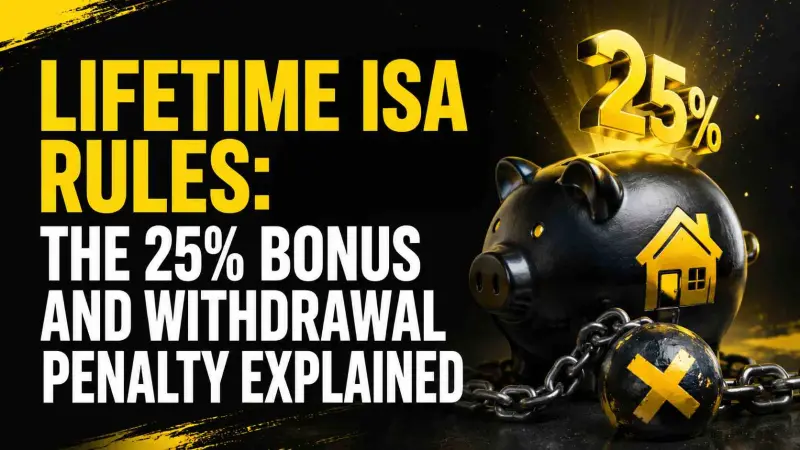
A Lifetime ISA can look almost too good to be true: put in up to £4,000 a year and the government adds a 25% bonus, potentially giving you another £1,000 a year at no extra cost. But there is a catch that can be expensive if you need your money for the wrong reason.
The Lifetime ISA withdrawal charge is 25% of the amount withdrawn, not simply 25% of the government bonus. That distinction matters. If you receive the bonus and later make an unauthorised withdrawal, you can end up losing some of your own contributions as well as the bonus.
A Lifetime ISA, or LISA, is designed for two main purposes: buying your first home or saving for later life, with penalty-free access from age 60. It can hold cash, investments, or a combination of both.
This guide explains exactly how the 25% bonus works, when you can withdraw without a charge, why the penalty can be larger than people expect, and the situations where a LISA may—or may not—make sense.
Understanding Lifetime ISA Rules, the 25% Bonus and the Withdrawal Charge
What is a Lifetime ISA?
A Lifetime ISA is a tax-free savings or investment account for eligible UK residents aged 18 to 39. You must make your first payment before turning 40, and you can continue contributing until you turn 50.
The basic attraction is straightforward:
- You can contribute up to £4,000 per tax year.
- The government adds a 25% bonus.
- The maximum annual government bonus is £1,000.
- The £4,000 LISA limit counts towards your overall ISA allowance.
- The overall ISA allowance is £20,000 for 2026/27.
- You can hold cash, stocks and shares, or both inside a LISA.
- Withdrawals can generally be made without a charge for an eligible first-home purchase, from age 60, or in qualifying terminal illness circumstances.
That makes the LISA particularly attractive to someone who has a clear long-term objective.
The less attractive side is equally important: the account is not designed to be a general emergency fund.
How does the 25% Lifetime ISA bonus actually work?
The government bonus is 25% of the amount you contribute, subject to the £4,000 annual contribution limit.
For example:
| Your contribution | Government bonus | Total before growth |
|---|---|---|
| £500 | £125 | £625 |
| £1,000 | £250 | £1,250 |
| £2,000 | £500 | £2,500 |
| £3,000 | £750 | £3,750 |
| £4,000 | £1,000 | £5,000 |
So if you contribute the full £4,000 in a tax year, you effectively receive £5,000 before interest or investment growth.
The bonus isn't a tax deduction in the conventional Income Tax sense. It is a government contribution added to your LISA.
The £4,000 contribution limit is also separate from the amount you might have available across your other ISA accounts. Because the LISA contribution counts towards the overall ISA allowance, paying £4,000 into a LISA leaves up to £16,000 of the £20,000 annual ISA allowance for other ISAs, assuming you have enough allowance and meet their rules.
A simple long-term example
Suppose someone contributes £4,000 every year for five years and receives the maximum £1,000 annual bonus.
Ignoring investment growth:
- Personal contributions: £20,000
- Government bonuses: £5,000
- Total: £25,000
Investment returns or interest could increase that amount, but they could also vary depending on whether the money is held in cash or invested.
Why is the withdrawal charge described as a 25% penalty?
This is where many explanations of LISAs become confusing.
The government bonus is 25% of your contribution.
The withdrawal charge is 25% of the amount being withdrawn.
Those are not mathematically identical.
Imagine you put £4,000 into a LISA.
The government adds £1,000.
Your account now contains £5,000, before interest or investment growth.
If you make an unauthorised withdrawal of the whole £5,000, a 25% withdrawal charge would be £1,250.
You would therefore receive £3,750.
That means you have lost £250 of your original £4,000 contribution, assuming there has been no investment growth or loss.
HMRC gives the same principle using an £800 contribution: an £800 contribution receives a £200 bonus, creating £1,000. A full unauthorised withdrawal would incur a £250 charge, leaving £750.
This is one of the most important Lifetime ISA rules to understand before opening an account.
Why the 25% charge can cost more than the bonus
The phrase "25% penalty" can make it sound as though the government simply takes back its £1,000 bonus.
That's not quite what happens.
The charge is calculated on the withdrawal amount, including the bonus and, where applicable, investment growth.
Suppose your LISA contains £10,000.
A 25% charge would be:
£10,000 × 25% = £2,500
You would receive £7,500.
The government bonus might have represented only part of that balance. The additional £1,500 difference between £2,500 and the original £1,000 bonus illustrates why an unauthorised withdrawal can leave you worse off than simply "giving the bonus back."
The government's own guidance explains that the charge is intended to recover the bonus and related benefit, while also discouraging people from using LISAs for purposes other than those for which they were designed.
When can you withdraw from a Lifetime ISA without paying the 25% charge?
There are three main situations:
- You are buying your first home and meet the LISA conditions.
- You are aged 60 or over.
- You are terminally ill and have less than 12 months to live.
There are also certain technical circumstances involving account administration, death, invalid accounts and other specific situations where a withdrawal charge does not apply.
For most savers, however, the three situations above are the ones that matter.
How does a Lifetime ISA work for buying your first home?
A LISA can be used towards a first residential property, but several conditions must be satisfied.
The property must:
- Cost £450,000 or less.
- Be purchased at least 12 months after your first LISA payment.
- Be bought with a qualifying mortgage.
- Be intended as your main residence.
- Be purchased using a solicitor or conveyancer.
- Have the LISA funds paid to the conveyancer rather than simply withdrawn into your personal bank account.
That 12-month rule is particularly important.
The first-payment clock matters
Suppose you open a LISA in January and make your first payment.
You cannot necessarily use the money for a qualifying house purchase immediately.
You generally need to wait at least 12 months from that first
payment before using the LISA withdrawal for the purchase.
This is why opening a LISA shortly before you expect to exchange contracts can be risky.
If you're planning to buy a home, the timing should be considered well before the purchase process begins.
What happens if the property costs more than £450,000?
This is another important limitation.
The qualifying property price is £450,000 or less. If the property exceeds that threshold, you cannot simply use the LISA bonus and accept a smaller benefit.
The withdrawal would not qualify for the first-home exemption if the relevant conditions are not met, meaning the 25% withdrawal charge can apply.
This creates a genuine planning issue in expensive property markets.
If you expect your first home to cost substantially more than £450,000, a LISA may not fit your circumstances as neatly as it does for someone buying below the threshold.
Can two first-time buyers use their Lifetime ISAs together?
Yes.
If two people are buying together and both have Lifetime ISAs, they can both potentially use their savings and government bonuses towards the purchase, provided both buyers satisfy the relevant first-time buyer conditions.
For example, a couple could each have £20,000 in a LISA.
If both qualify, their combined LISA funds could contribute significantly towards the deposit and purchase costs.
The important point is that each person must meet the rules for their own LISA withdrawal.
What if you inherit a property or have previously owned a home?
The LISA first-home benefit is intended for genuine first-time buyers.
If you have previously owned a residential property, including in certain circumstances through inheritance, you need to establish whether you still meet the statutory first-time buyer definition before relying on the LISA exemption.
This is an area where a conveyancer or qualified financial adviser can be useful, especially where ownership history is complicated.
Do not assume that simply not currently owning a home makes you a first-time buyer.
Can you use a Lifetime ISA for retirement instead?
Yes.
You do not have to use a LISA to buy a home.
You can keep the account for later life and make a charge-free withdrawal from age 60.
This gives the LISA a second major purpose.
Consider someone aged 30 who has no immediate intention of buying a property but wants to build long-term savings.
They could contribute up to £4,000 annually, receive the 25% government bonus, and keep the money invested or earning interest.
Once they reach 60, they can withdraw without the 25% charge.
That makes the LISA particularly interesting for younger savers who are unlikely to need the money before retirement.
What happens after you turn 50?
You can no longer contribute to your LISA once you reach 50, and you can no longer receive the 25% government bonus on new contributions.
However, the account does not simply disappear.
It can remain open, and the existing savings can continue to earn interest or generate investment returns according to the account's underlying holdings.
This means the important deadline is not age 50 for accessing your money.
It is primarily the point at which new contributions and bonuses stop.
Cash Lifetime ISA vs Stocks and Shares Lifetime ISA
A Lifetime ISA is not itself limited to cash.
You can generally choose between a cash-based LISA and a stocks and shares LISA, depending on what the provider offers.
| Option | Best suited to | Main benefit | Potential limitation |
|---|---|---|---|
| Cash LISA | Shorter-term house deposit planning | Lower investment volatility | Interest may be lower than long-term investment returns |
| Stocks & shares LISA | Long-term goals | Potential for higher long-term growth | Investments can fall in value |
| Combination | Savers with different objectives | Mix of stability and growth | More decisions and portfolio management |
For a first-home deposit needed relatively soon, taking substantial investment risk can be uncomfortable because markets can fall shortly before completion.
For someone saving until age 60, the longer time horizon may make investment risk more manageable, although there is never a guarantee of positive returns.
HMRC confirms that a LISA can contain cash, stocks and shares, or a combination.
What happens if your investments lose money?
The government bonus does not protect you from investment losses.
Suppose you contribute £4,000 and receive a £1,000 bonus, taking the account to £5,000.
If your investments subsequently fall by 20%, the account could fall to around £4,000.
The 25% government bonus does not act like a guaranteed investment return.
This distinction is particularly important for anyone choosing a stocks and shares LISA.
You receive the bonus because you contributed, but your overall account value remains exposed to the performance of the investments you hold.
What if you need the money for an emergency?
This is the uncomfortable part of Lifetime ISA planning.
If you suddenly need money for:
- Rent
- A car repair
- Redundancy
- A wedding
- A holiday
- Credit card repayments
- General living costs
- An unexpected purchase
a LISA is usually not the account you would want to rely on.
An unauthorised withdrawal normally attracts the 25% charge.
That is why a separate accessible emergency fund can be important.
A sensible savings structure might involve keeping emergency cash outside the LISA, while
using the LISA for the specific long-term objective that justified opening it.
How much do you actually need to withdraw to receive a particular amount?
The mathematics of the withdrawal charge is worth understanding.
Because the charge is 25%, you keep 75% of the amount withdrawn.
So, if you need £1,000 in cash and the withdrawal is chargeable:
£1,000 ÷ 0.75 = £1,333.33
You would need to withdraw approximately £1,333.33 to receive £1,000 after the 25% charge.
HMRC gives the same principle in its guidance: to receive £4,000 after a charge, the gross withdrawal would need to be £5,333.33, producing a £1,333.33 charge.
This is the part many casual explanations miss.
The charge is not 25% of what you receive.
It is 25% of the gross withdrawal.
Can you transfer a Lifetime ISA to another ISA?
You need to be careful.
A transfer from a LISA to another type of ISA can trigger the 25% withdrawal charge unless the transfer is handled under an applicable permitted process.
The government's guidance specifically warns that transferring a LISA to another type of ISA before age 60 can result in the charge.
This is why you should not treat a LISA as simply another version of a standard ISA.
The tax-free wrapper is similar, but the withdrawal conditions are substantially more restrictive.
What about transferring between Lifetime ISAs?
Moving a LISA from one provider to another is different from withdrawing the money for personal use.
A properly executed ISA transfer should be carried out through the relevant providers rather than by withdrawing the money yourself and depositing it into the new account.
If you withdraw the money personally and attempt to recreate the account elsewhere, you could create an unnecessary withdrawal-charge problem.
Always use the provider's formal transfer process.
What if a first-home purchase falls through?
This is an area where timing matters.
If LISA funds have been withdrawn for a qualifying property purchase and the purchase subsequently fails, the money generally needs to be returned to the LISA within the relevant rules and timescales to avoid a charge.
HMRC has specific rules covering failed first-time residential purchases.
A conveyancer should therefore understand that LISA money is involved from the beginning.
If the transaction collapses, contact both the conveyancer and LISA provider promptly rather than treating the money as ordinary cash.
What if you have a Help to Buy ISA as well?
You can have both a Help to Buy ISA and a LISA, subject to their respective rules.
However, you cannot use the government bonus from both accounts for the same first-home purchase.
You may be able to transfer a Help to Buy ISA into a LISA, but the treatment of the transfer depends on when and how it is made.
Since Help to Buy ISAs are closed to new applicants, this is mainly relevant to people who already have one.
Is a Lifetime ISA better than a normal savings account?
Not automatically.
The 25% bonus is powerful, but the account comes with restrictions.
| Feature | Lifetime ISA | Ordinary savings account |
|---|---|---|
| Government bonus | 25% on eligible contributions | No |
| Access | Restricted | Generally flexible |
| Withdrawal penalty | 25% for unauthorised withdrawals | Usually none, subject to account terms |
| Main purposes | First home or later life | Any purpose |
| Investment option | Cash or qualifying investments | Depends on product |
| Annual LISA contribution | £4,000 | No LISA-specific limit |
| Tax treatment | ISA tax advantages | Depends on interest and personal allowances |
The right choice depends on what the money is for.
If you're confident that your money will be used for a qualifying first home or kept until age 60, the bonus can be extremely valuable.
If you might need the money next year, the withdrawal restriction could outweigh the bonus.
What are the biggest Lifetime ISA mistakes?
1. Treating the LISA as an emergency fund
The withdrawal charge can turn a financial emergency into a larger loss.
2. Forgetting the 12-month first-home rule
Opening the account shortly before buying does not necessarily make the funds immediately eligible.
3. Assuming the penalty only takes back the bonus
The 25% charge applies to the withdrawal amount, not merely the government contribution.
4. Ignoring the £450,000 property ceiling
A property above the qualifying price can make the first-home withdrawal exemption unavailable.
5. Taking investment risk without considering your purchase date
A deposit needed in six months may not be suitable for an aggressive investment strategy.
6. Forgetting that £4,000 counts towards the overall ISA allowance
The LISA limit is part of the wider ISA framework, not an additional £4,000 on top of the £20,000 allowance.
Is the Lifetime ISA allowance changing?
As of the 2026/27 tax year, the overall ISA allowance is £20,000 and the LISA contribution limit remains £4,000.
Government information states that the £4,000 LISA annual subscription limit is expected to remain unchanged through 5 April 2031 under the announced framework.
There are broader ISA changes coming in 2027, particularly affecting cash ISA limits for people under 65. Those changes do not currently reduce the LISA contribution limit, but they may affect how some savers divide money between different ISA types.
The practical lesson is simple: check the current rules before making a large contribution, particularly if your plan depends on future tax years.
How should you decide whether a Lifetime ISA is right for you?
A useful way to think about it is to ask three questions.
Question 1: What is the money for?
If the answer is "my first home" or "long-term savings until at least 60", a LISA may fit.
If the answer is "I might need it", a flexible savings account may be more appropriate.
Question 2: Can you leave the money alone?
The government bonus is attractive precisely because the government expects the money to remain earmarked for its intended purpose.
If accessing the funds early is likely, the withdrawal charge matters more.
Question 3: Does the property meet the rules?
For a first-home strategy, check the £450,000 property ceiling, 12-month waiting period, mortgage requirement and other eligibility conditions before relying on the LISA for your deposit.
A practical Lifetime ISA strategy
For someone saving for a first home, a sensible process could look like this:
- Build an emergency fund separately.
- Open the LISA early enough to satisfy the 12-month rule.
- Contribute up to £4,000 if it fits your budget.
- Account for the £1,000 maximum annual government bonus.
- Choose cash or investments based on your timeframe and risk tolerance.
- Check that your expected property price is within the qualifying limit.
- Tell your conveyancer that you are using a LISA.
- Allow enough time for the provider and conveyancer to process the withdrawal.
- Do not manually withdraw and move the money if a formal ISA transfer is required.
- Keep separate accessible savings for unexpected expenses.
The key is not to chase the bonus in isolation.
The bonus is valuable only when the account structure matches your financial plans.
What does the future look like for Lifetime ISAs?
The LISA remains a distinctive product because it combines a government contribution with tax-free ISA treatment and restricted access.
The wider ISA market is changing, particularly with planned reforms to cash ISA limits from April 2027. The government has stated that the overall ISA allowance will remain £20,000 and that the LISA limit will remain £4,000 under the announced framework.
That could make the choice between cash ISAs, stocks and shares ISAs and LISAs more important for savers who are already using a large portion of their annual ISA allowance.
But future policy can change.
For that reason, treat current government announcements as the rules for planning today, not as a guarantee that every detail of the product will remain unchanged indefinitely.
Key Insights
- The Lifetime ISA bonus is 25% of eligible contributions, with a maximum government bonus of £1,000 per year on £4,000 of contributions.
- The 25% withdrawal charge is calculated on the amount withdrawn, not just on the bonus you received.
- You can normally withdraw without a charge for a qualifying first home, from age 60, or qualifying terminal illness.
- A first-home purchase generally needs to be £450,000 or less, and the LISA must have received its first payment at least 12 months before the withdrawal.
- A LISA can hold cash, stocks and shares, or both, so the investment choice should reflect your timeframe and risk tolerance.
- The £4,000 LISA limit counts towards the £20,000 overall ISA allowance for 2026/27.
- Keep emergency savings outside your LISA because early access for ordinary expenses can trigger a substantial charge.
- Don't judge the LISA purely by its 25% bonus; the account's value depends on whether you can follow its withdrawal rules.
FAQ
1. What is a Lifetime ISA?
A Lifetime ISA is a tax-free savings or investment account for eligible people aged 18 to 39. You can contribute up to £4,000 each tax year and receive a 25% government bonus, subject to the Lifetime ISA rules.
2. How much is the Lifetime ISA government bonus?
The government bonus is 25% of eligible contributions. If you contribute the maximum £4,000 in a tax year, the maximum bonus is £1,000.
3. Is the Lifetime ISA bonus really free money?
It is a government contribution, but it comes with conditions. If you make an unauthorised withdrawal, a 25% charge applies to the amount withdrawn, meaning you can lose part of your original contribution as well as the bonus.
4. What is the Lifetime ISA withdrawal penalty?
The standard charge for an unauthorised withdrawal is 25% of the amount withdrawn. It applies when you take out cash or assets for a reason that does not qualify for charge-free treatment.
5. Can I withdraw my Lifetime ISA before age 60?
Yes, but normally only without a charge if the withdrawal is for a qualifying first-home purchase or because you have a qualifying terminal illness. Other withdrawals normally attract the 25% charge.
6. Can I use a Lifetime ISA to buy any house?
No. For the first-home withdrawal exemption, the property must meet specific conditions, including a maximum purchase price of £450,000 and the 12-month rule.
7. How long must a Lifetime ISA be open before buying a house?
You generally need to have made your first LISA payment at least 12 months before making the qualifying withdrawal for your first-home purchase.
8. Can I use two Lifetime ISAs to buy a house with my partner?
Two eligible first-time buyers can generally use their respective LISAs for the same purchase, provided each person satisfies the relevant rules.
9. Can a Lifetime ISA be invested in stocks and shares?
Yes. A LISA can contain cash, stocks and shares, or a combination, depending on the provider and qualifying investments available.
10. Is a Lifetime ISA better than a stocks and shares ISA?
Neither is automatically better. A LISA provides the 25% government bonus but has stricter withdrawal rules. A standard stocks and shares ISA does not provide that bonus but generally offers greater withdrawal flexibility.
11. What happens if I withdraw £1,000 from my LISA without qualifying?
A 25% charge would normally apply to the £1,000 withdrawal, leaving £750. If you need £1,000 after the charge, you would need to withdraw more than £1,000.
12. Can I withdraw my Lifetime ISA at age 60 without a penalty?
Yes. Once you reach age 60, you can withdraw money from your LISA without the standard 25% withdrawal charge.
13. Can I keep contributing after age 50?
No. You cannot make new LISA contributions or receive further government bonuses after reaching age 50, although the account can remain open and existing funds can continue to earn returns.
14. Does the Lifetime ISA allowance count towards the £20,000 ISA allowance?
Yes. The £4,000 annual LISA contribution limit forms part of the overall ISA subscription limit, which is £20,000 for 2026/27.
15. Is a Lifetime ISA suitable for emergency savings?
Usually not. The account is intended for a first home or later life, and ordinary early withdrawals normally incur a 25% charge. Keeping emergency money in an accessible savings account can avoid locking up funds you may suddenly need.
Final Thoughts
A Lifetime ISA can be one of the most valuable government-supported savings options available to eligible younger savers—but its value depends on using it for the right purpose.
The 25% bonus is the headline feature, but the withdrawal rules are just as important. Contribute £4,000 and the government can add £1,000, but if you later make an unauthorised withdrawal, the 25% charge applies to the withdrawal itself. That is why the penalty can take more than the original bonus away.
For a first-time buyer, the LISA can provide a meaningful boost towards a qualifying property priced at £450,000 or less.
For someone saving for later life, it can provide a government-supported route to tax-free savings and investment growth until age 60.
The best approach is to think beyond the bonus. Check your age, contribution plans, house-buying timeframe, expected property price, investment risk and need for emergency access. If those pieces fit together, the LISA's 25% government contribution can be genuinely powerful. If they don't, the withdrawal charge can make the product much less attractive.
Disclaimer: The information provided in this article is for general informational and research purposes only. Company details, features, services, and market positions may change over time. Readers are advised to visit official company websites and conduct independent research before making any business decisions or purchasing services.
Most Searchable Keywords
Recent Blogs
Related Listings

Categories
- Accountants (295)
- Advertising Agencies (559)
- Architects (149)
- Automobiles (377)
- Beauty (300)
- Carpenters (146)
- Cleaning Services (387)
- Dentists (189)
- Driving (62)
- Education (1)
- Electricians (215)
- Energy (8)
- Event Organiser (687)
- Finance (602)
- Guide (3420)
- Health (2207)
- Information technology (206)
- Legal Services (361)
- Logistics (6)
- Maintenance (65)
Sponsored Listings in Plumbers

Related Blogs

What It Costs to Run an Electric Fan Air Frye...
Read this insightful article "What It Costs to Run an Electric Fan Air Fryer or Tumble Dryer" to expand your knowledge!
Octopus Agile vs Fixed Tariffs: Which Is Chea...
Read this insightful article "Octopus Agile vs Fixed Tariffs: Which Is Cheaper" to expand your knowledge!
Old Energy Supplier Owes You Money Claim a Re...
Read this insightful article "Old Energy Supplier Owes You Money Claim a Refund" to expand your knowledge!
Questions & Answers – Find What
You Need, Instantly!
How can I update my business listing?
Is it free to manage my business listing?
How long does it take for my updates to reflect?
Why is it important to keep my listing updated?
