
P45 vs P60: Differences and When You Get Each
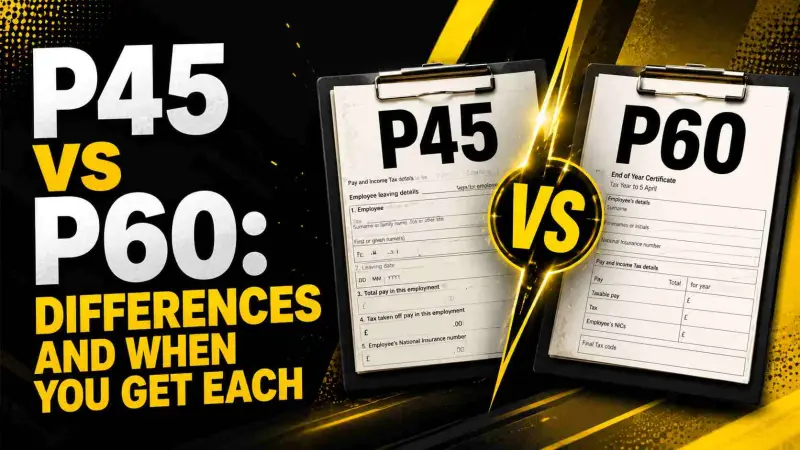
If you've recently left a job, started a new one, or reached the end of the UK tax year, you may come across two familiar-looking tax documents: the P45 and P60. Although both forms contain information about your pay and tax, they are issued for different reasons and at different points in your employment.
The simplest distinction is this: you normally receive a P45 when you leave an employer, while you receive a P60 if you are still employed by that employer on 5 April, the end of the UK tax year. Your P45 records your pay and tax from that employment up to your leaving date. Your P60 summarises your pay and tax for the tax year.
That difference matters in practical situations. A new employer may need information from your P45 to help operate the correct PAYE tax code. A P60 can be useful when checking your annual tax position, applying for a mortgage or loan, or supporting a claim for a tax refund.
It is also possible to have both forms in the same tax year. For example, you might leave one employer in September, receive a P45, and then work for another employer through 5 April and receive a P60 from that second employer.
This guide explains P45 vs P60 in straightforward terms, including what each form contains, when you should receive it, whether you can get both, what happens when you change jobs, and what to do if your employer has not provided the document you need.
P45 vs P60: How the Two UK Tax Forms Work
What is the difference between a P45 and a P60?
The main difference is when and why you receive the document.
A P45 is issued when you stop working for an employer. It records your pay and Income Tax deductions from the beginning of the relevant tax year up to the date you leave that employment.
A P60 is issued at the end of the tax year if you are still working for that employer on 5 April. It summarises your pay and tax for the tax year. Employers must provide the P60 by 31 May, either electronically or on paper.
| Feature | P45 | P60 |
|---|---|---|
| Main purpose | Records your pay and tax when you leave | Summarises your annual pay and tax |
| When issued | When you stop working for an employer | After the tax year ends |
| Relevant date | Your leaving date | 5 April |
| Tax period | Tax year to your leaving date | Tax year as a whole |
| Who normally receives it? | Someone leaving an employment | Someone still employed on 5 April |
| Deadline | When you leave / final payroll arrangements | By 31 May |
| Common use | Giving information to a new employer, benefits or tax matters | Tax records, refunds, income evidence |
| Can you receive both? | Yes | Yes |
The forms are therefore not alternatives. One does not replace the other.
What is a P45?
A P45 is an employment-leaving document.
When your employment ends, your employer must give you a P45. HMRC states that the form shows your pay and tax to the date you left the job.
For example, imagine you started working for Company A in April and left in November. Your P45 would contain information relating to that employment up to your leaving date.
The document is particularly useful if you are moving directly into another job because your new employer can use the information to help work out how much tax to deduct from your pay.
A P45 is therefore closely associated with changing employment.
What information appears on a P45?
The exact presentation can depend on how the payroll system provides the information, but the P45 contains important PAYE information relating to your employment.
It generally includes information such as:
- Your name and National Insurance details
- Your leaving date
- Your pay to the date you left
- Income Tax deducted
- Your tax code
- Employment and payroll information needed for PAYE administration
The information is also reported to HMRC by your employer.
One important point is that a P45 does not mean that you have completed your tax affairs for the entire tax year. It only records the relevant employment up to the point at which you left.
When should your employer give you a P45?
You should receive a P45 when you leave an employment.
HMRC's employer guidance states that an employer must give an employee a P45 when they leave.
In practice, the form is normally produced as part of the employer's final payroll process.
If you know you are leaving, it is sensible to ask your employer when your final pay and P45 will be processed. HMRC specifically recommends asking your employer about the P45 when you leave a job.
What is a P60?
A P60 is an end-of-tax-year certificate.
It summarises the pay you received and tax deducted during the tax year, which runs from 6 April to 5 April. If you are working for an employer on 5 April, that employer must provide you with a P60 by 31 May.
The P60 is not simply another version of a P45. Its purpose is different.
Instead of showing what happened when you left a particular job, the P60 provides an end-of-year record for an employment that you were still in at the end of the tax year.
Why is a P60 important?
Your P60 is useful because it provides evidence of your annual employment income and tax deductions.
For example, you may need information from your P60 when:
- Checking whether you have paid the right amount of tax
- Claiming back overpaid tax
- Providing proof of income
- Applying for a mortgage
- Applying for certain loans or financial products
- Completing tax-related paperwork
- Keeping your personal financial records up to date
HMRC specifically identifies claiming back overpaid tax and proving income for a loan or mortgage as examples of situations where a P60 can be useful.
What is the tax year covered by a P60?
The UK tax year runs from 6 April to 5 April.
So, for example, a P60 issued after 5 April 2026 relates to the tax year ending on 5 April 2026.
Your employer should give you the P60 by 31 May following the end of the tax year.
This is one reason the timing of a job change can be confusing.
If you leave an employer before 5 April, that employer will generally give you a P45 rather than a P60 for that employment.
If you are still employed by the employer on 5 April, you should receive a P60 from that employer.
Can you get a P45 and a P60 in the same tax year?
Yes. You can receive both.
This is one of the most common points of confusion.
Suppose you work for Employer A from April until August. You leave Employer A and receive a P45.
You then start Employer B in September and remain employed there on 5 April.
Employer B should provide a P60 for the tax year because you are still working there at the end of the tax year.
Your records could therefore contain:
- P45 from Employer A
- P60 from Employer B
The P45 records your first employment up to the date you left. The P60 records the annual pay and tax information for the employment that continued through 5 April.
What happens to your P45 when you start a new job?
Your P45 can be useful when starting another PAYE job.
HMRC says your new employer can use the P45 to work out how much tax to take from your pay.
This helps the new employer understand relevant information about your previous employment during the tax year.
If you do not have a P45, you may need to complete the employer's starter checklist instead.
HMRC notes that the old P46 form is no longer used for this purpose.
That means losing or not receiving a P45 does not necessarily prevent you from starting a new job. However, providing accurate information to your new employer can help avoid PAYE problems.
What if you start a new job before receiving your P45?
This situation can happen.
For example, you might leave one company on Friday and start another company on Monday, while the previous employer has not yet completed the final payroll process.
You should tell the new employer that you do not yet have the P45 and follow its starter process.
Your new employer may ask you to complete a starter checklist so it has the information needed to operate PAYE.
Once your tax records are updated, your tax position can be corrected where necessary.
The important thing is not to provide inaccurate information simply because you are worried about being placed on the wrong tax code.
Can a P45 show that you are due a tax refund?
A P45 itself is not automatically a tax refund.
However, it provides information that can help determine whether you have paid too much tax.
This can happen when someone stops working partway through a tax year and does not have enough taxable income during the rest of the year to use their available allowances.
It does not mean everyone leaving a job will receive money back. Your actual tax position depends on your income, tax code, other employment, benefits and other relevant circumstances.
If you believe you have overpaid tax, you can check your position through HMRC and use your employment records, including your P45, as supporting information.
What happens if you leave your job after 5 April?
The timing of your departure matters.
If you remain employed on 5 April, your employer generally has to provide a P60 for that tax year. If you then leave after 5 April, your employer would subsequently provide a P45 when that employment ends.
So you could receive a P60 for the tax year that ended on 5 April and then a P45 when you leave later.
This is another example showing that the documents serve different purposes.
The P60 closes the record for the tax year.
The P45 records the end of the employment.
What happens if your employer pays you after giving you a P45?
This is an area where people often become confused.
There are circumstances in which an employer may make a payment after your P45 has already been issued. Examples can include certain holiday pay, bonuses or other amounts connected with the former employment.
HMRC provides specific payroll rules for payments made after an employee has left. In general, the employer does not simply issue another P45 for each additional payment. Instead, the payment is reported through payroll using the original leaving information.
For some post-employment payments, HMRC requires the employer to use tax code 0T on a week 1 or month 1 basis. The precise treatment depends on the type of payment.
This matters if your final pay looks different from what you expected.
A payment made after leaving does not automatically indicate that your employer has made a payroll mistake.
How do redundancy payments affect your P45?
Redundancy and termination payments can make your final tax documents more complicated.
Some termination payments are treated as earnings and are subject to Income Tax and, where applicable, National Insurance. HMRC gives examples including unpaid wages, holiday pay, bonuses and certain payments in lieu of notice.
Where taxable termination payments are made through payroll, the employer deducts the relevant tax and National Insurance.
If a taxable termination payment is made after the P45 has already been issued, special PAYE rules can apply. HMRC states that an employer may use tax code 0T for certain payments after leaving.
If you receive a substantial redundancy or settlement package, do not assume that the amount on your P45 represents every payment associated with leaving the employer.
Keep your final payslips, P45 and any termination or settlement paperwork together.
What should you do if you do not receive your P45?
Your first step should normally be to contact your former employer.
HMRC advises employees to contact their employer if they do not have their P45, P60 or P11D.
Ask the employer's payroll or HR department when the document was issued and whether it was provided electronically or on paper.
If you have already started another job, tell your new employer that you do not yet have the P45. You may need to complete the starter checklist instead.
Do not ignore the issue if your tax code appears wrong afterward. Check your payslip and HMRC tax information.
What should you do if you do not receive your P60?
Your employer should provide your P60 by 31 May if you were working for them on 5 April.
If you have not received it, contact your employer first.
If you have lost a P60 that was already issued, HMRC says you can ask your employer for a replacement. You may also be able to find the relevant information through your Personal Tax Account or the HMRC app.
The P60 is worth keeping because it can provide useful evidence of your annual income and tax.
Is a P60 the same as your final payslip?
No.
A final payslip records the payment processed in that particular payroll period. A P60 is an end-of-year summary.
Your final payslip might include:
- Basic salary
- Overtime
- Holiday pay
- Bonuses
- Pension deductions
- Income Tax
- National Insurance
- Other payroll deductions
The P60 provides an annual summary rather than simply documenting one payment.
You should keep both where they are relevant, particularly if your final payment contains unusual items.
Is a P45 proof of your total income for the whole tax year?
Not necessarily.
A P45 shows your pay and tax from a particular employment up to the date you left.
If you had another job earlier or later in the same tax year, that income may be recorded on another PAYE document.
For example, someone could have three employments during one tax year. They might receive a P45 when leaving the first two jobs and have a P60 from the employer they were still working for on 5 April.
Looking at only one document could therefore give an incomplete picture of total income.
Do you get a separate P60 for every job?
If you are working for more than one employer at the end of the tax year, you can receive a separate P60 for each employment.
HMRC states that employees receive a separate P60 for each job every tax year.
That distinction is particularly relevant for people with multiple jobs.
Suppose you work part-time for Employer A and Employer B on 5 April. Each employer is responsible for the relevant end-of-year PAYE information for that employment.
You should therefore check that you have the expected documents rather than assuming one P60 represents all of your employment income.
Can your P60 help you check your tax code?
Yes, but it is not the only document you should check.
Your P60 contains your final tax code for the employment and records the tax deducted during the tax year.
If you think your tax has been calculated incorrectly, compare your P60 with:
- Your payslips
- Your tax code notices
- Other employment income
- Your HMRC Personal Tax Account
- Relevant pension or benefit information
A tax code problem can arise for several reasons, including having more than one employment or changes in taxable benefits.
The P60 can help you identify a discrepancy, but it does not by itself explain why one occurred.
P45 vs P60: which one should you use for a mortgage or loan?
For annual income evidence, a P60 is often more useful because it summarises the tax year.
However, lenders decide what evidence they require.
A lender may ask for a combination of documents, such as recent payslips, P60s, bank statements or employment information.
If you have recently changed jobs, your P45 may also help explain your previous employment and income history, but it should not automatically be treated as a substitute for whatever evidence a lender specifically requests.
How should you keep your P45 and P60?
Keep both documents securely with your other financial records.
HMRC recommends keeping records of employment income, including P45s and P60s.
A sensible digital record could include:
- Your P45 whenever you leave an employer.
- Your P60 for each employment that continues through 5 April.
- Your final and regular payslips.
- Tax code notices.
- Records relating to taxable benefits.
- Relevant redundancy or termination documents.
If you use digital storage, make sure the files are backed up and protected.
What are the most common P45 and P60 mistakes?
Most problems are not caused by the forms themselves. They arise because people misunderstand what each document represents.
Common mistakes include:
- Assuming a P45 is an annual tax statement
- Assuming a P60 is issued when you leave a job
- Forgetting that you can receive both documents
- Throwing away a P45 after starting a new job
- Assuming a P60 automatically means your tax bill is correct
- Failing to check a new tax code
- Ignoring a missing document
- Confusing a payslip with a P45 or P60
- Assuming one P60 covers multiple employers
- Forgetting about income from another job when checking your overall tax position
The simplest way to avoid confusion is to remember the event attached to each document.
P45 = leaving an employment.
P60 = still employed at the end of the tax year.
What should you check when you receive either document?
Do not simply file the form away without looking at it.
Check that key information appears reasonable.
For a P45, check:
- Your name and personal information
- Employer details
- Leaving date
- Pay figures
- Tax deducted
- Tax code
For a P60, check:
- Employer details
- Tax year
- Pay
- Income Tax deducted
- National Insurance information where shown
- Tax code
- Other relevant deductions or statutory payments
If something looks wrong, raise it with your employer's payroll department.
What if your P45 or P60 contains incorrect information?
Start with the employer that issued the document.
Payroll records are normally the first place to investigate an error because the employer submits PAYE information to HMRC.
If the issue affects your tax position and cannot be resolved through the employer, you can contact HMRC.
Do not alter the figures yourself.
Keep the original document and any corrected version or written explanation you receive. This creates a clear record if you later need to explain a discrepancy.
How P45 and P60 information connects with HMRC
Your employer does not simply hand you a form and leave HMRC out of the process.
Employers report PAYE information to HMRC, and HMRC uses that information to maintain your tax record. HMRC explains that employers provide information about employee pay and tax to the department.
This is why it can be useful to compare your own documents with your Personal Tax Account.
If your employer's records and your HMRC record appear inconsistent, investigate rather than assuming one source is automatically correct.
Do pensions use P60s?
P60s are not limited to employment salary.
HMRC explains that pension providers can issue P60s showing tax paid on pension income. For example, if you receive a private pension, the pension provider may deduct tax and provide a P60 at the end of the tax year.
This means someone who has employment income and pension income may have several end-of-year tax documents.
The same basic principle applies: the P60 provides an end-of-year record for the relevant PAYE source.
What is the future of paper tax documents?
UK PAYE administration is increasingly digital, but that does not make your personal records irrelevant.
HMRC allows employers to provide P60s electronically or on paper.
As payroll, tax accounts and financial services become more digital, employees are likely to rely more heavily on online records alongside downloadable documents.
For workers, the practical lesson is simple: keep your own copies even when your employer provides everything digitally.
Digital records can be easier to search and retrieve, but they are still financial records worth protecting.
What should you remember when comparing P45 vs P60?
If you remember only one thing, remember the event that triggers each document.
You get a P45 because an employment has ended.
You get a P60 because an employment continued through the end of the tax year.
The P45 tells you what happened with pay and tax in that employment up to the leaving date.
The P60 summarises pay and tax for the tax year.
Neither document is automatically a tax refund, and neither guarantees that your tax position is correct. They are records that help you, your employer and HMRC understand your PAYE position.
If you change jobs several times, have multiple jobs, receive pension income or receive payments after leaving employment, your records can become more complicated. In those situations, keeping every relevant payslip and tax document together can save considerable time later.
Key Insights
- A P45 is issued when you leave an employer, while a P60 is issued if you are still employed there on 5 April.
- A P45 records your pay and tax up to your leaving date; a P60 summarises your tax-year position.
- You can receive both a P45 and a P60 during the same tax year, particularly after changing jobs.
- Your new employer may use information from your P45 to help operate PAYE correctly.
- Your employer should provide your P60 by 31 May following the end of the tax year.
- If your P45 or P60 is missing, contact the employer that should have issued it.
- Check both forms rather than assuming the figures are automatically correct.
- Keep P45s, P60s, payslips and relevant tax records securely for future tax, income or financial applications.
FAQ
1. What is the main difference between a P45 and P60?
A P45 is given when you leave an employer and shows your pay and tax up to your leaving date. A P60 is given if you are still employed on 5 April and summarises your pay and tax for that tax year.
2. Do I get a P45 when I leave a job?
Yes. Employers must give employees a P45 when they leave an employment. The document records relevant pay and tax information up to the date employment ends.
3. When should I receive my P60?
If you are employed on 5 April, your employer should provide your P60 by 31 May. It can be supplied electronically or on paper.
4. Can I get a P45 and P60 in the same year?
Yes. You can receive a P45 after leaving one employer and later receive a P60 from another employer if you remain employed there on 5 April.
5. Do I get a P60 if I leave my job before 5 April?
Generally, you would receive a P45 when you leave rather than a P60 from that employer. A P60 is normally issued to employees who are still working for the employer on 5 April.
6. What should I do if my employer does not give me a P45?
Contact your former employer and ask the payroll or HR department for the document. If you have started another job, tell your new employer that you do not yet have your P45 and follow its starter process.
7. What should I do if I lose my P60?
Ask your employer for a replacement. HMRC also says you may be able to find the information that would appear on the P60 through your Personal Tax Account or the HMRC app.
8. Is a P60 proof of income?
A P60 can be used as evidence of employment income and tax paid for a tax year. HMRC specifically gives mortgage and loan applications as examples where P60 information can be useful.
9. Is a P45 proof of my annual income?
Not necessarily. A P45 covers a particular employment up to the date you leave. If you had other jobs or income during the same tax year, those amounts may be recorded separately.
10. Does a P45 mean I have paid the correct amount of tax?
No. A P45 records PAYE information from the employment, but it does not guarantee that your overall tax position for the year is correct.
11. Can my new employer use my P45?
Yes. HMRC says your new employer can use information from your P45 to help work out how much tax to deduct from your pay.
12. What happens if I do not have a P45 when starting a new job?
You may need to complete your new employer's starter checklist. HMRC confirms that the P46 is no longer used for this purpose.
13. Can I have several P60s?
Yes. If you are working for multiple employers on 5 April, you can receive a separate P60 for each employment.
14. Does a P45 include payments made after I leave?
Not necessarily. Payments made after a P45 has been issued can be handled separately through PAYE. HMRC has specific rules for post-employment payments, and employers generally should not issue another P45 simply because an additional payment is made.
15. Should I keep my P45 and P60?
Yes. Both are useful employment and tax records. Keeping them alongside payslips, tax code notices and other income documents makes it easier to check your tax position or provide evidence of income later.
Final Thoughts
Understanding P45 vs P60 becomes much easier once you stop thinking of them as two versions of the same tax form.
A P45 marks the end of an employment. A P60 marks the end of a tax year for an employment that continued through 5 April.
That distinction explains why someone changing jobs may receive a P45, while someone who stays with the same employer receives a P60. It also explains why you can have both documents in the same tax year.
The practical approach is to keep both forms, check the figures, and compare them with your payslips and HMRC records when something does not look right.
If a document is missing, start with the employer responsible for issuing it.
Your P45 and P60 are more than pieces of payroll paperwork. They form part of the evidence showing how your employment income and PAYE tax have been recorded. Keeping them organised can make tax checks, job changes, benefit applications and financial paperwork considerably easier.
Disclaimer: The information provided in this article is for general informational and research purposes only. Company details, features, services, and market positions may change over time. Readers are advised to visit official company websites and conduct independent research before making any business decisions or purchasing services.
Most Searchable Keywords
Recent Blogs


Related Listings

Categories
- Accountants (295)
- Advertising Agencies (559)
- Architects (149)
- Automobiles (377)
- Beauty (300)
- Carpenters (146)
- Cleaning Services (387)
- Dentists (189)
- Driving (62)
- Education (1)
- Electricians (215)
- Energy (8)
- Event Organiser (687)
- Finance (602)
- Guide (3419)
- Health (2207)
- Information technology (206)
- Legal Services (361)
- Logistics (6)
- Maintenance (65)
Sponsored Listings in Plumbers


Related Blogs

Octopus Agile vs Fixed Tariffs: Which Is Chea...
Read this insightful article "Octopus Agile vs Fixed Tariffs: Which Is Cheaper" to expand your knowledge!

Old Energy Supplier Owes You Money Claim a Re...
Read this insightful article "Old Energy Supplier Owes You Money Claim a Refund" to expand your knowledge!

Smart Meters: Pros, Cons and Dumb Mode Explai...
Read this insightful article "Smart Meters: Pros, Cons and Dumb Mode Explained" to expand your knowledge!
Questions & Answers – Find What
You Need, Instantly!
How can I update my business listing?
Is it free to manage my business listing?
How long does it take for my updates to reflect?
Why is it important to keep my listing updated?
