
Paid Search vs. Paid Social: The Ultimate Guide for UK Business Growth
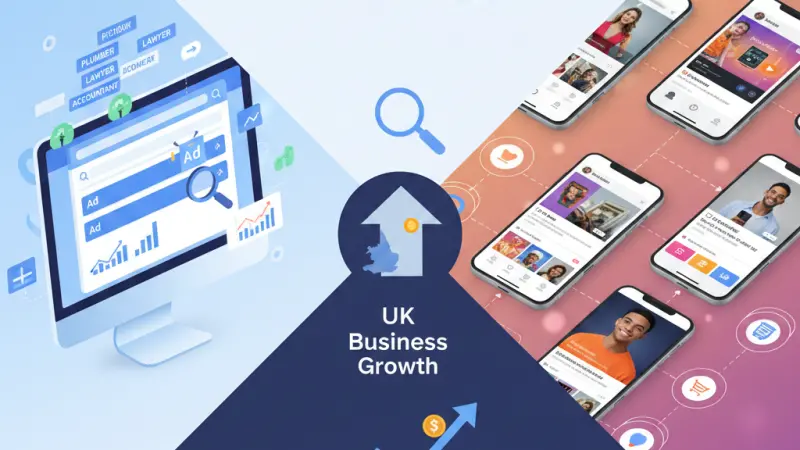
In the rapidly evolving digital landscape of 2026, the question for business owners is no longer if they should advertise online, but where they should invest their hard-earned capital. The two titans of the industry—Paid Search and Paid Social—dominate the market. While they might seem similar on the surface, they function as two entirely different engines driving the consumer journey.
Choosing the wrong platform can result in a "leaky bucket" for your marketing budget. However, choosing the right one can scale a small UK startup into a household name. This guide breaks down every nuance of these channels to help you make an informed, data-driven decision.
Demystifying Paid Search: The Power of Intent
Paid Search, commonly known as Search Engine Marketing (SEM) or Pay-Per-Click (PPC), is the process of bidding for top real estate on Search Engine Results Pages (SERPs) like Google and Bing.
The Mechanics of Intent
The magic of Paid Search lies in intent. When a user types "emergency plumber in London" or "best organic dog food," they are actively looking for a solution. They are "in-market." By using Paid Search, you aren't interrupting their day; you are providing the answer to their specific problem at the exact moment they need it.
Core Components of Paid Search:
Keywords: The foundation of SEM. You bid on terms that your customers use.
Ad Copy: Short, punchy text designed to earn a click.
Quality Score: Google’s metric that looks at your ad relevance and landing page experience to determine your cost-per-click (CPC).
Extensions: Additional snippets of info like phone numbers, location, or site links.
Understanding Paid Social: The Art of Discovery
If Paid Search is a digital phone book, Paid Social is a digital billboard in a highly curated shopping mall. Paid Social involves paying to place content in front of users on platforms like Facebook, Instagram, TikTok, LinkedIn, and Pinterest.
The Mechanics of Interest
Unlike search, social media users aren't usually looking for a product; they are looking for entertainment or connection. Therefore, Paid Social relies on disruptive marketing. You use the massive amounts of data these platforms have—age, interests, hobbies, job titles, and recent behaviors—to put your brand in front of people who are likely to want what you offer, even if they aren't searching for it yet.
Why Visuals Matter
On social media, the "thumb-stop" is the metric of success. Because these platforms are visual-first, your creative (images and video) does the heavy lifting that keywords do in search.
The Great Debate: Search vs. Social
To choose between them, we must look at the fundamental differences in how they interact with your audience.
| Feature | Paid Search (PPC) | Paid Social (Ads) |
|---|---|---|
| Primary Goal | Direct Conversions / Sales | Brand Awareness / Engagement |
| User Mindset | Active Search (High Intent) | Passive Browsing (Low Intent) |
| Targeting | Keywords & Phrases | Demographics & Interests |
| Format | Mostly Text-based | Visual (Image/Video) |
| Strategy | Reactive (Solving a problem) | Proactive (Creating a need) |
Deep Dive: Advantages & Disadvantages
The Pros of Paid Search
High Conversion Rates: Because users have high intent, the traffic is "warmer."
Granular Geotargeting: Perfect for local UK service providers who only want to target specific postcodes.
Speed to Market: You can turn on a Google Ad campaign and appear at the top of page one in minutes.
The Cons of Paid Search
Cost: In competitive industries (legal, insurance, SaaS), CPCs can be astronomical.
Visual Limitations: It is difficult to "brand" a text ad. You are limited to a few lines of copy.
Ad Blindness: Many savvy users skip the "Sponsored" section to find organic results.
The Pros of Paid Social
Advanced Targeting: You can target "Small business owners in Manchester who like golf and own an iPhone." This level of specificity is unmatched.
Affordability: Generally, the cost-per-impression (CPM) is lower than the cost-per-click on high-intent keywords.
Virality: Social ads can be shared, liked, and commented on, giving you free organic reach on top of your paid spend.
The Cons of Paid Social
Low Intent: People might "Like" your ad but have zero intention of buying today.
Creative Fatigue: You have to refresh your images and videos constantly, or people will stop seeing them.
Intrusiveness: If done poorly, ads can annoy users, leading to negative brand sentiment.
Which is Better for Small Businesses?
For a UK small business, the answer depends on your Current Objective.
Case A: The "Problem-Solver" Business
If you are a locksmith, a mechanic, or a lawyer, you should prioritize Paid Search. People don't follow a locksmith on Instagram "just in case" they get locked out. They search for one when the crisis happens.
Case B: The "Lifestyle/New Product" Business
If you have a new clothing brand, a unique gadget, or a subscription box, Paid Social is your best friend. People don't know your brand exists, so they won't search for it. You need to show them how cool it is through a TikTok or Instagram video.
Integrating Both: The "Full-Funnel" Approach
The most successful UK businesses don't choose one; they use both in a "Top-Down" strategy:
Awareness (Social): Use Facebook/Instagram to introduce your brand to a targeted demographic.
Retargeting (Social/Search): Show ads to people who visited your site but didn't buy.
Conversion (Search): Bid on your own brand name so that when those people finally search for you, they find you instantly.
Maximizing Your UK Presence
For any business operating in the UK, local signals are vital. Search engines and social algorithms prioritize local relevance. Ensuring your business is listed in reputable directories and local search ecosystems is the foundation upon which your paid ads sit. Without a strong local footprint, your "Cost Per Acquisition" will always be higher.
Boost Your UK Business Visibility
If you want to strengthen your local SEO and ensure your paid ads perform at their peak, you need a solid foundation in the UK's premier business networks.
The local page uk business directory is an essential tool for any company looking to dominate the regional market. By listing your company in a uk business directory, you enhance your digital footprint and make it easier for customers to find local businesses uk.
Whether you are looking for a uk small business directory to start your journey or a uk b2b business directory to find partners, we provide the ultimate uk business directory website.
Small businesses can take advantage of our business listing uk to gain immediate exposure. Getting a business listing uk spot or a business listing uk ensures your brand is visible without upfront costs. Our business listing uk is designed to support the growth of the uk local business directory ecosystem. From business listing uk to specialized business listing uk options, we help you get found.
Explore our extensive local business listings uk to see where you stand among uk verified business listings. Our platform serves as a comprehensive uk home services directory and uk trade services directory, offering the most reliable uk service listings in the country. Join the local page uk listings today and become one of the uk top rated local businesses that consumers trust. Whether you need an uk online business directory or a uk b2c business directory, Local Page UK is your partner in growth.
Questions Clients Commonly Ask
Is Google Ads more expensive than Facebook Ads?
Generally, yes. Google Ads (Search) often has a higher CPC because the intent to buy is higher.
Can I run ads with a small budget?
Absolutely. Both platforms allow you to set daily limits as low as £5.
What is a "Retargeting" ad?
These are ads shown to people who have already interacted with your website or social media.
Do I need a website to run Paid Search ads?
Yes, you need a landing page where users can "land" after clicking.
How long does it take to see results from Paid Social?
While ads go live quickly, the "learning phase" for the algorithm usually takes 3-7 days.
Which platform is better for B2B?
LinkedIn (Paid Social) and Google (Paid Search) are typically best for B2B.
What is "Ad Fatigue"?
When your audience sees the same social ad too many times and stops clicking, increasing your costs.
Can I target specific cities in the UK?
Yes, both platforms offer excellent geographic targeting for UK cities and regions.
Should I use video or images for Social Ads?
In 2026, short-form video (Reels/TikTok style) generally outperforms static images.
What is CTR?
Click-Through Rate. It measures how many people click your ad compared to how many see it.
Do people actually click on "Sponsored" search results?
Yes, roughly 45% of clicks on the page go to the top three paid ads.
Is TikTok better than Facebook for ads?
It depends on your audience. TikTok skews younger, while Facebook has the best data on the 35+ demographic.
How do I measure success?
Focus on ROAS (Return on Ad Spend) and CPA (Cost Per Acquisition).
What is a "Lookalike Audience"?
A feature on social platforms where the AI finds new people similar to your existing customers.
Can I manage these ads myself?
Yes, but many businesses hire experts to avoid wasting budget on incorrect settings.
Disclaimer: The information provided in this article is for general informational and research purposes only. Company details, features, services, and market positions may change over time. Readers are advised to visit official company websites and conduct independent research before making any business decisions or purchasing services.
Most Searchable Keywords
Recent Blogs


Related Listings
Categories
- Accountants (295)
- Advertising Agencies (559)
- Architects (149)
- Automobiles (377)
- Beauty (300)
- Carpenters (146)
- Cleaning Services (387)
- Dentists (189)
- Driving (62)
- Education (1)
- Electricians (215)
- Energy (8)
- Event Organiser (689)
- Finance (602)
- Guide (3492)
- Health (2207)
- Information technology (207)
- Legal Services (361)
- Logistics (6)
- Maintenance (65)
Sponsored Listings in Travel Agencies


Related Blogs

Creamfields Daresbury: Impact on Local Reside...
Read this insightful article "Creamfields Daresbury: Impact on Local Residents" to expand your knowledge!

UK High Street Businesses in 2026-27: Which S...
Read this insightful article "UK High Street Businesses in 2026-27: Which Sectors Are Growing?" to expand your knowledge!

Why Complete Business Listings Matter More Th...
Read this insightful article "Why Complete Business Listings Matter More Than You Think" to expand your knowledge!
Questions & Answers – Find What You Need, Instantly!
Connect with local business experts, share verified insights, and find trusted answers across the Local Page UK network.
Ask Community
Ask questions to the Local Page UK community
Share Knowledge
Share your knowledge to help out others
Find Solutions
Find answers or offer instant solutions
Some of the most popular fantasy TV shows include "Game of Thrones," known for its epic battles and political intrigue, "The Witcher," which features monster hunting and magic, and "Stranger Things," blending supernatural elements with 1980s nostalgia. Other notable mentions are "His Dark Materials," "Shadow and Bone," and "The Mandalorian," each offering unique worlds and captivating storytelling that have garnered large fan bases.
When seeking bathroom renovation providers that handle both plumbing and tiling, it's advisable to look for licensed contractors who specialize in comprehensive bathroom remodels. Companies such as Home Depot, Lowe's, and Bath Fitter offer these services, often providing a seamless experience by managing all aspects of the renovation process. Additionally, local contractors with positive reviews in platforms like Angie's List or Houzz may also offer tailored solutions for your bathroom needs.
Absolutely, there are several distributors that supply crash mats and soft play equipment to gymnastics clubs in and around Birmingham. National companies like Gymnova, S & G (Spieth Gymnastics), and Jaques of London offer a wide range of crash mats, foam pits, and soft play pieces, and they typically deliver to the Birmingham area. For more local options, you might try The Gym Equipment Company, which has a showroom in the West Midlands, or check out smaller specialist suppliers like Playtime UK. Many of these distributors cater specifically to clubs, offering high-density foam mats that meet safety standards. I'd recommend reaching out to a few to compare pricing, delivery times, and whether they offer custom sizes or installation services. It's also worth checking if any of them have a physical showroom near Birmingham so you can test the equipment before buying. Happy tumbling!
For professionals seeking a reliable sanitaryware supplier in Manchester with trade account facilities, several established merchants combine extensive product ranges, competitive pricing, and dedicated trade support. The most reputable option is Graham Plumbers Merchant, which operates multiple branches across Manchester, including Salford Quays and Oldham. They offer a dedicated trade account service with preferential pricing, priority delivery scheduling, and access to a vast inventory of leading sanitaryware brands such as Villeroy & Boch, Duravit, Ideal Standard, and Roca. Their trade accounts typically include net 30-day payment terms, online account management, and a tailored project quotation system. Similarly, City Plumbing Supplies has several Manchester-based depots (such as Ashton-under-Lyne and Stockport) that cater specifically to trade customers, providing a rapid order-and-collect service, trade-only promotions, and a loyalty programme offering rebates on repeat purchases. Their product range covers everything from basins and WCs to complete bathroom suites and brassware, with in-house technical advisors available for specification support. Another key player is Plumb Center, part of the Wolseley Group, which offers trade accounts with bespoke pricing structures, direct-to-site deliveries within the Greater Manchester area, and access to over 10,000 lines of sanitaryware, including premium brands like Grohe and Hansgrohe. Their trade portal allows for real-time stock checking and order history tracking, facilitating efficient project management. For those seeking a more specialist or high-end option, Bathroom Spares in Manchester provides trade accounts with a focus on hard-to-find sanitaryware and discontinued ranges, which can be invaluable for refurbishment projects. Additionally, independent merchants such as M&B Plumbase in Trafford Park offer flexible trade terms, personalised service, and competitive pricing on both mainstream and luxury sanitaryware. When evaluating suppliers, trade customers should consider factors beyond price: reliability of stock availability, delivery timescales within Manchester’s often congested zones, clarity of returns policies, and the quality of after-sales support for warranty claims. It is advisable to request a trade account application from at least two to three suppliers to compare discounts, minimum order values, and payment terms. Many suppliers also offer showroom access for trade clients, allowing you to inspect finishes and dimensions before committing to large orders. For ongoing projects, establishing a relationship with a single supplier who offers consolidated invoicing and dedicated account management can streamline procurement. Ultimately, the most reliable supplier for your trade account in Manchester will be one that aligns with your volume requirements, preferred brands, and service expectations, so a site visit to their local branch and a discussion about your specific trade needs is highly recommended before committing to an account.
People in Leeds are loving their local florists—customers often mention gorgeous, fresh arrangements and super friendly service. Many rave about reliable same-day delivery and creative wedding bouquets. A few note pricing can vary, but overall, the buzz is all about quality and that personal touch making every order feel special.
Common problems for commercial gardening in Bristol include weed overgrowth, soil degradation, pest infestations, and irrigation malfunctions. Additionally, managing seasonal transitions, adhering to sustainability regulations, and maintaining consistent aesthetics pose significant challenges. Expert services mitigate these via structured maintenance, integrated pest management, and soil analysis to ensure long-term landscape health.