
Premier League Table Explained: Goal Difference, European Spots & PSR Rules
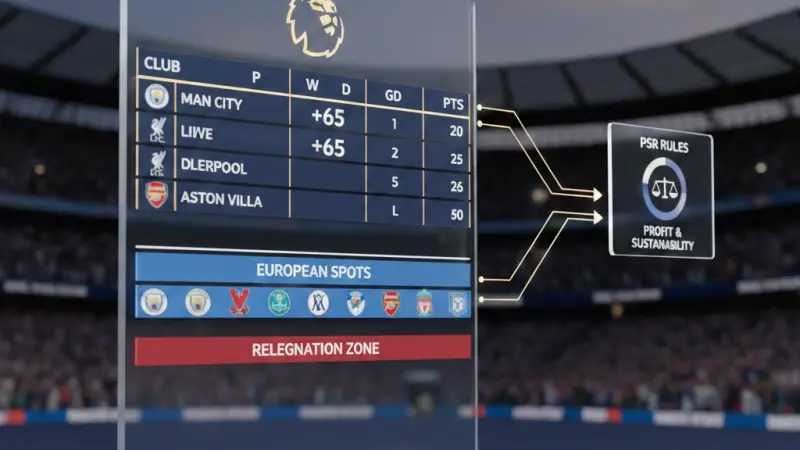
The Premier League table represents the definitive hierarchy of English football, serving as a live barometer for success, failure, and financial fortune in the world’s most-watched sporting league. At its simplest, the table is a ranking of twenty clubs based on points accumulated through wins and draws over a thirty-eight-game season. However, the significance of these standings extends far beyond mere numbers; they dictate billion-pound broadcasting distributions, determine entry into elite continental competitions like the Champions League, and decide the fate of clubs facing the devastating financial cliff of relegation to the Championship. Whether you are tracking the intense battle for the title at the summit or monitoring the desperate scrap for survival at the bottom, the table provides a constant narrative of drama and sporting excellence. For fans across the United Kingdom and globally, checking the latest standings is a weekly ritual that informs every conversation, debate, and prediction regarding the beautiful game’s top tier.

What is the Premier League table? The Premier League table is the official ranking system for the twenty clubs competing in England's top flight. Teams earn three points for a win, one for a draw, and zero for a loss. Rankings are determined by total points, followed by goal difference and then goals scored to separate teams on equal points.
Understanding the architecture of the standings
The structure of the top flight standings is designed to reward consistency and offensive prowess over a grueling ten-month period. Unlike knockout tournaments where a single bad day can end a campaign, the league format ensures that the eventual champions are truly the most deserving side. The points system is the primary metric, but the secondary tie-breakers are where the real tactical nuances often emerge. Goal difference acts as a vital "extra point," encouraging teams to remain attacking even when they have a comfortable lead, or to defend resolutely even in defeat to minimise damage. In the modern era, the margins are so slim that a single goal in August could theoretically determine a European spot in May. This mathematical framework creates a high-stakes environment where every tackle, save, and finish contributes to a club's final position and, subsequently, its historical legacy and financial health for the following year.
The significance of goal difference
Goal difference serves as the first port of call when points are level, acting as a sophisticated measure of a team’s efficiency at both ends of the pitch. A healthy positive figure usually indicates a balanced squad capable of dominant victories, whereas a negative figure for a mid-table side highlights defensive vulnerabilities that could prove costly. Over recent seasons, we have seen title races and relegation battles decided by this single metric, forcing managers to consider the long-term impact of their goal tallies throughout the winter months when fatigue sets in.
Separating teams on level terms
If points and goal difference are identical, total goals scored becomes the deciding factor. This specific rule rewards attacking ambition, ensuring that a team that scores more frequently is given the advantage over a more conservative side with a similar defensive record. It is a subtle but effective way to maintain the league's reputation for high-scoring entertainment.
Champions League and European qualification pathways
Securing a place in the top four has traditionally been the "holy grail" for ambitious Premier League clubs, as it guarantees entry into the lucrative UEFA Champions League. This competition brings immense prestige and a substantial influx of revenue that can fundamentally alter a club’s transfer budget and global standing. However, the landscape of European qualification is increasingly fluid due to changes in UEFA coefficients and the introduction of the Europa Conference League. The table now acts as a complex map for various routes into continental football, with the fifth, sixth, and sometimes seventh positions offering pathways into the Europa League or Conference League depending on the winners of domestic trophies like the FA Cup and League Cup. For many clubs, finishing in these spots represents a successful season, providing a platform to attract international talent and grow their brand across Europe, while also satisfying the expectations of a demanding domestic fanbase.
The race for the top four spots
The battle for the top four is often more intense than the title race itself, involving a "Big Six" or "Big Seven" group of clubs with massive infrastructures. Missing out on the Champions League can lead to a significant "cooling off" period where a club might struggle to retain its best players. The financial gap between Europe's top tier and the Europa League is substantial, making the fourth-place spot one of the most valuable positions in professional sport today.
Impact of domestic cup results
The final destination of European spots is often not confirmed until the domestic cup finals are played. If the winners of the FA Cup or League Cup have already qualified for Europe via their league position, the spots "cascade" down the table. This keeps teams as low as eighth place interested in the standings until the very final weeks of the campaign.
The brutal reality of the relegation zone
While the top of the table represents glory, the bottom three positions represent a sporting and financial catastrophe. Relegation to the Championship often results in a massive loss of revenue, forced player sales, and significant staff redundancies. The "relegation dogfight" is a unique feature of the English game, where teams in the bottom half of the table fight with a level of desperation that often produces unpredictable results against the league leaders. The psychological pressure of being in the "drop zone" during the spring months can be overbearing for players and supporters alike. Survival is often celebrated with as much fervour as a trophy win, as it ensures another year of multi-million-pound television rights and the opportunity to compete against the elite. The table at the bottom is a unforgiving tracker of a club’s ability to handle pressure, manage a squad under duress, and find enough resilience to escape the bottom three before the final whistle of the season.
The financial cliff of the Championship
Dropping out of the Premier League means moving from a world of global visibility to the much more difficult financial landscape of the second tier. Parachute payments are designed to soften the blow, but they rarely cover the full cost of a top-flight wage bill.
This fiscal reality makes every point in the bottom third of the table worth tens of millions of pounds, creating a high-pressure environment for owners and managers.
The psychological battle for survival
Teams in the bottom three often suffer from a "relegation mentality" that can be hard to shake. Breaking out of the zone early in the season is vital for morale. Fans often look for a "magic number" of points—traditionally forty—to feel safe from the threat of the drop, though this threshold varies annually based on the performance of the bottom-placed teams.
Mid table stability versus stagnation
Teams residing between eighth and fourteenth place are often described as being in "mid-table," a position that offers both security and frustration. For smaller clubs, a comfortable mid-table finish is a sign of a well-run organization and tactical competence, providing a foundation to build upon for future seasons. However, for larger clubs with bigger aspirations, it can be viewed as stagnation or a "wasted" season. The challenge for these teams is to find the motivation to keep pushing when both European qualification and relegation seem unlikely. This part of the table is frequently a experimental ground where managers might blood young talent or trial new tactical systems in preparation for the following year. Yet, the difference in prize money between finishing tenth and fourteenth can be several million pounds, ensuring there is always a commercial incentive to climb as high as possible before the season concludes.
The importance of merit payments
The Premier League distributes a portion of its central income based on final league position, known as merit payments. Each place higher in the table is worth a specific increment in GBP, which can be the difference between signing a top-tier target or settling for a secondary option. This ensures that even "dead rubber" matches at the end of the season have significant financial implications for the clubs involved.
Building for the next campaign
Mid-table clubs often use the final ten games to identify which areas of the squad need investment. A strong finish can provide momentum going into the summer transfer window, making the club a more attractive destination for potential signings who want to see a clear upward trajectory rather than a team that is merely content to survive.
Common mistakes in interpreting the table
One of the most frequent errors made by observers is overreacting to the table in the opening weeks of the season. Standings are often skewed by the difficulty of early fixtures; a team may appear to be in crisis simply because they have faced three of the top four sides in their first five matches. Conversely, a newly promoted side might sit near the top after an easy run, only to plummet as the schedule toughens. Another mistake is ignoring "games in hand." Due to cup postponements or television rescheduling, teams often have played fewer matches than their rivals. Calculating "potential points" is essential for a true reflection of the race. Additionally, ignoring the "form guide"—the record of the last five matches—can lead to a false sense of security. A team in twelfth who has won four in a row is often in a much stronger position than a team in sixth who has lost four on the bounce.
Beware the early season outliers
The table only truly begins to take its final shape after the busy Christmas and New Year period. Prior to that, small sample sizes can create misleading narratives. Analysts recommend waiting until at least ten games have been played before drawing any definitive conclusions about a team’s likely final destination or their tactical effectiveness under a new manager.
Calculating games in hand accurately
When comparing two teams with a different number of matches played, it is a common pitfall to assume the team with games in hand will win them. History shows that the pressure of playing "catch-up" can often lead to dropped points, making "points on the board" generally more valuable than "games in hand" in the business end of the season.
Step by step guide to tracking standings
To stay truly informed about the Premier League table, followers should adopt a systematic approach to monitoring updates. Firstly, always check the table immediately after the final whistle of a weekend’s fixtures, as the "live" standings change throughout the afternoon. Secondly, pay close attention to the "Expected Goals" (xG) metrics alongside the actual table; this can tell you if a team is over-performing or under-performing based on the quality of chances they create. Thirdly, use a reputable football app or the official league website to monitor disciplinary records and injury news, as these factors often precede a slide down the standings. Fourthly, keep a calendar of domestic and European cup dates to understand when games in hand might be played. Finally, integrate the form table into your analysis to see which teams are building momentum, as this is often a better predictor of future league position than the current total points.
Utilising live score applications
In the digital age, several high-quality applications provide real-time updates to the league table. These tools allow you to see a "virtual" table as goals go in across the country, providing an immediate sense of how a single goal can shift a team's fortunes.
Many of these apps also offer historical data, allowing you to compare a team's current progress against previous seasons.
Analysing the difficulty of upcoming fixtures
A vital step in tracking the table is looking ahead at the next five opponents for teams in key battles. The "Fixture Difficulty Rating" is a common tool used by fantasy football players and serious analysts alike to predict when a team might climb or fall in the standings, allowing for a more nuanced understanding of the long-term outlook.
The future evolution of league standings
The way we view and interact with the Premier League table is set to change significantly in the coming years. With the potential expansion of European competitions and the constant debate surrounding "Game 39" or international fixtures, the traditional thirty-eight-game format is under scrutiny. Furthermore, the integration of advanced data and "real-time" probability into the viewing experience means that future tables might include predictive models directly alongside current points. We may see "Projected Final Position" become as prominent as current standings during live broadcasts. Additionally, the tightening of Profit and Sustainability Rules (PSR) means that points deductions are becoming a more frequent feature of the table. This adds a legal and financial layer to the standings, where a team’s position can be altered not just by their performance on the grass, but by the bookkeeping in the boardroom, making the table a more complex reflection of a club's total health.
Points deductions and financial fair play
The modern table must now account for off-field issues that result in immediate sporting sanctions. As the league enforces stricter financial regulations, teams may find themselves moving down the table due to administrative breaches. This makes the "adjusted" table a vital tool for fans who need to understand the realistic chances of their team staying up or qualifying for Europe despite penalties.
The role of artificial intelligence in predictions
As AI technology matures, we can expect the Premier League table to be accompanied by sophisticated simulations that run thousands of scenarios for the remainder of the season. These models will provide fans with a percentage chance of various outcomes, such as winning the title or being relegated, adding a layer of scientific forecasting to the traditional excitement of the standings.
Strategic importance of home and away form
A club’s position in the table is often a tale of two different records: their performance at home and their resilience on the road. Historically, "fortress" stadiums have been the backbone of successful campaigns, where the support of the home crowd helps grind out results against superior opposition. However, the modern Premier League sees more teams adopting sophisticated counter-attacking styles that are highly effective away from home. When analysing the table, it is crucial to look at the "Home/Away" split. A team that is high in the table but relies solely on home wins may struggle in the latter half of the season if their remaining fixtures are predominantly away. Conversely, a team that can pick up points consistently on their travels is usually more robust and likely to maintain their position during the high-pressure run-in. Understanding this balance provides a deeper insight into a team’s tactical flexibility and mental strength.
Creating a fortress at home
For teams outside the elite, winning home matches against their direct rivals is the most sustainable way to climb the table. High-intensity pressing and utilizing the smaller pitch dimensions of some traditional English grounds can nullify the technical advantage of larger clubs. A strong home record provides a safety net that allows a team to take more risks in their overall tactical approach throughout the year.
The art of the away day performance
The most successful sides in Premier League history are those that can adapt their style to win in hostile environments. This often requires a more disciplined defensive shape and clinical finishing on the break.
Teams that consistently pick up "ugly" wins away from home are almost always the ones that find themselves at the business end of the table come May.
FAQ
How are teams separated if they are level on points in the table?
If two or more teams finish the season with the same number of points, their position is determined by goal difference (total goals scored minus total goals conceded). If they are still level, the total number of goals scored is used. In the rare event they remain tied for a title, relegation, or European spot, a play-off match at a neutral venue may be required.
What does the 'c' or 'q' next to a team name mean in the standings?
These notations are used towards the end of the season to indicate a team's confirmed status. A 'c' typically stands for 'Champions,' meaning the team has mathematically secured first place. A 'q' or 'Q' signifies that a team has mathematically qualified for a specific European competition, such as the Champions League, regardless of their remaining results in the campaign.
How many teams are relegated from the Premier League each season?
Exactly three teams are relegated from the Premier League to the Championship at the conclusion of each season. These are the clubs that occupy the eighteenth, nineteenth, and twentieth positions in the final table. They are replaced by the top two teams from the Championship and the winner of the Championship play-offs, ensuring the league always maintains a twenty-club membership.
Do games in hand always benefit the team that has them?
Not necessarily. While games in hand represent potential points, they also create fixture congestion, forcing a squad to play more matches in a shorter period. This can lead to increased fatigue and injury risk. Many managers prefer "points on the board" because the pressure of having to win those extra games to catch up can negatively impact a team’s performance and focus.
What is the 'European places' cut-off in the Premier League table?
Generally, the top four teams qualify for the Champions League. The fifth-placed team usually enters the Europa League. However, depending on who wins the FA Cup and League Cup, European spots can extend down to seventh or even eighth place. Recent changes to UEFA rules mean that a fifth Champions League spot can also be awarded based on a country's collective performance in Europe.

Disclaimer: The information provided in this article is for general informational and research purposes only. Company details, features, services, and market positions may change over time. Readers are advised to visit official company websites and conduct independent research before making any business decisions or purchasing services.
Most Searchable Keywords

Recent Blogs



Related Listings


Categories
- Accountants (295)
- Advertising Agencies (559)
- Architects (149)
- Automobiles (377)
- Beauty (300)
- Carpenters (146)
- Cleaning Services (386)
- Dentists (189)
- Driving (62)
- Electricians (215)
- Energy (8)
- Event Organiser (685)
- Finance (599)
- Guide (3365)
- Health (2207)
- Information technology (206)
- Legal Services (353)
- Logistics (6)
- Maintenance (65)
- Manufacturing (35)

Sponsored Listings in Locksmith Services


Related Blogs

Your UK Sponsor Licence 2026 Step by Step Gui...
Read this insightful article "Your UK Sponsor Licence 2026 Step by Step Guide" to expand your knowledge!

What Is the £12.71 National Living Wage Strat...
Read this insightful article "What Is the £12.71 National Living Wage Strategy for UK Employers" to expand your knowledge!

Where to Find the Best Summer Festivals in Br...
Read this insightful article "Where to Find the Best Summer Festivals in Bristol" to expand your knowledge!
Questions & Answers – Find What
You Need, Instantly!
How can I update my business listing?
Is it free to manage my business listing?
How long does it take for my updates to reflect?
Why is it important to keep my listing updated?
