
Royal Mail Stamp Prices: First & Second Class Costs
Royal Mail stamp prices have become something many households notice only when they reach the Post Office counter and discover that a simple letter now costs considerably more than it used to. For anyone sending birthday cards, official documents, invitations, bills or business correspondence, knowing the current rate can make a noticeable difference over the course of a year.
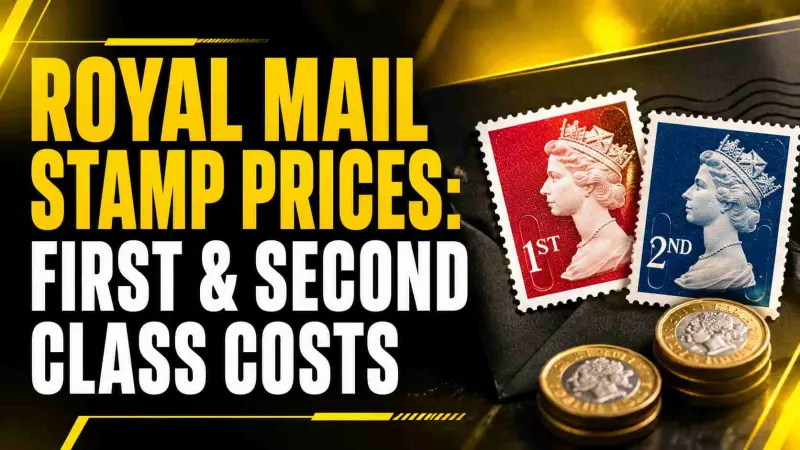
As of August 2026, a standard Royal Mail First Class letter up to 100g costs £1.80, while a Second Class letter up to 100g costs 91p. Both cover a standard letter measuring no more than 24cm × 16.5cm × 0.5cm. First Class has a delivery aim of the next working day, including Saturdays, while Second Class generally aims to arrive within two to three working days.
The difference is therefore not simply price. It is mainly about how quickly you need the item delivered and whether paying extra for speed makes sense.
There are also ways to keep postage under control. Choosing Second Class when timing allows, checking the size and weight of an item before buying postage, using online postage for eligible parcels, and making sure you use valid barcoded stamps can all prevent unnecessary spending.
This guide explains the current Royal Mail stamp prices, how First and Second Class compare, what happens when an item is larger or heavier, and the practical ways households and small businesses can spend less on postage.
Understanding Royal Mail Stamp Prices and Choosing the Cheapest Suitable Option
How much is a First Class stamp in 2026?
A standard First Class Royal Mail stamp costs £1.80 for a letter weighing up to 100g. The standard letter must be no larger than 24cm long, 16.5cm wide and 0.5cm thick. Royal Mail says First Class letters have a delivery aim of the next working day, including Saturdays.
For many people, First Class is the natural choice when something needs to arrive quickly. That could include a time-sensitive document, an important card, a form being returned close to a deadline, or business correspondence where waiting several additional days is inconvenient.
However, "delivery aim" does not mean a guaranteed delivery date. If a letter must arrive by a particular deadline, First Class should not automatically be treated as guaranteed next-day delivery.
How much is a Second Class stamp?
A standard Second Class stamp costs 91p for a letter weighing up to 100g. The delivery aim is two to three working days, including Saturdays.
The price difference between First and Second Class is therefore:
| Service | Standard letter up to 100g | Delivery aim |
|---|---|---|
| First Class | £1.80 | Next working day |
| Second Class | 91p | 2–3 working days |
That means Second Class saves 89p per standard letter compared with First Class.
For one occasional letter, the saving may seem small. For a household sending dozens of cards or a small business posting hundreds of letters, it adds up quickly.
For example, sending 50 standard letters by Second Class rather than First Class would cost £45.50 instead of £90. The difference is £44.50.
That is why choosing the appropriate service can be more effective than looking for a discount on the stamp itself.
Is First Class worth paying more for?
It depends on how quickly the recipient needs the letter.
First Class makes sense when:
- The letter is time-sensitive.
- You want the faster delivery aim.
- The extra 89p is worthwhile for the particular item.
- You are sending something where a delay could cause inconvenience.
Second Class is usually the better-value option when:
- The letter is not urgent.
- You are sending greeting cards well ahead of the event.
- You are posting routine correspondence.
- You send a large volume of letters.
- Saving money matters more than delivery speed.
The key point is that First Class is not automatically "better". It is simply the faster standard letter service.
What counts as a standard letter?
A standard Royal Mail letter has a maximum size of 24cm × 16.5cm × 0.5cm and can weigh up to 100g.
This covers many everyday items, including:
- Personal letters
- Greeting cards
- Postcards
- Small documents
- Standard envelopes
If your envelope is too thick, too large or too heavy, you may need to pay the Large Letter rate instead.
This is one of the easiest ways to accidentally overpay or underpay for postage.
A letter that feels like a normal envelope may become a Large Letter if it is too thick. A bulky greeting card, for example, can sometimes cross the size threshold even when it weighs very little.
What are the current Large Letter prices?
For items that fall into the Large Letter category, the price increases significantly.
For First Class, a Large Letter up to 100g currently costs £3.30 at the standard rate, while Royal Mail lists an online price of £3.20. For Second Class, a Large Letter up to 100g costs £1.55.
Second Class Large Letter prices increase further with weight:
| Second Class Large Letter | Current price |
| Up to 100g | £1.55 |
| 101–250g | £1.90 |
| 251–500g | £2.40 |
| 501–750g | £2.70 |
The maximum Large Letter dimensions are 35.3cm × 25cm × 2.5cm, with a maximum weight of 750g.
This illustrates why checking dimensions before posting matters. The difference between a standard letter and Large Letter can be much greater than the difference between First and Second Class.
What is the cheapest way to send an ordinary UK letter?
For a standard letter that is not urgent, Second Class at 91p is currently the cheapest of the two standard stamped services.
If you are sending a standard letter that qualifies for the ordinary letter rate, there is no need to buy First Class simply because you want to use Royal Mail.
A useful rule is:
Urgent = consider First Class.
Not urgent = Second Class is usually better value.
There are situations where another service makes more sense, particularly when you need tracking, proof of delivery or a guaranteed delivery service.
Can you use more than one stamp?
Yes. Royal Mail confirms that customers can combine multiple stamps to make up the required postage value, provided the total covers the postage required for the item.
This can be useful if you have older valid stamps, make-up-value stamps or a mixture of denominations.
For example, if the required postage is £1.80, you do not necessarily need one stamp showing exactly £1.80. You can use valid stamps whose combined value reaches the required amount.
The important point is that the stamps must be valid and the total must cover the required postage.
What happened to old non-barcoded Royal Mail stamps?
This is an important issue for anyone who has a stamp collection sitting in a drawer.
Regular Royal Mail definitive stamps without barcodes are no longer valid for postage. Royal Mail introduced barcodes as part of
its modernisation programme, and non-barcoded definitive stamps can be exchanged through its Stamp Swap Out scheme.
This mainly affects traditional everyday stamps featuring the late Queen's profile.
There is an important exception: certain special issue stamps and older non-barcoded Christmas stamps remain valid under Royal Mail's rules. They should not automatically be treated in the same way as ordinary non-barcoded definitive stamps.
If you find a book of old stamps, do not simply throw them away. Check whether they qualify for Stamp Swap Out.
Royal Mail says there is currently no end date for swapping eligible non-barcoded stamps.
How does the Stamp Swap Out scheme work?
Royal Mail's Stamp Swap Out process allows eligible non-barcoded stamps to be exchanged for barcoded equivalents.
The basic process is:
- Obtain the appropriate Stamp Swap Out form.
- Complete the form.
- Package the eligible stamps with the form.
- Send them to Royal Mail using the instructions provided.
- Royal Mail sends replacement barcoded stamps.
For up to £200 worth of non-barcoded stamps, Royal Mail provides a standard swap-out route. Larger quantities require the appropriate bulk form.
One useful detail is that the amount you originally paid for an eligible non-barcoded stamp does not determine the replacement. Royal Mail says non-barcoded NVI stamps are exchanged for the equivalent current barcoded NVI stamp.
Can you save money by buying stamps in bulk?
Buying a larger quantity does not normally reduce the face value of each ordinary First or Second Class stamp. A 50-stamp sheet costs the equivalent of 50 individual stamps.
Royal Mail's shop currently lists a 50-stamp First Class sheet at £90, consistent with the £1.80 current First Class rate.
The financial benefit of buying in bulk is therefore mainly convenience rather than a traditional volume discount.
There can be another advantage, though: if you send letters regularly, buying a supply means you already have postage available when needed. You avoid last-minute trips to purchase individual stamps.
That said, do not buy a huge quantity simply because you think stamp prices will definitely rise. Prices can change, and your postage requirements may change too.
Is it cheaper to buy Royal Mail postage online?
For ordinary stamped letters, the headline price can be the same online and at the counter. Royal Mail's current First and Second Class letter prices are £1.80 and 91p respectively.
The bigger savings appear with certain larger items and parcels.
Royal Mail explicitly states that buying parcel postage online can be cheaper than paying over the counter. For example, its current Second Class small parcel price is £4.25 at the standard rate but £3.95 online. First Class small parcels are £5.45 at the standard rate and £5.15 online.
For people who regularly sell items online, this difference can become meaningful.
What is Click & Drop?
Royal Mail's Click & Drop service allows customers to purchase postage online and create labels for their items.
For regular senders, online postage can make it easier to:
- Compare available services.
- Calculate postage based on size and weight.
- Print labels.
- Arrange collection where available.
- Keep postage records.
- Reduce counter transactions.
For occasional letter senders, buying a stamp may still be simpler. For a seller sending several parcels a week, online postage can be considerably more convenient.
How can small businesses reduce Royal Mail postage costs?
Small businesses often make the mistake of treating postage as a fixed cost. It is not. Packaging, dimensions, service selection and purchasing method can all affect the final amount.
Start by separating your mail into categories.
Routine letters
Use Second Class where delivery speed is not important.
Time-sensitive correspondence
Use First Class when its faster delivery aim provides a practical benefit.
Parcels
Check online prices before automatically paying at a Post Office counter.
Important documents
Consider whether Signed For or a tracked service is actually necessary.
The goal is not to choose the cheapest service every time. It is to choose the least expensive service that adequately meets the need.
Is Signed For worth the extra cost?
Royal Mail Signed For adds a signature on delivery and online delivery confirmation.
For Second Class, a standard letter currently starts at £2.91, compared with 91p for ordinary Second Class.
That is a substantial increase, so it should be used for a reason.
Signed For can make sense where you want evidence that delivery was completed. However, it should not automatically be used for every important letter.
If the contents are valuable or you require a guaranteed delivery time, Royal Mail recommends considering a more appropriate service, such as Special Delivery Guaranteed, rather than assuming Signed For provides the same protection.
What is the biggest mistake people make with postage?
The most common mistake is focusing on the stamp price while ignoring the item's size, weight and service requirements.
Someone may think, "This is only a letter," but if the envelope is too thick, it may need to be priced as a Large Letter.
Another common mistake is paying for First Class automatically.
If you send 100 routine letters, choosing First Class instead of Second Class would cost £89 more at current rates. If those letters do not need the faster delivery aim, that is money spent without a meaningful benefit.
A simple way to calculate your annual postage cost
You can estimate your annual spending with a basic formula:
Number of letters × price per letter = annual postage cost
Suppose a household sends 80 standard letters a year.
At £1.80 each, First Class would cost:
80 × £1.80 = £144
At 91p each, Second Class would cost:
80 × £0.91 = £72.80
The difference is £71.20 a year.
For a business sending 500 standard letters, the difference becomes much larger:
500 × £1.80 = £900
compared with:
500 × £0.91 = £455
That is a £445 difference.
The lesson is simple: the best postage saving is often a service-selection decision, not a discount code.
What should you check before putting a stamp on an envelope?
Before posting, take a few seconds to check:
- Weight – Is it within the relevant limit?
- Dimensions – Is it a standard Letter or Large Letter?
- Thickness – Could the envelope have crossed the 5mm standard-letter limit?
- Urgency – Does it really need First Class?
- Security – Do you need Signed For or tracking?
- Stamp validity – Is the stamp barcoded or otherwise still valid?
- Postage value – Does the total value cover the required rate?
This small checklist can prevent both underpayment and unnecessary spending.
What does the latest Royal Mail pricing change mean?
Royal Mail changed its personal-customer and marketplace-seller prices on 7 April 2026, covering domestic letters, Large Letters and parcels among other services. Royal Mail's current pricing pages now show the rates applicable after that change.
Royal Mail reviews and updates prices at key points during the year, so anyone publishing postage prices should check the current official price guide rather than relying on an old article or a price remembered from previous years.
This matters particularly for businesses that publish shipping rates on websites, invoices or marketplace listings.
What should online sellers do?
If you sell through platforms such as eBay or other marketplaces, postage can affect your margins surprisingly quickly.
A practical approach is to:
- Weigh the packaged item rather than estimating.
- Measure the finished package.
- Compare Second Class, Tracked and other appropriate services.
- Check Royal Mail's online rates before setting a shipping charge.
- Review postage costs whenever Royal Mail announces a price change.
- Avoid charging customers based on an outdated postage table.
Royal Mail says online prices are available through Click & Drop and other online channels, while its standard price guide covers stamped items and counter purchases.
Are Royal Mail stamp prices likely to change again?
Future price changes cannot be predicted with certainty.
Royal Mail says it updates prices at key points in the year and publishes announced changes through its pricing information.
For consumers, the sensible approach is not to speculate about exactly when the next increase will happen. Instead, check the current Royal Mail price page whenever you are calculating postage for a large mailing.
Businesses should be even more careful because a small per-item increase can materially affect shipping budgets.
The broader postal market is also changing as fewer people rely on traditional letters for everyday communication and more correspondence moves online. At the same time, physical documents, cards, invitations and business mail continue to create demand for postal services.
That combination means postage decisions are increasingly about choosing the right service for the job rather than simply asking, "How much is a stamp?"
The future of postage: what should consumers and businesses expect?
The postal system is becoming increasingly digital even when the item being delivered is physical.
Barcodes are already a major part of Royal Mail's stamp system. They support operational processing and allow Royal Mail to introduce additional services and security features.
Online postage is another part of the shift. Customers can increasingly calculate prices, buy labels and arrange collections without visiting a counter.
For consumers, this means that the cheapest option may increasingly depend on the entire postage process rather than the face value of a stamp.
For businesses, the change is more significant. Automated label creation, online postage accounts, tracking information
and digital records can make postage management easier to integrate into order fulfilment.
The future is therefore unlikely to mean the disappearance of stamps overnight. Instead, traditional stamps are becoming one part of a broader postal system that combines physical delivery with digital purchasing, barcodes and electronic information.
Any prediction beyond that should be treated as an industry outlook rather than a guaranteed outcome.
How to spend less without compromising delivery
The simplest strategy is to match the service to the job.
If a birthday card is being posted two weeks before the celebration, First Class may offer little practical advantage.
If an important document needs to reach someone quickly, saving 89p may not be worth the extra uncertainty.
If you are sending parcels every week, online postage deserves more attention because the online rates can be lower than counter prices for some services.
And if you discover a drawer full of old stamps, check whether they qualify for Royal Mail's Stamp Swap Out scheme rather than assuming they have no value.
The cheapest postage is not necessarily the lowest headline price. It is the lowest cost that still gives you the speed, size allowance, security and compensation appropriate for what you are sending.
Key Insights
- First Class currently costs £1.80 for a standard letter up to 100g.
- Second Class currently costs 91p for the same standard letter.
- Second Class can save 89p per letter when next-working-day delivery is unnecessary.
- Check dimensions as well as weight because oversized or thick envelopes can move into the Large Letter category.
- Some parcel services are cheaper when postage is purchased online.
- Ordinary non-barcoded definitive stamps are no longer valid, but eligible stamps can be exchanged through Stamp Swap Out.
- Signed For should be used when its additional delivery confirmation is genuinely useful, rather than automatically adding it to every letter.
- Businesses should regularly review Royal Mail's official price guides because prices can change during the year.
Frequently Asked Questions
How much is a First Class stamp in the UK in 2026?
A standard First Class stamp currently costs £1.80 for a letter weighing up to 100g and measuring no more than 24cm × 16.5cm × 0.5cm. Royal Mail gives First Class letters a delivery aim of the next working day, including Saturdays.
How much is a Second Class stamp in the UK in 2026?
A standard Second Class stamp currently costs 91p for a letter up to 100g within the standard letter size limits. Royal Mail gives Second Class a delivery aim of two to three working days, including Saturdays.
Is Second Class cheaper than First Class?
Yes. A standard Second Class letter costs 91p compared with £1.80 for First Class. That makes Second Class 89p cheaper per letter, although it has a slower delivery aim.
How much can I save by using Second Class?
You save 89p on every standard letter compared with First Class. For 100 letters, the saving is £89. For 500 letters, the saving reaches £445, assuming every item qualifies for the standard letter rate.
Does First Class guarantee next-day delivery?
No. First Class has a delivery aim of the next working day, including Saturdays. A delivery aim should not be interpreted as a guaranteed delivery deadline.
What size is a standard Royal Mail letter?
A standard letter can measure up to 24cm × 16.5cm × 0.5cm and weigh up to 100g. Items exceeding these limits may need to be sent as Large Letters or parcels.
How much is a Second Class Large Letter?
A Second Class Large Letter up to 100g currently costs £1.55. Prices increase with weight, reaching £2.70 for items weighing 501–750g.
Can I use several stamps on one letter?
Yes. Royal Mail allows multiple valid stamps to be combined to make up the required postage. The combined value must cover the postage needed for the item.
Are old Royal Mail stamps still valid?
Regular non-barcoded definitive stamps are no longer valid for postage. Eligible stamps can be exchanged for barcoded replacements through Royal Mail's Stamp Swap Out scheme. Some special issue and older Christmas stamps are treated differently.
Can old Queen's-head stamps be exchanged?
Eligible non-barcoded definitive stamps featuring the late Queen's profile can generally be submitted through Stamp Swap Out. Royal Mail says unused eligible definitive stamps can be replaced regardless of their age.
Is buying postage online cheaper than buying stamps?
For standard First and Second Class letters, the current prices are £1.80 and 91p. However, some parcel services are cheaper online. For example, Royal Mail lists Second Class small parcels at £4.25 at the standard rate and £3.95 online.
Is Signed For First or Second Class worth the extra money?
It depends on what you are sending. Signed For adds signature-on-delivery and online delivery confirmation. It costs more than ordinary postage, so it is most useful when those additional features provide a genuine benefit.
What is the cheapest Royal Mail service for a normal letter?
For a standard UK letter that does not need faster delivery, Second Class at 91p is currently the cheaper option. First Class costs £1.80 and provides a faster delivery aim.
Can I send a parcel using a First or Second Class stamp?
First and Second Class pricing also applies to larger Royal Mail items, but the required postage depends on the item's category, dimensions and weight. A standard letter stamp should not be assumed to cover a parcel.
How often does Royal Mail change its prices?
Royal Mail updates its prices at key points during the year. It publishes announced changes and current prices through its official pricing information, so customers and businesses should check the latest rates before relying on an old price.
Where can I check the latest Royal Mail postage prices?
The safest source is Royal Mail's current pricing information and its postage price guides. Royal Mail current postage prices
Final Thoughts
Royal Mail stamp prices are straightforward once you separate the three things that matter most: size, weight and urgency.
For a standard UK letter up to 100g, First Class currently costs £1.80 and Second Class costs 91p. If delivery speed is not important, choosing Second Class can make a substantial difference when you send letters regularly.
The bigger savings come from looking beyond the stamp itself. Check whether an envelope qualifies as a standard letter, avoid paying for First Class when you do not need it, compare online parcel prices, and make sure old stamps are still valid.
For businesses, these small decisions deserve more attention because postage costs multiply across hundreds or thousands of items. For households, the same principle applies
on a smaller scale: you do not need to pay for a faster service unless the extra speed actually benefits you.
Royal Mail prices can change, so treat any quoted rate as time-sensitive. Before a large mailing, the best final check is always Royal Mail's current price guide rather than an old article, an outdated postage chart or a price you remember from a previous year.
Disclaimer: The information provided in this article is for general informational and research purposes only. Company details, features, services, and market positions may change over time. Readers are advised to visit official company websites and conduct independent research before making any business decisions or purchasing services.
Most Searchable Keywords
Recent Blogs

Related Listings


Categories
- Accountants (295)
- Advertising Agencies (559)
- Architects (149)
- Automobiles (377)
- Beauty (300)
- Carpenters (146)
- Cleaning Services (387)
- Dentists (189)
- Driving (62)
- Education (1)
- Electricians (215)
- Energy (8)
- Event Organiser (687)
- Finance (602)
- Guide (3422)
- Health (2207)
- Information technology (206)
- Legal Services (361)
- Logistics (6)
- Maintenance (65)
Sponsored Listings in Plumbers
Related Blogs
Water Meter or Fixed Bill: Which Is Cheaper
Read this insightful article "Water Meter or Fixed Bill: Which Is Cheaper" to expand your knowledge!
ECO4 Free Insulation: What’s Still Available...
Read this insightful article "ECO4 Free Insulation: What’s Still Available in This Year" to expand your knowledge!

What It Costs to Run an Electric Fan Air Frye...
Read this insightful article "What It Costs to Run an Electric Fan Air Fryer or Tumble Dryer" to expand your knowledge!
Questions & Answers – Find What
You Need, Instantly!
How can I update my business listing?
Is it free to manage my business listing?
How long does it take for my updates to reflect?
Why is it important to keep my listing updated?
