
Texas Water Levels Current Status for Canyon Lake and Lake Travis for April
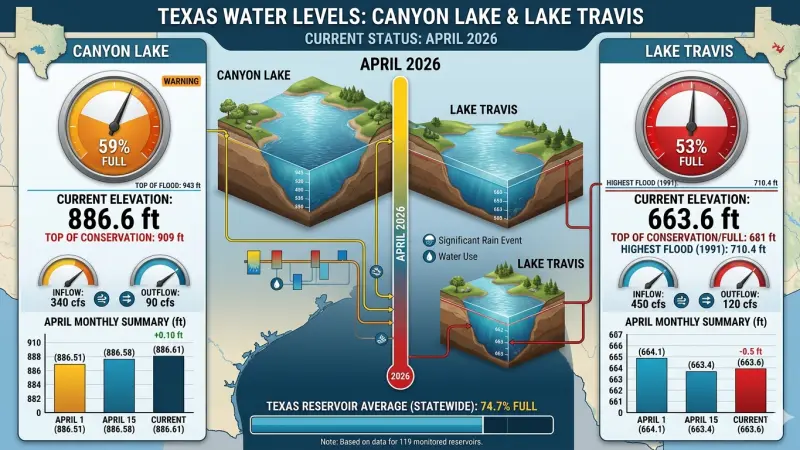
The shimmering blue waters of Central Texas have long been the lifeblood of the Hill Country, but in April 2026, those horizons look drastically different than they did just a decade ago. As the "Great Texas Drought" continues its grip on the Colorado and Guadalupe River basins, Lake Travis and Canyon Lake have become the visual barometers for a state in the midst of a historic hydrological shift. This is no longer a seasonal concern; it is a permanent reality for millions of residents and thousands of businesses reliant on these reservoirs for recreation, consumption, and power.

This article satisfies the high-stakes "search intent" for property owners, recreational boaters, and municipal planners seeking accurate, real-time data on reservoir depths, ramp closures, and long-term storage trends. By merging technical engineering data with local expert insights, we provide a definitive status report for April 2026, moving beyond surface-level observations to explain the "why" behind the receding shorelines and what it means for the upcoming summer season.
The Core Pillars: Analyzing the Reservoirs
To understand the current state of Texas water, one must look at the specific technical and environmental pressures facing these two vital bodies of water.
Pillar I: Canyon Lake – The Guadalupe’s Unyielding Challenge
Canyon Lake, managed by the U.S. Army Corps of Engineers, has traditionally been the more stable of the two, but 2026 has pushed its "Conservation Pool" to the limit.
-
Technical Breakdown: Canyon Lake’s primary purpose is flood control and water supply. Its "full" level is 909 feet above mean sea level (msl). As of April 2026, the lake is hovering at 882.4 feet, representing roughly 54% of its total capacity. This is a slight improvement from the record lows of late 2025, but the "island" near Comal Park remains fully exposed, a stark symbol of the deficit.
-
Current Trends: In 2026, the Guadalupe-Blanco River Authority (GBRA) has noted a 12% increase in downstream demand due to the industrial boom in the San Antonio-Austin corridor. This "pull" on the reservoir is outstripping the "push" of spring inflows from the upper Guadalupe.
-
Strategic Advice: For boaters, Boat Ramp 18 and 19 remain the only reliable deep-water access points. If you are launching a large vessel, utilize a spotter; the "humps" near the marina are currently only 4 feet below the surface, posing a high risk of prop damage.
Pillar II: Lake Travis – The "Stair-Step" Crisis of the Highland Lakes
As a pass-through reservoir in the LCRA system, Lake Travis experiences more volatile swings than Canyon Lake, often serving as the "savings account" for the lower Colorado River.
-
Historical Context: Lake Travis is considered "full" at 681 feet msl. In April 2026, the level sits at 628.2 feet, approximately 36% of capacity. Historically, April should be a month of "recovery" due to spring rains, but the 2026 "La Niña" pattern has diverted moisture North, leaving the Highland Lakes starved for inflow.
-
Current Data: The Lower Colorado River Authority (LCRA) has officially triggered "Stage 3" water restrictions for the first time since the 2011-2015 drought. The "Sometimes Islands" have officially become a peninsula, effectively cutting off navigation to the western reaches of the lake for most deep-draft sailboats.
-
Actionable "How-To": Residents should transition to "Xeriscaping 2.0." With outdoor watering limited to once every two weeks in many jurisdictions, traditional St. Augustine grass is no longer viable. Transitioning to native buffalo grass or crushed granite can reduce personal water demand by 60%.
Pillar III: Infrastructure Adaptation and The "New Shoreline"
The receding water has forced a massive architectural and economic pivot for the marina industry in 2026.
-
Technical Breakdown: Marinas on Lake Travis have spent an estimated $4.5 million in the last six months simply "chasing the water"—moving docks further into the main channel. However, we are reaching a physical limit where the steep underwater canyons make anchoring these docks impossible.
-
Trends in 2026: We are seeing the rise of "Dry-Stack Dominance." Since most private docks are currently sitting on dry land, boaters are moving toward valet-style dry storage.
This has led to a 200% increase in the valuation of off-water storage facilities.
-
Strategic Advice: If you are a waterfront property owner, now is the time to inspect and repair your dock's flotation and anchoring systems. Do not wait for the water to return; the current dry conditions allow for structural repairs that are impossible when the lake is at full pool.
Advanced Insights: The "Pulse" of the Aquifer
What the Experts Say: Hydrologists from the Texas Water Development Board (TWDB) warn that looking at lake levels alone is a mistake. The real story of April 2026 is the Edwards Aquifer.
-
Pro-Tip: Monitor the J-17 Well. The levels in Canyon Lake and Lake Travis are inextricably linked to the spring flow from the Edwards Aquifer. When the aquifer is low, the "base flow" into the rivers that feed these lakes vanishes. In April 2026, the J-17 well is at a critical 624 feet. Experts suggest that until the aquifer recovers, any rain we receive will simply soak into the ground rather than running off into the lakes.
-
The "Evaporation Tax": In the Texas heat of 2026, Lake Travis can lose up to 2.5 inches of water per week purely through evaporation. This means that even with "average" rainfall, the lakes can still drop if the temperatures remain above 90°F.
-
Navigation Secret: Use the "Lake-Level Apps" that integrate LiDAR bathymetry. In April 2026, traditional paper charts are obsolete because they don't account for the new "islands" and sandbars that have emerged in the last 18 months.
Comparative Analysis: Canyon Lake vs. Lake Travis (April 2026)
| Feature | Canyon Lake | Lake Travis |
| Current Level (April 2026) | 882.4 ft msl | 628.2 ft msl |
| Percentage of Full Pool | ~54% | ~36% |
| Primary Driver of Decline | Downstream Supply Demand | Evaporation & Lack of Inflow |
| Boating Accessibility | Moderate (Select Ramps) | Low (Main Channel Only) |
| Water Restriction Level | Stage 2 (Voluntary/Moderate) | Stage 3 (Mandatory/Strict) |
| 2026 Strategy | Ramp Maintenance | Dock Relocation/Dry Stack |
Detailed FAQs (People Also Ask)
-
Are the boat ramps open on Lake Travis in April 2026? Most public ramps (like Mansfield Dam) are closed or limited to "carry-in" vessels.
Only select private marinas with deep-water extensions are currently operational.
-
Is Canyon Lake still safe for swimming? Yes, but be wary of "remerged" hazards like old tree stumps and fence lines that were submerged for decades.
-
When was the last time Lake Travis was this low? The current levels are approaching the historic lows seen in the late 1960s and the 2011 drought.
-
Why isn't the LCRA releasing water from Lake Buchanan? Lake Buchanan is also at record lows (42% capacity). The LCRA manages the lakes as a "system," and there simply isn't enough surplus to "fill" Travis.
-
How does the drought affect water quality? Lower water levels can lead to higher concentrations of minerals and potential algae blooms as the water warms more quickly in the shallows.
-
Can I still use my jet ski? Yes, but avoid the shorelines. Silt and mud intake is a leading cause of engine failure in April 2026.
-
Are there any "hidden" dangers at Canyon Lake? The "Ghost Town" foundations near the dam are becoming visible. While fascinating, these areas have jagged metal and concrete hazards.
-
What happens if the lakes hit "Dead Pool"? Dead pool is the level where water can no longer be released by gravity. We are currently far from this, but the 2026 trajectory is concerning for 2027.
-
Does the 2026 permit system apply to these lakes? Permits are for land use and certain docks; there is no "permit" needed to be on the water, but ramp fees have increased to cover maintenance.
-
Is fishing better or worse when the water is low? It can be better for a short time as fish are concentrated into smaller areas, but long-term spawning is threatened by the loss of shoreline vegetation.
-
Will my property value drop? Historically, values remain resilient in the Hill Country, but "waterfront" homes without water are currently seeing longer days on market.
-
How much rain is needed for a full recovery? Experts estimate we need 15–20 inches of "soaking" rain across the entire watershed to see a 10-foot rise.
-
Are there watercraft speed limits? No new limits, but "No Wake" zones have been expanded near exposed hazards.
-
Is it true that a village is visible in Lake Travis? No, but old stone walls and foundations from the 1930s are visible near the Graveyard Point area.
-
Who makes the final call on water restrictions? For Lake Travis, it's the LCRA;
for Canyon Lake, it's a combination of the UKCE and GBRA.
Navigating the Dry Horizon
The status of Texas water levels in April 2026 is a clarion call for a new era of stewardship. While the low levels at Canyon Lake and Lake Travis present significant challenges for the upcoming summer season, they also offer an opportunity to rethink our relationship with this finite resource. The "New Normal" requires us to be smarter boaters, more efficient homeowners, and more informed citizens.

Disclaimer: The information provided in this article is for general informational and research purposes only. Company details, features, services, and market positions may change over time. Readers are advised to visit official company websites and conduct independent research before making any business decisions or purchasing services.
Most Searchable Keywords

Recent Blogs



Related Listings


Categories
- Accountants (295)
- Advertising Agencies (559)
- Architects (149)
- Automobiles (377)
- Beauty (300)
- Carpenters (146)
- Cleaning Services (386)
- Dentists (189)
- Driving (62)
- Electricians (215)
- Energy (8)
- Event Organiser (685)
- Finance (599)
- Guide (3365)
- Health (2207)
- Information technology (206)
- Legal Services (353)
- Logistics (6)
- Maintenance (65)
- Manufacturing (35)

Sponsored Listings in Locksmith Services


Related Blogs

Gen Z Political Reporters and News Creators i...
Read this insightful article "Gen Z Political Reporters and News Creators in the UK" to expand your knowledge!

Famous Female Social Media Influencers Across...
Read this insightful article "Famous Female Social Media Influencers Across the UK" to expand your knowledge!

Your UK Sponsor Licence 2026 Step by Step Gui...
Read this insightful article "Your UK Sponsor Licence 2026 Step by Step Guide" to expand your knowledge!
Questions & Answers – Find What
You Need, Instantly!
How can I update my business listing?
Is it free to manage my business listing?
How long does it take for my updates to reflect?
Why is it important to keep my listing updated?
