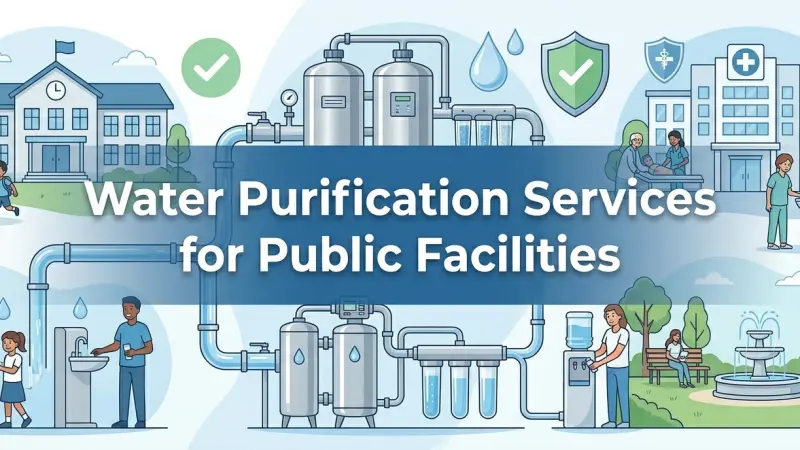
In a bustling metropolitan environment or a quiet rural community, have you ever considered the invisible infrastructure required to ensure that the water served in schools, hospitals, and municipal buildings is safe for thousands of daily users? Public facilities carry a unique responsibility to provide high-quality water that meets rigorous health and safety standards while managing the heavy demands of constant consumption. The maintenance and purification of these large-scale systems require specialized services that go far beyond standard domestic plumbing, involving advanced engineering, chemical analysis, and strict regulatory adherence.
The Scale and Complexity of Public Water Systems
Public facilities, such as government offices, leisure centres, and educational institutions, operate on a scale that creates distinct challenges for water purity. Unlike a single-family home, these buildings often feature complex networks of storage tanks, booster pumps, and extensive pipework that can span multiple floors and wings. This complexity increases the risk of water stagnation, which is a primary driver for the growth of harmful bacteria and the accumulation of sediment.
Purification services for these environments must account for the high volume of flow required during peak hours. A primary school, for instance, requires a surge in water availability during break times, whereas a hospital requires a consistent, 24-hour supply of highly purified water for medical procedures and patient care. The design of the purification infrastructure must therefore be robust enough to handle these fluctuations without compromising the chemical or biological integrity of the output.
Regulatory Framework and Compliance in the UK
In the United Kingdom, the management of water in public spaces is governed by a strict set of regulations designed to protect public health. This includes the Water Supply (Water Quality) Regulations and the Health and Safety at Work Act. For facility managers, compliance is not optional; it is a legal mandate that requires regular documentation and proof of maintenance.
Legionella Risk Management
One of the most critical aspects of public water services is the prevention of Legionnaires' disease. Large plumbing systems with dead-legs or infrequently used outlets are prone to the growth of Legionella bacteria. Specialized purification services involve regular temperature monitoring, tank disinfection, and the installation of secondary disinfection systems such as chlorine dioxide generators or copper-silver ionisation. These measures ensure that the water remains biostatically stable throughout the entire distribution network.
Lead and Heavy Metal Monitoring
Many public buildings in the UK, particularly older schools and municipal halls, may still contain legacy lead piping. While the water supplied by the utility company may be lead-free, it can pick up contaminants as it travels through the building's internal plumbing.
Professional services include regular sampling at the point of use to ensure that heavy metal concentrations remain well below the legal limits. Where issues are identified, point-of-entry filtration or pipe replacement strategies are implemented to safeguard users.
Key Technologies in Large-Scale Purification
To meet the diverse needs of public facilities, a variety of advanced technologies are employed. These systems are often automated and integrated into the building's central management system to allow for real-time monitoring of water quality parameters.
Industrial Ultraviolet Disinfection
UV-C disinfection is a preferred method for public facilities because it provides immediate protection against pathogens without altering the taste or chemical composition of the water. High-intensity UV lamps are installed at the point where water enters the building or after storage tanks. This acts as a final barrier against bacteria and viruses, providing an extra layer of security beyond the residual chlorine provided by the water utility.
Commercial Water Softening and Scale Inhibition
Scale buildup is a major concern for public facilities, especially those with large industrial kitchens or laundry facilities. Limescale can reduce the efficiency of water heaters and lead to frequent equipment failure. Large-capacity ion-exchange softeners or physical scale inhibitors are essential components of a public water service strategy. By managing mineral content, these facilities can reduce their energy consumption and maintenance costs significantly.
The Role of Storage and Distribution Maintenance
Most public buildings utilize large cold-water storage tanks to ensure supply continuity. However, these tanks can become breeding grounds for contaminants if not maintained correctly. Professional services include annual tank inspections, cleaning, and chlorination. This process involves draining the tank, removing any accumulated silt, and treating the surfaces with a concentrated disinfectant to ensure that the stored water remains fresh and safe.
Furthermore, the distribution network itself must be balanced. In a large hospital, for example, the "hot water return" system must be carefully managed to ensure that hot water reaches all outlets at a temperature high enough to kill bacteria but safe enough to prevent scalding.
The integration of thermostatic mixing valves and automated flushing systems is a key part of the technical service provided to these facilities.
Real-World Context and Public Benefit
The provision of reliable water purification is a fundamental pillar of public health infrastructure in the United Kingdom, ensuring that essential services such as healthcare and education operate in a safe environment. By implementing high-level purification strategies, local authorities and private facility managers protect vulnerable populations from waterborne illnesses and ensure the longevity of multi-million pound building assets. This professional oversight is a vital contribution to the national standard of living, supported by a network of specialized technicians who maintain the invisible systems upon which modern society depends.
Sustainability and Water Efficiency
In addition to purity, modern services for public facilities focus heavily on sustainability. With the UK's increasing focus on "Net Zero" targets, water purification systems are being designed to be more water-efficient. This includes the installation of high-recovery reverse osmosis systems and the use of greywater harvesting for non-potable uses like toilet flushing. By reducing the overall demand on the mains supply, these facilities can lower their environmental footprint while maintaining the highest standards of hygiene.
Selecting a Professional Service Provider
Given the legal and health implications, selecting a provider for water purification services is a critical decision for any public facility. Providers must demonstrate a deep understanding of UK water regulations and possess the technical capability to manage complex industrial-grade equipment. Verification of credentials, such as membership in the Legionella Control Association or WRAS approval for all components, is a standard part of the procurement process.
The Digital Evolution of Facility Management
The landscape of environmental services in the UK is shifting toward a model where technical excellence must be matched by high levels of accessibility and professional transparency. For the engineering firms and hygiene specialists who ensure the safety of our public spaces, the ability to be found by facility managers and procurement officers is a cornerstone of operational success. Many leading providers find that being listed on an online business listing uk free of charge allows them to showcase their compliance certificates and specialized service offerings to a national audience.
By utilizing an online business listing uk free platform, these experts can bridge the gap between their complex engineering solutions and the municipal leaders who require them. Maintaining an active profile on a Local Page UK ensures that when a school or hospital requires an urgent water safety audit, they can easily locate a verified provider through a business listing uk search. Ultimately, the health of our public infrastructure is bolstered by the free online listing uk of these essential services, making business listing online uk free to access for those responsible for our collective well-being.
Frequently Asked Questions
How often should water tanks in public buildings be cleaned?
According to ACoP L8 guidelines, water tanks should be inspected annually. If sediment or contamination is found during the inspection, a full clean and disinfection must be carried out immediately.
What is secondary disinfection in a public facility?
Secondary disinfection refers to an additional treatment stage, such as UV light or chlorine dioxide dosing, installed within the building to ensure the water remains sterile after it has left the utility's mains supply.
Are schools required to test for lead in their water?
While there is no universal law requiring annual testing, schools have a duty of care to ensure water safety. If the building was constructed before 1970, testing for lead is highly recommended as part of a standard risk assessment.
Can a public facility use harvested rainwater for drinking?
Generally, no. Harvested rainwater is typically used for non-potable applications like irrigation or toilet flushing. To make it potable would require an extremely high and costly level of purification and constant monitoring.
What is a water safety plan?
A Water Safety Plan (WSP) is a comprehensive document that identifies potential risks in a building's water system and outlines
the specific steps taken to monitor and mitigate those risks, ensuring a safe supply at all times.
Why is water temperature so important in public buildings?
Temperature control is the primary method for managing Legionella. Cold water must be kept below 20°C, and hot water should be stored at 60°C and distributed so that it reaches outlets at no less than 50°C.