
Delta Goodrem Shines in Eurovision 2026: Australia Advances to Grand Final After Stunning 'Eclipse' Performance
 Previous


Delta Goodrem has done what no Australian act has managed in three years — powered her way into the Eurovision Song Contest grand final. The Australian pop icon delivered a breathtaking performance of her epic ballad "Eclipse" during Friday morning's second semi-final, securing a spot in the final courtesy of the public vote. With the win, Goodrem not only silenced doubters but also reignited hopes that Australia may finally claim its first Eurovision crown.
A Career-Defining Moment for Delta Goodrem
For Goodrem, this is more than just another live television appearance. It is a moment that places her among the greats of Australian music on one of the world's biggest stages. Known for her powerhouse vocals, emotional songwriting, and magnetic stage presence, Goodrem has spent decades captivating audiences. But Eurovision presents a unique challenge — one that demands perfect vocal control, theatrical flair, and the ability to connect with millions of viewers across the globe in under three minutes.
Her performance of "Eclipse" delivered on every front. From the first haunting piano notes to the soaring final chorus, Goodrem commanded the stage at Vienna's Wiener Stadthalle with confidence and precision. The song, which builds from a delicate intro into a dramatic, arena-filling crescendo, was tailor-made for Eurovision's grand scale. The performance felt like a statement: Australia is not just here to participate — Australia is here to win.
How Australia Reached the Grand Final
Australia's path to the final was sealed by the public vote, a significant achievement in a competition where jury scores and viewer support can often diverge. Goodrem's performance earned Australia a place among the second-round qualifiers, joining a powerhouse lineup of nations including Ukraine, Bulgaria, Romania, Norway, Cyprus, Malta, Albania, Denmark, and Czechia.
They will now compete against the first-round winners, a group that includes Finland, Sweden, Greece, Moldova, Israel, Belgium, Serbia, Lithuania, Croatia, and Poland. With such a strong field, the grand final promises to be one of the most competitive in recent Eurovision history. But early indicators suggest Australia is already being seen as a serious threat.
Fan and Bookmaker Reactions: Australia Among the Favorites
Following Friday's broadcast, Eurovision fans flooded social media with praise for Goodrem's performance. The reaction was immediate, emphatic, and nearly unanimous.
- One fan wrote: "Delta Goodrem really just came out here and said Eurovision winner? That would be me. A vocal masterclass. Her stage presence is UNMATCHED!! Australia, 12 points!!!!"
- Another commented: "No doubt who gave the best performance in the two Semi Finals of the ESC - tonight Delta Goodrem knocked it out of the ball park for Australia. Repeat that on Saturday night & she has a great chance of first Aussie win."
- A third added: "Delta just SMASHED the stage of #eurovision. That's what an artist means."
The enthusiasm from fans has been reflected in the betting markets. Sportsbet currently ranks Australia as the second favorite to win the entire competition, trailing only Finland. That positioning is a clear indicator that Goodrem's performance has resonated beyond the Eurovision faithful and into the broader mainstream — something that could prove decisive in a contest defined by momentum and visibility.
The Visually Ambitious Staging of "Eclipse"
Beyond the vocals, Goodrem's staging has been widely described as one of the most visually ambitious Eurovision performances of the year. Insiders have praised the production for transforming the Wiener Stadthalle into a shimmering cosmic landscape, complete with dramatic beams of light, cascading shadows, and swirling smoke. The visual concept draws directly from the solar eclipse imagery embedded in the song's title and lyrics, creating a sensory experience that feels both intimate and epic.
The staging was designed to mirror the shifting brilliance of an eclipse — the way light fades, returns, and eventually overwhelms. It is a bold, artistic choice that sets Goodrem apart from the traditional Eurovision pageantry. By blending cinematic visuals with raw musicality, Australia has delivered a performance that feels less like a typical contest entry and more like a closing ceremony spectacle.
The Piano Miming Controversy Explained
Ahead of the grand final, speculation has emerged that Goodrem may have been forced to mime one crucial part of her performance. The singer, who is an accomplished pianist and regularly performs live on piano, is seated at an instrument during "Eclipse." However, Eurovision's strict rules — in place since 1999 — prohibit live instruments on stage. All instruments must be pre-recorded and played through backing tracks to ensure the massive live broadcast runs smoothly.
This means the piano Goodrem plays during her performance may well be a prop rather than a functioning instrument. While fans have noted the irony that such a talented musician is restricted from playing live, the rule is applied equally to all performers in an effort to maintain technical consistency across the show.
Interestingly, one exception has reportedly been made this year: Linda Lampenius has been granted permission to play violin live for Finland. It remains unclear whether Goodrem received a similar exemption for the piano. Either way, the controversy has not dulled the excitement surrounding Australia's chances.
Australia's Eurovision Legacy and What's at Stake
Australia's relationship with Eurovision has always been a fascinating one. As a non-European nation, Australia was initially invited as a one-off guest for the 60th anniversary in 2015, represented by Guy Sebastian. The response was so enthusiastic that Australia became a permanent participant, delivering a series of memorable entries ever since.
Dami Im came closest to victory in 2016 with the powerful "Sound of Silence," finishing runner-up to Ukraine. Other notable Australian acts include Jessica Mauboy, Kate Miller-Heidke, Isaiah Firebrace, and Sheldon Riley. Each brought a distinct style to the competition, but none has yet brought the trophy home. Goodrem now has a chance to change that story forever.
With her proven vocal ability, a song built for the Eurovision stage, and a visual presentation that has captured international attention, the pieces appear to be in place for a historic result. The grand final, airing Sunday, May 17th on SBS and SBS On Demand, will be the ultimate test.
This is more than just another song contest performance — it is a milestone for Australian music on the global stage. If Goodrem can repeat Friday's magic, she may finally deliver the answer to the question fans have been asking for years: Can Australia win Eurovision? Saturday night will tell.
Disclaimer - All celebrity-related content, information, and images on this website are based on publicly available online sources and AI-generated insights/data. Information such as biography, age, career, personal details, and images may change without notice over time. While we strive for accuracy, we do not guarantee the accuracy, completeness, reliability, or timeliness of any information or imagery displayed on this website. This content is provided for general informational purposes only.
Top Trending News of Music Events
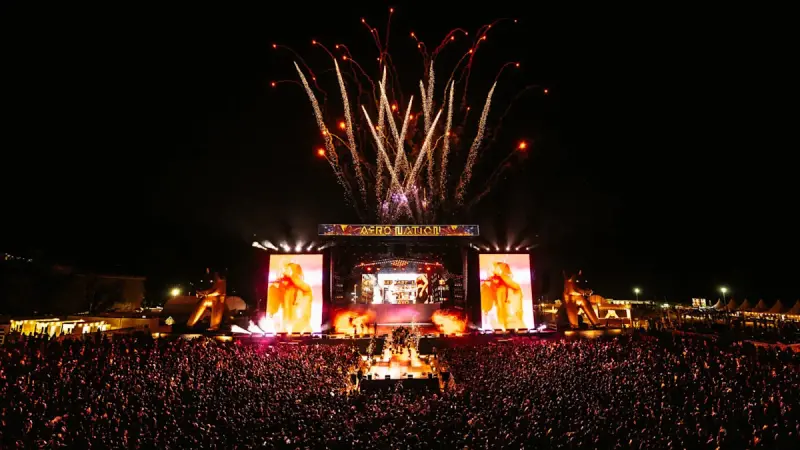 👁️ 217 views
🔥 Afro Nation Portugal 2026: The Essential First-Timer’s Guide to the World’s Biggest Afrobeats Festival
Get the ultimate first-timer's guide to Afro Nation Portugal 2026 – the world's largest Afrobeats festival. Dates, tickets, travel tips, and what to expect in Portimão this July.
 👁️ 186 views
🔥 Golden Disc Awards 2026: Rookie Revolution as CORTIS, ALLDAY PROJECT, and Hearts2Hearts Redefine K-Pop's New Wave
Golden Disc Awards 2026 saw an unprecedented rookie sweep as CORTIS, ALLDAY PROJECT, Hearts2Hearts, izna, and KiiiKiii dominated major categories. Read our in-depth analysis of K-pop's new generation takeover and what it means for the industry.









Details
Send Us an Enquiry
We'll get back to you as soon as possible.
Thank You!
Your enquiry has been submitted. We'll be in touch shortly.