
Eurovision 2026 Grand Final Proceeds Amid Historic Boycotts, On-Stage Protests, and a Political Firestorm
 Previous

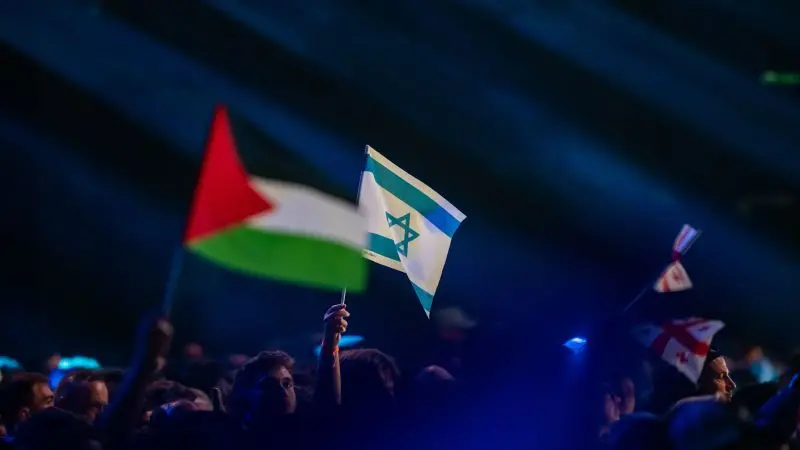
The Eurovision Song Contest has long traded on glitter cannons, key changes, and gloriously absurd performances. But this year, the world’s biggest live music event has swapped pure camp for a geopolitical crisis unlike anything in its 70-year history. As Vienna prepares to host Saturday’s grand final, the contest is battling organized boycotts, angry audiences, and intense scrutiny over Israel’s participation—leaving fans and organizers asking whether Eurovision can survive its own politics.
Five countries—Ireland, Spain, Slovenia, the Netherlands, and Iceland—have formally withdrawn from this year’s event over Israel’s continued presence. It is the largest boycott in the contest’s history, and it has transformed the normally joyful, high-camp extravaganza into a political battleground. With only 35 countries competing in Vienna, the lowest number since 2004, and ticket availability unusually high, the atmosphere inside the arena is noticeably more subdued than in previous years.
A Contest Under Siege: Why Five Countries Walked Away
Tensions have been building since December, when the European Broadcasting Union (EBU), which organizes Eurovision, met to discuss Israel’s participation amid the war in Gaza. No formal vote was held, but the EBU introduced what it called “targeted changes” to “reinforce trust, transparency and the neutrality of the event.” Within weeks, Ireland, Spain, the Netherlands, and Slovenia announced boycotts, with Iceland following a week later. Israeli officials expressed outrage, with the foreign minister saying he was “ashamed” of the boycotting nations.
The boycotts stem from more than just political disagreement. A New York Times investigation published Monday described an alleged “well-organized campaign” by Prime Minister Benjamin Netanyahu’s government to use Eurovision as a soft-power tool, including promoting mass voting. The Times reported that under the contest’s previous rules, one person could vote up to 20 times, meaning a few hundred determined voters could swing the public vote. The EBU has never commented on the allegations directly, but it has since reduced the maximum votes per person to 10. Organizers also told the Israeli delegation, fronted by singer-songwriter Noam Bettan, to remove videos urging fans to “vote 10 times for Israel.”
- Ireland — RTÉ pulled out of broadcasting the contest and instead aired an episode of Father Ted featuring a Eurovision parody.
- Spain — RTVE joined the boycott, citing Israel’s participation and the wider humanitarian crisis.
- Slovenia — RTV replaced Eurovision programming with films and documentaries under the banner “Voices of Palestine.”
- The Netherlands — AVROTROS withdrew amid escalating pressure from artists and audiences.
- Iceland — RÚV joined the boycott a week after the initial four, deepening the crisis.
Inside the Arena: Jeers, Shouts, and Security Removals
Politics has already reached the stage. During Tuesday’s semifinal, as Noam Bettan performed his song “Michelle,” audience members could be heard shouting “Stop, stop the genocide.” The EBU later confirmed that one person “close to a microphone, loudly expressed their views as the Israeli artist began his performance” and was removed by security. Three other people were also ejected for “disruptive behavior.” Bettan acknowledged the protests in a BBC interview, saying he felt “a little bit of shock” when he heard the boos and chants mid-performance.
The disruption is a far cry from the pyrotechnic-filled, flag-waving celebration Eurovision fans have come to expect. Even the arena’s visual landscape has shifted: Israeli and Palestinian flags were both visible during the semifinals, a reflection of the deep divisions the contest now embodies. For many attendees, the joy has been replaced by a sense of unease. Frank Dermody, president of the Irish Eurovision Fanclub, told CNN that while around 800 Irish fans normally travel to the host city, only about 40 have made the trip this year. “There’s a lot of people from other countries who are not coming as well,” he said. “They just don’t feel comfortable.”
Artists Take Sides: Open Letters, Rival Protests, and Alternative Programming
Eurovision has become a cultural tug-of-war, with the entertainment world splintering over Israel’s involvement. More than 2,100 artists, including Brian Eno, Massive Attack, and Peter Gabriel, signed an open letter condemning Israel’s participation. In response, a separate letter supporting Israel’s presence was signed by over 1,000 public figures, including Helen Mirren, Amy Schumer, and Scooter Braun.
Human-rights organizations have also weighed in. Amnesty International argued that Israel’s continued participation “offers the country a platform to try to deflect attention from and normalize its ongoing genocide in the occupied Gaza strip.” Israel has firmly denied accusations that its military operations constitute genocide, but its broader regional actions—including recent strikes in Lebanon following the assassination of Iran’s Supreme Leader—have drawn widespread condemnation. The Israeli government’s Minister of Diaspora Affairs, Amichai Chikli, claimed his ministry “has identified a sharp and coordinated surge in antisemitic and anti-Israel discourse surrounding Eurovision 2026.”
Some boycotting broadcasters are filling the programming gap with pointed alternatives. Slovenia’s RTV is airing “Voices of Palestine,” a series of films and documentaries, while Ireland’s RTÉ opted for a beloved Father Ted episode in which the characters compete in Eurovision. The decision to boycott is deeply entwined with the contest’s structure: national broadcasters, not a central authority, produce and select participants, making Eurovision inherently political.
The Music Remains: Highlights Ahead of the Grand Final
Despite the turmoil, the show goes on—and Saturday’s lineup still offers plenty of the delicious weirdness that made Eurovision famous. Fans who tuned into the first semifinal may have done a double-take while watching San Marino’s Senhit, who shared the stage with none other than Boy George. Their performance of “Superstar” was pure Eurovision theater, though it failed to secure a place in the final.
Finland enters as the bookmakers’ favorite, with Linda Lampenius and Pete Parkkonen performing “Liekinheitin,” an electropop banger featuring a blazing violin solo by Lampenius, flames cascading from the ceiling, and lyrics that lean into fiery, toxic-romance metaphors. Greece’s Akylas is another one to watch, delivering “Ferto,” a wonderfully chaotic ride that combines traditional Greek instruments, video-game beats, falling emojis, and a scooter, before unexpectedly pivoting into a ballad about his mother’s financial struggles. It should not work. Somehow, it does.
Denmark’s Søren Torpegaard Lund brings another angst-filled bop, while France’s 17-year-old Monroe impresses with a mature, operatic voice on “Regarde !” (the space is intentional, presumably). For long-time fans, these performances are a reminder of what Eurovision does best: offering something for everyone, whiplashing from pop to opera to heavy metal and back again in a single night.
What This Means for Eurovision’s Future
For dedicated Eurovision followers, this year has been deeply unsettling. Gabe Milne, a Eurovision content creator known as ESCGabe, told CNN that the contest feels “a little flat and forlorn” and “doesn’t feel quite as joyous as it normally does.” But he believes the crisis points to larger structural flaws in how Eurovision is governed. “The interests of the EBU as the organizer and controller of this event and the interest of the contest have diverged so much now,” he said. “I wonder whether you have to fundamentally rethink the decision-making process, the leadership model, and the way it is owned.”
As the finalists take the stage on Saturday, many in the arena and watching from home will be hoping the music can momentarily transcend the politics—but the questions this year have raised will not disappear with the final chord. Frank Dermody captured the bittersweet mood perfectly: “Eurovision is one of the most unique communities I’ve ever come across in my life,” he said. “It’s a great festival of craziness, uniqueness and oddities—and it’s ours. It would be very upsetting to see something truly uniquely European disappear.” Whether Eurovision can emerge from this chapter intact may depend not just on the votes, but on whether the EBU is willing to fundamentally reimagine a contest that has suddenly become too political for its own good.
Disclaimer - All celebrity-related content, information, and images on this website are based on publicly available online sources and AI-generated insights/data. Information such as biography, age, career, personal details, and images may change without notice over time. While we strive for accuracy, we do not guarantee the accuracy, completeness, reliability, or timeliness of any information or imagery displayed on this website. This content is provided for general informational purposes only.
Top Trending News of Music Events
 👁️ 217 views
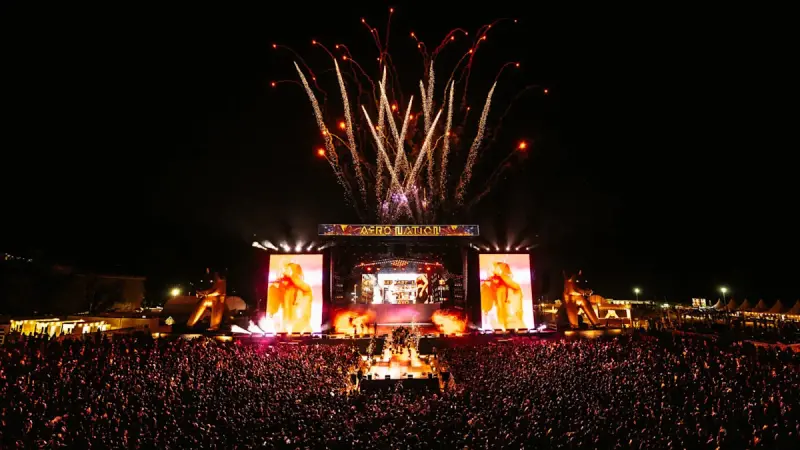
🔥 Afro Nation Portugal 2026: The Essential First-Timer’s Guide to the World’s Biggest Afrobeats Festival
Get the ultimate first-timer's guide to Afro Nation Portugal 2026 – the world's largest Afrobeats festival. Dates, tickets, travel tips, and what to expect in Portimão this July.
 👁️ 186 views
🔥 Golden Disc Awards 2026: Rookie Revolution as CORTIS, ALLDAY PROJECT, and Hearts2Hearts Redefine K-Pop's New Wave
Golden Disc Awards 2026 saw an unprecedented rookie sweep as CORTIS, ALLDAY PROJECT, Hearts2Hearts, izna, and KiiiKiii dominated major categories. Read our in-depth analysis of K-pop's new generation takeover and what it means for the industry.



Details
Send Us an Enquiry
We'll get back to you as soon as possible.
Thank You!
Your enquiry has been submitted. We'll be in touch shortly.