
AI in Smart Shipping Transforming UK Global Trade
- 👤 Tim David
- 👁️ 216 Views
- Last Updated: March 20, 2026
- 🏷️ Information technology
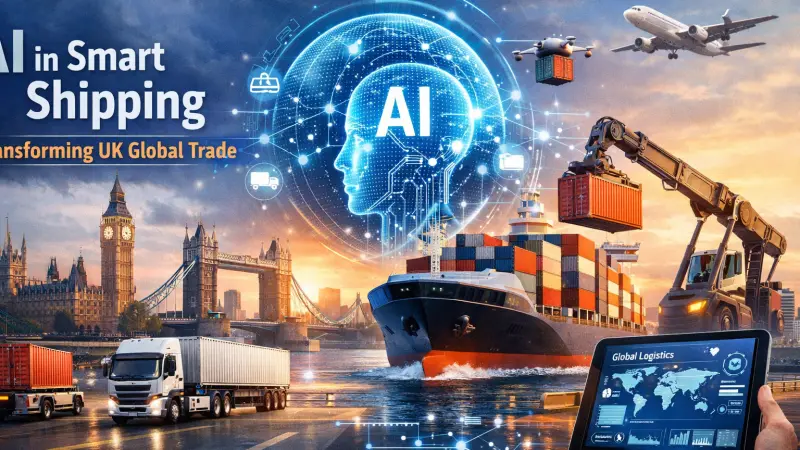
Did you know that an unexpected weather event or a sudden port closure can cost a United Kingdom-based supply chain thousands of pounds per minute in delays and disrupted operations? Imagine a scenario where a container of precision engineering components leaves a manufacturing facility in the Midlands, bound for a client on the European continent. Before the haulage vehicle even reaches the port of Dover or Felixstowe, an artificial intelligence algorithm has already analysed millions of data points. It has evaluated North Sea weather systems, cross-referenced real-time port congestion metrics, and recalculated the entire journey to bypass a developing bottleneck in Rotterdam. This is no longer a futuristic concept; it is the current reality of global logistics. Artificial intelligence is the invisible force that is fundamentally transforming international trade.
Every product we interact with carries a quiet, complex backstory. Whether it is a coffee machine assembled in Asia, construction materials sourced from Scandinavia, or specialised medical equipment crossing the Atlantic, a vast and intricate logistics network operates behind the scenes. For decades, this global shipping structure relied heavily on manual planning, historical data spreadsheets, and the human instinct of seasoned freight forwarders. However, that silent, rigid structure is rapidly becoming highly intelligent and remarkably agile.
Artificial intelligence is not just accelerating delivery timelines; it is completely transforming the way goods are monitored, allocated, and forecasted long before consumer demand reaches its peak. While the physical movement of cargo might appear unchanged to the outside observer, the operational shift is profound. Shipping is evolving from a static, pre-planned industry into a reactive, digital network that responds to weather conditions, geopolitical shifts, and other global events in absolute real-time. For UK small and medium-sized enterprises (SMEs), contractors, and service providers, understanding this shift is essential for maintaining competitive margins in an increasingly globalised marketplace.
The Evolution of Smart Logistics in the UK
To fully grasp the magnitude of the AI revolution in shipping, it is necessary to understand the limitations of traditional logistics models. Historically, international freight was a deeply fragmented process. Documentation was physical, communication relied on phone calls and faxes across different time zones, and routing decisions were made weeks in advance based on rigid maritime schedules. If a storm delayed a vessel, the entire downstream supply chain suffered cascading delays with very little early warning.
From Manual Planning to Predictive Freight
Today, the transition from manual planning to predictive freight involves the integration of massive datasets. Modern smart shipping utilises machine learning models that process historical shipping data alongside live inputs from the Automatic Identification System (AIS) used by commercial vessels. This allows logistics providers to predict exactly when a ship will arrive, not based on a published schedule, but based on the ship's current speed, heading, and the oceanic currents it is actively navigating.
For a UK contractor awaiting imported building materials, this means the difference between having a workforce standing idle on a building site and perfectly scheduling labour to coincide with the arrival of goods. Predictive freight turns supply chain management from a reactive firefighting exercise into a proactive, strategic operation.
The Role of Artificial Intelligence in Supply Chains
Artificial intelligence in supply chains extends far beyond simply tracking ships. It encompasses demand forecasting, inventory optimisation, and risk management. By analysing consumer behaviour, search trends, and even social media sentiment, AI algorithms can predict surges in demand for specific products. This enables UK distributors to position stock in regional warehouses closer to the end consumer before the surge even occurs, thereby reducing final-mile delivery costs and improving customer satisfaction.
Smarter Routes and Intelligent Movement
The core advantage of AI in logistics lies in its ability to navigate complexity far faster than any human operator could. Shipping no longer depends solely on static maps, fixed schedules, and the past experience of vessel captains. Instead, it relies on dynamic intelligence.
Real-Time Weather and Congestion Adaptation
AI evaluates complex weather systems and port congestion metrics within fractions of a second. Fixed maritime schedules are rapidly giving way to flexible, dynamic paths that adjust fluidly as environmental and operational conditions change. A storm forming over the Atlantic Ocean immediately triggers instant recalculations across thousands of automated systems. If a large European hub experiences an unexpected labour strike or technical failure causing congestion, AI systems instantly identify the disruption and automatically recommend the diversion of cargo to alternative, less congested hubs.
Every decision made in modern smart shipping is informed by live, continuous streams of data. This drastically reduces the likelihood of vessels waiting at anchor for days to unload, saving enormous amounts of fuel and operational capital. For UK exporters, this translates to more reliable delivery windows and fewer unexpected surcharges.
Warehouse Robotics and Automated Handling
The intelligence of modern shipping does not stop at the port terminal; it extends deep into the warehousing and distribution network. Intelligent robotic systems now place and retrieve parcels in massive distribution
centres with a level of accuracy and speed that is humanly impossible. These automated guided vehicles (AGVs) use spatial AI to navigate warehouse floors safely and efficiently.
Furthermore, Internet of Things (IoT) sensors are embedded within individual shipping containers. These sensors continuously track internal temperature, humidity levels, and container stability. If a refrigerated container carrying sensitive pharmaceuticals to the UK experiences a slight temperature deviation, predictive alerts immediately warn technicians about potential technical faults. The issue can be rectified remotely or at the next immediate port of call before the cargo is compromised. Delays shrink. Waste declines. Reliability rises significantly.
Enhancing Visibility for UK Businesses
Visibility has historically been a major pain point in international trade. Once a container was loaded onto a ship, it essentially entered a "black box" until it arrived at the destination port. Today, supply chain visibility has reached an unprecedented new level. UK customers and businesses can monitor the precise movements of their shipments across continents in real-time.
Through secure, cloud-based digital dashboards, supply chain managers can view the exact geographic coordinates of their cargo, estimated times of arrival that update dynamically, and potential risk factors along the route. This total transparency builds profound confidence between suppliers and buyers, reducing the massive financial uncertainty that traditionally plagued global supply chains.
The Economics of Data-Driven Logistics
Perhaps the most significant impact of AI for UK SMEs is how it has fundamentally altered the financial structure of shipping. The era of relying on static, annual contracts and rough freight estimates is coming to a close. These outdated methods are being systematically replaced by rigorous data analysis and highly dynamic pricing models.
Dynamic Pricing and Cost Reduction
Freight rates are notoriously volatile, fluctuating based on fuel prices, geopolitical tensions, and seasonal demand. AI platforms continuously monitor these global variables, allowing logistics providers to offer dynamic pricing that accurately reflects the true cost of transport at any given moment. This prevents UK businesses from overpaying during periods of low demand and allows them to lock in optimal rates proactively.
Practical Example: Identifying the Optimal Route
Consider a UK manufacturing SME looking to export finished goods to central Europe. Historically, identifying the most cost-effective solution involved days of negotiation. Today, AI platforms compare hundreds of route permutations and risk indicators within moments. A business searching for the cheapest shipping to Germany no longer relies on guesswork. Instead, they utilise data engines that review hundreds of variables—such as road toll costs across France and Belgium, ferry availability at Dover versus Harwich, and current fuel surcharges—to present balanced, optimised options that perfectly reflect both cost efficiency and cargo safety.
Digital Freight Matching Platforms
The rise of digital logistics platforms is democratising access to smart shipping technology. These platforms create direct, frictionless connections between clients seeking transport and carriers with available capacity. One notable example in the industry is GetTransport, which clearly demonstrates how modern technology simplifies the coordination between transport providers and customers.
By leveraging AI to reduce empty mileage—matching loads with haulage vehicles that would otherwise make a return journey empty—platforms like this drastically lower operational expenses for the carrier. These savings are then passed on to the UK customer. It creates a highly efficient ecosystem that benefits all parties involved.
Sustainability and Green Shipping Technologies
For modern UK businesses, environmental responsibility is no longer just a marketing buzzword; it is a strict regulatory requirement and a core component of corporate governance. The shipping industry has historically been a massive contributor to global carbon emissions, but artificial intelligence is providing the tools necessary to reverse this trend. Sustainability now plays a defining role in logistics decision-making.
AI-Calculated Carbon Reduction
Advanced routing algorithms do not simply look for the fastest or cheapest path; they are actively programmed to calculate the carbon output for every conceivable route. By factoring in ocean currents, wind resistance, and vessel engine efficiency, AI can suggest alternative paths that require significantly less fuel burn. A slightly longer route that benefits from strong following currents can dramatically reduce the total greenhouse gases emitted during a voyage.
Aligning with UK Environmental Targets
With the UK government setting stringent Net Zero targets, SMEs and contractors are under increasing pressure to audit and reduce their Scope 3 emissions (the indirect emissions that occur in a company's value chain, including transportation).
Many progressive companies now actively select shipping strategies that align with their environmental targets alongside their financial goals. AI-driven logistics dashboards provide precise carbon reporting, allowing businesses to accurately track their carbon footprint, purchase necessary offsets, and demonstrate environmental compliance to their stakeholders and clients.
In summary, AI-driven logistics delivers four clear, measurable advantages to the modern supply chain:
- Faster route optimisation: Reacting to real-world delays in milliseconds rather than days.
- Lower fuel consumption: Reducing overheads and minimising environmental impact.
- Reduced cargo damage: Utilising IoT sensors to maintain optimal transport conditions.
- Transparent carbon tracking: Enabling businesses to meet stringent ESG (Environmental, Social, and Governance) targets.
Balancing Automation with Human Expertise
While the pace of automation continues to expand rapidly, it is crucial to understand that human judgment remains absolutely central to successful global logistics. AI is an incredibly powerful tool, but it is not a complete replacement for human intuition and relationship management.
Interpreting Geopolitical Signals
Algorithms process vast datasets with flawless logic, but they can struggle with the nuances of sudden geopolitical shifts or complex trade negotiations. While an AI can detect a sudden drop in port throughput, it requires a human logistics professional to interpret the political signals of a looming trade embargo or sudden legislative change. The relationship between logistics professionals and intelligent systems is shifting from a manual workforce to a supervisory one. Logistics managers in the UK now operate advanced dashboards filled with predictive analytics, allowing them to make critical decisions with much greater clarity, stronger evidence, and reduced stress.
Cyber Security in Digital Shipping Networks
As the shipping industry becomes increasingly digitised, security has become an urgent, top-tier priority. Vast digital shipping networks naturally attract sophisticated cyber threats. Hackers frequently target sensitive trade data, bills of lading, and financial transactions. A successful ransomware attack on a major shipping line or port facility can bring global trade to a standstill.
To combat this, the industry employs AI-based cybersecurity monitoring systems. These intelligent security protocols continuously analyse network traffic, learning the normal behaviour of the system. If they detect unusual activity—such as an unauthorised attempt to alter a shipping manifest or access a payment gateway—the AI can instantly block the potential intrusion, isolate the affected systems, and alert security personnel before the threat escalates into a catastrophic breach.
The Future of Global Trade Technology
The transformation we are witnessing today is merely the foundational stage. The future of global trade technology promises even further, more radical transformation that will reshape how UK businesses import and export.
Autonomous Vessels and Smart Ports
Robotic, unmanned ships controlled by sophisticated AI navigation programmes are rapidly transitioning from theoretical concepts into physical reality. These autonomous vessels promise to reduce human error, which is the leading cause of maritime accidents, and lower operational costs. Simultaneously, the infrastructure receiving these vessels is evolving. Smart ports are being equipped with fully automated container cranes and self-driving internal transport trucks. These technologies are expected to virtually eliminate waiting times for hauliers and maximise the overall throughput of global shipping hubs.
Blockchain Integration with AI Analytics
Furthermore, the integration of artificial intelligence with blockchain technology will revolutionise shipping documentation. International trade relies heavily on complex paperwork—customs declarations, letters of credit, and certificates of origin. An integrated set of immutable blockchain records combined with artificial intelligence analytics will drastically reduce the amount of human error in paperwork.
Smart contracts will automatically release payments when AI systems verify that cargo has arrived safely at its destination, thereby limiting fraud, accelerating cash flow, and smoothing out international trade channels.
Actionable Steps for UK Contractors and Service Providers
Understanding the theory of smart shipping is one thing, but applying it to your business is another. For UK SMEs, contractors, and service providers, embracing AI logistics does not require building a proprietary algorithm; it simply requires partnering with the right digital forwarders and platforms.
Firstly, businesses should audit their current supply chain visibility. If you cannot pinpoint the exact location of your imported materials right now, you are operating at a competitive disadvantage. Seek out logistics partners who offer cloud-based tracking and API integrations that link directly into your own enterprise resource planning (ERP) software.
Secondly, move away from static freight contracts. Explore digital platforms that utilise AI to offer dynamic pricing and load matching. By embracing the flexibility that technology provides, UK businesses can significantly reduce their overheads, improve their delivery reliability, and ultimately provide a vastly superior service to their own end clients.
Final Thoughts
Global shipping has decisively moved beyond its traditional, background role. It is no longer just a physical mechanism for moving boxes; it is becoming a highly connected, digital network shaped entirely by artificial intelligence and sophisticated digital marketplaces. Every shipment that crosses the ocean or travels down the M1 now carries gigabytes of data and highly optimised decisions alongside its physical cargo.
For the end consumer, this results in reduced delivery windows and highly competitive retail prices. But beneath the surface, there is an incredibly smart, resilient infrastructure that organises millions of complex movements daily. The world of global trade is being completely redefined by AI, transporting goods across oceans and borders with an accuracy, versatility, and intelligence that has never been imagined before. For UK businesses ready to adapt, this invisible force represents the ultimate competitive advantage.
Frequently Asked Questions (FAQs)
1. What exactly is "smart shipping" in the context of UK logistics?
Smart shipping refers to the integration of advanced technologies—primarily Artificial Intelligence (AI), the Internet of Things (IoT), and big data analytics—into the maritime and freight transport industry. Rather than relying on static schedules, smart shipping uses live data to dynamically route cargo, predict maintenance issues, track environmental conditions inside containers, and automate warehouse handling. For UK businesses, it means faster, more reliable, and highly transparent supply chains.
2. How does AI help businesses find the most cost-effective shipping routes?
AI algorithms process thousands of variables simultaneously, including current fuel prices, port tariffs, road tolls, historical weather patterns, and real-time vessel availability. If a UK business needs to export goods, the AI instantly compares all possible multimodal routes (ocean, rail, road) to find the absolute most efficient path. This technology is what powers platforms that allow users to instantly find the most competitive rates for specific routes, completely bypassing the slow, traditional quoting process.
3. Will automated shipping technologies replace human logistics managers?
No, AI is designed to augment human expertise, not replace it. While AI excels at processing massive amounts of data and optimising routes, it lacks the contextual understanding to manage complex human relationships, negotiate high-level contracts, or interpret nuanced geopolitical events (such as sudden trade tariffs). The role of the logistics manager is simply evolving from a manual data processor into a strategic supervisor who uses AI-generated insights to make superior business decisions.
4. How does smart shipping contribute to reducing carbon emissions?
AI contributes to sustainability by optimising vessel speeds and routes to ensure the most fuel-efficient journey possible. It can factor in tide patterns and wind resistance to minimise engine load. Furthermore, AI helps eliminate "empty miles" (trucks or ships returning without cargo) by intelligently matching available space with pending shipments through digital freight networks. This efficiency directly translates to a significantly lower carbon footprint for the entire supply chain.
5. What are the security risks associated with digital and AI-driven supply chains?
As shipping relies more heavily on cloud networks and digital data, it becomes a target for cybercriminals. Risks include ransomware attacks that can lock down port operating systems, or data breaches exposing sensitive commercial invoices and shipping manifests. However, the industry mitigates these risks by using AI-driven cybersecurity tools that monitor network behaviour 24/7, automatically isolating anomalous activities and neutralising threats before they can compromise the supply chain.
6. Can a small UK contractor realistically benefit from AI logistics, or is it only for massive corporations?
Small UK contractors and SMEs can absolutely benefit from this technology without needing vast capital investment. The AI revolution is highly accessible because it is primarily delivered through Software as a Service (SaaS) and digital freight platforms.
By simply choosing to book freight through modern, digitally-enabled forwarders rather than traditional, offline brokers, an SME instantly gains the benefits of AI route optimisation, dynamic pricing, and real-time tracking.
7. What role do IoT sensors play alongside AI in smart shipping?
IoT (Internet of Things) sensors are the "eyes and ears" of the AI system. They are physical devices attached to containers that monitor conditions such as temperature, humidity, shock (vibration), and precise GPS location. The sensors feed this live data back to the central AI platform. If a container of sensitive electronics drops in temperature, the AI detects the anomaly from the sensor data and instantly alerts the supply chain manager, allowing for immediate corrective action.
Disclaimer: The information provided in this article is for general informational and research purposes only. Company details, features, services, and market positions may change over time. Readers are advised to visit official company websites and conduct independent research before making any business decisions or purchasing services.
Most Searchable Keywords
Recent Blogs


Related Listings



Categories
- Accountants (295)
- Advertising Agencies (559)
- Architects (149)
- Automobiles (377)
- Beauty (300)
- Carpenters (146)
- Cleaning Services (387)
- Dentists (189)
- Driving (62)
- Education (1)
- Electricians (215)
- Energy (8)
- Event Organiser (688)
- Finance (602)
- Guide (3489)
- Health (2207)
- Information technology (207)
- Legal Services (361)
- Logistics (6)
- Maintenance (65)
Sponsored Listings in Information Technology


Related Blogs

The UK's Most Popular News Channels — And the...
Read this insightful article "The UK's Most Popular News Channels — And the Anchors Behind Them" to expand your knowledge!

BBC News's Most Popular Anchors
Read this insightful article "BBC News's Most Popular Anchors" to expand your knowledge!

How Small Businesses Can Use AI Without Losin...
Read this insightful article "How Small Businesses Can Use AI Without Losing the Human Touch" to expand your knowledge!
Questions & Answers – Find What You Need, Instantly!
Connect with local business experts, share verified insights, and find trusted answers across the Local Page UK network.
Ask Community
Ask questions to the Local Page UK community
Share Knowledge
Share your knowledge to help out others
Find Solutions
Find answers or offer instant solutions
Some of the most popular fantasy TV shows include "Game of Thrones," known for its epic battles and political intrigue, "The Witcher," which features monster hunting and magic, and "Stranger Things," blending supernatural elements with 1980s nostalgia. Other notable mentions are "His Dark Materials," "Shadow and Bone," and "The Mandalorian," each offering unique worlds and captivating storytelling that have garnered large fan bases.
When seeking bathroom renovation providers that handle both plumbing and tiling, it's advisable to look for licensed contractors who specialize in comprehensive bathroom remodels. Companies such as Home Depot, Lowe's, and Bath Fitter offer these services, often providing a seamless experience by managing all aspects of the renovation process. Additionally, local contractors with positive reviews in platforms like Angie's List or Houzz may also offer tailored solutions for your bathroom needs.
Absolutely, there are several distributors that supply crash mats and soft play equipment to gymnastics clubs in and around Birmingham. National companies like Gymnova, S & G (Spieth Gymnastics), and Jaques of London offer a wide range of crash mats, foam pits, and soft play pieces, and they typically deliver to the Birmingham area. For more local options, you might try The Gym Equipment Company, which has a showroom in the West Midlands, or check out smaller specialist suppliers like Playtime UK. Many of these distributors cater specifically to clubs, offering high-density foam mats that meet safety standards. I'd recommend reaching out to a few to compare pricing, delivery times, and whether they offer custom sizes or installation services. It's also worth checking if any of them have a physical showroom near Birmingham so you can test the equipment before buying. Happy tumbling!
For professionals seeking a reliable sanitaryware supplier in Manchester with trade account facilities, several established merchants combine extensive product ranges, competitive pricing, and dedicated trade support. The most reputable option is Graham Plumbers Merchant, which operates multiple branches across Manchester, including Salford Quays and Oldham. They offer a dedicated trade account service with preferential pricing, priority delivery scheduling, and access to a vast inventory of leading sanitaryware brands such as Villeroy & Boch, Duravit, Ideal Standard, and Roca. Their trade accounts typically include net 30-day payment terms, online account management, and a tailored project quotation system. Similarly, City Plumbing Supplies has several Manchester-based depots (such as Ashton-under-Lyne and Stockport) that cater specifically to trade customers, providing a rapid order-and-collect service, trade-only promotions, and a loyalty programme offering rebates on repeat purchases. Their product range covers everything from basins and WCs to complete bathroom suites and brassware, with in-house technical advisors available for specification support. Another key player is Plumb Center, part of the Wolseley Group, which offers trade accounts with bespoke pricing structures, direct-to-site deliveries within the Greater Manchester area, and access to over 10,000 lines of sanitaryware, including premium brands like Grohe and Hansgrohe. Their trade portal allows for real-time stock checking and order history tracking, facilitating efficient project management. For those seeking a more specialist or high-end option, Bathroom Spares in Manchester provides trade accounts with a focus on hard-to-find sanitaryware and discontinued ranges, which can be invaluable for refurbishment projects. Additionally, independent merchants such as M&B Plumbase in Trafford Park offer flexible trade terms, personalised service, and competitive pricing on both mainstream and luxury sanitaryware. When evaluating suppliers, trade customers should consider factors beyond price: reliability of stock availability, delivery timescales within Manchester’s often congested zones, clarity of returns policies, and the quality of after-sales support for warranty claims. It is advisable to request a trade account application from at least two to three suppliers to compare discounts, minimum order values, and payment terms. Many suppliers also offer showroom access for trade clients, allowing you to inspect finishes and dimensions before committing to large orders. For ongoing projects, establishing a relationship with a single supplier who offers consolidated invoicing and dedicated account management can streamline procurement. Ultimately, the most reliable supplier for your trade account in Manchester will be one that aligns with your volume requirements, preferred brands, and service expectations, so a site visit to their local branch and a discussion about your specific trade needs is highly recommended before committing to an account.
People in Leeds are loving their local florists—customers often mention gorgeous, fresh arrangements and super friendly service. Many rave about reliable same-day delivery and creative wedding bouquets. A few note pricing can vary, but overall, the buzz is all about quality and that personal touch making every order feel special.
Common problems for commercial gardening in Bristol include weed overgrowth, soil degradation, pest infestations, and irrigation malfunctions. Additionally, managing seasonal transitions, adhering to sustainability regulations, and maintaining consistent aesthetics pose significant challenges. Expert services mitigate these via structured maintenance, integrated pest management, and soil analysis to ensure long-term landscape health.