
How to Check Council Tax Band UK
How to Check Council Tax Band UK
Published by LocalPage.uk Content Architecture Team | Updated for the 2025/2026 Fiscal Year
For UK business owners, property developers, and professional service providers, the accuracy of a property’s council tax band is not merely a matter of administrative curiosity; it is a critical component of financial compliance and overhead management. As we navigate the 2025-2026 fiscal period, local authority funding pressures have led to increased scrutiny of property valuations. Understanding how to check council tax band data across England, Scotland, Wales, and Northern Ireland is essential for ensuring that liabilities are correctly calculated and that opportunities for significant savings are not overlooked.
5.6m UK private sector businesses are currently navigating the complexities of local taxation and operational overheads. With 99.3% of these being SMEs, the impact of an incorrectly banded property can be the difference between a surplus and a deficit in annual budgeting.
Identifying the Correct Valuation Authority for Your Region
The UK does not operate a single, unified system for property valuation. Depending on where your business or property is situated, you will interact with different statutory bodies. It is a common misconception amongst startups that a single GOV.UK portal handles all queries; in reality, the digital infrastructure is segmented by national borders.
The Role of the Valuation Office Agency in England and Wales
In England and Wales, council tax bands are determined by the Valuation Office Agency (VOA), an executive agency of HMRC. The VOA maintains a comprehensive database of all domestic properties, including those used for partial business purposes. Businesses operating from home offices or mixed-use premises must be particularly vigilant about how these valuations intersect with business rates.
Interacting with the Scottish Assessors Association
Scotland operates under a distinct legislative framework. The Scottish Assessors Association (SAA) manages the valuation roll and council tax list. Whilst the principles of banding are similar to England, the valuation dates and appeal timelines differ significantly. Scottish businesses must consult the SAA portal specifically to ensure they are looking at the correct historical valuation data.
Verification of Official Portals
Always ensure you are using .gov.uk or .gov.scot domains. Third-party "valuation checkers" often harvest data and may not reflect the most recent 2025 adjustments made by local authorities.
Navigating the National Property Databases for Immediate Results
Checking a council tax band is now a streamlined digital process, provided you have the correct identifiers. For professionals managing multiple sites, the ability to rapidly audit bands across different jurisdictions is a valuable operational skill. Most local authorities now integrate this data directly into their business portals, but the national registers remain the definitive source of truth.
Executing a Search by Postcode or Address
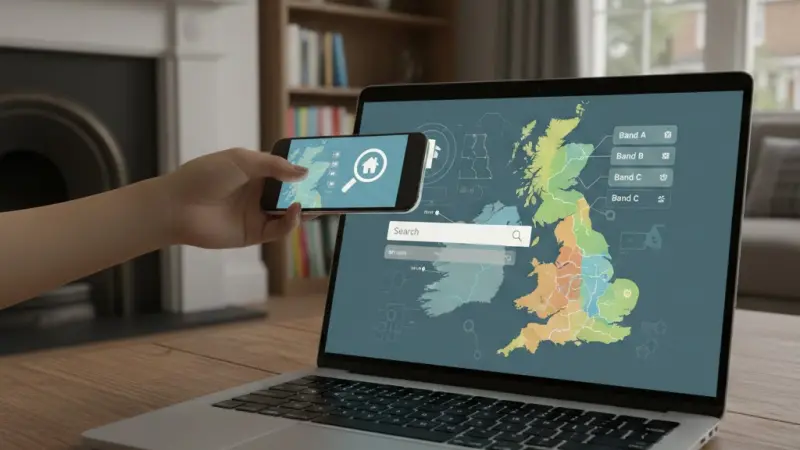
The primary method for checking a band is via a postcode search. In England, the VOA website allows users to enter a postcode to view the bands of all properties within that area. This is particularly useful for businesses conducting competitor analysis or market research for new retail locations. By comparing a property to its immediate neighbours, you can quickly identify "outliers" that may be incorrectly banded.
Understanding Property Identifiers and Unique Reference Numbers
Every property in the UK is assigned a Unique Property Reference Number (UPRN). When communicating with local authorities or the VOA, using this number ensures there is no ambiguity, especially in multi-tenanted buildings or converted professional services offices. In Northern Ireland, Land & Property Services (LPS) uses similar identifiers to manage the capital value system, which replaces traditional banding.
Accuracy in Documentation
When recording the band for your business accounts, ensure you capture the "Effective Date." This is the date from which the current band applies, which is crucial if you intend to claim a backdated refund.
Analysing the Financial Impact of Banding on Business Overheads
Council tax and non-domestic rates represent a significant portion of the £2.3 trillion contributed by small businesses to the UK economy. A property that is one band higher than it should be can result in an overpayment of several hundred pounds per year—costs that accumulate over a five-year valuation cycle.
76% of UK consumers now research local businesses online. For businesses in the hospitality or retail sector, maintaining a physical presence is vital, but the associated property taxes must be optimised to remain competitive against digital-only entities.
The Relationship Between Council Tax and Business Rates
For many micro-businesses—of which there are 4.2 million in the UK—the line between domestic and commercial property is blurred. If you run a bed and breakfast or a small workshop attached to your home, you may be liable for both Council Tax and Business Rates.
Checking your band is the first step in determining if you qualify for Small Business Rate Relief (SBRR) or other regional incentives like the Retail, Hospitality and Leisure relief scheme.
Budgeting for 2025-2026 Local Authority Increases
Most local authorities in England are expected to increase council tax by the maximum permitted 4.99% in the 2025/26 cycle. By verifying your band now, you can accurately forecast your cash flow. If your business is located in London or the South East (representing 34% of the UK business population), these increases are often compounded by higher base valuations.
The Criteria for Challenging an Incorrect Council Tax Band
Simply being unhappy with the amount you pay is not grounds for a challenge. To successfully lower your band, you must endeavour to provide evidence based on specific legal triggers. Professional services firms often assist clients in this area, but the process is designed to be accessible to the individual business owner.
Grounds for a Formal Valuation Review
Common grounds include a physical change to the property (such as demolition of part of the building), a change in the local area (such as a new major road or a large-scale development), or evidence that the original 1991 valuation (for England) was flawed. In Wales, the system was revalued more recently, making the evidence requirements slightly different.
Gathering Comparative Evidence from Neighbours
The most effective way to challenge a band is by showing that similar properties in your immediate vicinity are in a lower band. When you check the council tax band for your own property, you should also check the bands for at least five similar properties on your street. If they are identical in size and layout but sit in a lower band, you have a strong case for a review.
Submission Timelines
Note that you usually have six months to challenge a band after a "trigger event," such as moving into a new business premises or a change in the property's use. Delaying this check can result in a loss of rights to appeal.
Regional Variations: Scotland, Wales, and Northern Ireland
A "one size fits all" approach to UK property tax is a recipe for compliance failure. Regional devolution means that the rules in Belfast are fundamentally different from those in Birmingham or Glasgow. As cross-border trade in Northern Ireland has increased by 12% since 2024, more businesses are finding themselves managing properties across multiple jurisdictions.
Northern Ireland: The Capital Value System
Unlike the rest of the UK, Northern Ireland does not use lettered bands (A-H). Instead, Land & Property Services (LPS) calculates a "Capital Value" for each domestic property. To check your status here, you must use the spatial NI portal. This system is more reactive to market changes than the English 1991-based system, requiring more frequent checks from property managers.
The Welsh Revaluation Context
Welsh businesses operate under a system that was revalued in 2005. This means the gap between market value and tax band is often narrower than in England. Business Wales provides specific support for enterprises in the North and South, where 94% of businesses are micro-enterprises, often operating from homes where banding accuracy is paramount.
Specific Guidance for Home-Based Businesses and Startups
The surge in remote working and home-based startups has prompted the VOA and HMRC to provide clearer guidance on "mixed-use" properties. If you have converted a garage into a professional studio or a garden building into an office, your council tax band may be affected, or you may be liable for business rates on that specific portion of the property.
When a Home Office Triggers a Revaluation
Generally, using a room as a home office does not change your council tax band. However, if the change is "substantial" or if you employ staff at the location, the local authority may seek to revalue the property. Checking your band regularly ensures you are not surprised by a sudden re-categorisation by the local assessor.
HMRC and Capital Gains Tax Considerations
Whilst checking your band, consider the long-term implications. If you successfully argue that a large portion of your home is used for business to lower your council tax, you may inadvertently increase your liability for Capital Gains Tax (CGT) when you eventually sell the property. Consult with a qualified accountant before making formal declarations to the VOA.
Professional Tip for 2026
If you are a tenant in a commercial-residential split property, ensure your lease clearly defines who is responsible for the council tax portion. Many disputes arise because the "check" was never performed at the start of the tenancy, leading to backdated bills from the local authority.
Technology and Tools for Property Tax Management
In 2026, managing property taxes has moved beyond spreadsheets. With 82% of UK adults owning a smartphone, many local authorities have launched apps that allow you to check your band and pay your bill in a single interface.
For businesses with multiple locations, API-driven tools can now track valuation changes across the entire VOA database in real-time.
Automating the Audit Process
Large-scale professional services firms now use automated scrapers to monitor the SAA and VOA registers. For smaller businesses, setting a biannual reminder to manually check the band of your premises is a sufficient and cost-effective strategy. This ensures you are aware of any "neighbourhood shifts" that might justify a banding appeal.
The Rise of Voice Search in Local Property Queries
Interestingly, voice search queries for "council tax band near me" have increased by 43%. This reflects a trend towards more immediate, location-based information gathering. As a business owner, ensuring your own address data is correct on Google Business Profile and Companies House is essential for maintaining consistency across these automated systems.
Avoiding Scams and Unauthorised Valuation Agents
The complexity of the UK tax system has unfortunately given rise to "Council Tax Scams." These often involve firms promising a guaranteed lower band and a large refund in exchange for an upfront fee. It is critical to remember that you can check your council tax band and challenge it for free via official government channels.
Identifying Red Flags in Property Tax Advice
The VOA and local authorities will never call you out of the blue to ask for your bank details in relation to a refund. If you receive an unsolicited email or text message about your council tax band, do not click any links. Instead, go directly to GOV.UK or the SAA website to verify the information independently.
The Role of Local Enterprise Partnerships (LEPs)
If you are unsure about the legitimacy of a valuation agent, contact your local Chamber of Commerce or LEP. These organisations provide verified resources for small businesses and can often point you toward reputable professional surveyors if your case is genuinely complex and requires expert intervention.
Future Trends: Will the UK Move to a New Banding System?
There is ongoing debate within the British Chambers of Commerce and the Federation of Small Businesses regarding the fairness of the 1991 valuation base in England. Whilst a full revaluation is not currently scheduled for 2026, incremental changes to the multiplier and the introduction of new "super-bands" for high-value properties are frequently discussed in Parliament.
The Impact of Net Zero Improvements on Valuations
A key concern for 2026 is whether installing solar panels, heat pumps, or other green technology will increase a property's council tax band. Current guidance suggests that most energy-efficiency improvements will not trigger an immediate revaluation until the property is sold, encouraging businesses to invest in sustainability without the fear of an immediate tax hike.
Monitoring Legislative Changes via ICO and FCA
While the ICO (Information Commissioner's Office) ensures your property data is handled securely, the FCA (Financial Conduct Authority) monitors firms that provide financial advice related to tax. Staying informed through these bodies ensures that your approach to property tax management remains compliant with the latest consumer and business protection standards.
Voice Search & Instant Answers
"Hey Google, how do I find my council tax band?"
You can find your band by visiting the 'Check your Council Tax band' service on GOV.UK.
You simply need your postcode. For properties in Scotland, use the Scottish Assessors Association website (saa.gov.uk).
"Siri, is my business property in the right tax band?"
Check the VOA or SAA register to see your current band, then compare it with similar properties in your street. If yours is higher than identical neighbouring properties, you may be eligible to challenge the valuation for free.
Summary: Proactive Management of Local Tax Obligations
In conclusion, the ability to check council tax band data is a fundamental skill for any UK professional. By leveraging official portals, understanding regional nuances, and acting quickly on valuation discrepancies, businesses can protect their bottom line and ensure they are paying no more than their fair share. As we move through 2026, staying informed via authoritative sources like Companies House, HMRC, and LocalPage.uk remains the best defence against operational inefficiencies.
Optimize Your Business Presence Today
Ensure your business is visible to the 76% of UK consumers who search locally before they buy. Join thousands of verified UK enterprises in our professional directory.
Claim Your Free Business Listing
Frequently Asked Questions
Can I check a council tax band without knowing the full address?
Yes, you can search the VOA or SAA registers using only a postcode. This will provide a list of all registered properties in that area and their corresponding bands. This is particularly useful for surveyors or businesses looking at potential new premises in a specific neighborhood where the exact street number isn't yet known.
Why is my property in a different band than my next-door neighbour?
This often happens if one property has been extended or significantly improved since the last general valuation. In England, an extension usually only triggers a revaluation when the property is sold. However, it could also indicate a valuation error. You should check if the internal square footage and number of rooms are truly identical before considering a challenge.
How long does it take for the VOA to review a band challenge?
In most cases, the VOA aims to provide a decision within 90 days. However, complex cases involving mixed-use properties or historical evidence can take longer. Throughout the process, you must continue to pay your current council tax bill. If your challenge is successful, the local authority will issue a refund for any overpayments made.
Does checking my council tax band cost anything?
No, checking your band via the official GOV.UK, SAA, or LPS portals is completely free. You should be wary of any website or service that asks for a fee to provide this information. The data is part of the public record and is maintained by government agencies for the purpose of transparency in local taxation.
What if my property is in Northern Ireland where there are no bands?
In Northern Ireland, you check the 'Capital Value' rather than a band. You can do this through the Land & Property Services (LPS) section of the nidirect website. The amount you pay is calculated by multiplying this capital value by the 'domestic rate' set by your local council and the Northern Ireland Executive.
Can a council tax band be increased after a check?
Yes, it is a risk. When you ask for a review, the VOA looks at the property again. If they find it was actually undervalued (for example, due to improvements you or a previous owner made), they could move it into a higher band. This is why it is vital to check the evidence thoroughly before submitting a formal challenge.
I’m a tenant - am I allowed to check and challenge the band?
As the person liable for the bill, a tenant has the right to challenge the council tax band. However, it is professional courtesy (and sometimes a lease requirement) to inform the landlord, as a change in the band will permanently affect the property's value and the tax liability for future tenants or owners.
How do I find out what the 1991 value of my house was?
The 1991 values are not generally publicised as individual figures; instead, they are categorised into the bands (A to H). To see the price brackets for each band in 1991, you can consult the VOA's explanatory pages. This helps you understand if your property's estimated 1991 value correctly aligns with its current assigned band.
What is 'Mixed-Use' banding for small businesses?
Mixed-use banding applies when a property is used for both domestic and business purposes (e.g., a shop with a flat above). The domestic part receives a council tax band,
while the business part is assessed for business rates. Checking both is essential to ensure you aren't being double-taxed on the same square footage.
Is the process different in Wales compared to England?
The core process of using the VOA portal is similar, but the valuation date for Wales is 2003 (not 1991), and there are nine bands (A to I) instead of eight. Welsh businesses should also check with Business Wales for specific grants that might offset the costs of council tax in certain enterprise zones.
Disclaimer: The information provided in this article is for general informational and research purposes only. Company details, features, services, and market positions may change over time. Readers are advised to visit official company websites and conduct independent research before making any business decisions or purchasing services.
Most Searchable Keywords
Recent Blogs
-

Pavel Durov — The Visionary Founder Behind Telegram Messenger
-
UK Exam Calendar 2026–2027: The Complete Guide to Every Upcoming Exam, Deadline & Results Day
-
How Much BBC Radio 4 Today Programme Hosts Really Earn
-
New UK Trade Union Access Rules for Employers in 2026
-
Winter Fuel Payment Eligibility and How Much You Could Get

Related Listings
Categories
- Accountants (295)
- Advertising Agencies (559)
- Architects (149)
- Automobiles (377)
- Beauty (300)
- Carpenters (146)
- Cleaning Services (387)
- Dentists (189)
- Driving (62)
- Education (1)
- Electricians (215)
- Energy (8)
- Event Organiser (686)
- Finance (602)
- Guide (3377)
- Health (2207)
- Information technology (206)
- Legal Services (357)
- Logistics (6)
- Maintenance (65)
Sponsored Listings in Business Services



Related Blogs

Pavel Durov — The Visionary Founder Behind Te...
Read this insightful article "Pavel Durov — The Visionary Founder Behind Telegram Messenger" to expand your knowledge!

UK Exam Calendar 2026–2027: The Complete Guid...
Read this insightful article "UK Exam Calendar 2026–2027: The Complete Guide to Every Upcoming Exam, Deadline & Results Day" to expand your...

How Much BBC Radio 4 Today Programme Hosts Re...
Read this insightful article "How Much BBC Radio 4 Today Programme Hosts Really Earn" to expand your knowledge!
Questions & Answers – Find What
You Need, Instantly!
How can I update my business listing?
Is it free to manage my business listing?
How long does it take for my updates to reflect?
Why is it important to keep my listing updated?
