
How to Insulate a Loft UK
How to Insulate a Loft in the UK: A Strategic 2026 Guide
Published by LocalPage.uk Senior Content Architect • Last Updated February 2026 • 12 Minute Read

In an era of volatile energy markets and stringent carbon reduction targets, loft insulation has transitioned from a basic home improvement task to a critical strategic investment for UK businesses and property owners. Whether you are a small business owner managing your own premises, a tradesperson looking to optimise your service delivery, or a commercial landlord aiming to meet minimum energy efficiency standards, understanding the nuances of modern insulation is paramount.
25% of a building's heat is lost through an uninsulated roof. In 2026, with energy costs remaining a top-three overhead for 64% of UK SMEs, high-performance insulation is the most effective way to protect bottom-line profitability.
The Economic Case for Superior Loft Insulation in 2026
Measuring ROI and Energy Savings for UK Commercial Premises
For the 5.6 million private sector businesses currently operating in the UK, cost control is an endless endeavour. Traditional mineral wool insulation remains the "gold standard" for cost-to-benefit ratios, but 2026 has seen a surge in the adoption of PIR boards and sheep’s wool for high-spec commercial refurbishments. A correctly insulated loft space in a typical UK office or retail unit can pay for itself within 24 months through reduced heating and cooling demands.
The Impact on Asset Value and EPC Compliance
The UK government's commitment to net-zero by 2050 has direct implications for property valuations. Buildings with an Energy Performance Certificate (EPC) rating below 'C' are increasingly difficult to lease in the professional services sector. Improving loft insulation is often the most cost-effective way to jump a full grade on the EPC scale, directly enhancing the marketability of the asset to the 99.3% of UK businesses that fall into the SME category.
Prioritising the 'Fabric First' Approach
Before investing in expensive air-source heat pumps or solar arrays, ensure the building envelope is secure. Insulation acts as the primary barrier; without it, renewable technologies struggle to reach peak efficiency, leading to higher operational costs in the long term.
Essential Pre-Installation Checks and UK Safety Standards
Assessing Structural Integrity and Existing Damp Levels
Before any material is laid, a thorough survey is required. In the South West of England, where coastal humidity levels are higher, and in parts of Scotland where driving rain is common, checking for existing dampness or wood rot is non-negotiable. If you discover moisture, it must be addressed via HMRC-registered tradespeople or certified damp specialists before proceeding, or you risk trapping rot within the structure.
Identifying Hazardous Materials in Older UK Properties
Many UK commercial properties built before the late 1990s may still contain asbestos within old insulation or textured coatings. Under the Control of Asbestos Regulations 2012, businesses have a "duty to manage" asbestos. If you encounter grey, fibrous materials, you must stop immediately and consult a licensed professional. Furthermore, older electrical wiring—especially the "rubber and lead" variety—must be inspected, as covering old cables with thick insulation can lead to overheating and fire risks.
Regional Guidance: Businesses in Northern Ireland should note that cross-border trade and materials sourcing may be subject to specific Windsor Framework guidance. Ensure all insulation materials carry the UKCA mark, or the CE mark where applicable under current NI protocol arrangements.
Choosing the Right Materials for the 2026 UK Climate
Traditional Mineral Wool vs. High-Performance Rigid Boards
Mineral wool (glass or stone) remains popular due to its fire-retardant properties and ease of installation between joists. However, for retail units or hospitality venues in London and the South East where space is at a premium, rigid PIR (Polyisocyanurate) boards offer a higher R-value per millimetre. This allows for thinner layers while maintaining the 0.16 W/m²K U-value currently recommended by most local authorities for new renovations.
Sustainable Alternatives: Sheep’s Wool and Hemp
As corporate social responsibility (CSR) becomes a focal point for UK consumers—with 76% researching a business's green credentials before purchase—sustainable insulation is a growing trend. Sheep’s wool is naturally breathable and hygroscopic, making it ideal for the
traditional stone buildings frequently found in Wales and the North of England. While the initial capital outlay is higher, the longevity and moisture-regulation benefits often outweigh the costs for heritage-based businesses.
The 270mm Standard for 2026
UK building regulations generally suggest a minimum thickness of 270mm for glass wool. If your premises currently has 100mm or less, you are essentially throwing away hundreds of pounds every winter. Topping up is a viable and affordable strategy for most micro-businesses.
Step-by-Step Installation Strategy for Trades and DIY
Preparation: Clearing, Cleaning, and Lighting
A cluttered loft is impossible to insulate effectively. Start by removing all stored items. In a professional environment, this might involve archiving physical records in accordance with ICO data protection guidelines. Ensure you have adequate portable lighting; LED work lights are preferred to avoid fire risks in confined spaces.
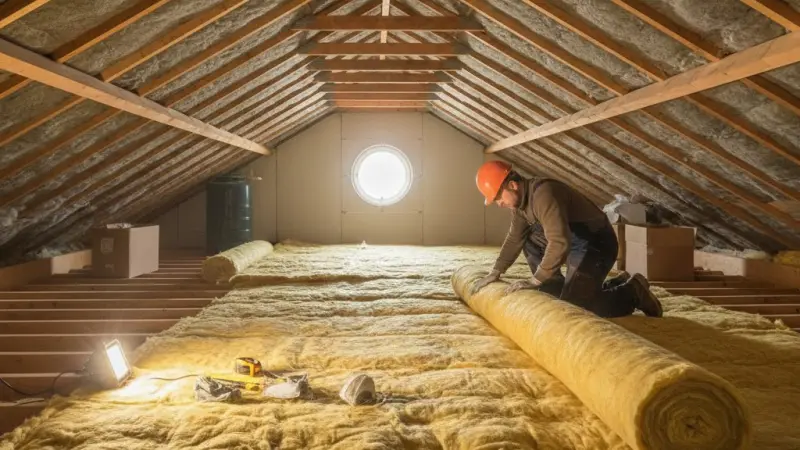
The Base Layer: Working Between the Joists
The first layer of insulation should be laid between the joists. It is vital not to compress the material, as its effectiveness comes from the air trapped within its fibres. In Scotland, where Scottish Enterprise-funded projects often mandate higher thermal performance, meticulous attention to detail at the eaves is required to prevent "cold bridging"—where heat escapes through gaps in the insulation coverage.
The Top Layer: Cross-Laying for Maximum Thermal Resistance
To reach the 270mm-300mm target, a second layer should be laid at right angles (perpendicular) to the joists. This covers the timber themselves, which can otherwise act as a thermal bridge. This technique is standard practice across England and Wales and is the most effective way to eliminate cold spots that lead to internal condensation in office environments.
Ventilation: The Often-Overlooked Critical Factor
Preventing Interstitial Condensation and Mould Growth
As we make buildings more airtight to save energy, we must ensure they can still "breathe." In Northern Ireland and Wales, where annual rainfall is significantly higher than the UK average, poor loft ventilation leads to rapid mould growth. This not only damages the building fabric but can lead to sick building syndrome, impacting employee health and productivity.
Installing Soffit, Lap, and Tile Vents
Ensure that insulation does not block the eaves. Air must be able to flow from the outside, through the loft space, and out again. If the loft is used for commercial storage, using "loft legs" to raise a boarded floor above the 270mm insulation line is essential. This maintains the air gap required to prevent moisture build-up between the insulation and the floorboards.
82% of UK adults own a smartphone and use it to search for local trades. If you are a contractor, highlighting your expertise in "ventilated insulation systems" can differentiate your business in a crowded market.
Regulatory Compliance and Financial Support
HMRC, Tax Incentives, and Capital Allowances
For UK businesses, the cost of installing insulation can often be claimed as a capital allowance, reducing the overall corporation tax burden. It is advisable to consult with a qualified accountant to understand how "Annual Investment Allowances" (AIA) apply to your specific project. Furthermore, some energy companies offer grants under the Energy Company Obligation (ECO4) scheme, which has been extended through 2026 to help lower-income households and certain small business premises.
Local Authority Permissions and Listed Building Consent
If your business operates from a listed building—common in historic centres like York, Bath, or Edinburgh—you must obtain Listed Building Consent from your local authority before making significant changes. Using the wrong type of modern non-breathable insulation in a 200-year-old structure can cause irreversible damage to the masonry.
The Role of the Federation of Small Businesses (FSB)
Members of the FSB can often access legal and environmental hubs that provide templates for compliance and risk assessments. Utilising these resources ensures that your insulation project meets both health and safety standards and local planning requirements.
Managing the Loft Space Post-Insulation
Safe Access and Storage Solutions for Businesses
Once insulated, the loft remains a utility space. If access is required for plant machinery, server racks, or air conditioning units, a permanent walkway should be installed.
This prevents staff from treading on the insulation, which would reduce its R-value and potentially lead to accidental ceiling damage.
Ongoing Maintenance and Monitoring
Inspect the loft at least once a year, preferably in late autumn. Look for signs of pests—such as rats or squirrels—which find modern insulation an ideal nesting ground. In rural parts of Wales and Scotland, this is a particularly common issue that can lead to chewed wiring and fire hazards if left unchecked.
"What is the best way to insulate a loft in the UK?"
The most effective method for 2026 is a two-layer approach using mineral wool or sheep’s wool. Lay the first 100mm between the joists and a further 170mm-200mm perpendicular to the joists to reach a total depth of 270mm-300mm. Ensure you do not block the eaves to maintain vital airflow.
"Is loft insulation worth the cost for a small business?"
Absolutely. With heat loss through the roof accounting for up to 25% of energy bills, most UK businesses see a full return on investment within two years. Additionally, it improves your EPC rating, which is increasingly vital for commercial property compliance and valuation.
Common Mistakes to Avoid During Installation
Compressing the Insulation Material
The most frequent error is "squashing" the insulation to fit boards directly onto joists. This removes the air pockets that provide the thermal barrier. Always use raised loft legs or a similar spacing system if you intend to board over the area for storage.
Forgetting the Loft Hatch
An uninsulated loft hatch is like leaving a window open. Use draught-strips around the edges and fix a block of rigid insulation to the top of the hatch itself. In a commercial setting, this simple 10-minute task can noticeably reduce cold draughts in the corridor or office below.
Ignoring Recessed Downlights
If your premises has recessed spotlights in the ceiling below the loft, they must not be covered directly with insulation unless you use "downlight covers" or fire hoods.
Covering them directly is a major fire risk as it prevents the heat from the bulbs from dissipating.
The Future of Insulation: Trends for 2027 and Beyond
Smart Sensors and Thermal Monitoring
We are seeing an increase in UK businesses installing low-cost IoT (Internet of Things) sensors in their loft spaces. These monitor humidity and temperature in real-time, alerting the business owner via smartphone if a leak occurs or if ventilation fails. This proactive management is becoming standard in London's tech-focused office spaces.
The Move Toward Circular Economy Materials
By 2027, we expect to see wider availability of insulation made from recycled textiles and ocean plastics. These materials offer comparable thermal performance to mineral wool but with a significantly lower carbon footprint, aligning with the sustainability goals of the British Chambers of Commerce and other national bodies.
Frequently Asked Questions
How much does it cost to insulate a loft in the UK in 2026? +
For a standard UK small business premises, costs typically range from £600 to £1,200 depending on the material and loft size. While DIY is cheaper, professional installation ensures compliance with current building regulations and may be required to validate commercial insurance policies or grant applications.
Do I need planning permission for loft insulation? +
Generally, no. Loft insulation is considered "permitted development." However, if your business is in a listed building or a conservation area in places like Edinburgh or Cardiff, you must check with your local planning office. They may require specific "breathable" materials to protect the heritage fabric of the building.
Can I get a grant for business loft insulation? +
While most grants like ECO4 target domestic properties, some Local Enterprise Partnerships (LEPs) and Scottish Enterprise offer "Green Growth" grants for SMEs. These can cover up to 50% of the costs for energy efficiency improvements. Always check your local authority website for current 2026 availability.
Is sheep's wool better than glass wool? +
Sheep’s wool is superior in moisture management and sustainability, but more expensive. It’s excellent for older Welsh or Northern Irish buildings. Glass wool is more cost-effective and offers better fire resistance. The "best" choice depends on your building's age and your business's environmental goals.
What is the recommended U-value for a loft in 2026? +
The current UK target for a renovated loft is a U-value of 0.16 W/m²K or lower. Achieving this typically requires around 270mm of standard mineral wool. Lower U-values indicate better insulation and higher energy savings for your premises.
How long does loft insulation actually last? +
Most modern insulation materials, if kept dry and uncompressed, are designed to last at least 40 years. However, you should check it every 5 years for signs of settling, pest damage, or dampness, especially in high-exposure regions like the Scottish Highlands or the Welsh valleys.
Should I remove my old insulation first? +
Not necessarily. If the old insulation is dry and free from pests, you can simply "top it up" with new layers. However, if the old material is damp, mouldy, or contains hazardous substances like asbestos, it must be professionally removed before new material is installed.
Can I use the loft for storage after insulating? +
Yes, but you cannot place items directly on the insulation. You must install "loft legs" or a raised sub-frame to create a platform above the 270mm insulation line. This protects the material from compression and ensures adequate ventilation for the timbers below.
Does loft insulation help in the summer? +
Yes. While we often think of insulation for keeping heat in, it also works to keep heat out during UK summer heatwaves.
This reduces the need for air conditioning in offices and retail spaces, leading to lower electricity bills during the warmer months.
Is DIY insulation safe for a business owner? +
It is physically possible but requires strict adherence to health and safety standards. You must use appropriate PPE (masks, gloves, goggles), ensure the loft is safely boarded for walking, and be aware of electrical risks. For commercial sites, hiring a certified contractor is usually the safer and more compliant route.

Disclaimer: The information provided in this article is for general informational and research purposes only. Company details, features, services, and market positions may change over time. Readers are advised to visit official company websites and conduct independent research before making any business decisions or purchasing services.
Most Searchable Keywords

Recent Blogs



Related Listings

Categories
- Accountants (295)
- Advertising Agencies (559)
- Architects (149)
- Automobiles (377)
- Beauty (300)
- Carpenters (146)
- Cleaning Services (386)
- Dentists (189)
- Driving (62)
- Electricians (215)
- Energy (8)
- Event Organiser (684)
- Finance (598)
- Guide (3364)
- Health (2207)
- Information technology (206)
- Legal Services (353)
- Logistics (6)
- Maintenance (65)
- Manufacturing (35)

Sponsored Listings in Locksmith Services


Related Blogs

Provisional Driving Licence UK Benefits and L...
Read this insightful article "Provisional Driving Licence UK Benefits and Limits Explained" to expand your knowledge!

Ross on Wye Minibus Hire for Group Travel Mad...
Read this insightful article "Ross on Wye Minibus Hire for Group Travel Made Simple" to expand your knowledge!
Explore Tyre Fitting and Automotive Services...
Read this insightful article "Explore Tyre Fitting and Automotive Services in Yate" to expand your knowledge!
Questions & Answers – Find What
You Need, Instantly!
How can I update my business listing?
Is it free to manage my business listing?
How long does it take for my updates to reflect?
Why is it important to keep my listing updated?
