
How to Lay Patio Slabs
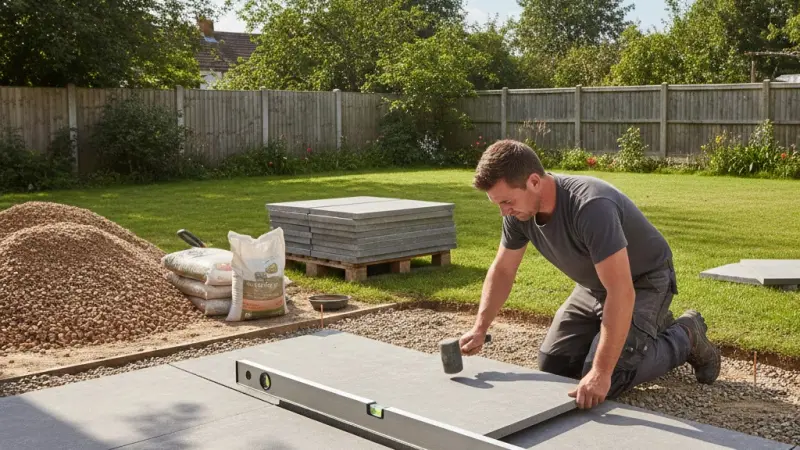
How to Lay Patio Slabs: A Professional Business Guide
Published: February 2026 | By LocalPage.uk Content Architecture Team | Primary Focus: UK Construction & Trades

The UK construction sector continues to be a cornerstone of the national economy. As of 2025, the Department for Business and Trade reports that there are over 5.6 million private sector businesses in the UK, with the construction and trades industries accounting for over 385,000 of these enterprises. For small businesses, professional landscapers, and property developers, mastering the technical execution of "patio slab installation" is not merely a matter of aesthetics but a requirement of structural compliance and long-term asset management.
£2.3tn The total annual turnover contributed by UK SMEs to the economy. In the trades sector, quality of workmanship remains the primary driver for customer retention and word-of-mouth referrals.
Essential Pre-Installation Planning and Site Surveying
Before a single spade hits the earth, professional trades must endeavour to conduct a thorough site survey. This involves more than just measuring dimensions; it requires an understanding of the local topography and soil composition. Whether you are operating in the clay-heavy soils of the London Basin or the more resilient granite-based landscapes of the Scottish Highlands, your sub-base requirements will vary significantly.
Analysing Soil Condition and Drainage Requirements
In the UK, drainage is governed by Part H of the Building Regulations. For businesses in England and Wales, ensuring that surface water does not flow onto public highways or neighbouring properties is a legal imperative. We recommend a "soil perk" test to determine the drainage rate. In Northern Ireland, where rainfall averages remain amongst the highest in the UK, integrating additional sub-surface drainage channels or "French drains" is often a strategic necessity rather than an optional extra.
Identifying Underground Utilities and Services
Avoidance of utility damage is critical for business insurance compliance. Always consult with "LinesearchbeforeUdig" or similar services. In 2025, the cost of repairing a severed fibre-optic cable or a gas main can exceed the total value of a domestic landscaping project. Professional contractors should always use a CAT (Cable Avoidance Tool) scanner to optimise safety before excavation commences.
Legal Depth Considerations
Always ensure your patio surface sits at least 150mm below the Damp Proof Course (DPC) of any adjacent building. This is a non-negotiable standard across all UK local authorities to prevent rising damp and structural deterioration.
Material Selection for the 2026 UK Climate
The choice of paving material has evolved. Whilst traditional riven sandstone remains popular, 2026 trends show a significant shift towards vitrified porcelain. This material offers superior frost resistance and lower porosity, which is essential given the increasingly volatile UK weather patterns.
Comparing Natural Stone vs Porcelain Performance
Natural stone, such as Indian Sandstone, requires sealing to maintain its colour and structural integrity against the UK's acidic rainfall. In contrast, porcelain slabs are virtually maintenance-free. For businesses operating in Scotland or Northern England, where "freeze-thaw" cycles are more frequent, porcelain’s 0.5% water absorption rate makes it the technically superior choice for longevity.
Sourcing from Authoritative UK Suppliers
We recommend sourcing materials from members of the British Association of Landscape Industries (BALI) or the Association of Professional Landscapers (APL). This ensures that the stone is ethically sourced and meets the BS EN 1341 standards for external paving. Using certified suppliers also assists in maintaining your business's ESG (Environmental, Social, and Governance) credentials, which is increasingly important for public sector contracts.
The Foundation: Excavation and Sub-Base Construction
A patio is only as stable as the ground it sits upon. The "sub-base" is the structural heart of the installation. For a standard domestic patio, a minimum of 100mm of compacted MOT Type 1 is the industry standard. However, for commercial environments or areas intended for heavy furniture, this should be increased to 150mm.
76% of UK consumers now research a trade business's technical processes online before hiring. Demonstrating a commitment to "Type 1" sub-bases over inferior "scalpings" can be a significant competitive advantage.
Correct Excavation Depths and Waste Disposal
Total excavation depth is calculated by adding the slab thickness (typically 20-30mm), the mortar bed (30-40mm), and the sub-base (100mm). This usually results in a 150-170mm dig.
For businesses based in London or the South East, waste disposal costs for "muck away" have risen by 12% in the last year; therefore, precise calculation of skip requirements is essential for maintaining project margins.
Achieving Maximum Compaction with MOT Type 1
Use a vibrating plate compactor (wacker plate) in layers (lifts) of 50mm. This ensures that no air pockets remain. In Wales, where the "Well-being of Future Generations Act" influences local planning, sustainable drainage systems (SuDS) are often favoured. In these instances, consider using MOT Type 3, which is open-graded and allows for better water infiltration into the water table.
The Geotextile Layer Advantage
Always place a heavy-duty geotextile membrane beneath the sub-base. This prevents the stone from sinking into the sub-grade (the natural soil) over time, a common cause of patio failure in the damp UK climate.
Mastering the Full Bed Mortar Technique
The "dot and dab" method—placing slabs on five spots of mortar—is widely considered professional negligence in 2026. This method creates voids where water collects, freezes, and eventually pops the slabs loose. A "full bed" of mortar is the only acceptable standard for professional UK trades.
The Ideal Mortar Mix Ratio for UK Weathering
A 4:1 or 5:1 ratio of sharp sand to CEM I or CEM II cement is standard. The mix should be "moist" but not "wet"—resembling the consistency of a cake mix. For projects in coastal regions, such as Cornwall or the Norfolk coast, ensure the use of sulphate-resistant cement to counter the effects of salt spray and high mineral content in the groundwater.
Applying SBR Priming Slurry for Maximum Adhesion
Modern porcelain and even some dense natural stones have very low suction. To ensure a permanent bond, the underside of every slab must be coated with an SBR (Styrene-Butadiene Rubber) priming slurry. Without this, the slab will simply "float" on the mortar bed rather than bonding to it. This is particularly crucial for the high-wind environments often found in Western Scotland and Northern Ireland.
Precision Laying: Alignment, Falls, and Spacing
A professional patio must be perfectly level in terms of its appearance, yet strategically angled to shed water. This "fall" should ideally be 1:60, meaning for every 600mm of patio, there is a 10mm drop away from the property.
Utilising String Lines and Laser Levels
For large-scale commercial patios, laser levels are the preferred tool to ensure accuracy across vast spans. For smaller residential jobs, traditional string lines and a long spirit level remain effective. Accuracy here is what separates a professional trade from a DIY attempt; a "bird bath" (a puddle in the middle of a patio) is a sign of poor craftsmanship that can lead to disputes and withheld payments.
Determining Joint Widths and Pattern Logic
Standard joint widths range from 5mm for porcelain to 10-15mm for natural stone. Whether you choose a "random bond," "herringbone," or "stretcher bond" pattern, ensure the joints are staggered. In 2026, the "large format" slab (900mm x 600mm) remains the most requested size amongst UK homeowners, as it creates a sense of space in smaller urban gardens.
Handling Slab Variation
Always draw slabs from multiple crates simultaneously. Natural stone varies in colour; by mixing the crates, you avoid "patchiness" and ensure a consistent, professional blend across the entire surface area.
Senior Architect's Insight: For businesses in Northern Ireland, be aware that cross-border trade for certain construction materials has seen a 12% increase in complexity due to the Windsor Framework. Always verify that your mortar additives and SBR primers are compliant with both UK and EU reach regulations if sourcing across the border.
Grouting and Jointing Solutions for Longevity
The final stage of the installation is the jointing. The choice of grout can determine how well the patio resists weed growth and weather erosion over the next decade. Traditional sand and cement pointing is increasingly being replaced by brush-in polymeric sands or two-part epoxy resins.
The Shift Towards Polymeric Jointing Mortars
Brush-in compounds like "EasyJoint" or similar products allow for installation even in damp conditions—a major benefit for UK contractors who cannot always wait for a dry window. These compounds remain semi-flexible, allowing for the natural thermal expansion and contraction of the slabs without cracking.
Applying Two-Part Epoxy Resins for Commercial Use
For high-traffic areas or areas cleaned with pressure washers, two-part epoxy resins provide a rock-hard finish that is impervious to water and chemicals.
This is the recommended choice for hospitality venues in major cities like Manchester or Birmingham, where patios are subject to heavy use and frequent industrial cleaning.
Post-Installation Care and Business Liability
Once the installation is complete, a professional business must provide the client with an "Aftercare Guide." This not only adds value but also protects the business from liability if the client uses inappropriate cleaning chemicals that damage the stone's surface.
Cleaning Protocols and Sealing Recommendations
Advise clients to avoid acidic cleaners on limestone or sandstone. Instead, recommend pH-neutral soaps. If you have installed natural stone, offering a sealing service 6-12 months after installation can be a lucrative "upsell" and provides an opportunity to inspect the work a year later, fostering long-term client relationships.
Managing Customer Expectations and Warranties
Be clear about what is a "natural occurrence" (such as efflorescence—the white salt staining that can appear on new concrete or stone) and what is a defect. Providing a 5-year structural warranty is becoming standard practice for members of the Federation of Small Businesses (FSB) to build consumer trust.
"How long does a patio take to dry before I can walk on it?"
Typically, you should allow 24 to 48 hours before walking on a newly laid patio in the UK. However, if using epoxy resins or in the colder months in Scotland and Northern England, this can extend to 72 hours. Full cure of the mortar bed usually takes 28 days.
"Do I need planning permission for a patio in England?"
Generally, no, provided the patio is at ground level and incorporates porous materials or directs water to a lawn or flower bed (SuDS compliant). If you are in a conservation area or a listed building, always check with your local authority before commencing work.
Navigating Regional UK Regulations and Support
The regulatory landscape for construction is not uniform across the UK. Each nation has specific bodies and support networks designed to assist small businesses in maintaining compliance and high standards.
Working with Local Authorities and Building Control
In England, the Planning Portal is your primary resource. In Scotland, the Scottish Government’s Building Standards division oversees these regulations. Always ensure your business is registered with the Information Commissioner's Office (ICO) if you are handling customer data for quotes and invoicing, as failure to comply with GDPR can lead to significant fines.
Accessing Business Support in Wales and Northern Ireland
Welsh businesses should leverage "Business Wales" for bilingual support and grants related to sustainable construction. In Northern Ireland, "Invest NI" provides resources for businesses looking to scale
their operations or invest in modern plant machinery like vacuum slab lifters, which are essential for health and safety when handling large-format slabs.
Project Management and Margin Optimisation
For a landscaping business, the difference between a profitable job and a loss often comes down to logistics. Efficiently managing the "supply chain" and reducing "double handling" of materials is key.
Accurate Estimating and Quote Transparency
In 2026, transparency is everything. Provide itemised quotes that break down labour, materials, and waste disposal. Use digital accounting tools approved by HMRC for "Making Tax Digital" (MTD) to track your project expenses in real-time. This allows you to identify if a particular project is exceeding its budget early enough to take corrective action.
Investing in Professional Tools for Speed and Quality
Manual handling is a significant risk. Investing in suction lifters not only protects your staff's health—reducing potential claims against your Employers' Liability Insurance—but also allows for much faster and more precise placement of slabs. This increases your "meterage per day" and directly improves your bottom line.
99.3% Of UK businesses are SMEs. In a crowded market, those who adopt professional standards, such as those set by the British Chambers of Commerce, are most likely to survive the first five years of trading.
Frequently Asked Questions
Can I lay patio slabs directly onto sand?
No, this is not recommended for professional installations in the UK. Laying on sand alone leads to "slab movement" and "rocking" as the sand washes away or shifts during heavy rain. A full mortar bed over a compacted MOT Type 1 sub-base is essential for a stable, long-lasting patio that meets professional standards.
How do I prevent weeds from growing through my patio?
Weeds don't usually grow "through" the slabs but rather in the dirt that accumulates in the joints. By using a high-quality polymeric jointing compound or an epoxy resin, you create a solid barrier that prevents seeds from taking root. Ensuring a solid sub-base also prevents the cracks where weeds typically thrive.
Is it possible to lay a patio in the winter in the UK?
Yes, but with precautions. Mortar must not freeze before it sets, as this destroys its structural integrity. If temperatures are forecast to drop below 3°C, you should avoid laying. Use frost-proofing additives if necessary, and always cover new work with hessian or thermal blankets to maintain a stable curing temperature.
What is the best way to cut porcelain patio slabs?
Porcelain is extremely hard. You must use a dedicated diamond blade specifically designed for porcelain (often marked as "wet-cut"). A petrol disc cutter or a table saw with a continuous water feed is required to prevent the blade from overheating and the slab from chipping or cracking.
How much fall should a patio have for drainage?
The industry standard in the UK is a fall of 1 in 60. This equates to approximately 17mm of drop for every 1 metre of patio width. This ensures that even during heavy UK downpours, water is efficiently directed away from building foundations and into suitable drainage or soakaways.
Should I seal my patio slabs immediately after laying?
For natural stone, it is often better to wait. Many professionals recommend waiting 3-6 months to allow any natural efflorescence (salt) to escape the stone. If you seal too early, you can trap these salts under the sealer, creating permanent white clouds. Porcelain does not require sealing.
What is MOT Type 1 and why is it used?
MOT Type 1 is a granular sub-base material approved by the Ministry of Transport. It consists of crushed stone, usually limestone or granite, ranging from 40mm down to dust. When compacted, the different sizes interlock to create a load-bearing surface that won't shift under the weight of the patio.
Are there legal restrictions on patio sizes?
There are no specific "size" limits, but "permeability" is key. If the patio exceeds 5 square metres and isn't made of porous material or directed to a soakaway, you may technically need planning permission. Always check the current "General Permitted Development" rules on the GOV.UK website.
Does a patio increase the value of a UK property?
According to 2025 property market trends, a well-installed, professional patio can add between 5% and 10% to a home's value.
For businesses, this makes "quality of finish" a major selling point when quoting for residential property developers or homeowners looking to invest in their assets.
What insurance do I need as a patio contractor?
At a minimum, you require Public Liability Insurance (usually £2m to £5m depending on the contract). If you have employees or casual labourers, Employers' Liability Insurance is a legal requirement under the Employers' Liability (Compulsory Insurance) Act 1969. Professional Indemnity insurance is also advised if you provide design services.

Disclaimer: The information provided in this article is for general informational and research purposes only. Company details, features, services, and market positions may change over time. Readers are advised to visit official company websites and conduct independent research before making any business decisions or purchasing services.
Most Searchable Keywords

Recent Blogs



Related Listings


Categories
- Accountants (295)
- Advertising Agencies (559)
- Architects (149)
- Automobiles (377)
- Beauty (300)
- Carpenters (146)
- Cleaning Services (386)
- Dentists (189)
- Driving (62)
- Electricians (215)
- Energy (8)
- Event Organiser (685)
- Finance (599)
- Guide (3365)
- Health (2207)
- Information technology (206)
- Legal Services (353)
- Logistics (6)
- Maintenance (65)
- Manufacturing (35)

Sponsored Listings in Locksmith Services


Related Blogs

Gen Z Political Reporters and News Creators i...
Read this insightful article "Gen Z Political Reporters and News Creators in the UK" to expand your knowledge!

Famous Female Social Media Influencers Across...
Read this insightful article "Famous Female Social Media Influencers Across the UK" to expand your knowledge!

Your UK Sponsor Licence 2026 Step by Step Gui...
Read this insightful article "Your UK Sponsor Licence 2026 Step by Step Guide" to expand your knowledge!
Questions & Answers – Find What
You Need, Instantly!
How can I update my business listing?
Is it free to manage my business listing?
How long does it take for my updates to reflect?
Why is it important to keep my listing updated?
