
How to Unblock a Drain UK
How to Unblock a Drain UK: A Comprehensive Business Infrastructure Guide
Published: February 2026 | Industry: Facilities Management & Trades | Region: UK-Wide

Drainage failure is rarely a convenience; for a UK business, it is a significant operational threat. Whether you are managing a boutique hotel in the Scottish Highlands, a retail unit in Cardiff, or a high-volume restaurant in London’s West End, a blocked drain represents potential health and safety breaches, lost revenue, and reputational damage. In the current 2025-2026 economic landscape, where efficiency is paramount, understanding the mechanics, legalities, and practical solutions for drainage maintenance is an essential facet of modern commercial management.
385,000+ UK businesses operate within the construction and trades sector in 2025, with a growing emphasis on preventative digital monitoring of commercial infrastructure.
Determining Responsibility for UK Drainage Systems
Before attempting any physical intervention, a business owner must establish who is legally responsible for the blockage. The law regarding sewers and lateral drains underwent significant changes across the UK, though nuances remain between nations. In England and Wales, the Water Industry (Schemes for Adoption of Private Sewers) Regulations 2011 transferred many private sewers to water companies, but the "private" portion remains the owner's liability.
The Boundary Between Private and Public Sewerage
Generally, a business is responsible for the pipes located within the property boundary that serve only that specific premises. Once the pipe leaves the boundary or joins a pipe serving another property, it usually becomes a "lateral drain" or "public sewer," managed by regional water authorities such as Thames Water, Welsh Water (Dŵr Cymru), or Scottish Water. However, for businesses in Northern Ireland, NI Water maintains a distinct set of criteria for adoption under the Water and Sewerage Services (Northern Ireland) Order 2006.
Legal Implications of Improper Waste Disposal
UK businesses are bound by the Environmental Protection Act 1990 and the Water Industry Act 1991. If a blockage is caused by the prohibited disposal of "Fats, Oils, and Grease" (FOG), the local authority or water company may issue a "notice to repair" or even prosecute. In 2025, regional water companies have increased their use of "sewer baiting" and CCTV inspections to trace blockages back to specific commercial kitchens, leading to substantial fines for non-compliance with grease trap regulations.
Evidence-Based Maintenance Logs
Maintaining a digital log of drain inspections is now considered a best-practice requirement for insurance compliance in 2026. Without proof of regular maintenance, some UK insurers may reject business interruption claims caused by flooding or sewage backflow.
Identifying the Severity and Location of the Blockage
Diagnosing the issue accurately prevents unnecessary expenditure. A blockage in a single sink differs fundamentally from a main-line failure that affects an entire commercial block.
Symptoms of Main-Line vs Localised Blockages
If multiple fixtures are backing up simultaneously, the issue is likely in the main stack or the external private drain. Localised issues, such as a single slow-draining basin in an office washroom, usually indicate a trap or U-bend obstruction. In older Victorian-era commercial properties common in Northern England and parts of Scotland, "combined" systems (where rainwater and foul water share pipes) are more susceptible to blockages during the increasingly frequent heavy rainfall events predicted for the 2025-26 season.
Using Modern Diagnostic Tools
While traditional "plunging" remains a first-line response, many UK SMEs are now investing in basic endoscope cameras that connect to smartphones. These tools allow facilities managers to inspect pipes internally before calling out expensive emergency contractors. In Wales, Business Wales has recently highlighted how digital adoption in facilities management can reduce emergency repair costs by up to 22% for hospitality venues.
Safe Practical Techniques for Minor Blockages
For minor, accessible blockages, internal staff may be able to resolve the issue safely, provided they adhere to COSHH (Control of Substances Hazardous to Health) regulations and use appropriate Personal Protective Equipment (PPE).
Mechanical Solutions: Plungers and Snakes
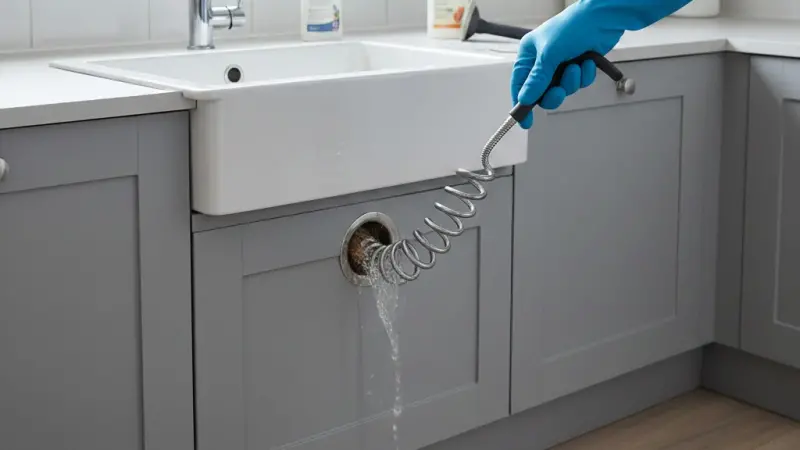
Standard sink plungers are often insufficient for commercial-grade pipes. A "bellows" plunger provides higher pressure. For deeper obstructions, a manual drain auger or "snake" can be fed through the pipe. It is vital to note that in high-rise commercial buildings in cities like Birmingham or Manchester, improper use of a drain snake can damage the internal lining of old cast-iron stacks, leading to leaks in units below.
The Risks of Chemical Unblockers in Commercial Settings
Heavy-duty caustic cleaners are widely available in UK trade counters, but they carry significant risks. Beyond the potential for chemical burns to staff, these substances can generate intense heat that softens modern PVC piping or crystallises FOG, making the blockage harder to remove.
By 2026, many UK local authorities are encouraging businesses to move toward biological "enzyme-based" cleaners that break down organic matter without damaging the infrastructure or the wider environment.
Checking the Air Admittance Valve (AAV)
Often, what appears to be a blockage is actually a vacuum issue caused by a stuck "Durgo" or AAV. Ensuring these valves are functioning correctly is a simple check that can save a call-out fee.
Commercial Equipment for Major Drainage Obstructions
When manual methods fail, the professional "jetting" or "mechanical coring" phase begins. For large UK retail parks or industrial estates, this is the standard approach to maintaining "high-flow" systems.
High-Pressure Water Jetting (HPWJ)
This involves a high-pressure hose with a specialised nozzle that blasts water at pressures often exceeding 3,000 PSI. It is the only effective way to clear "fatbergs"—the hardened masses of grease and wet wipes that plague UK urban centres. Water companies across the UK, including Severn Trent and United Utilities, have reported that fatbergs remain the leading cause of the 300,000+ sewer blockages occurring annually in the UK.
Electro-Mechanical Cleaning and Descaling
In areas with "hard water," such as the South East of England and East Anglia, limescale build-up can narrow the internal diameter of pipes. Electro-mechanical cleaning uses a rotating steel cable with various cutting heads to "core" out the scale. This is particularly relevant for businesses in the hospitality sector where dishwashers and glasswashers operate at high temperatures, accelerating scale formation.
The Impact of Regional Variations and Infrastructure
The UK’s drainage landscape is not monolithic. Age, geography, and local governance play a significant role in how you should approach unblocking.
Dealing with Heritage and Listed Buildings
In historic centres like Bath, York, or Edinburgh, drainage pipes are often integrated into protected masonry. Unblocking these requires non-invasive techniques. Any major replacement of drainage in a Grade I or II listed building in England and Wales requires Listed Building Consent from the local planning authority. Failure to obtain this can lead to enforcement action under the Planning (Listed Buildings and Conservation Areas) Act 1990.
Extreme Weather Resilience in Northern Ireland and Scotland
With the 2025-2026 winter forecast suggesting higher-than-average precipitation, businesses in Scotland and Northern Ireland must ensure their external "gully" pots are clear of silt and leaves. Invest Northern Ireland has recently promoted resilience grants for businesses to install "non-return valves" (NRVs) to prevent sewage backflow during flash floods, a common side effect of blocked downstream public sewers.
76% Of UK consumers research a business online first. If your physical premises has a "drainage odour" or closed washrooms, it negatively impacts your digital reputation via Google and Trustpilot reviews.
Preventative Strategies: Fats, Oils, and Grease (FOG) Management
The best way to unblock a drain is to ensure it never blocks in the first place. For any business involved in food preparation, FOG management is a legal and operational necessity.
Grease Trap Installation and Maintenance
Modern grease traps (Passive or Automatic Grease Removal Units) are mandatory for most new UK commercial kitchens. HMRC allows for the capital allowance on the purchase of such plant and machinery, providing a tax incentive for businesses to upgrade their drainage protection. In 2025, regular servicing of these units is often a condition of local authority food hygiene ratings.
Staff Training and Disposal Protocols
The "Bin it, don't flush it" campaign by the Consumer Council for Water remains highly relevant. Training staff in "dry wiping" plates before washing can reduce FOG entry by 40%. Businesses should partner with certified waste oil collectors who provide a Duty of Care waste transfer note, ensuring compliance with the ICO (Information Commissioner's Office) if any personal data is handled during the transaction, though usually, this falls under general waste regulations.
Contractor Management and Professional Standards
When the situation exceeds internal capabilities, selecting the right contractor is vital for liability and quality assurance.
Accreditations to Look For
Always verify that a drainage contractor is a member of the National Association of Drainage Contractors (NADC) or has SafeContractor accreditation. In the UK, drainage is unregulated in terms
of mandatory licensing, so these voluntary memberships are the only way to ensure the technician has been trained in HPWJ safety and environmental standards.
Understanding CCTV Survey Reports
If you have recurring blockages, a CCTV survey is essential. A professional report should include a "WRC" (Water Research Centre) coded structural assessment. This will identify if the blockage is caused by "root ingress"—a common problem in leafy London suburbs or the South West—where tree roots penetrate clay pipe joints to access moisture.
The Cost of Emergency Call-Outs in 2026
Average emergency call-out fees in London and the South East currently range from £150 to £250 for the first hour, while rates in the North East and Wales remain more competitive, often starting at £90. Businesses should always clarify "portal-to-portal" charging policies before booking.
Health and Safety Compliance during Drainage Works
The unblocking of drains involves exposure to pathogens, including E. coli and Leptospirosis (Weil's Disease). Business owners have a duty of care under the Health and Safety at Work etc. Act 1974 to protect employees and the public.
Sanitisation and Post-Unblock Procedures
Once a blockage is cleared, the affected area must be professionally sanitised. For retail and hospitality businesses, this may require temporary closure. Using an industrial-grade disinfectant that meets BS EN 1276 standards is required to ensure the area is safe for food service or public access.
Ventilation and Gas Risks
Decomposing organic matter in a blocked drain can produce Hydrogen Sulphide (H2S), which is toxic. If a "rotten egg" smell is overpowering, staff should evacuate the immediate area. In 2026, many UK health and safety consultants recommend that facilities managers carry portable gas detectors if they are required to enter confined spaces or deep basement pump rooms.
Voice Search: Quick Drainage Answers
"Hey Siri, who is responsible for my blocked drain in the UK?"
You are responsible for the pipes within your property boundary. Once the pipe leaves your boundary or serves another property, it usually becomes the responsibility of your regional water company (e.g., Thames Water or Scottish Water).
"Alexa, how much does it cost to unblock a commercial drain?"
Commercial drain unblocking in the UK typically costs between £90 and £250 for a standard call-out, depending on your location and the equipment required (like high-pressure jetting).
Sustainable Drainage Systems (SuDS) and the Future
As the UK moves towards more sustainable infrastructure, the way we manage
drainage is shifting from "reactive unblocking" to "proactive management."
The Introduction of Schedule 3 (Flood and Water Management Act 2010)
With the implementation of Schedule 3 in England (following Wales), new commercial developments must include Sustainable Drainage Systems (SuDS). These systems, such as permeable paving and "blue roofs," reduce the load on traditional sewers, significantly lowering the risk of downstream blockages and flooding. Businesses in Wales have already seen the benefits of mandatory SuDS in reducing local drainage failures.
Environmental Monitoring and IoT Sensors
By 2026, the use of Internet of Things (IoT) sensors in commercial grease traps and main stacks is becoming common for larger UK SMEs. These sensors alert facilities managers to rising water levels or grease accumulation via a smartphone app, allowing for an unblock before the system actually fails. This "Predictive Maintenance" is the most cost-effective way to manage UK business infrastructure in the long term.
Need a Professional Drainage Partner?
Ensure your business remains compliant and operational with our vetted UK trade listings.
Find Drainage Specialists Near You
Frequently Asked Questions
1. Can I use a pressure washer to unblock my business drains?
While a domestic pressure washer might clear very soft blockages, it lacks the volume and specialized "retro-jets" of a professional HPWJ unit. Using the wrong nozzle can also damage clay pipes. For commercial settings, it is safer to hire a professional to ensure the pipe is thoroughly descaled rather than just "poked" through.
2. Is a blocked drain considered a health and safety emergency?
Yes. Under the Workplace (Health, Safety and Welfare) Regulations 1992, UK businesses must provide adequate, functioning sanitary conveniences. If a blockage prevents staff or customers from using toilets or washing hands, the premises may be legally required to close until the issue is rectified to prevent the spread of disease.
3. What is the most common cause of commercial blockages in the UK?
Currently, "unflushable" items—specifically wet wipes and feminine hygiene products—combined with Fats, Oils, and Grease (FOG) account for over 80% of UK commercial blockages. Even products labelled as "flushable" often do not break down quickly enough for the UK's ageing Victorian sewer infrastructure.
4. Do I need to inform my landlord about a blocked drain?
Generally, yes. Most UK commercial leases (Full Repairing and Insuring) make the tenant responsible for internal drainage, but the landlord may be responsible for structural issues or communal pipes. Review your lease or contact your solicitor to confirm who pays for the call-out fee before booking a contractor.
5. Will my business insurance cover the cost of unblocking?
Most standard policies cover "accidental damage" or "escape of water," but rarely the cost of unblocking a drain caused by "fair wear and tear" or poor maintenance. However, if the blockage causes a flood that damages stock or equipment, that part of the claim is usually covered, provided you have maintained proper records.
6. Does the process differ for businesses in Scotland?
In Scotland, Scottish Water manages the public network. Businesses pay for water and sewerage through a Licensed Provider (LP). If the blockage is in the public section, your LP can help coordinate with Scottish Water, but the private boundary rules remain similar to the rest of the UK.
7. How often should a commercial grease trap be cleaned?
This depends on the volume of food service, but at a minimum, most UK local authorities recommend a full clean every 2 to 4 weeks. Automatic units may require daily maintenance of the collection tray. Failure to keep records can lead to an "Improvement Notice" from your Environmental Health Officer (EHO).
8. Can tree roots block drains in urban London properties?
Yes, root ingress is a major issue in older London boroughs. Small cracks in clay pipes allow microscopic root hairs to enter. Once inside, they thrive on the nutrients in the wastewater, eventually forming a thick "mat" that catches debris and causes a total blockage. This usually requires a CCTV survey and root-cutting equipment.
9. What should I do if my drain is overflowing into a public street?
This is an environmental priority. You must immediately contact your water company (e.g., United Utilities or Anglian Water). If the blockage is on your private land and causing a
public nuisance, the local authority can step in, clear it, and charge you "rechargeable costs" which are often much higher than private contractor rates.
10. Are there specific regulations for Northern Ireland businesses?
Businesses in NI should refer to the Water and Sewerage Services (NI) Order 2006. NI Water has specific requirements for what can be discharged into the system. Cross-border businesses should note that regulations in the Republic of Ireland differ, particularly regarding environmental discharge permits.

Disclaimer: The information provided in this article is for general informational and research purposes only. Company details, features, services, and market positions may change over time. Readers are advised to visit official company websites and conduct independent research before making any business decisions or purchasing services.
Most Searchable Keywords

Recent Blogs
-

Explore Supermarkets in Chepstow and the Surrounding Wye Valley
-
Elite Guide to Taxi and Private Hire Services in Hereford
-
Explore Fuel and Roadside Convenience Across Beckington Today
-
Explore Abergavenny Tyre Services with Expert Local Fitters
-
Claim Your HMRC UK Tax Refund Before Application Deadlines



Categories
- Accountants (295)
- Advertising Agencies (559)
- Architects (149)
- Automobiles (376)
- Beauty (300)
- Carpenters (146)
- Cleaning Services (386)
- Dentists (189)
- Driving (61)
- Electricians (215)
- Energy (7)
- Event Organiser (683)
- Finance (597)
- Guide (3358)
- Health (2205)
- Information technology (206)
- Legal Services (352)
- Logistics (6)
- Maintenance (65)
- Manufacturing (35)

Sponsored Listings in Accountants



Related Blogs

Explore Supermarkets in Chepstow and the Surr...
Read this insightful article "Explore Supermarkets in Chepstow and the Surrounding Wye Valley" to expand your knowledge!

Elite Guide to Taxi and Private Hire Services...
Read this insightful article "Elite Guide to Taxi and Private Hire Services in Hereford" to expand your knowledge!
Explore Fuel and Roadside Convenience Across...
Read this insightful article "Explore Fuel and Roadside Convenience Across Beckington Today" to expand your knowledge!
Questions & Answers – Find What
You Need, Instantly!
How can I update my business listing?
Is it free to manage my business listing?
How long does it take for my updates to reflect?
Why is it important to keep my listing updated?
