
Learner Driver Insurance Short Term Cover vs Named Driver Which Is Cheaper
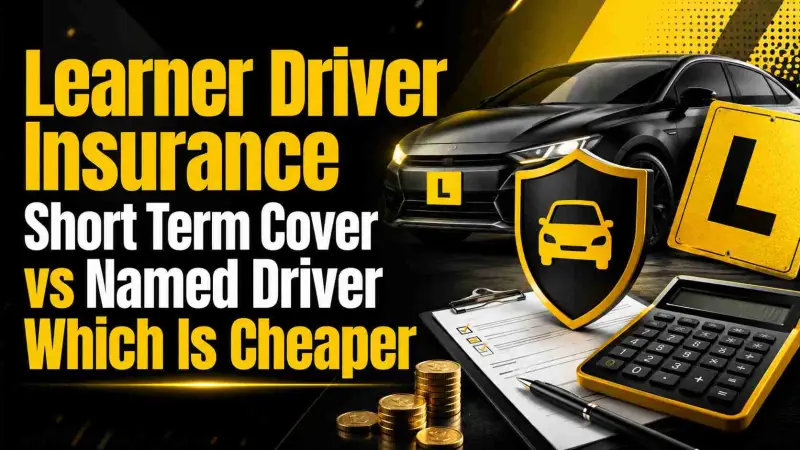
If you're learning to drive in the UK and want to practise in a parent’s, partner’s or another family member’s car, there are two common insurance routes: short-term learner driver insurance or being added to the vehicle owner's policy as a named driver.
So, which is cheaper?
There is no single answer because insurers price policies according to factors such as your age, provisional licence status, vehicle, location, driving history, cover level and how long you need insurance. However, named driver cover can be cheaper when you need regular, longer-term access to the same car, while short-term learner insurance can make more sense when you only need cover for a limited period and want to protect the vehicle owner's existing policy.
GOV.UK confirms that a learner practising in someone else's car must either be covered by the owner's insurance as a learner driver or have their own learner driver policy. If the learner owns the car, they need their own insurance policy.
The important part is not simply comparing two prices. You need to compare what each policy covers, whose no-claims discount is exposed, how long the cover lasts, whether the learner is genuinely a secondary driver and what happens after the driving test.
This guide explains the differences, costs, advantages and drawbacks of each option so you can make a sensible choice rather than automatically choosing the cheapest quote.
Short-Term Learner Driver Insurance vs Named Driver: Which Option Is Cheaper?
What is short-term learner driver insurance?
Short-term learner driver insurance is a temporary policy designed to cover a learner while they practise driving a particular vehicle.
Depending on the insurer and policy, cover can be arranged for a relatively short period rather than committing to a full annual policy. Temporary insurance can be useful when someone wants additional practice before their test, needs to borrow a family car or wants cover that is separate from the owner's main policy.
MoneyHelper explains that temporary car insurance can sometimes be more cost-effective than adding another driver to an existing policy, particularly when the additional cover is only needed for a short period. However, temporary insurance can become more expensive if it needs to be extended repeatedly.
For a learner, that distinction matters.
If you only need three weeks of extra practice before your test, paying for an annual arrangement may not make financial sense. If you expect to practise for another six or nine months, however, a short-term policy renewed several times may eventually cost more than another insurance arrangement.
What is named driver insurance?
A named driver is someone added to an existing car insurance policy and allowed to drive the insured vehicle.
The learner does not normally purchase a separate policy for that vehicle. Instead, the vehicle owner's insurer adds the learner to the existing policy, subject to the insurer accepting the learner's age, licence status and risk profile.
The ABI states that a named driver generally receives the same level of cover as the main driver. However, named driver arrangements are appropriate only where the named driver is not actually the main user or owner of the vehicle.
This is particularly relevant for families.
For example, imagine a parent owns a car and normally uses it for commuting. Their 17-year-old child occasionally uses the car for supervised practice. Adding the child as a named driver could be appropriate if the insurer allows it and the parent genuinely remains the main driver.
But if the child is actually using the car most of the time, listing the parent as the main driver simply to reduce the premium can become fronting, which is insurance fraud.
Short answer: which is normally cheaper?
Named driver cover may be cheaper for regular use, while short-term learner insurance may be better value for limited or occasional practice.
There is no universal cheapest option because insurance premiums are individually calculated.
A useful way to think about it is:
| Option | Usually makes more sense when | Main advantage | Main drawback |
|---|---|---|---|
| Short-term learner insurance | You need cover temporarily | Flexible and separate from the owner's main policy | Can become expensive if repeatedly extended |
| Named driver | You regularly practise in the same family car | Convenient and potentially cheaper over a longer period | Claims can affect the main policy and no-claims discount |
| Annual learner policy | You need regular cover for many months | Long-term arrangement | May cost more than temporary cover for a short period |
| Own car + own policy | The learner owns the vehicle | Clear ownership and insurance arrangement | Often more expensive for young drivers |
The only reliable way to determine the cheapest option for your circumstances is to obtain comparable quotes and check the cover behind each price.
Why are learner driver insurance premiums expensive?
Learners and young drivers can face relatively high insurance prices because insurers consider inexperienced drivers to represent greater risk.
The ABI says drivers aged 17 to 24 represent 7% of UK licence holders but are involved in 24% of fatal collisions, illustrating why age and driving experience can have a significant effect on insurance pricing.
That does not mean every learner receives the same premium.
Insurers can consider:
- Age
- Location
- Vehicle make and model
- Engine size
- Vehicle value
- Where the car is parked overnight
- Provisional licence status
- Intended mileage
- Level of cover
- Previous driving experience
- Claims history where applicable
- Other drivers on the policy
- Whether telematics is used
- Duration of cover
A learner practising in a small, relatively low-powered car may therefore receive a very different quote from another learner practising in a newer, higher-powered vehicle.
When can short-term cover be cheaper?
Short-term learner insurance can be attractive when the learner's need is genuinely temporary.
Consider this example.
A learner has already completed most of their driving lessons and has a practical test booked in four weeks. Their parent has a fully insured car that the learner wants to use for several private practice sessions.
Taking out short-term learner cover could avoid making a long-term change to the parent's policy.
The calculation becomes particularly interesting when the parent has a substantial no-claims discount or is concerned about the effect a learner claim could have on their policy.
GOV.UK specifically warns that if a learner is added to someone else's insurance, the vehicle owner's no-claims discount could be affected if the learner makes a claim. With a separate learner policy, the effect on the owner's no-claims discount depends on the temporary insurer and policy terms, so this should be checked before purchasing.
When can adding a named driver be cheaper?
Named driver cover may be financially attractive when the learner will practise regularly and the insurer offers a reasonable additional premium.
For example, suppose a parent already has an annual policy and their child needs to practise several times a week for six months.
Instead of purchasing multiple temporary policies, the parent could ask their insurer for a quotation to add the learner.
The insurer might offer a competitive additional premium, particularly if the vehicle is relatively inexpensive to insure.
MoneyHelper notes that adding an experienced driver to a young driver's policy can sometimes reduce the premium, although the main driver must always be the person who genuinely uses the car most.
The reverse situation is also important: adding an inexperienced learner to an existing policy can increase the premium significantly.
Therefore, you cannot assume that "named driver" automatically means "cheaper".
Does short-term learner insurance protect the parent's no-claims discount?
Potentially, but you must check the individual policy.
This is one of the biggest reasons some families consider separate learner insurance rather than simply adding the learner to the parent's policy.
If the learner is a named driver and has an accident, the claim is generally made against the main vehicle policy. The ABI confirms that a named driver's claim can affect the main policy and that named drivers should understand the consequences of making a claim.
With separate learner insurance, the claim may instead be handled under the learner's temporary policy.
However, policies differ. Some insurers may have conditions relating to claims, vehicle damage, excesses or the owner's no-claims discount.
Never assume that separate learner insurance automatically protects every part of the owner's insurance history. Read the policy wording.
What happens if the learner crashes the car?
The answer depends on which policy is providing cover.
With named driver insurance, the claim normally sits against the main car insurance policy.
With separate learner insurance, the temporary policy is generally intended to provide the learner's cover while practising, subject to its terms.
This difference can be important because the financial consequences of an accident extend beyond the immediate repair bill.
You should consider:
- Policy excess
- Damage to the insured car
- Third-party claims
- No-claims discount
- Future premiums
- Whether the insurer requires notification
- Any exclusions applying to learner drivers
The cheapest premium is not necessarily the cheapest outcome if the cover is unsuitable.
Can a learner simply drive the parent's car under the parent's existing insurance?
Not automatically.
GOV.UK says that if a learner is practising in someone else's car, they need to either be covered by the owner's insurance policy as a learner driver or have their own policy covering them as a learner.
The learner should never assume that because the parent has comprehensive insurance, the learner is automatically covered.
The policy needs to permit the learner to drive the vehicle.
This is a common mistake because people sometimes confuse the car being insured with every person being insured to drive it.
They are not the same thing.
What about comprehensive versus third-party cover?
The level of insurance also affects the comparison.
Third-party insurance generally covers liability for injury or property damage caused to other people, but does not cover damage to your own vehicle. Third-party, fire and theft adds protection against theft and fire, while comprehensive cover generally provides broader protection, including damage to the insured vehicle subject to the policy terms.
For a learner practising in a family car, checking the actual level of cover is essential.
A very cheap policy with restrictive cover may not be comparable with a more expensive policy providing broader protection.
When comparing quotes, look at the policy rather than the headline price.
Can a named driver build a no-claims bonus?
Usually, being a named driver does not automatically build the same no-claims history as holding your own policy.
This is one potential disadvantage for a learner who expects to buy their own car after passing the test.
A separate policy may or may not provide a recognised no-claims discount depending on the insurer and policy structure.
Therefore, if you are choosing insurance partly to establish a future insurance history, ask the insurer:
"Will this policy give me a no-claims discount that another insurer will recognise?"
Do not assume that every temporary policy will do so.
What is fronting and why should learners avoid it?
Fronting is one of the most serious issues to understand when comparing named driver options.
It happens when someone is incorrectly declared as the main driver to obtain a cheaper insurance premium, while another person actually uses the vehicle most.
For example, suppose a 19-year-old uses a car every day but the policy lists their parent as the main driver because the parent's insurance quote is cheaper.
That can be fronting.
The ABI describes fronting as insurance fraud and warns that a policy can be invalidated if the insurer discovers it. It can also result in serious financial and legal consequences.
The correct approach is simple:
Tell the insurer who actually uses the car most.
Adding a genuinely occasional learner as a named driver is very different from disguising the learner as an occasional driver when they are actually the main user.
How should you compare the two options?
Don't compare only the first number displayed on a quote.
Use the same assumptions for both options wherever possible.
Step 1: Establish how long you need cover
Ask yourself whether you need insurance for:
- A few days
- Several weeks
- One or two months
- Several months
- The remainder of the year
Short-term cover becomes less attractive if you continually renew it.
Step 2: Check the exact vehicle
Insurance pricing can vary significantly between vehicles.
A small hatchback may be substantially cheaper to insure than a high-performance vehicle.
The ABI recommends choosing a vehicle carefully because engine size, vehicle value and insurance risk can all affect premiums.
Step 3: Get a named-driver quotation
Ask the existing insurer how much it would cost to add the learner.
Do not make any change until the insurer confirms the learner is covered.
Step 4: Get a separate learner quotation
Obtain a quote for the same vehicle and intended period.
Compare the total cost rather than the daily rate alone.
Step 5: Compare the excess
A policy costing £20 less but carrying a much higher excess may not be the better choice.
Step 6: Check claims and no-claims implications
Find out what happens if the learner damages the car.
This can be more important than a relatively small difference in premium.
Step 7: Check what happens after the test
Passing the driving test can change the insurance arrangement.
A learner policy may no longer provide the same cover once the driver becomes fully licensed, depending on its terms.
The driver needs appropriate insurance allowing them to drive without supervision after passing. GOV.UK confirms that a driver must have insurance that allows them to drive without supervision once they pass their test.
Example: which option could win?
Imagine a learner needs private practice in a parent's car for six weeks.
The family receives these hypothetical quotes:
| Cost factor | Short-term learner cover | Named driver |
| Six-week insurance cost | £180 | £240 additional premium |
| Effect on parent's policy | Potentially limited, subject to terms | Claim would generally be under main policy |
| Flexibility | High | Lower |
| No-claims benefit | Depends on policy | Usually not the same as holding own policy |
| Best fit | Temporary practice | Longer-term regular use |
In this example, the temporary policy is cheaper.
Now imagine the learner needs cover for nine months. If the temporary policy costs £180 every six weeks, repeatedly renewing it could become far more expensive than the named-driver option.
That illustrates why there is no fixed answer to "which is cheaper?"
Duration changes the calculation.
What can make learner insurance cheaper?
There are several legitimate ways to reduce the price.
Choose a sensible car
A smaller engine and lower-risk vehicle can often produce a better quote.
Compare insurers
The ABI recommends shopping around because motor insurance prices vary between providers.
Consider telematics
Some insurers offer telematics or "black box" policies that use driving behaviour to help determine premiums.
ABI guidance explains that telematics policies can use information about how drivers drive to calculate premiums or other benefits, although restrictions and device-related charges can apply.
Keep the information accurate
Never change your address, occupation, mileage, main-driver status or parking arrangements simply to obtain a lower quotation.
A cheaper quote is worthless if the information is inaccurate and the policy does not respond properly to a claim.
Compare the total cost
Include:
- Premium
- Administration charges
- Cancellation fees
- Policy excess
- Telematics costs
- Extension charges
- Any relevant optional extras
What should parents check before adding a learner?
Parents often focus on the premium and overlook the policy implications.
Before adding a learner, check:
- Whether the insurer accepts provisional licence holders.
- Whether the learner receives comprehensive cover.
- Whether there are age restrictions.
- Whether private practice is permitted.
- Whether there are restrictions on when the learner can drive.
- What happens to the parent's no-claims discount after a claim.
- Whether the learner can use the car for a driving test.
- Whether the policy changes after the learner passes.
- Whether the excess changes.
- Whether the learner is genuinely a secondary driver.
GOV.UK also notes that some insurers have minimum age requirements for the person supervising a learner, so the insurance policy should be checked before practice begins.
What should learners check before buying short-term cover?
A temporary policy can look attractive because the upfront price is easy to understand.
Before purchasing, check:
- Exact start and end dates
- Vehicle registration details
- Provisional licence eligibility
- Level of cover
- Excess
- Theft and fire conditions
- Accident claims procedure
- Whether the policy covers driving lessons in the car
- Whether the policy covers the practical test
- Whether the policy ends or changes after passing
- Cancellation rules
- Extension options
- Whether the owner's no-claims discount is affected
This is especially important because a temporary policy is not necessarily a miniature version of an annual policy. Its terms may be different.
Can you use short-term learner insurance for a driving test?
Potentially, but check the policy before booking or taking the test.
The car must be appropriately insured and meet the relevant legal requirements. If the insurance policy does not allow the learner to take a test in that vehicle, having an otherwise valid temporary policy may not solve the problem.
It is sensible to confirm test-day cover directly with the insurer before relying on the vehicle.
What happens to insurance after passing the test?
Passing the test does not mean you can simply continue driving under assumptions made while you were a learner.
Your insurance needs to cover you as a full licence holder and allow you to drive without supervision.
The price may also change because the insurer is now rating you
as a newly qualified driver rather than a provisional licence holder.
This can mean the premium increases, decreases or changes depending on the policy and insurer.
Before the test, ask the insurer what you need to do immediately after passing.
Which option is best for frequent practice?
For frequent practice over many months, adding the learner to the existing policy can sometimes provide better overall value, provided the insurer offers an acceptable price and the arrangement accurately reflects who uses the vehicle.
However, separate learner insurance can still be preferable where the family wants to separate the learner's cover from the parent's main policy.
The decision should be based on the complete cost and risk, not simply the premium.
Which option is best for occasional practice?
For occasional or short bursts of practice, short-term learner insurance can be particularly useful.
It gives the learner flexibility without necessarily requiring a long-term change to the main policy.
MoneyHelper specifically identifies flexibility as an advantage of temporary insurance and notes that it can be suitable for short trips and emergencies.
The future of learner driver insurance
Learner insurance is likely to continue becoming more data-driven.
Telematics already allows insurers to assess driving behaviour rather than relying solely on traditional rating factors. As connected-car technology develops, insurers may have more information about braking, acceleration, mileage, journey times and other driving characteristics.
That could create more personalised pricing, particularly for younger drivers.
However, this is an evolving area rather than a guaranteed prediction. More data can also mean more conditions, monitoring and privacy considerations.
The wider insurance market is also likely to continue focusing on digital quotations, flexible policies and usage-based insurance.
For learners, the practical lesson is straightforward: don't assume the cheapest insurance structure today will always be the cheapest one for your next stage of driving. Recompare when your circumstances change.
Key Insights
- Short-term learner insurance is often useful for temporary practice, especially when you only need cover for a few weeks.
- Named driver cover can be cheaper for longer periods, but you must obtain a specific quotation from the existing insurer.
- The cheapest option depends on the learner, vehicle, location, duration and insurer.
- A named driver should genuinely be a secondary user; incorrectly declaring the main driver can amount to fronting.
- A learner's claim on a parent's policy can affect the parent's no-claims discount.
- Separate learner insurance may offer useful flexibility, but policy terms differ between providers.
- Compare excesses, cancellation charges, claims arrangements and cover levels rather than looking only at the headline premium.
- After passing the driving test, make sure the insurance allows the driver to drive unsupervised.
Frequently Asked Questions
Is short-term learner driver insurance cheaper than being a named driver?
Sometimes. Short-term cover can be cheaper when you only need insurance for a few weeks, while named driver cover may offer better value for regular use over several months. The actual price depends on the driver, vehicle, insurer and length of cover.
Can I be a named driver on my parents' car as a learner?
Yes, if the insurer accepts provisional licence holders and adds you to the policy with appropriate learner cover. You should not drive the vehicle until the insurer confirms that you are covered.
Does adding a learner driver increase insurance?
It can. Learners are generally considered higher-risk drivers because of their limited experience, so adding one to an existing policy may increase the premium.
Does learner insurance protect my parent's no-claims discount?
It may reduce the exposure of the parent's policy, but you should check the specific learner policy. Some policies can have different arrangements regarding claims and the owner's no-claims discount.
What is fronting in car insurance?
Fronting occurs when someone is incorrectly declared as the main driver to obtain a cheaper premium, even though another person actually uses the vehicle most. It is considered insurance fraud and can have serious consequences.
Can I drive my parent's car with their comprehensive insurance?
Not automatically. You must be specifically insured to drive the vehicle. GOV.UK says a learner using someone else's car must either be covered by the owner's insurance or have their own learner policy.
Is temporary learner insurance worth it?
It can be, particularly if you need cover for a short, defined period. It becomes less attractive if you repeatedly extend or renew the policy for many months.
Does a named driver get the same insurance cover?
Generally, a named driver receives the same level of cover as the main driver, according to the ABI. However, always check the individual policy because conditions and exclusions can vary.
Can a learner build a no-claims bonus as a named driver?
Being a named driver does not normally build the same personal no-claims history as holding your own policy. If building an insurance history is important, ask the insurer whether it provides recognised no-claims entitlement.
Can I get temporary insurance for one month?
Temporary insurance products can cover relatively short periods, but available durations vary by insurer. Check the exact policy period, minimum term and extension conditions before purchasing.
Is learner driver insurance required for private practice?
Yes, the learner must be insured to drive the vehicle. If practising in someone else's car, they need either appropriate cover under the owner's policy or their own learner driver insurance.
Can I use learner insurance for my driving test?
Some policies may allow it, but you must confirm this with the insurer. Never assume that a temporary learner policy automatically covers the practical test.
What happens to my learner insurance after passing?
It depends on the policy. Passing your test changes your licence status, so you need insurance that permits you to drive as a qualified driver without supervision. Check the policy before driving after passing.
Can a named learner driver damage the parent's no-claims discount?
Yes. If a learner is covered under the parent's policy and makes a claim, it can affect the main policy and potentially the parent's no-claims discount.
How can I find the cheapest learner driver insurance?
Compare quotes using identical information and check the total cost, excess, cover level, cancellation terms and claims arrangements. The cheapest headline quote is not necessarily the cheapest policy overall.
Final Thoughts
Choosing between short-term learner driver insurance and named driver cover comes down to how often you will drive, how long you need cover and how the insurance arrangement affects the vehicle owner's existing policy.
If you only need a few weeks of practice before your test, temporary learner insurance can provide useful flexibility. If you will regularly use a family car for several months, adding yourself as a named driver may prove more economical, but only if the insurer offers a competitive quote and you genuinely are not the main driver.
The safest approach is to compare both options using the same vehicle and circumstances. Look beyond the premium and check the excess, cover level, claims implications, cancellation terms and what happens when you pass your test.
Most importantly, never manipulate the main-driver information to obtain a lower price. A legitimate saving is useful; a cheaper policy that is based on incorrect information can become extremely expensive after a claim.
For most learners, the right question isn't simply "Which insurance is cheapest?" It is "Which policy gives
me the cover I actually need at the lowest realistic total cost?"
That is the comparison that can save money without creating problems later.
Disclaimer: The information provided in this article is for general informational and research purposes only. Company details, features, services, and market positions may change over time. Readers are advised to visit official company websites and conduct independent research before making any business decisions or purchasing services.
Most Searchable Keywords
Recent Blogs


Related Listings


Categories
- Accountants (295)
- Advertising Agencies (559)
- Architects (149)
- Automobiles (377)
- Beauty (300)
- Carpenters (146)
- Cleaning Services (387)
- Dentists (189)
- Driving (62)
- Education (1)
- Electricians (215)
- Energy (8)
- Event Organiser (687)
- Finance (602)
- Guide (3449)
- Health (2207)
- Information technology (206)
- Legal Services (361)
- Logistics (6)
- Maintenance (65)
Sponsored Listings in Legal Services
Related Blogs

Hand Luggage Sizes Ryanair easyJet Jet2 and B...
Read this insightful article "Hand Luggage Sizes Ryanair easyJet Jet2 and BA" to expand your knowledge!
UK Airport Liquid Rules 2 Litres vs 100ml
Read this insightful article "UK Airport Liquid Rules 2 Litres vs 100ml" to expand your knowledge!
GHIC Card How to Apply Cover and Exclusions
Read this insightful article "GHIC Card How to Apply Cover and Exclusions" to expand your knowledge!
Questions & Answers – Find What
You Need, Instantly!
How can I update my business listing?
Is it free to manage my business listing?
How long does it take for my updates to reflect?
Why is it important to keep my listing updated?
