
Sole Trader vs. Limited Company: Which Business Structure is Best for You?
The dream of being your own boss is often born out of a desire for freedom—freedom from the 9-to-5 grind, freedom from office politics, and the freedom to build something truly yours. However, before you can start invoicing clients, you must choose a legal identity.
In the UK, the two most common paths are becoming a Sole Trader or forming a Limited Company. Neither is objectively "better" than the other; rather, the "correct" choice depends entirely on your industry, your projected turnover, and your appetite for administrative tasks.
Defining the Structures
What is a Sole Trader?
A sole trader is the simplest business form. Legally, there is no distinction between you and your business. You are the business. You keep all the profits after tax, but you are also personally responsible for any losses or debts.
What is a Limited Company?
A limited company is a separate legal entity from its owners. It has its own assets, its own bank account, and its own tax liabilities. Even if you are the only person in the company (acting as both Director and Shareholder), the law treats the company as a "person" separate from you.
The Impact of Your Industry
The industry you operate in often dictates which structure is more viable.
Creative and Freelance Sectors: If you are a writer, graphic designer, or tutor, being a sole trader is standard. Clients in these fields are accustomed to dealing with individuals.
Professional Services and B2B: If you are a consultant, IT contractor, or working with large corporations, a Limited Company is often preferred. Large firms often have "Limited Only" hiring policies to avoid complications with IR35 legislation and to ensure they are dealing with a transparent entity registered at Companies House.
High-Risk Trades: If your work involves significant financial risk (like construction or manufacturing), the "limited liability" of a company offers a safety net that the sole trader route does not.
The Paperwork Burden: Admin vs. Ease
One of the most significant differences between the two is the amount of "red tape" involved.
Sole Trader Admin
Self-Assessment: You must file a personal tax return once a year.
Record Keeping: You must keep records of your business income and expenses.
VAT: You only need to register for VAT if your turnover exceeds the current threshold (historically around £81,000–£90,000).
Limited Company Admin
Annual Accounts: You must prepare statutory accounts.
Confirmation Statements: An annual "snapshot" of company data sent to Companies House.
Corporation Tax: Filing a CT600 return.
Higher Penalties: HMRC and Companies House are stricter with limited companies. Missing a deadline can result in significant fines that far exceed those levied against sole traders.
Financial Responsibility and Risk
This is the "make or break" section for many business owners.
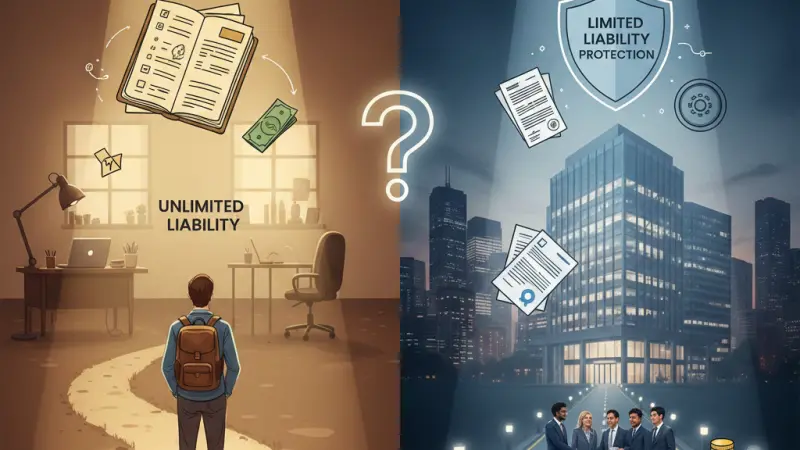
As a Sole Trader, your liability is unlimited. If your business is sued or fails while owing money to creditors, your personal assets—including your home, car, and savings—could be seized to pay those debts.
As a Limited Company, your liability is limited. Provided you haven't traded fraudulently or given personal guarantees for loans, your personal assets are protected. If the company goes bust, it is the company that owes the money, not you personally.
Taxation and Take-Home Pay
The way you get paid differs vastly:
Sole Traders pay Income Tax and Class 2/4 National Insurance on their profits. Once you've paid the tax, the rest of the money is yours to spend.
Limited Company Directors usually take a small salary and the remainder as dividends. Dividends have lower tax rates than salary and do not attract National Insurance.
While this can be more tax-efficient, you must be careful not to "overdraw" from the company, as this can lead to complex Director’s Loan Account issues.
Promote Your Business Growth with Local Page UK
Establishing your business structure is only the first step; the next is ensuring customers can actually find you. Whether you are a newly registered sole trader or a fresh limited company, visibility is the currency of the digital age.
To boost your online presence, you should utilize a reputable uk online business directory. Being listed on a high-traffic uk business directory like Local Page UK helps bridge the gap between your services and local customers. For small startups, finding a uk local business directory that prioritizes local SEO is essential to find local businesses uk and get discovered by your community.
By joining a local businesses list uk, you improve your search engine rankings. Local Page UK serves as a comprehensive uk small business directory that caters to both the uk b2b business directory and uk b2c business directory markets. It is more than just a list; it is a business directory uk online designed for growth. For those offering specific expertise, appearing in a uk service providers directory ensures your uk business listings online are seen by the right audience. The local page uk business directory is widely considered a premier uk business directory website.
If you are just starting out and watching your budget, you can take advantage of a business listing uk. Getting on a business listing uk allows you to test the waters without upfront costs. A business listing uk is a powerful tool for SEO, and using a business listing uk is a "must-do" for any new director or sole trader. Secure your business listing uk or a business listing uk today. Even a business listing uk can lead to your first big contract. Explore the business listing uk options, including a business listing uk or business listing uk.
For those looking for more robust features, the local business listings uk section offers uk service listings and uk verified business listings to build trust with your audience. Clients looking for uk top rated local businesses often browse the uk home services directory or uk professional services listings. From uk trade services listings to a specialized uk local trades directory, the local page uk listings make any uk local business search simple and effective.
What Professionals Often Want to Know
Can I start as a sole trader and change to a limited company later? Yes, this is a very common path as businesses grow in turnover and risk.
Is a limited company always more tax-efficient? Usually, once your profits exceed £30,000–£40,000, but recent tax changes have narrowed the gap.
Do I need a business bank account as a sole trader? It’s not legally
required, but highly recommended to keep your personal and business finances separate.
Do I need a business bank account as a limited company? Yes, legally the company's money is not your money.
What is the VAT threshold? You must register if your taxable turnover exceeds £90,000 (check current HMRC guidelines for the latest figures).
Does a limited company provide more privacy? Actually, no. Your company accounts and director details are public on Companies House. Sole trader details are private between you and HMRC.
What is "Limited Liability"? It means your personal financial loss is limited to the amount you invested in the company.
Can I be the only employee of my limited company? Yes, you can be the sole Director and Shareholder.
How do I register as a sole trader? You must register for Self Assessment with HMRC by October 5th after the end of the tax year in which you started.
How long does it take to form a limited company? Often within 24 hours if using an online formation service.
Do I need an accountant? It’s optional for sole traders, but highly recommended for limited companies due to the complex filing requirements.
What are "Articles of Association"? The governing documents that outline how a limited company is run.
Can I work from home under both structures? Yes, you can claim home-as-office expenses under both, though the rules differ slightly.
Which structure is better for getting a loan? Limited companies are often viewed as
more "professional" by banks, but sole traders can still access personal-business loans.
What happens if my business fails? Sole traders are personally liable for all debts; limited company directors are generally protected unless they’ve acted illegally.
Disclaimer: The information provided in this article is for general informational and research purposes only. Company details, features, services, and market positions may change over time. Readers are advised to visit official company websites and conduct independent research before making any business decisions or purchasing services.
Most Searchable Keywords
Recent Blogs


Related Listings

Categories
- Accountants (295)
- Advertising Agencies (559)
- Architects (149)
- Automobiles (377)
- Beauty (300)
- Carpenters (146)
- Cleaning Services (387)
- Dentists (189)
- Driving (62)
- Education (1)
- Electricians (215)
- Energy (8)
- Event Organiser (686)
- Finance (602)
- Guide (3381)
- Health (2207)
- Information technology (206)
- Legal Services (359)
- Logistics (6)
- Maintenance (65)
Sponsored Listings in Home and Garden


Related Blogs

Strictly Come Dancing Pros Net Worth Salary a...
Read this insightful article "Strictly Come Dancing Pros Net Worth Salary and Personal Life" to expand your knowledge!

Britains Richest Authors Ranked for 2026 by N...
Read this insightful article "Britains Richest Authors Ranked for 2026 by Net Worth" to expand your knowledge!

Why Basel Market Risk Deadline Has Shifted to...
Read this insightful article "Why Basel Market Risk Deadline Has Shifted to 2028" to expand your knowledge!
Questions & Answers – Find What
You Need, Instantly!
How can I update my business listing?
Is it free to manage my business listing?
How long does it take for my updates to reflect?
Why is it important to keep my listing updated?
