
The Ultimate Guide to UK SIC Codes: Choosing the Right Category for Your Business
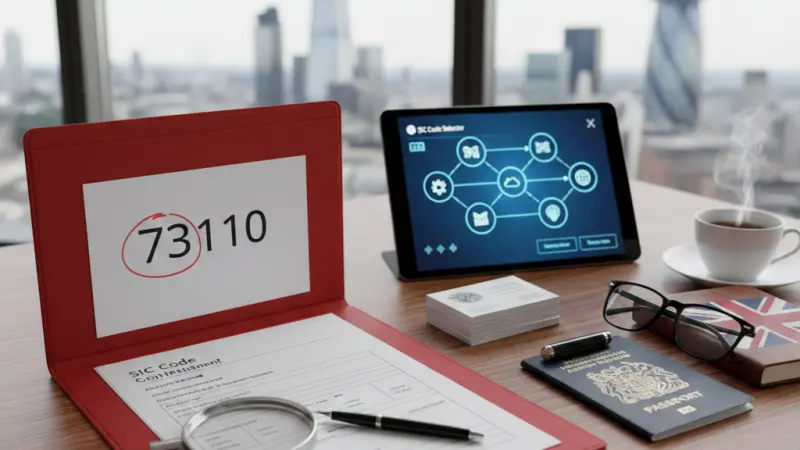
Starting a new business in the UK is an exhilarating journey, but it comes with its fair share of administrative "alphabet soup." Between VAT, PAYE, and PSCs, one acronym often trips up new entrepreneurs more than most: the SIC code.

If you are currently registering a business with Companies House or preparing your first annual Confirmation Statement, you have likely encountered the requirement to provide a SIC code. While it might seem like just another box to tick, this five-digit number is a fundamental part of the UK’s economic infrastructure.
In this comprehensive guide, we will demystify the Standard Industrial Classification (SIC) system, explain why it is vital for your company’s legal standing, and show you exactly how to select the perfect code for your operations in 2026.
What Exactly is a SIC Code?
The term SIC code stands for Standard Industrial Classification code.In its simplest form, it is a numerical system used to describe and categorize the primary business activities of a company.
Think of it as a "digital label" for your business. Instead of Companies House reading through every company's unique (and often lengthy) description of what they do, the SIC system allows the government to group similar businesses together using a universal language.
The History of the SIC System
The UK first adopted the SIC system in 1948.Since then, it has undergone several major revisions to keep pace with the evolving economy—moving from heavy manufacturing and agriculture in the mid-20th century to the digital-first, service-based economy we see today.Significant updates occurred in 1958, 1968, 1980, 1992, 1997, 2003, and the most current major version, UK SIC 2007.
As of 2026, the ONS (Office for National Statistics) is rolling out the SIC 2026 framework, which provides even more granular detail for emerging sectors like AI, green energy, and the creator economy.
Why Does Your Business Need a SIC Code?
Every registered UK company—whether it is a private limited company (LTD), a limited liability partnership (LLP), or even a dormant entity—must report at least one SIC code to Companies House.
There are three primary reasons why this code is mandatory:
1. Public Transparency and Research
Your SIC code is part of the public record.Anyone—from potential investors to competitors—can view your company’s SIC code on the Companies House register.This transparency helps market researchers, government bodies, and trade associations analyze industry trends and the health of specific sectors within the UK economy.
2. Government Data and Statistics
The Office for National Statistics (ONS) uses these codes to track the growth or decline of industries. When you hear reports about "the growth of the UK tech sector" or "challenges in the retail industry," that data is largely derived from the SIC codes assigned to registered businesses.
3. Regulatory and Financial Compliance
Banks, insurance companies, and even HMRC use SIC codes to assess risk and eligibility. For instance:
Business Banking: Some banks may be hesitant to offer accounts to businesses in "high-risk" SIC categories (such as gambling or certain financial services).
Insurance: Your premium may be influenced by your SIC code, as some industries are inherently riskier than others.
Grants and Funding: Many government grants are industry-specific. If your SIC code doesn't match the grant's requirements, you may be automatically disqualified.
Understanding the Hierarchy: How Codes are Structured
The SIC system is hierarchical, meaning it moves from broad industry sectors down to very specific activities.The 2007 version (and the 2026 updates) generally uses a five-digit format.
The structure is broken down into:
Sections: Broad categories represented by letters (A to U).For example, Section C is "Manufacturing."
Divisions: The first two digits of the code.
Groups: The first three digits.
Classes: The first four digits (aligned with international standards).
Subclasses: The full five digits, which provide specific UK-level detail.
Example: The Road Haulage Business
Let’s use a real-world example to see how this "drilling down" works:
Section H: Transportation and Storage.
Division 49: Land transport and transport via pipelines.
Group 49.4: Freight transport by road and removal services.
Class 49.41: Freight transport by road.
Full SIC Code (49410): Freight transport by road.
This specific code would cover activities ranging from logging and stock haulage to the transport of waste (without collection) and even renting trucks with a driver.
When Do You Have to Provide Your SIC Code?
There are two primary times when you will interact with the SIC code system:
1. During Company Formation
Since June 30, 2016, you cannot form a new company in the UK without providing at least one SIC code. Companies House will reject any application that leaves this section blank. You should research your code before starting the online registration process to avoid delays.
2. The Annual Confirmation Statement
Every year, your company must file a Confirmation Statement (form CS01).This document confirms that the information Companies House holds about your company is accurate. During this filing, you must review your current SIC code. If your business has pivoted or added new revenue streams, you must update your code at this stage.
How to Find the Right SIC Code for Your Business
Finding your code can feel like looking for a needle in a haystack, especially since there are over 600 individual codes to choose from. Here is the best way to navigate the process:
Step 1: Consult the Official List
Companies House maintains a "condensed" list of SIC codes. While the ONS has a massive, highly technical document, the Companies House version is much more user-friendly for small business owners.
Step 2: Search by Keyword
Don't just look for your job title; look for your activity. If you are a "Graphic Designer," you might search for "Design" or "Advertising." You will find that "74100 - Specialised design activities" is the most appropriate match.
Step 3: What if There Isn’t an Exact Match?
If your business is in a niche or obscure sector, you might not find a word-for-word match.
In this case, you should choose the closest possible fit. Many sections include an "Other" or "Not elsewhere classified" (n.e.c.) category. For example:
82990 – Other business support service activities n.e.c.
96090 – Other service activities n.e.c.
Step 4: Codes for Dormant or Non-Trading Companies
Even if your business isn't actually doing anything yet, you still need a code:
99999: For Dormant companies (no significant accounting transactions).
74990: For Non-trading companies (those that are inactive but may have some minimal financial transactions).
Can I Have More Than One SIC Code?
Yes! Many modern businesses are "hybrids." Perhaps you have a physical shop (Retail) but you also offer consulting services (Professional Services).
Companies House allows you to select up to four SIC codes for a single company. This is particularly useful if your business is complex or spans multiple sectors. However, most small businesses find that one or two codes are sufficient to describe their core revenue-generating activities.
Common Pitfalls and How to Avoid Them
The "Good Faith" Rule
New owners often worry that picking the "wrong" code will lead to legal trouble. In reality, Companies House rarely penalizes a business for an honest mistake in classification, provided the choice was made in good faith.As long as you aren't intentionally trying to hide the nature of your business (e.g., classifying a high-risk financial firm as a "flower shop"), you can simply correct the code in your next Confirmation Statement.
Don’t Be Too Broad
While it’s tempting to pick a broad "catch-all" code, being specific can help you. For example, if you are a software developer, using 62012 (Business and domestic software development) is better than a generic "Other IT" code, as it clearly signals your expertise to potential partners.
The Future of SIC: The 2026 Revision
As we move through 2026, the ONS is finalizing the most significant overhaul of the SIC system in nearly two decades. The goal is to better capture the "Digital Economy." We are seeing new, dedicated codes for:
Virtual Reality and Metaverse services.
Blockchain and Cryptocurrency activities.
Specialized Green Technologies and Carbon Capture.
E-commerce niches that were previously lumped into general retail.
Staying aware of these changes ensures your business remains accurately represented in the 21st-century marketplace.
Grow Your Presence Beyond Companies House
While a SIC code helps the government find you, it won't help customers find you. Once your legal registration is complete, the next step is ensuring your business is visible to the UK public.
At Local Page UK, we specialize in helping businesses bridge the gap between registration and revenue. Whether you are looking for an uk online business directory to boost your SEO or want to find local businesses uk for B2B partnerships, our platform is the gold standard.
We offer a business listing uk to help startups get off the ground without upfront costs. By securing a business listing uk spot, you increase your digital footprint and make it easier for clients to discover your services. Our local business listings uk are designed to highlight uk verified business listings, giving you the credibility you need to compete.
From a uk small business directory for local trades to a comprehensive uk b2b business directory for professional services, Local Page UK business directory is your partner in growth. Don't just be a number on the Companies House register—get your business listing uk profile today and join the uk top rated local businesses in our network.
What Professionals Often Want to Know
1. Is a SIC code the same as a VAT number?
No. A SIC code identifies your industry, while a VAT number is a unique identifier for tax purposes once you register with HMRC for Value Added Tax.
2. Where can I find my current SIC code?
You can find it by searching for your company name on the Companies House Service. It will be listed under "Nature of business."
3. Does a Sole Trader need a SIC code?
No. SIC codes are a requirement for companies registered at Companies House (Limited Companies and LLPs). Sole traders do not register with Companies House and therefore do not need a SIC code for registration, though they may need to provide a trade description to HMRC.
4. Can I change my SIC code at any time?
You don't need to file a special form immediately. Most businesses wait until they file their annual Confirmation Statement to update their SIC codes. However, if you want the change to show on the public record sooner, you can file your Confirmation Statement early.
5. What is the SIC code for a holding company?
The most common code for a holding company is 64209 (Activities of other holding companies not elsewhere classified).
6. Why does my bank care about my SIC code?
Banks use SIC codes to determine if your business falls into a "high-risk" category for money laundering or credit risk. An incorrect code could lead to issues with opening or maintaining a business bank account.
7. What happens if I use the wrong SIC code?
If it’s an honest mistake, you can simply correct it during your next annual filing. There are generally no fines for a good-faith error, though it might affect your insurance or bank's perception of your risk.
8. Can I use more than four SIC codes?
No, Companies House limits each company to a maximum of four codes.
9. What is the difference between SIC 2003 and SIC 2007?
SIC 2007 is the updated version that uses 5-digit codes, whereas the older 2003 version used 4-digit codes. All filings now must use the 2007 (or 2026 update) format.
10. Do I need a SIC code if my company is not trading?
Yes. You should use code 74990 for non-trading companies or 99999 if the company is strictly dormant.
11. Who creates these codes?
In the UK, the codes are maintained and revised by the Office for National Statistics (ONS).
12. Is the SIC code list the same globally?
Not exactly. While the UK SIC system is aligned with European (NACE) and International (ISIC) standards at the first four digits, the fifth digit is unique to the UK.
13. Does my SIC code affect my Corporation Tax?
While the code itself doesn't determine your tax rate, it tells HMRC what industry you are in, which can trigger certain industry-specific tax reliefs or R&D credit eligibility.
14. Can I look up other companies' SIC codes?
Yes, all SIC codes for registered UK companies are public information and
can be searched for free on the Companies House website.
15. How often is the SIC list updated?
Major revisions happen roughly every 10–15 years. The current 2007 version is presently being supplemented by the 2026 framework to account for the modern digital economy.

Disclaimer: The information provided in this article is for general informational and research purposes only. Company details, features, services, and market positions may change over time. Readers are advised to visit official company websites and conduct independent research before making any business decisions or purchasing services.
Most Searchable Keywords

Recent Blogs


Related Listings

Categories
- Accountants (295)
- Advertising Agencies (559)
- Architects (149)
- Automobiles (377)
- Beauty (300)
- Carpenters (146)
- Cleaning Services (386)
- Dentists (189)
- Driving (62)
- Electricians (215)
- Energy (8)
- Event Organiser (685)
- Finance (599)
- Guide (3365)
- Health (2207)
- Information technology (206)
- Legal Services (353)
- Logistics (6)
- Maintenance (65)
- Manufacturing (35)

Sponsored Listings in Locksmith Services


Related Blogs

Gen Z Political Reporters and News Creators i...
Read this insightful article "Gen Z Political Reporters and News Creators in the UK" to expand your knowledge!

Famous Female Social Media Influencers Across...
Read this insightful article "Famous Female Social Media Influencers Across the UK" to expand your knowledge!

Your UK Sponsor Licence 2026 Step by Step Gui...
Read this insightful article "Your UK Sponsor Licence 2026 Step by Step Guide" to expand your knowledge!
Questions & Answers – Find What
You Need, Instantly!
How can I update my business listing?
Is it free to manage my business listing?
How long does it take for my updates to reflect?
Why is it important to keep my listing updated?
