
ESA to Universal Credit Migration Deadline Guide
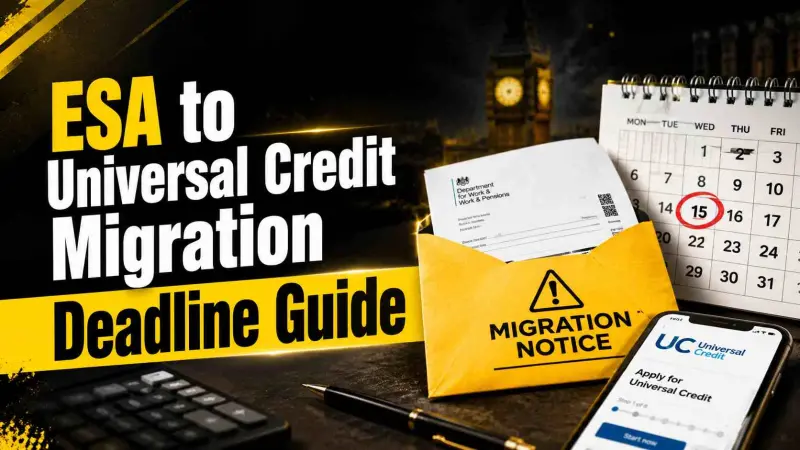
If you receive Employment and Support Allowance (ESA) and have received a letter telling you to move to Universal Credit, the date printed on that letter matters. A Migration Notice means the Department for Work and Pensions (DWP) is asking you to make a Universal Credit claim because an existing benefit is being replaced or is ending.
For most people who receive a Migration Notice, the key deadline is three months from the date the notice is issued, although the exact deadline is the date written in your letter. You need to make your Universal Credit claim by that date if you want to continue receiving financial support and protect your eligibility for managed-migration transitional protection.
The move can feel worrying, particularly if ESA is supporting you because of a health condition or disability. However, receiving a Migration Notice does not simply mean that your financial support will suddenly disappear. There are specific rules for people moving from ESA, including protections around Work Capability Assessments and transitional protection in qualifying cases.
This guide explains what the letter means, which type of ESA is affected, what happens to your existing payments, how the Universal Credit claim works, what happens if you miss the deadline and what you should check before completing the move.
What does an ESA Migration Notice mean and what should you do before the deadline?
What is an ESA Migration Notice?
A Migration Notice is an official letter telling you that you need to claim Universal Credit because the benefit you currently receive is being replaced or is coming to an end.
For ESA claimants, the important distinction is that income-related ESA is being replaced by Universal Credit. Universal Credit is designed to replace several older means-tested benefits, including income-related ESA. GOV.UK confirms that income-related ESA is among the benefits being replaced, while benefits such as Personal Independence Payment (PIP) continue separately.
The letter is therefore not simply general information. It is a formal notification that you need to take action.
The most important information in the letter is your deadline date.
You should not assume that everyone has the same deadline. Your individual Migration Notice gives the date by which you need to make a Universal Credit claim.
How long do you have to claim Universal Credit?
Managed migration notices normally provide a three-month deadline for making a Universal Credit claim. The regulations require the deadline day specified in a Migration Notice to be no earlier than three months after the notice is issued.
For example, imagine your Migration Notice is issued on 8 August.
Your letter will give you a specific deadline, generally allowing roughly three months for you to complete the move.
The important point is simple:
Do not calculate your deadline from a general article or from someone else's letter. Use the exact date printed on your own Migration Notice.
Keep the letter somewhere safe and, if possible, make a note of the deadline in your calendar.
Why the deadline matters so much
The deadline matters because your existing benefit will eventually end if you do not make the required move.
GOV.UK states that you must claim Universal Credit by the deadline in your Migration Notice to continue receiving financial support. If you cannot claim by the date, you should contact the Universal Credit Migration Notice helpline and request more time where you have a good reason. The request should be made before the deadline.
This is why leaving the application until the final day can create unnecessary problems.
You may need time to:
- gather information about your income and savings
- check your rent and housing costs
- obtain bank details and identification
- understand how your health condition will be treated
- arrange support with the online application
- deal with technical or accessibility problems
- contact DWP if something in the letter appears incorrect
If you are approaching the deadline and have not yet claimed, act rather than waiting.
Does receiving a Migration Notice mean your ESA stops immediately?
No.
The Migration Notice starts a managed process. Your existing benefit does not normally disappear on the day you receive the letter.
The timing of the final payment depends on whether you claim Universal Credit and when you make the claim.
GOV.UK explains that if you make a Universal Credit claim, you can continue receiving your existing benefit for two additional weeks, provided you remain eligible for that benefit. Those extra payments do not have to be repaid and do not reduce the Universal Credit you may receive.
If you do not make a claim by the deadline, your existing benefit entitlement can end two weeks after the deadline.
That makes the deadline important, but it also means that the system contains a transition period rather than an instant stop.
Which ESA is being replaced?
This is one of the most important points because not every form of ESA should be treated in exactly the same way.
The old system included:
- income-related ESA
- contribution-based ESA
Income-related ESA is means-tested and is being replaced by Universal Credit.
Contribution-based ESA has evolved into New Style ESA. From 1 December 2025, the law changed so that new entitlement is no longer created under the old income-related ESA rules, while contributory ESA is now referred to as New Style ESA. Existing payments were not simply stopped because of that terminology change.
New Style ESA is a contributory benefit based largely on National Insurance contributions. It can be paid on its own or alongside Universal Credit.
If you receive both, the New Style ESA amount is generally taken into account when Universal Credit is calculated, reducing the Universal Credit payment by the amount of New Style ESA received.
So, if your letter is confusing, check exactly which benefit you currently receive rather than assuming that every ESA claimant has to follow the same process.
What happens to your health-related support when moving from ESA?
This is often the biggest concern for ESA claimants.
A person receiving ESA may already have gone through a Work Capability Assessment (WCA). The treatment of that assessment can be different from someone making a completely new Universal Credit claim.
According to current GOV.UK guidance, if you move from ESA to Universal Credit without a break, have already completed a WCA, and were in the ESA support group or work-related activity group when you made your Universal Credit claim, you generally will not need to provide medical evidence such as fit notes or have another WCA immediately.
However, this does not mean that every ESA claimant automatically avoids another assessment forever.
A further assessment may be required if, for example:
- your WCA is due for review
- your health condition changes
- you were still providing medical evidence when you moved to Universal Credit
- your circumstances do not meet the conditions for carrying the previous assessment across
If you were providing medical evidence before the move, you may still need to provide evidence under Universal Credit until a WCA decision is made.
The practical lesson is to answer the health-related questions on your Universal Credit claim accurately and keep copies of relevant correspondence.
What is transitional protection?
Transitional protection is one of the most important safeguards associated with managed migration.
In simple terms, it can protect eligible claimants where their calculated Universal Credit entitlement would otherwise be lower than the amount they were receiving under their previous benefits.
The transitional element is an additional amount included in Universal Credit where the rules
show that an eligible claimant would otherwise receive less following the move.
For example, suppose a simplified assessment showed:
| Situation | Amount |
|---|---|
| Previous qualifying benefits | £900 |
| Universal Credit calculation | £760 |
| Potential transitional element | £140 |
| Total after transitional element | £900 |
This is only an illustration. Your actual entitlement depends on your circumstances and the DWP calculation.
You do not normally apply separately for the transitional element. DWP assesses whether you qualify as part of the managed-migration process.
Why claiming by the deadline can protect transitional support
Receiving a Migration Notice is significant because managed migration has protections that do not necessarily apply when someone voluntarily moves to Universal Credit.
Official DWP guidance says transitional protection is available where a qualifying claimant receives a Migration Notice and makes the required Universal Credit claim within the applicable deadline.
This is one reason you should not decide to ignore the letter simply because you are worried that Universal Credit might initially appear lower.
The calculation is more complicated than comparing one payment against another. Your household circumstances, housing costs, income, savings, disability-related elements and other factors can affect the final Universal Credit award.
What if you miss the deadline?
Missing the date on your letter does not necessarily mean that every possible protection disappears immediately, but you should treat a missed deadline as urgent.
DWP guidance says you can contact the Migration Notice helpline if you cannot claim by your deadline and may be able to receive more time if you have a good reason. The request should be made before the deadline where possible.
There is also an important technical point in DWP's managed-migration statistics methodology: qualifying claims made within a month after the deadline can still be assessed for transitional protection under the relevant rules, subject to the conditions applying to the claim.
That should not be interpreted as permission to ignore your deadline.
The safest approach is:
- Claim by the date printed on your letter.
- If that is impossible, contact DWP before the deadline.
- Explain why you need more time.
- Keep evidence of your contact.
- If the deadline has already passed, contact DWP immediately rather than assuming your case is lost.
What happens when you first claim Universal Credit?
Universal Credit claims are generally managed online.
Your claim starts from the date you submit it through your account. GOV.UK says the first Universal Credit payment usually takes around five weeks.
That delay is worth planning for.
If your existing ESA payment pattern is changing, your household budget may feel different even if your overall entitlement is protected.
You may need to consider:
- rent
- energy bills
- food
- travel
- existing debts
- direct debits
- childcare costs
- medical or disability-related expenses
If you need financial help while waiting for your first Universal Credit payment, you may be able to request an advance through your Universal Credit account. An advance is not additional free money; it is repaid from future Universal Credit payments.
What information should you have ready?
Before beginning the claim, gather the information you are likely to need.
This can include:
- your National Insurance number
- bank or building society details
- email address and phone number
- information about your rent
- landlord details
- household information
- earnings and other income
- savings and capital information
- childcare costs where relevant
- details of your health condition or disability
- information about your existing benefits
You should answer questions carefully rather than estimating when you can find the correct information.
A mistake in income, rent or household circumstances can affect your Universal Credit award.
What happens to PIP when you move from ESA?
A Migration Notice for Universal Credit does not automatically mean that PIP is being replaced.
GOV.UK specifically states that other benefits, including Personal Independence Payment, can continue when income-related benefits are replaced by Universal Credit.
This distinction matters because ESA and PIP serve different purposes.
Universal Credit is a means-tested benefit that can provide support with living costs and additional amounts depending on circumstances.
PIP is a separate disability benefit based on how a person's condition affects daily living and mobility.
So, if you receive ESA and PIP, do not assume that moving to Universal Credit means you must make a new PIP claim.
What about New Style ESA after the move?
If your ESA includes a contributory element, the position can be more complicated.
DWP guidance explains that where someone was receiving contribution-based ESA alongside income-related ESA during the old system, they may move to New Style ESA while also claiming Universal Credit. The New Style ESA payment is then deducted from the Universal Credit calculation.
New Style ESA remains a separate contributory benefit. It is based on National Insurance contribution conditions rather than the Universal Credit means test.
This means someone can potentially have:
New Style ESA + Universal Credit
rather than assuming that one completely replaces the other.
What should you check if your letter looks wrong?
Do not ignore a Migration Notice simply because something appears incorrect.
Check:
- your name
- your address
- the benefits listed
- the deadline date
- whether you are being asked to make a joint claim
- whether you have an appointee
- whether the household circumstances described are accurate
If you believe the letter has been sent to you incorrectly, contact the relevant DWP service rather than relying on advice from social media or an unofficial website.
An appointee can also be involved where someone is formally responsible for managing another person's benefit claims. GOV.UK states that where an appointee is responsible for making and maintaining the claim, the Migration Notice is sent directly to them and they need to make the Universal Credit claim.
What if you need help making the claim?
You do not have to struggle through the process alone.
If you have difficulty using the online system, need help understanding the letter or have accessibility needs, seek assistance as soon as possible.
The official Universal Credit service provides support through its helpline and online channels. Current GOV.UK guidance lists the Universal Credit helpline as 0800 328 5644, Monday to Friday, 8am to 6pm.
You can also seek independent benefits advice.
The important thing is not to wait until the final hours before the deadline if you already know that you need help.
What are the biggest mistakes ESA claimants make during migration?
The most common problems are often practical rather than complicated.
Waiting until the deadline
A person may put the letter aside because their ESA payment continues as normal. Weeks later, they discover that the deadline is approaching.
Better approach: record the date immediately.
Assuming ESA automatically becomes the same amount of Universal Credit
Universal Credit uses a different calculation.
Better approach: review your household circumstances, income, savings, housing and health-related entitlement before making assumptions.
Assuming every ESA claimant needs a brand-new WCA
Some ESA claimants moving under the specified managed-migration conditions can have their previous WCA treatment carried across.
Better approach: read the health-related instructions in your claim and check your individual circumstances.
Ignoring New Style ESA
Some people hear that ESA is being replaced and assume every form of ESA is disappearing.
Better approach: distinguish income-related ESA from contributory/New Style ESA.
Missing the first-payment gap
Universal Credit is normally paid monthly and the first payment usually takes around five weeks.
Better approach: budget for the transition and investigate whether an advance is appropriate if you cannot cover essential living costs.
Can your Universal Credit amount be lower than ESA?
It can be possible for the calculation to differ, which is why transitional protection exists for qualifying managed-migration cases.
DWP's transitional-element guidance explains that the calculation compares the relevant existing benefit entitlement with the Universal Credit calculation. If the Universal Credit calculation is lower and the claimant meets the qualifying rules, a transitional element may be included.
However, transitional protection is not a permanent promise that your Universal Credit payment will always remain at exactly the same level.
The transitional element can reduce as Universal Credit entitlement increases, and certain significant changes in circumstances can affect or end transitional protection. The exact effect depends on the rules applying to your case.
What happens to transitional protection after migration?
Transitional protection is designed to support the move rather than permanently freeze your benefit entitlement.
If your Universal Credit entitlement later rises, the transitional element can reduce.
This means you should not treat an initial transitional element as a guaranteed lifelong addition to your payment.
Changes in circumstances can also affect the protection.
For example, a change in household composition can have consequences for the Universal Credit calculation and the transitional element.
This is why it is useful to keep your Universal Credit account updated and report relevant changes promptly.
What is the future of ESA and Universal Credit migration?
The broader direction is clear: the legacy benefit system is being replaced by Universal Credit, while contributory support continues through New Style benefits.
DWP statistics show that managed migration notices have been progressively extended across different legacy-benefit groups. Migration notices began reaching income-related ESA households in broader combinations during 2024, with other income-based benefit combinations following later.
The practical implication for claimants is that receiving a Migration Notice is increasingly part of the planned transition rather than an isolated administrative change.
For anyone still receiving a legacy benefit, keeping correspondence up to date and understanding the distinction between managed migration and a voluntary Universal Credit claim is becoming increasingly important.
The rules can also change, so readers should check current GOV.UK guidance rather than relying on an old letter, social media post or article written several years ago.
A simple ESA-to-Universal-Credit action plan
If your letter has arrived and you are unsure what to do, use this sequence.
Step 1: Find the deadline.
Read the Migration Notice and write down the exact date.
Step 2: Identify your ESA type.
Check whether you are receiving income-related ESA, New Style ESA or an arrangement involving both.
Step 3: Check your household circumstances.
Look at your partner, children, rent, income, savings and other benefits.
Step 4: Prepare your information.
Collect the documents and details needed for your Universal Credit claim.
Step 5: Start the claim early.
Do not deliberately wait until the final day.
Step 6: Check health information carefully.
If you have already completed a WCA, make sure you provide accurate information about your existing decision and health condition.
Step 7: Review your first Universal Credit statement.
Check that the household, income, housing and relevant elements appear correct.
Step 8: Act quickly if something is wrong.
Use your Universal Credit account or the relevant DWP contact route to report an issue.
What about Northern Ireland?
The main DWP guidance discussed in this article applies to England, Scotland and Wales.
Northern Ireland has its own social security administration, so people living there should use the relevant Northern Ireland guidance rather than automatically applying every DWP rule to their circumstances.
The underlying concept is similar: certain legacy benefits are being replaced by Universal Credit and claimants receiving a Migration Notice need to follow the deadline and instructions in their own letter.
This distinction is particularly important when checking contact details, payment arrangements and local support.
Key Insights
- Your Migration Notice deadline is personal. Use the exact date printed in your letter rather than relying on a general three-month calculation.
- Income-related ESA is being replaced by Universal Credit, while New Style ESA operates as a contributory benefit and can be paid alongside Universal Credit in qualifying cases.
- Do not ignore the letter. You need to make your Universal Credit claim by the deadline to continue financial support and protect qualifying managed-migration provisions.
- ESA claimants may have protections around Work Capability Assessments when moving without a break and meeting the specified conditions.
- Transitional protection can help eligible households where their Universal Credit calculation would otherwise be lower than their previous qualifying benefits.
- The first Universal Credit payment usually takes around five weeks, so plan for the change in payment timing.
- If you cannot meet the deadline, contact DWP immediately. You may be able to request more time where you have a good reason.
- Do not assume that PIP automatically ends. PIP is separate from income-related ESA and can continue alongside Universal Credit.
FAQ
1. What is an ESA Migration Notice?
An ESA Migration Notice is a letter telling you that you need to claim Universal Credit because an existing benefit, such as income-related ESA, is ending or being replaced. The letter gives you a specific deadline for making your claim.
2. How long do I have to move from ESA to Universal Credit?
Managed Migration Notices normally give around three months to make a Universal Credit claim. However, your own letter contains the legally relevant deadline, so use that date rather than calculating it yourself.
3. What happens if I miss my ESA Universal Credit deadline?
Contact the Universal Credit Migration Notice service immediately. If you have a good reason for needing more time, you may be able to receive an extension. DWP also has rules covering certain qualifying claims made after the deadline.
4. Will my ESA stop as soon as I receive the letter?
No. Receiving the letter does not normally stop ESA immediately. The timing of your existing benefit ending depends on when you make your Universal Credit claim and the deadline in your notice.
5. Will I lose money when moving from ESA to Universal Credit?
Not necessarily. Eligible people moved through managed migration may receive transitional protection if their Universal Credit calculation is lower than their relevant previous benefit entitlement.
6. Do ESA claimants need another Work Capability Assessment?
Not always. If you move from ESA without a break, have already completed a WCA and meet the specified ESA group conditions, you may not need another assessment immediately. A later review or change in circumstances can result in another assessment.
7. Does PIP stop when I move from ESA to Universal Credit?
No. PIP is a separate benefit and can continue when someone moves from income-related ESA to Universal Credit, provided they remain entitled to PIP.
8. What is transitional protection on Universal Credit?
Transitional protection is designed to prevent an eligible household from immediately receiving less following managed migration when its calculated Universal Credit entitlement is lower than its relevant legacy-benefit entitlement.
9. Can I get New Style ESA and Universal Credit together?
Yes, in qualifying circumstances. New Style ESA is a contributory benefit and can be claimed alongside Universal Credit. However, the New Style ESA payment is normally taken into account and reduces the Universal Credit payment by the corresponding amount.
10. Does savings affect Universal Credit after ESA migration?
Universal Credit is means-tested, so savings and capital can affect entitlement. The rules are different from New Style ESA, which is a contributory benefit. Your household's financial circumstances should therefore be checked carefully before and during the claim.
11. How long does the first Universal Credit payment take?
Your Universal Credit claim begins from the date you submit it, but the first payment usually takes around five weeks. If you cannot manage financially while waiting, you may be able to request an advance.
12. Can I get more time to make my Universal Credit claim?
You may be able to receive more time if you have a good reason for missing or being unable to meet the deadline. Contact the Migration Notice service as early as possible, preferably before the deadline.
13. Should I claim Universal Credit before receiving a Migration Notice?
A voluntary move is different from managed migration and can have different transitional-protection consequences. If you have received a Migration Notice, follow the instructions in that letter rather than making assumptions about voluntary migration.
14. What should I do if information in my Migration Notice is wrong?
Check the details carefully and contact the relevant DWP service if something appears incorrect. Do not ignore the letter while waiting for the issue to be resolved because your deadline still matters.
15. Where can I get official help with my Universal Credit migration?
You can use the official GOV.UK Universal Credit guidance and contact Universal Credit through the available online and telephone channels. The current Universal Credit helpline is 0800 328 5644, Monday to Friday, 8am to 6pm.
Final Thoughts
An ESA Migration Notice is a letter that deserves immediate attention, but it does not mean you should panic.
The most important step is to identify the exact deadline written on your letter and make your Universal Credit claim within that period. Managed migration has specific rules that can protect eligible claimants, including transitional protection and particular treatment of previous ESA Work Capability Assessments.
Remember that income-related ESA and New Style ESA are not the same thing. Your health-related benefits, such as PIP, are also separate and do not automatically disappear simply because you move to Universal Credit.
If you are worried about the amount you may receive, the effect of your health condition, your housing costs
or the first-payment gap, get help early. Do not wait until the deadline is days away.
The safest approach is straightforward: read the letter carefully, record the deadline, prepare your information, make the claim in good time and contact DWP promptly if you have a problem.
Disclaimer: The information provided in this article is for general informational and research purposes only. Company details, features, services, and market positions may change over time. Readers are advised to visit official company websites and conduct independent research before making any business decisions or purchasing services.
Most Searchable Keywords
Recent Blogs

Related Listings


Categories
- Accountants (295)
- Advertising Agencies (559)
- Architects (149)
- Automobiles (377)
- Beauty (300)
- Carpenters (146)
- Cleaning Services (387)
- Dentists (189)
- Driving (62)
- Education (1)
- Electricians (215)
- Energy (8)
- Event Organiser (687)
- Finance (602)
- Guide (3406)
- Health (2207)
- Information technology (206)
- Legal Services (361)
- Logistics (6)
- Maintenance (65)
Sponsored Listings in Plumbers

Related Blogs

Find a Lost Child Trust Fund Account
Read this insightful article "Find a Lost Child Trust Fund Account" to expand your knowledge!

Vinted, eBay & Depop Tax: Do Sellers Owe Tax?
Read this insightful article "Vinted, eBay & Depop Tax: Do Sellers Owe Tax?" to expand your knowledge!

P45 vs P60: Differences and When You Get Each
Read this insightful article "P45 vs P60: Differences and When You Get Each" to expand your knowledge!
Questions & Answers – Find What
You Need, Instantly!
How can I update my business listing?
Is it free to manage my business listing?
How long does it take for my updates to reflect?
Why is it important to keep my listing updated?
